
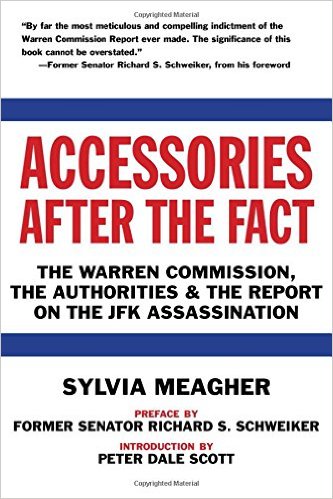
Sixty years have passed since the assassination of President John F. Kennedy (1917-1963) in Dallas, Texas on November 22, 1963. Public opinion in regard to the Warren Commission’s report has continued to shift, with a majority of Americans disapproving of its conclusions. Over time, the National Archives has released more documents relating to Kennedy’s murder, but there are still important materials that remain classified. When taken at face value, the Commission’s report seems to provide an open and shut case; three bullets fired by a lone deranged gunman from his sniper’s position on the sixth floor at the former Texas School Book Depository building. But upon closer examination, it becomes clear that there are unanswered questions and troubling aspects of the official investigation which have never been explained.
The biggest issue with the Warren Commission’s report is the lack of a usable index. This inadequacy combined with contradictions and other unnerving aspects, convinced the late Sylvia Meagher (1921-1989), that action was needed. As she read the report and its supporting volumes, she could not ignore the growing belief inside of her that the official story was not true. This book is her dissection of the Commission’s report, paying close focus on the case against Oswald and the story put forth by the Dallas Police Department. To be clear, there is no smoking gun and Meagher does suggest who might have pulled the trigger. She does, however, stick to the evidence which results in hair-raising questions about what really happened that day.
Officially, the U.S. Government has maintained that Lee Harvey Oswald (1939-1963) fired three shots from a bolt-action Mannlicher Carcano rifle in six seconds, fatally wounding Kennedy and seriously wounding Texas Governor John Connally (1917-1993). Incredibly, it is claimed that one bullet struck both, inflicting multiple non-fatal wounds. This “single bullet” theory has been the foundation of the Commission’s conclusion that Oswald was the lone gunman. But the question remains, if no one saw Oswald pull the trigger or on the sixth floor at the time of the assassination, then who did? Skeptics of Meagher will say that Oswald purchased the rifle, brought it to work, assembled it before killing Kennedy and decided to leave the evidence behind as he “escaped” from the building and boarded a bus then taxi to arrive home in the Oak Cliff section of Dallas. A selling point of his guilt has been that he “fled” from Dealey Plaza and had previously attempted to assassinate ultra right-wing General Edwin Walker (1909-1993). But is that really true? Meagher points out remarkably interesting evidence that does not support that thesis. Further, Oswald’s widow Marina admitted to initially lying to investigators out of her “distrust” of them. Oswald may have been telling the truth when he said he was a patsy.
The murder of Dallas Police Officer J.D. Tippit (1924-1963) has been used to convince the public that Oswald was cold-blooded murderer who not only killed an officer in the line of duty but also eliminated the head of the U.S. Government. However, like everything else, Tippit’s story is far from open and shut. The author discusses his situation and points out things that raise more questions. The analysis is thorough and I strongly recommend Joseph McBride’s ‘Into the Nightmare: My Search for the Killers of President John F. Kennedy and Officer J.D. Tippit‘ which provides even more crucial information about Tippit’s life. To date, there is no evidence that proves Tippit was part of a conspiracy to murder Kennedy. However, his movements in the forty-five-minute window prior to his death are highly unusual and have never been fully explained. In fact, his communications with the police dispatcher only add to the mystery.
A major topic of debate has been whether Oswald was on an intelligence mission at the time of the Kennedy’s death. His mother Marguerite Oswald (1907-1981) claimed several years before the assassination that her son was working for U.S. intelligence. At times she has been written off as a crackpot, but when Oswald’s movement’s to and from the Soviet Union are explored, one cannot ignore that his ability to escape the U.S. criminal justice system is nothing short of mind blowing. Meagher revisits his move to the Soviet Union, attempt to “defect” and provide military secrets to the Russians, and return to the United States with a Soviet wife, and without any criminal prosecution during the infamous Cold War. The story is surreal but was written off by the Commission as ordinary.
Following Kennedy and Tippit’s murders, Oswald was apprehended at the Texas Theater. While he sat in the Dallas County jail, many strange things and people were moving behind the scenes unbeknownst to him. One of these people was Jack Ruby (1911-1967) whose murder of Oswald on November 25, 1963 on live television, sent shockwaves across the globe. Ruby insisted that he was emotional and snapped when murdering Oswald. But his actions that weekend around Dallas and the jail are highly questionable, and Meagher makes sure to take a deep dive into the two days when the world was on edge. One thing that stood out is Ruby’s appearances near the homicide office on the third floor of the jail complex. Further, his access to the basement of the jail preceding Oswald’s murder has always been a murky tale. While it is known that Ruby had scores of officers as friends, none were ever charged with letting him into the jail. But was he “let in” or “allowed in”? The testimony excerpts from Dallas policemen only add to the confusion.
On a final note, Meagher mentions the investigation by former New Orleans District Attorney James “Jim” Garrison (1921-1992). His case, which was both groundbreaking and problematic, is a topic for a whole other discussion. However, Meagher does point out something in regard to the Warren Commission report’s role in Garrison’s case which I had not noticed previously. And as I read her words, I had to scratch my head in disbelief. On January 14, 1989, Meagher died at the age of 67 at St. Vincent’s Hospital in New York City from complications of the flu. Had she lived, I believe she would have been thrilled to see Oliver Stone’s ‘JFK’, the film which renewed public interest, resulted in the JFK Assassination Records Collection Act of 1992 and supported Garrison’s belief that rogue elements of the intelligence community played a role in Kennedy’s death. Stone’s film is solid, but Garrison and his investigation were far more complicated. The case against Clay L. Shaw (1913-1974) was weak but Garrison did succeed in opening the door for more analysis of the crime. The investigation into the events in Dealey Plaza is far from over and the search for truth as to who killed John F. Kennedy continues. And this tool can help guide the way.
ASIN : B00E25IM6S
 FREETHINKING BIBLIOPHILE