
 The recent events that have transpired in Northern Ireland have given rise to concern and fear across the United Kingdom. A return of the Troubles which resulted in the deaths of over three thousand peoples is on the minds of many as the situation plays itself out. Cooler heads have mostly prevailed up until this point and the paramilitary groups on both sides have managed to keep themselves largely in check. But there are those who know that a return of the violence that plagued Northern Ireland for more than thirty years, would take the conflict in a far more deadly direction. On the Republican side, the Irish Republican Army (“IRA”) has carried the banner of a United Ireland and will not rest until it sees the expulsion of British rule. On the loyalist side, the Ulster Volunteer Force (“UVF”) and Ulster Defense Association (“UDA”) are unwavering in their support of British rule. Currently, a cease fire remains in place but both sides are ready to resume operations if open warfare should return. After reading extensively on the IRA, I decided to shift my focus and look at the Troubles from the loyalist side.
I saw this book on Amazon and the title immediately caught my attention. The UVF is firmly cemented in the history of the Troubles but its full role is sometimes mentioned vaguely in discussions about the conflict. Authors Jim Cusack and Henry McDonald take us deep inside the loyalist cause in this book that peels back the layers of the UVF and the UDA. But before proceeding, I feel compelled to warn readers that this book is dark. The number of murders and violent acts is staggering and as I read through the book, I felt a chill as the magnitude of the Troubles fell heavily upon me. The actions of the IRA are well-documented, and the organization has been seen as a courier of death and destruction. But make no mistake, the UVF and UDA were just as deadly and just as feared. The authors put it even more bluntly:
“The UDA and UVF are merely the most violent manifestation of Unionist opposition to republican goals.”
The statement is telling but I would go even further to say that the conflict was far deadlier that some realize. The vitriol with which each side views the other is chilling and sets the stage for the dark times to come. Every story has its central figures as the Troubles are no different. But instead of figures such as Robert Gerard “Bobby” Sands (1954-1981), Brendan “The Dark” Hughes (1948-2008) and Dolours Price (1951-2013), we are introduced to others who remain martyrs to the loyalist cause. The Rev. Ian Richard Kyle Paisley (1926-2014) makes an appearance but only on few occasions. The UVF and UDA take center stage and no holds are barred as they go after the IRA and supporters of the unionist platform. The conflict spiraled out of control and those known to be Catholics were targeted for murder sometimes based on their faith I had previously learned of the IRA’s most infamous actions, but I began to see that the loyalists were just as fanatical and, in some cases, deadlier than their Republican counterparts. In fact, the UVF became some dangerous that even Britain began to take notice. We learn through the authors that:
“By October 1973 the British army view of the UVF was changing. The UVF was making and planting bigger and bigger bombs, killing more people. A senior British army witness called by the British government during the European Court of Human Rights case of 1975 indicated that before 1973, the army was not greatly concerned with acts of terrorism emanating from the Protestant community. He had regarded the UVF in the early 1970s as a shadow organisation, an object of curiosity and not to be taken seriously.”
That shadow organization along with the UDA had morphed into monsters that could not be contained by the Crown. Having finished the book, the names of Lenny Murphy (1952-1982), John “Big John” McMichael (1948-1987) and Billy “King Rat” Wright (1960-1997) have been seared into my memory as defenders of the protestant goal for permanent British rule in Ireland. As an American, I have always had an outsider’s view of the conflict and have never felt that passion that runs through the veins of loyalists and nationalists. And the violence that ensues was difficult to read about and at some point, I lost count of the names of victims for the list is simply too long.
There is another aspect of the story that I believe is quite interesting and that is the dis-jointed approach by the loyalist side. In particular, the strange and sometimes hostile relationship between the UVF and UDA is explored thoroughly and what is revealed is that both organizations co-existed but largely in a superficial manner. Sharp divisions in the loyalist beliefs and a bloodthirst for dead IRA and Catholics pitted loyalist factions against each other and numerous paramilitary groups operating under the radar. The haphazard approach was so dysfunctional that the two botched a hair-raising encounter involving former Sinn Féin Gerry Adams, a prized target of loyalist groups. The larger picture of course, shows that there were many paramilitary groups on both sides that turned Northern Ireland into a hotbed of extremism. And while a cease-fire continues to hold, tensions under the surface can rise at any moment. It is hoped by many on all sides that the peace remains firm. The road taken to achieve peace is also revisited from the loyalist side. Today we know with hindsight that peace was achieved and that there are those on both sides doing what they can to hold it in place. But the memories of the Troubles are never far away.
The future remains to seen for Northern Ireland but there is hope that peace will prevail, and that Brexit will not give away to a return of the violence that plunged the United Kingdom into darkness. This cold hard look at the UVF and loyalist groups serves as a case study of the true history of the Troubles and the messengers of death on both sides of the conflict. The IRA is widely seen as the organization responsible for violent acts across Ireland and England, but it can be seen here that they were joined in the mayhem by their opponents who equally as effective in committing acts of terror. For those who want to know more about the UVF, UDA and the loyalist side in the Troubles, this book is an excellent place to start.
ASIN : B00ANB8KPI
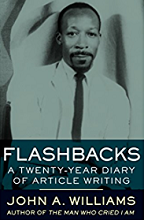 When I saw this book on sale, I felt a small sense of embarrassment because I did not know who John A. Williams (1925-2015) was. While it is true that he would be considered “before my time”, voices from the past are often as important as those of today. And any person that spends twenty years writing articles must have a significant number of experiences to reflect on. I gave in to my curiosity and decided to make the purchase. I can honestly say that I received more than I bargained for and have a newfound appreciation the late journalist. To be clear, the book is not an autobiography but more of a recollection of his most vivid memories about his early life, breaking into journalism and the numerous larger than life figures he had the chance to interview and, in some cases, form friendships with. Writers can tell you that composing an article is not always a simple as it seems and financially, it is not a way to get rich quick. In fact, the author removes all illusions of grandeur when he says:
 It truly is amazing that a person can learn so much about the future by examining the past. In America, there are parts of our nation’s history that people find difficult to control. Race is at the top of the list and continues to find itself the topic of discussions as the country grapples with instances of systematic discrimination and overt acts by individuals. However, America is also a very great nation that has the courage to critically examine itself. The problems we have are not new but instead, more attention is now being paid to them. And I honestly believe that to remedy those issues, we must continue to look at the past for it provides many valuable lessons from which we can learn. I picked up this book because 1) I have been a fan of Lorraine Hansberry (1930-1965) for many years and 2) I knew that the book would contain a wealth of highly intellectual discussions about American society that have relevance, even today. And I can say unquestionably that this short book is a good look at Hansberry’s brilliant mind that was able to dissect America in ways that sets the stage for meaningful dialogue and change.
  The death of George Floyd (1973-2020) initiated a chain of events that have resulted in a criminal trial and more discussions about race in America. It is a subject that will never go away and many still struggle to confront it with the honesty that is sometimes necessary. I have noticed that when it comes to race in America and the nation’s history, it is almost impossible to grasp the entire picture without factoring in the effect of the American Civil War (1861-1865). The conflict tore the nation apart over several issues, the most important of which was the topic of slavery. Many states in the North had already abolished slavery, but in the South, it remained a way of life. And because it was so critical to the South’s existence, the states that formed the Confederacy were willing to fight to the death to preserve what they felt was their right. Today we know with the benefit of hindsight that it was a lost cause from the start but the battle that ensued was a long and bloody conflict that left thousands dead and others critically wounded. Veterans who survived the conflict were forced to live with horrible memories of war that remained with them until their final days. Among the war’s combatants was the Eighteenth President of the United States and former General
  FREETHINKING BIBLIOPHILE
You must be logged in to post a comment.