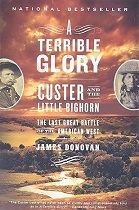
A Terrible Glory: Custer and the Little Bighorn – the Last Great Battle of the American West – James Donovan

CusterOn June 25, 1876, the United States Army’s Seventh Calvary Unit engaged a combined force of Lakota Sioux, Northern Cheyenne, and Arapaho tribe warriors in a battle which resulted in a stunning defeat for the military and became known as “Custer’s Last Stand” due to the death of Lt. Col. George Armstrong Custer (1839-1876). Custer has become a part of American pop culture, and his demise has been studied by scholars and historians. But was his demise a last stand? James Donovan revisits the tragedy of the Seventh Calvary in this book the author calls the last great battle of the American West.

The book is not intended to be a biography of Custer, but Donovan’s discussion of Custer’s early life is important in understanding the soldier he developed into. In comparison to the glorified image of Custer that prevailed in the wake of his death, the truth is far more complex, and the real Custer emerges as a multi-dimensional figure that is part of history for reasons he surely would not have wanted. However, before his demise, he did live an interesting life during the 1800s when America was still expanding its borders, even if it meant war with the natives. Following Custer’s childhood in Ohio, the author moves to his military career which includes service in the American Civil War. And on a personal note, we learn of Custer’s love for his wife, Elizabeth Bacon Custer (1842-1933) who is left to grieve after the battle at Little Bighorn. Custer’s service in the Civil War eventually ended with the defeat of the Confederacy, but for former soldiers, life after the war was far from easy. In fact, Donovan explains the sobering reality army officers faced after the South’s surrender. For Custer, life outside of a uniform was not much of a reality. Fate intervened, and he would join a new mission that would shed as much bloodshed as the Civil War: the battle to contain North America’s Indian tribes. And this is where the book takes a dark turn.

Readers who are sensitive to descriptions of violence, combat and the like should use discretion as the depictions of skirmishes between army troops and native tribes are revisited. The battles were brutal, and the tensions ran high across North America as white settlers and government troops pushed further west. Those who ventured past America’s western border, entered parts unknown. Some were never seen alive again. Treaties between the native tribes and the Bureau of Indian Affairs, did not count for much, and the escalation of tension between both sides raises the level of suspense as Donovan tells the story.  Custer found himself in need of a purpose which came through an invitation to join the Seventh Calvary. This decision would seal his fate although he could not have known this at the time.

As the story moves closer to the battle, Custer prepares his force which includes Indian scouts and even a Black volunteer named Isaiah Dorman (1832-1876) which was strange considering Custer’s views towards black troops during the Civil War. While Custer was preparing for what he believed would be a glorious battle, the natives had plans of their own. And leading the pack were the warriors Sitting Bull (1831-1890) and Crazy Horse (d. 1877). Had Custer known what they were planning, history might be different today. But he did not, and we soon reach the part of the story where the Seventh Calvary moves out on its mission. It was Custer’s last mission and I warn readers that it was far from a last stand but annihilation. In fact, I had to steel myself as I read about the battle’s aftermath. But why did Custer fail?

Donovan discusses the failed strategy that led to defeat but it is hard to say what Custer believed at the time. However, his decision to split the calvary proved to be deadly. As they engage the natives, they soon learn that they are up against thousands of warriors and severely outnumbered. The fractured military units led by Senior Officer Marcus Reno (1834-1889), Captain Frederick Benteen (1834-1898) and Captain Thomas McDougall (1845-1909) were all in trouble and the three military commanders made the decision to withdraw in the face of oncoming waves of tribal warriors. After the battle, the officers would each face scrutiny with Reno becoming persona non grata in military circles. The reasons for his downfall are explained in the book, as well as the position of the Army, forced to confront Custer’s defeat.  But on the side of the late soldier were those determined to preserve his legacy as we seen in the story. His widow Libbie is chief among them even as she continued to mourn the loss of her husband. The book continues after Custer’s death and the fallout is interesting. Of course, politics come into play, and the military itself goes on the defensive. And interesting, it managed to secure Custer’s legacy well into the 1900s.

I cannot ignore the dark undertone of the book, fueled by the fact that Custer’s last moments are still peppered with mystery. That he died in combat is not in dispute, but his movements as the battle rage and the native attack that took his life leave more questions than answers. They also cast a darker cloud over the battle of Little Bighorn. To supplement the book, I watched a couple of videos regarding the battle to learn what historians have discovered in recent years. What I learned is that the battle was even more gruesome than the descriptions in this book. I could not imagine being in that battle against the native tribes thirsty for blood and without the “restraints” of conventional warfare. The author here removes all doubt that the native tribes had one goal and that was to kill as many troops as possible. Sadly, that goal was accomplished, and Custer’s life came to a tragic end. This is not the sole book on the battle nor the definitive account, but it is an excellent place to start if you want to know the story of George Armstrong Custer and the battle that changed American history.

“We will never know, without a reasonable doubt, what happened to Custer and his 210 men. That is because no white observer saw any man of that contingent alive again, and the accounts of those who witnessed its movements—the Sioux and Cheyenne who defeated Custer—are, for many reasons, sketchy and often contradictory.” – James Donovan

ASIN :‎ B000SHPTG0

One Child: The Story of China’s Most Radical Experiment – Mei Fong

fongOn September 25, 1980, the Central Committee of the Chinese Communist Party (“CCP”) took an unprecedented step in drafting an open letter to party members urging support for the “One-Child Policy” initialized by former CCP leader Deng Xiaoping (1904-1997).  The policy became controversial and set into motion a series of events that threaten the long-term stability of the nation known as the “Red Dragon”. Author Mei Fong is a former reporter for the China bureau of the Wall Street Journal and lived in the country for a significant period. This book is an examination of the one child policy and the dark reality of life in China. 
Radical policies are not alien to China. In fact, the nation had already experienced the “Great Leap Forward” instituted by Mao Zedong (1893-1976) in 1958. However, the One-Child Policy was different, and it had devastating effects on multiple levels. The grim reality is revealed in this book that peels back the layers on what took place as the CCP made good on its word. I warn readers that some sections of the book are difficult, in particular discussions about pregnancy terminations. And though there are no brutally graphic descriptions of aggression, the weight of the situations can be felt. Such scenes are unimaginable in the West but in China under the one-child policy, procreation came with staggering risk. The chances of being caught did not deter all couples, and babies were born. But the preference for male babies, coupled with the one-child policy, opened the door for a system dysfunction the author highlights throughout the book. The policy may be obsolete, but the damage it did continues. 

As I read the book, I could only shake my head at the unwelcomed changes in Chinese society. A surplus of bachelors, an aging population, and lack of new births has placed China in a tough position. Currently, the alarm bells have gone off within China that it needs more people. The problem for the CCP is that you cannot undue decades of dangerous policy overnight, and that is a central theme in the book as we learn of the horror stories from the Chinese men and women brave enough to talk to Fong. Their experiences are surreal but sadly normal under the restrictive policy. However, the book contains far more than just a battle over having multiple children. In fact, there are other areas she explores which are mind boggling. 

Readers who have lived in China or are deeply familiar with Chinese society will know and understand what Fong discusses. But for others who are unaware of the dark side to the CCP’s rule, there is a wealth of information to process. Fong takes us inside the international adoption market, supported by the CCP, private lives of men who paid for wives only to see them flee during the night, and the sex doll industry, flourishing as the result of an imbalance between genders. These parts of the book are dark, but necessary in understanding how a misguided policy has damaged those it was designed to protect. The book also focuses on the growing problem of China’s aging population and what it means for the future. 

In the middle of these issue is Fong’s own story as a wife going through the maternity process in China, providing her with a first-hand view of what expectant mothers confront as they carry a child. She eventually leaves China but is sure to open the reader’s eyes to the surrogate market, which thrives in the book. There is also a disturbing section about the possibility of genetic manipulation that will make the hair on your neck stand up.  The author pulls no punches here and lays it all out for the reader to absorb. China will eventually recover at some point, but the past is always prologue. For China, things may become very dark before the light returns. Until then, the policies of CCP leaders will continue to haunt the People’s Republic of China. And this book is crucial in understanding how and why. 

ASIN :‎ B00QPHNV4E

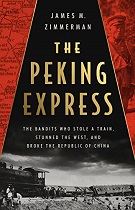
The Peking Express: The Bandits Who Stole a Train, Stunned the West, and Broke the Republic of China – James M. Zimmerman

PekingOn October 1, 1949, Chinese Communist Party leader Mao Zedong (1893-1976) announced the creation of the People’s Republic of China after a brutal struggle against the Kuomintang (“KMT”) forces under the leadership of General Chiang Kai-Shek (1888-1975).  Mao and the CCP had watched China grapple with its own internal conflicts for years which led to instability and uncertainty. On the night of May 5, 1923, Chinese bandits commanded by Sun Meiyao (1898-1923) seized a train traveling between Shanghai and Beijing, known as the “Peking Express”. Local citizens and foreigners were taken hostage by the bandits and forced to march towards Paotzuku mountain. This is the story of what became known as the “Lincheng Incident” re-told by author James M. Zimmerman in stunning detail.

One hundred years have now passed since the events in this book occurred, but the effects of the crisis on modern day China should not be overlooked. After introducing us to the well-connected passengers aboard the train, mostly foreigners, the author changes gears and takes us to the night when all hell breaks loose as a crude act of sabotage changes the lives of the train’s passengers and the course of history. Of course, the most important question is why? Well, there is more than one reason for the bandits’ actions, but financial gain is among them. But I could not ignore the savagery displayed towards native Chinese passengers by the bandits. Mental and physical exhaustion soon creeps in, making the hostage situation difficult to say the least. The female passengers which included Lucy Aldrich (1869-1955), daughter of Rhode Island Republican Senator Nelson W. Aldrich (1841-1915), are released over the course of several days following the incident, but the male passengers were remanded for several more weeks as the incident played out. However, as readers will see, the women did not have an “easy” time, and found that in the wilderness, the elements spare no one.

As I read the book, I began to understand that the rebels did not have a long-term plan. Aside from taking hostages, the end game did not make much sense. Further, the arrival of Chinese military personnel combined with pressure from foreign governments made it clear that the kidnappings would have to be resolved. What ensues is a haphazard pace of events in which more passengers are released while others use any means available to make their escape. And I had no illusions that the bandits were in store for anything but grisly fates upon the events’ conclusion.

The story is surreal, and the lawlessness of rural China in the early 1900s comes into sharp focus. This story is mind boggling, but incredibly important in Chinese history, and it served as the basis for the 1932 film ‘Shanghai Express‘ starring the late Marlene Dietrich (1901-1992).  Following the release of the passengers, the Chinese government wastes no time in dealing with the rebels, and their fates as told by the author, are not for the faint of heart. Frankly, justice was swift and brutal, but to be expected in China. Zimmerman also provides a few words about the lives of the famous passengers whose experiences continued long after their release from the bandits. But none of them could have imagined than fourteen years later, the Japanese Army would launch a military operation during World War II which brought death and destruction to China and made it clear to both the CCP and KMT, that China could only survive once free from foreign occupation. Mao Zedong, years away from becoming “Chaiman Mao”, shrewdly observed the lasting effect of the incident, and as the author points out:

“One of the people closely following the Lincheng Incident was the young Chinese communist leader Mao Tse-tung. In one of his first public speeches, at the Hunan Peasant Congress in December 1926, Mao specifically cited the event as an example of “starving peasants rioting” against the imperialists, warlords, and feudal classes.”

Zimmerman’s research into the events is incredible and my attention never waned while reading. The story is told at the right pace with the right amount of suspense. Without this book, the Lincheng incident may have been forgotten history. However, this book keeps the unbelievable story alive, and is a valuable account of a moment when the world changed.

ASIN ‏ : ‎ B0B9BCP7LP

Last Man Out: Surviving the Burma-Thailand Death Railway: A Memoir – H. Robert Charles

lastmanoutThe soldier above all others prays for peace, for it is the soldier who must suffer and bear the deepest wounds and scars of war. ” – Gen. Douglas McArthur (1880-1964)

Seventy-eight years have passed since Japan surrendered to Allied forces, marking the end of World War II. The war’s brutal conclusion, culminating with the detonation of two atomic weapons, changed history. Although subsequent wars have been fought, World War II remains the deadliest conflict in human history. The European theater of combat during the war has received significant attention due to the existential threat to the world in the form of the Third Reich. However, in the Pacific, the Japanese military waged its own campaign of death and destruction across Asia. H. Robert Charles served as United States Marne about the USS Houston, and on February 28, 1942, he found himself among the survivors of a Japanese attack in the Sunda Strait that decimated their forces and vessel. The surviving soldiers were taken captive as Prisoners of War (“POW”) by the Japanese, who had every intention of making the Americans pay for the battle against Japan. The prisoners were forced to build the Burma-Thailand railway, and this is Charles’s story of the nightmare ordeal the POWs faced until liberation.

Before starting the story of his captivity, a foreword opens the book, followed by a prologue explaining the long road from war survivor to author. It is apparent that he returned home with what we call Post-Traumatic Stress Disorder (“PTSD”) today. But after being coaxed by a fellow veteran to seek counseling, he has a discussion with a therapist who helps break down the walls preventing him from telling his story. And with determination and a sense of purpose, he has left us with this story of a dark time in history which we should never wish to repeat.

As to be expected, the author recalls his early life in post-depression America before joining the United States Marines in 1940. On December 7, 1941, life for Americans changed when the Japanese army bombed the Pearl Harbor, Hawaii Naval Base. The act was in effect a call to arms for the United States. But for Charles and fellow soldiers aboard the USS Houston, the war took them in a different direction. Following their surrender to Japanese forces, the men are moved to Serang, Java and began their ordeal at the labor camp. There is no shortage of brutality by the Japanese, but the men eventually find a solace in a doctor who becomes a savior in the story: Dr. Henri Hekking (1903-1994) of the Royal Dutch Army. To say that he was a godsend would be an understatement. Admittedly, I had never heard of Hekking, but I am sure he is one of many unsung heroes of World War II.

Hekking was a physician well versed in standard practice, but he was also experienced in herbal treatments, often referred to as “unconventional”. As the story progresses, we witness the deterioration in the condition of the prisoners, who begin to suffer from the effects of malnutrition and lack of proper sanitary and hygienic protocols. Injuries are also an issue, and the lack of antiseptic tools made infection a prime concern. However, the doctor proves to be more resourceful than anyone could have imagined. But he was not without his detractors as we see in the story. Despite early misgivings, “Doc” as he is known, earns the trust of everyone as he brings back plants, roots and other items from the nearby jungles that help keep the men alive as the Japanese compel them into manual labor building the long-awaited railway they desired. Morale is low at times as physical exhaustion sets in, but Hekking never gives up and offers these words of advice which still hold true today:

 “It is in the nature of things that without despair there can be no hope, without darkness no daylight,” Doc said. “There has to be meaning. Even if we can’t see it.”

Although Hekking emerges as a pivotal figure, the author is sure to tell his own story which becomes permanently linked to the experience of their Dutch savior who commands respect even from the Japanese, who are never short on cruelty. Unbeknownst to the soldiers, events outside the camp mandated their transfer across several camps, one as far as Saigon in French Indochina. And without warning, they are told that World War II is over, and deserted by evacuating Japanese troops. This is by far the most bizarre part of the book. However, the empire had fallen, and Japan reduced to shell of its former self. For Charles, Hekking and the survivors, their ordeals were far from over as they were faced with having to rebuild their lives in the wake of the war. The author returns to the Midwest and confronts his own demons. Hekking continued to search for his wife and children, with whom he is eventually reunited. And years later, the doctor makes his way to America to see the boys one more time. There is far more to the story contained in the book, which concludes on an uplifting note. If you need an enjoyable book about the Japanese aspect of World War II, this will be a welcomed addition to the library.

“Thanks to Dr. Hekking, only thirteen out of 194 were dead—less than seven percent. It was the best report of any of the doctors in the sixty-five slave labor camps along the railway.” – H. Robert Charles 

ASIN :‎ B005S741XW