
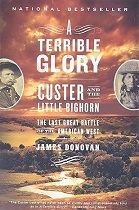
 On June 25, 1876, the United States Army’s Seventh Calvary Unit engaged a combined force of Lakota Sioux, Northern Cheyenne, and Arapaho tribe warriors in a battle which resulted in a stunning defeat for the military and became known as “Custer’s Last Stand” due to the death of Lt. Col. George Armstrong Custer (1839-1876). Custer has become a part of American pop culture, and his demise has been studied by scholars and historians. But was his demise a last stand? James Donovan revisits the tragedy of the Seventh Calvary in this book the author calls the last great battle of the American West.
The book is not intended to be a biography of Custer, but Donovan’s discussion of Custer’s early life is important in understanding the soldier he developed into. In comparison to the glorified image of Custer that prevailed in the wake of his death, the truth is far more complex, and the real Custer emerges as a multi-dimensional figure that is part of history for reasons he surely would not have wanted. However, before his demise, he did live an interesting life during the 1800s when America was still expanding its borders, even if it meant war with the natives. Following Custer’s childhood in Ohio, the author moves to his military career which includes service in the American Civil War. And on a personal note, we learn of Custer’s love for his wife, Elizabeth Bacon Custer (1842-1933) who is left to grieve after the battle at Little Bighorn. Custer’s service in the Civil War eventually ended with the defeat of the Confederacy, but for former soldiers, life after the war was far from easy. In fact, Donovan explains the sobering reality army officers faced after the South’s surrender. For Custer, life outside of a uniform was not much of a reality. Fate intervened, and he would join a new mission that would shed as much bloodshed as the Civil War: the battle to contain North America’s Indian tribes. And this is where the book takes a dark turn.
Readers who are sensitive to descriptions of violence, combat and the like should use discretion as the depictions of skirmishes between army troops and native tribes are revisited. The battles were brutal, and the tensions ran high across North America as white settlers and government troops pushed further west. Those who ventured past America’s western border, entered parts unknown. Some were never seen alive again. Treaties between the native tribes and the Bureau of Indian Affairs, did not count for much, and the escalation of tension between both sides raises the level of suspense as Donovan tells the story. Custer found himself in need of a purpose which came through an invitation to join the Seventh Calvary. This decision would seal his fate although he could not have known this at the time.
As the story moves closer to the battle, Custer prepares his force which includes Indian scouts and even a Black volunteer named Isaiah Dorman (1832-1876) which was strange considering Custer’s views towards black troops during the Civil War. While Custer was preparing for what he believed would be a glorious battle, the natives had plans of their own. And leading the pack were the warriors Sitting Bull (1831-1890) and Crazy Horse (d. 1877). Had Custer known what they were planning, history might be different today. But he did not, and we soon reach the part of the story where the Seventh Calvary moves out on its mission. It was Custer’s last mission and I warn readers that it was far from a last stand but annihilation. In fact, I had to steel myself as I read about the battle’s aftermath. But why did Custer fail?
Donovan discusses the failed strategy that led to defeat but it is hard to say what Custer believed at the time. However, his decision to split the calvary proved to be deadly. As they engage the natives, they soon learn that they are up against thousands of warriors and severely outnumbered. The fractured military units led by Senior Officer Marcus Reno (1834-1889), Captain Frederick Benteen (1834-1898) and Captain Thomas McDougall (1845-1909) were all in trouble and the three military commanders made the decision to withdraw in the face of oncoming waves of tribal warriors. After the battle, the officers would each face scrutiny with Reno becoming persona non grata in military circles. The reasons for his downfall are explained in the book, as well as the position of the Army, forced to confront Custer’s defeat. But on the side of the late soldier were those determined to preserve his legacy as we seen in the story. His widow Libbie is chief among them even as she continued to mourn the loss of her husband. The book continues after Custer’s death and the fallout is interesting. Of course, politics come into play, and the military itself goes on the defensive. And interesting, it managed to secure Custer’s legacy well into the 1900s.
I cannot ignore the dark undertone of the book, fueled by the fact that Custer’s last moments are still peppered with mystery. That he died in combat is not in dispute, but his movements as the battle rage and the native attack that took his life leave more questions than answers. They also cast a darker cloud over the battle of Little Bighorn. To supplement the book, I watched a couple of videos regarding the battle to learn what historians have discovered in recent years. What I learned is that the battle was even more gruesome than the descriptions in this book. I could not imagine being in that battle against the native tribes thirsty for blood and without the “restraints” of conventional warfare. The author here removes all doubt that the native tribes had one goal and that was to kill as many troops as possible. Sadly, that goal was accomplished, and Custer’s life came to a tragic end. This is not the sole book on the battle nor the definitive account, but it is an excellent place to start if you want to know the story of George Armstrong Custer and the battle that changed American history.
“We will never know, without a reasonable doubt, what happened to Custer and his 210 men. That is because no white observer saw any man of that contingent alive again, and the accounts of those who witnessed its movements—the Sioux and Cheyenne who defeated Custer—are, for many reasons, sketchy and often contradictory.” – James Donovan
ASIN : B000SHPTG0
 FREETHINKING BIBLIOPHILE