
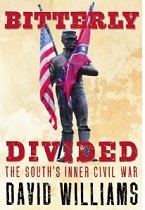
 I am consistently amazed at the amount of history related to the American Civil War. The conflict which bitterly divided America, was a moment in which the United States had to reconcile with its dark past and an uncertain future. As a Northerner, the image I had of the Confederacy was generated from films and television. However, the reality of the South was a society divided and plagued with inner turmoil and dysfunction. Author David Williams explores this little-known history of the Confederacy, and the resistance from within to keep the Union together and dismantle the slave-holding elite class in the South.
Within several minutes of reading the opening section of the book, I could not help but feel that the South was doomed from the start. But the war’s conclusion could have been quite different as the author points out, had the South been better prepared and more realistic about secession and independence. However, that did not happen, and as the book progresses, the grim reality facing the Confederate States of America and its President Jefferson Davis (1808-1889) comes into sharper focus. I previously reviewed Bruce Levine’s ‘The Fall of the House of Dixie: The Civil War and the Social Revolution That Transformed the South’, which discusses social changes in the South in the aftermath of the conflict. Williams’ account is focused on the failures that began to affect the South’s mission from the very start and the unsettling truths for proponents of the ‘Lost Cause’ myth. There was no grand or noble effort to crush the North. In fact, what the author reveals here is far from admirable and shows that the South was coming apart at the seams.
I was aware of the high desertion rate Confederate commanders faced as they engaged Union troops. But the number of soldiers who laid down their arms and deserted is staggering. And the crux of the issue is why they deserted to begin with. Williams takes a deep dive into the social climate in which the book is set. A minority of powerful and wealthy figures decided war was good, even if the majority of Southerners were not wealthy, did not own slaves and saw secession as pointless. This detachment from reality placed the South at a disadvantage from the moment the opening shot was fired at Fort Sumter, Charleston, South Carolina on April 12, 1861. It also fostered hatred among citizens of the South towards the slave owners who dragged them into war. But there is far more to the story which Williams tells brilliantly.
Aside from desertion, we also learn that famine was just as crippling. But the actions of women across the South determined to feed their families was eye-opening. The stories told in the book should remove any doubt that the South was “self-sufficient”. In fact, it becomes very obvious that the South could not feed all of its people. Several of the stories are shocking and show that the women had no fear of anyone because food and survival trumped any effort to push back against the Union. But that also raises the question: how could the government not see this ahead of time? There is a good reason which the author discusses, and to say that it was poor planning would be an understatement. The situation across the South was that food was scarce, citizens were bitter, and resentment was building exponentially. And if that were not enough, we also learn more of the anti-secession/pro-Union militias operating within the South to bring down the Confederacy and end the bloody war.
We know from the early part of the book that the majority of Southerners did not approve of secession from the Union. But rebel units loyal to the Union are an aspect of the conflict which I had never heard discussed in any classroom I can recall. This was mind blowing. Civil War buffs may know this part of the story very-well, but if you are not one of those people, this part of the story is surreal. The story is so engaging that I could not stop reading and my mind absorbed the information like a sponge. However, this is the elephant in the room throughout the book and that is slavery.
Williams pulls no punches is discussing the attitude towards slavery whether it is in the South or the North. And what he shows is that while the two sides engaged in war, it was seen as a white man’s war and regardless of the outcome, President Abraham Lincoln had no desire to confront slavery once and for all (1809-1865). Lincoln was willing to let slavery continue if he were able to come to a compromise and hold the Union together. And in the South, slaves themselves became higher in value due to conscription and the South’s need for more able-bodied soldiers. Both sides underestimated the resolve of free and enslaved Blacks who were no longer willing to tolerate being held in bondage. And as we see in the book, although both sides initially abhorred the use of Black troops for varied reasons, the entry of Black Union soldiers into the conflict helped turn the tide of the war. Also, those not in uniform but determined to undermine the South as they spied on the Confederacy are discussed so that their names are not lost to history. By the time I finished the book, I realized that the South was doomed, and nothing was going to save it.
If we are to truly learn American history, we need books such as this which tell us the uncomfortable and sobering truths about what really happened. History is rarely pleasant and often filled with facts that we would rather forget. But the reality is that the Civil War and its aftermath shaped the America we see today. And though the country continues to change, many more years are needed to move away from the not too distant past when the United States became divided and the nation went to war with itself.
ASIN : B0042RU4D0
 FREETHINKING BIBLIOPHILE
This is an insightul review. I didn’t realize that the south didn’t have a new system of government setup before they started the war. That being said; the Confederates were called Rebels for a reason.
LikeLike
Thank you! Agreed, they were called rebels for good reason. The book left me speechless at times and I have a better understanding of the Civil War, and the craziness within the Confederacy.
LikeLike