
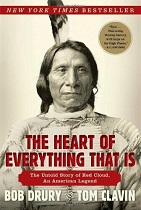
 In the 1800s, the United States was a rapidly growing nation that had evolved from thirteen British colonies to a country seeking to expand across North America. The ideology of “manifest destiny” propelled the drive west into the unchartered and unknown. White settlers who dared to venture past America’s borders faced severe dangers with no guarantee of military aid. But all knew that the gravest dangers outside of the United States were the Native American tribes who called the continent home. As explorers and American military personnel moved further west, the native tribes reaffirmed their commitment to preserving their way of life. Washington’s plan for establishing more territory set the two opposing cultures on a collision course that spread violence, mistrust, and cast a dark cloud over American history that exist to this day. The names of Sitting Bull (1831-1890) and Crazy Horse (d. 1877) are legend, but there were other warriors who struck fear across the continent and wanted fugitives as Washington sought to solve the “Indian problem”. Among them was Red Cloud (1822-1909), an Oglala Sioux who caught the attention of the U.S. Government as his united front of warriors handed America a horrific defeat at what became known as the “Fetterman” massacre. This is the story of Red Cloud’s life, America’s war against Native Americans, and the fallout from the conflicts which turned the continent red.
Before continuing, I want to point out that this book is not for the faint of heart. It is the raw uncut truth which will be upsetting to readers sensitive to descriptions of violence and the tragedies that befell people on both sides. Should you choose to read the book, understand that this is a dark chapter in American history that you did not learn in grade school. Drury and Clavin pull no punches, and it is clear during the story that the America we know today is vastly different from what life was like during the violent 1800s when the United States was still charting its course and went to war with itself as the issue of slavery divided the North and South.
Red Cloud’s story begins near the Platte River in modern-day Nebraska, in 1822. His people, the Oglala, are a subtribe of the Lakota people, whose homes could be found in what are known as the Dakotas today (North and South). The authors provide a good course on Sioux history, their customs, and Red Cloud’s early life in which he comes of age at a time when change began to spread across North America. in 1836, one of the most shocking Indian raids occurred at Fort Parker in Texas, as discussed by S.C. Gwynne in the book ‘Empire of the Summer Moon‘. The story of Hugh Glass (1783-1833), brought to life in the 2015 film ‘The Revenant‘, provides interesting insight into life at that time. The film is fictionalized in certain aspects but does provide realistic examples of the threats one faced when outside of America’s borders. I assure you that the film is tame compared to what happens in this book.
As Washington’s war against the Indians heats up, the battles become more intense and both sides dig in for a protracted struggle. Both sides score victories, but what happens to those on the losing side is beyond words. It is fair to say that if the American troops caught you, your chances of survival were far higher than if the Native Americans found you. In fact, what happened to settlers and troops unfortunate enough to be caught alive at the hands of the Oglala and other tribes such as the Comanches, is horrifying. And it should come as no surprise that for some troops, suicide was a preferred option to capture. But the authors provide an explanation for the Indian’s actions which I had not heard previously. And while it does not explain all the barbarity on display, it does clarify their attitude to the remains of fallen enemies. Regardless, what happens to the captured settlers and soldiers in the book should be a sobering reminder of the deadly environment which dispersed across the continent. It should also be noted that Native American tribes had their own wars against each other before the arrival of Europeans, and those battles were just as deadly as what we see take place regarding American exploration.
Red Cloud soon makes his entry into the battles as he matures into a young man, with a wife at home. On a side note, the story of his marriage and the tragedy surrounding that affair adds a sorrowful footnote to his story. But warriors were needed, and in time Red Cloud would prove himself in ways no one could have predicted. On the American side, the job of containing Red Cloud and the union of tribes fell on Commander Henry B. Carrington (1824-1912) and Captain William J. Fetterman (1833-1866). And this is where the stage is set for the battle that will change history. As the saga plays out, we witness the Indians’ ability to circumvent American military operations and the soldiers’ underestimation of their opponents’ determination to keep white faces out of their territory. The missteps on the American side become hauntingly clear and I could not help developing a sinking feeling as the decisive battle inched closer. Whether it was miscommunication, ego or stubbornness is lost to history, but the failure to follow orders, make uninformed decisions and the lack of intelligence surrounding the Indians’ plans, doomed the mission from the start. The climatic battle on December 21, 1866, is re-told in all its savagery, as blood is spilled, and lives are lost. The post-battle recapitulation will leave readers speechless. The carnage to be found is second only to Gen. George Armstrong Custer’s (1839-1876) last stand at the Battle of Little Big Horn in June 1876. Fetterman suffered a stunning defeat, and the reality of native resistance struck Washington at its core. In 1868, the Treaty of Fort Laramie was signed, however, it would soon be violated leading to more conflict as settlers encroached on Indian territory. Despite fierce resistance, Indian tribes realized that America’s military might was too strong and accepted placement on reservations. Sadly, there are tribes now extinct due to the battles for control of North America. As for Red Cloud, he survived until his own passing 1909, but he had secured his place in history as the Indian who withstood an American military attack and handed its forces a demoralizing loss. This is American history; the good, the bad and the ugly. It is also a definitive account of Red Cloud’s rise and fall.
ASIN: B00BSAZ614
 FREETHINKING BIBLIOPHILE