
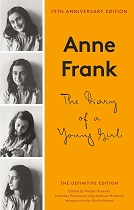
 A couple of weeks ago I was in search of a new book to read, however, an old favorite popped up in my list of recommendations. I had previously read and reviewed ‘The Diary of a Young Girl’ by Annelies Marie “Anne” Frank (1929-1945) but I noticed this 75th anniversary edition which drew me in further, and I decided to read it again. I have always found it fascinating that Frank had no idea her private diary would one day become a best-selling book. Her mind was pre-occupied with things one would expect from a teenage girl. However, it was also occupied with war raging across Europe as the Allied forces collided with the Axis powers during World War II.
The prior review I wrote in 2015 was brief, but it touched on important aspects of the story and times. After reading her diary again, I have a deeper understanding of Anne and what happened leading up to their last days in hiding. The diary begins shortly before the family relocates to the annex, and Anne provides a succinct description of how unbearable life has become for Jews in Amsterdam. This part should come as no surprise to anyone who is familiar with her story and that of World War II. The diary contains nothing about life in Germany, but Nazi ideology had spread extensively, and the Netherlands had already fallen into German hands. The Franks and their fellow Jewish neighbors were living in an occupied zone. The family soon arrives at the attic where they are joined by several others, whose names are slightly altered by Anne in the diary in which she writes to the fictional reader “Kitty”, in memory of the cat she left behind, Moortje. Her housemates, the Van Pels, become the Van Daans, and Fritz Pfeffer (1889-1944) becomes Mr. Dussel. Additionally, there are several others who are not Jewish and live outside of the annex and do their best to help when possible. Daily life inside the attic takes center stage with all the drama one would expect. And having visited the attic myself in person, I remain astounded that all of them found refuge in such tight quarters. However, their lives were on the line as the Third Reich tightened its grip over Europe and commenced the “Final Solution“.
As I read the diary, I was struck by Anne’s maturity at such a youthful age. Of course, there are times where she comes off as obnoxious and defiant, and other occasions when she is not the nicest to her mother Edith (1900-1945). In fact, there are several journal entries in which Anne explains a confrontation which had occurred earlier in the day resulting in the two not speaking. However, she does love her mother, but their bond stands in stark contrast to the overwhelming love she had for her father Otto. He was by far, the person she was closest to and cherished the most. He also had the unfortunate role of mediator as his wife and daughter clashed. Otto returned the favor to his daughter after surviving the war by publishing her diary which has become the gift that continues to give. But I do not want to forget Anne’s older sister Margo (1926-1945), who appears on occasion throughout the diary but rarely in favorable light. While Anne did not dislike her old sister, there was a sibling rivalry. Added to the issues within the Frank family are the interactions with the fellow residents in the attic. To say that things were tense would be an understatement. There are fights over food, territory, opinions on the war, and child raising with jealousy providing a source of ignition for conflict. However, Anne is not oblivious to what drives the dysfunction, and I agree with her assessment. The situation in the attic was far from normal, and they lived under tremendous strain and fear, side by side daily until the end, on August 1, 1944, her last journal entry. But, the question remains, were they betrayed?
To the best of my knowledge, there is no conclusive evidence of anyone informing the local authorities, but Anne provides a clue that might explain the chain of events that led up to the discovery. In her journal, she writes about three burglaries that took place while the family was in hiding. The third and final break-in she details was the most serious as the men in the attic were seen from the outside as they responded to the after-hours incident. Although they were spotted, the police did not arrive that night. However, there were other things taking place at the warehouse underneath the attic that the family may not have been aware of. The break-ins and the suspicious activity in the warehouse may have caught the attention of the Dutch police. It is known that it took about an hour before they discovered the secret annex, but it is unclear if that was the sole reason for their visit. Of course, it is possible that they were betrayed but the answer may be lost to history.
Anne was a gifted writer and fiercely determined for her age. She was also incredibly young, and still had much to learn about the world. There are times she comes across as spoiled in the book, but other times keenly observant. I did remind myself that she was only fifteen when the annex was discovered. All the things you might expect from a teenage girl are here, but that makes her story even more relatable. She was not a celebrity and understood the danger they faced due to being Jewish. And in one of the notations made in this edition, we learn that she intentionally kept some sections under guard for personal reasons. In another diary entry, she makes a remark about her journal being read ten years later and its reception. If only she could see how important her diary became. It remains one of the most important books of World War II. Anne was not afforded the chance to mature into adulthood and learn the error of her ways. Had she lived, I believe she would have come to understand and cherish her mother and older sister Margot. I cannot say whether Peter Van Pels (1926-1945) would have become her beau, but the signs were certainly there.
If you have the chance to visit Amsterdam, please be sure to visit the annex museum if you have not done so already. It is a moving experience that I cannot put into words. But if you cannot make it there in person just yet, Anne’s diary provides a wealth of information about their lives during one of the darkest periods in world history. Highly recommended.
“I get frightened myself when I think of close friends who are now at the mercy of the cruelest monsters ever to stalk the earth. And all because they’re Jews.” – Anne Frank
ASIN : B0041OT9W6
© Anchor Publishing, 2010
 FREETHINKING BIBLIOPHILE