
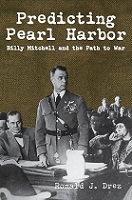
 Several days ago, America marked eighty-three years since the Japanese military attacked the U.S. Naval Base at Pearl Harbor, Hawaii. The attack claimed the lives of 2,403 people and paved the way for America’s entry into World War II. On December 8, the day after the attack, President Franklin D. Roosevelt (1882-1945) declared the attack a “Day of Infamy”. Four years later, Japan surrendered following the use of two atomic weapons by the United States Air Force. In the years that followed, there would be speculation as to whether the White House knew in advance that Pearl Harbor would be attacked. The issue remains controversial but there were officials who had predicted a Japanese military attack in the Pacific. Among them was the late Col. William Lendrum “Billy” Mitchell (1879-1936), an early pioneer of air defense whose premonitions were vindicated by the success of Air Force General Curtis E. Lemay (1906-1990) during World War II. Today Mitchell is a footnote in history, but this seasoned commander never wavered in his outspoken belief that Japan would attack America in the pacific. This is his story and how America’s military brass missed a crucial opportunity to take the lead in air defense.
You may be wondering why you have never heard of Billy Mitchell. Sadly, he died in 1936, three years before German Chancellor Adolf Hitler (1889-1945) gave the green light for the German Wehrmacht to invade neighboring Poland and ignite the second world war. However, his importance to history cannot be overlooked. But the key to understanding Mitchell’s relentless crusade to change the mindset of military commanders lies in the Japanese empire itself, often misunderstood from a historical context. The author provides a thorough discussion of the closed-door policy held by Japan and the risk of execution by those who dared to enter its vicinity and even Japanese seeking to return home. The expedition by U.S. Naval Officer Matthew C. Perry (1794-1858) which is discussed in the book, was a pivotal moment in world history but far from the end of the story. In fact, Japan was the beast that was now wide awake.
Mitchell was a World War I veteran, but his focus had shifted to the Pacific which he came to believe was the perfect avenue for Japanese expansion. His reasons are explained methodically by the author who relays Mitchell’s own observations and writings about what he learned as he toured the Far East in 1923. In America, he knew he was facing an uphill battle but believed that demonstrations were key. Thus, we learn from the story of several demonstrations of air power which left commanders speechless and proved that air combat was a reality. Mitchell was on the money, but the military was not yet ready to listen. Undeterred, his mission to change the view of air power proceeded, but he soon found enemies from within.
As I read the story, I kept asking myself why very few people in high command were watching Japan. The author reviews the country’s movements in the years before Pearl Harbor as its empire expanded across Asian. Further, Japan’s departure from the League of Nations on March 27, 1933, alarm bells should have been ringing throughout the nation. Readers will see the pieces of the puzzle come together as the Land of the Rising Sun ramps up its war effort. Mitchell and the late Gen. Homer Lea (1876-1912), an officer in the army of Chinese President Sun Yat-sen (1886-1925), had both warned of Japanese influence but to no avail. But Mitchell would not give up and we eventually reach the final act of the book when he is tried before a military court due to his refusal to abandon support for a dedicated air defense system.
The court trial proceeded like the staged event Mitchell expected but he came out swinging, backed by public opinion and supported by fellow aviators who later made their claims to fame. While reading I had hoped that Mitchell would prevail, but he knew his fate was sealed. The court testimony is riveting and shows the politics at play in the armed forces. But in the end, Mitchell could not escape the court-martial waiting for him. The sad conclusion marks the end to a valiant effort to alert America to a growing threat in the Far East. Unfortunately, it would take the attack at Pearl Harbor to wake up America’s military which then pushed for an air defense network and combat network. Mitchell’s chilling warnings in his report on the Pacific were shunned and ignored but later came back to haunt the American military. But the air force would not let his memory die, and the B-29 bomber conducted the missions that would have made Mitchell proud. The author writes in smooth narrative that keeps the reader engaged from start to finish. And at the end of the book, we are given another story about events on the Pacific Island of Niihau which provided the blueprint for internment of suspected foreign sympathizers here in America. Highly recommended.
“With us air people, the future of our nation is indissolubly bound up in the development of air power.” – Col. Billy Mitchell
ASIN : 1455623156
Publisher : Pelican Publishing (August 15, 2017)
 FREETHINKING BIBLIOPHILE