
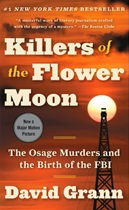
I was in the search for a new book and saw this title by David Grann which caught my attention because I knew that I had seen the name before. Then I realized that a Hollywood film of the same name had been released starring Leonardo DiCaprio, Lily Gladstone and Robert De Niro. I have yet to see the film and in hindsight, having read the book first may be a bonus. The movie is on my watchlist and if it is close to the story told within, I can expect a powerful film from director Martin Scorsese. Prior to reading the book, I was not familiar with the Osage murders in Oklahoma during the early 1900s. As a result, I learned the story for the first time, and after finishing the book, I felt anger and sadness. But despite the range of emotions triggered by the story, the book is excellent and the suspense kept me glued to the book as I learned the story of a dark time in Oklahoma’s history.
The book begins with the disappearance of Anna Brown (1885-1921) on May 21, 1921. We soon learn about Anna’s family history and the Osage tribe to which they belong. Her sister Molly Burkhart (1886-1937) and husband Ernest Burkhart (1892-1986) quickly emerge as the central figures in the story, and begin a desperate search for Anna. However, there is more than meets the eye, and to understand Anna’s fate, the author explains the Osage tribe and their relocation from Kansas to Oklahoma by the United States Government. The move proved to be a blessing and a curse but the statistics regarding the Osage’s financial status left me speechless. I was not prepared for the jaw dropping numbers presented by the author. But it was easy to see how they became targets for the violence which arrived at their doorsteps. The situation is made more complex with the mixed marriages between Osage women and white men. Today the couples would not earn a second glance but in the 1920s, Native Americans were still sadly viewed as “savages”. Statements by Ernest’s aunt in the book reflect this mindset. At first, the mixed marriages provided me with a sense of hope but as the layers are pulled back on murders, the plot thickens in ways I did not expect. And this resulted in me wanting to read even more of the book as the saga continued to unfold.
Every story regarding the dark side of human nature has an antagonist, and this book is no different. Here, that person is William K. Hale (1874-1962). It did not take long to realize that Hale was a strange character, and he cast a dark cloud over the story. I could feel the shift in the mood through the author’s words as I learned of Hale’s background and his actions regarding the Osage. The feeling I had about Hale was right on the mark. In Washington, D.C., the Osage murders did not go unnoticed and the Bureau of Investigation, later renamed the Federal Bureau of Investigation (“FBI”), found itself involved with the case after its director J. Edgar Hoover (1895-1792) dispatched special agents under Tom White (1881-1971) to solve the case and bring the murderers to justice. White had his hands full but soon learns that there are dark secrets in the Osage case, and his investigation also highlights the mistakes made by local police. But he gets a break when the home of local resident Bill Smith implodes. The fallout from the collapse of the Smith house soon leads White on another path that goes into the heart of the Osage murders, and what he learns will leave readers reeling. If the story had you on the edge of your seat up until this point, you had better hold on tight because it soon takes another turn into the dark.
At first, I was not sure how the Smith case would help break the murder investigation, but like a series of dominoes, people begin to fall, and the truth begins to come out, and I could not believe what I read. The tragedy of the Osage tribe is heartbreaking, and the way in which they were targeted is repulsive. Actions of those cursed with greed highlight the power money has over people and the lengths to which people are willing to go to obtain wealth. However, justice prevails and there are prison sentences handed out. And while they may seem light to some readers, I was both surprised and grateful that justice was done in a time when being Native American still provoked disgust and discrimination. But just when you think the story is over, the author takes us another ride in the epilogue where he discusses a disturbing aspect of the Osage murders that the police and FBI have not fully addressed. And the question emerges; how many murders have occurred which were never solved? And how long did the crimes occur? And did the perpetrators have the protection of local officials? The full truth will never be known, but the author presents a chilling case for a far more disturbing trend which had developed in Osage territory.
After I finished the book, I had a moment of silence for Anna Brown and the Osage tribe members whose lives were taken due to greed and vindictiveness. Their story is a tragic tale of Native Americans whose lives were upended, improved and then imperiled. We are unable to go back in time and correct the wrongs done to them, but we can honor their legacy by never forgetting their story. I did not know what to expect when I began this book but it has become a story I will not forget. This book is well-written and well-researched, and the story is told in a narrative which maintains the right mix of elements to convey the author’s words. And when I do watch the film about the Osage murders, I can reflect back on Grann’s work which I am grateful to have discovered. Highly recommended.
ASIN : 0385534248
Publisher : Doubleday, April 18, 2017
 FREETHINKING BIBLIOPHILE