
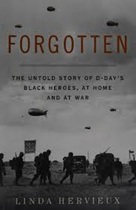
On June 6, 1944, Allied forces launched a combined military assault across five beaches in Normandy, France during World War II (1939-1945). The assault was costly but the success of troops in storming German defenses, showed the military brass in Berlin that the war would be lost. The mission titled ‘Operation Overlord’ set the stage for the collapse of the Third Reich. And when German General Alfred Jodl (1890-1946) signed an unconditional surrender at Reims, France on May 7, 1945, millions of people around the world felt relieved. However, for America’s Black soldiers, the battle was far from over, and they would soon return to a nation in which they had another war to fight for civil rights. Their service in the war was overlooked for a considerable number of years but in the past two decades there has been a resurgence of stories regarding the contributions of Black Americans in World War II. Author Linda Hervieux re-examines the historic D-Day invasion and the forgotten roles of its Black heroes.
Discretion is advised to readers sensitive to descriptions of racial discrimination. There are parts of the book both shocking and mind boggling, but Hervieux pulls no punches in showing the experiences of Black men who found themselves in the military. As a sample of the substantial number of men who served, the author focuses on a select few whose stories serve as a representation of common patterns throughout the book. But before we reach D-Day, Hervieux discusses the dark climate in America prior to the war in which Jim Crow was raging unrestrained. And this is a crucial section of the narrative because it helps to explain why the military became a destination for young men with limited options. But make no mistake, many of the men knew that the military was not free of prejudice and they would have to fight in more ways than one and the biggest challenges they faced were not only physical but the mindset of superior officers and politicians who firmly believed that Black troops could never perform correctly on the battlefield. Hervieux dives deep in this prevailing assumption that was not only dehumanizing but also completely wrong as she shows later in the book.
After building up the suspense and pulling at the reader’s emotions, the author changes gears and takes us to Europe where Black troops found a whole new world unlike anything they had experienced in the United States. However, there were people in high positions in government in Europe who held some of the same absurd ideas as their American counterparts, but the reality was that the war required soldiers and in order to defeat Nazi Germany that mean a full-scale onslaught with troops from all over. At Normandy, we are re-introduced to the carnage which ensued as troops stormed the beaches. The scene is hellish, and I felt chills while reading of the devastation awaiting troops as they battled sea sickness and confronted the reality that they may not survive the landings on the beaches. But for the soldiers who did survive, the German retreat was a breath of fresh air, and if you were Black, then your life was about to change in ways you did not expect. As we step back from the battlefield, Hervieux discusses the interactions between the people of Europe and the black faces from America. And what she reveals is uplifting, heartwarming and heartbreaking, but not for the reasons one may expect.
Admittedly, I was not fully aware of the issues behind the scenes in European towns as American officers sought to enforce Jim Crow in another country. Today it seems mind-bending, but the world was a vastly different place in the 1940s. However, the people of Europe who are unfamiliar with Jim Crow have a unique experience with the Black troops and it will change the way you view World War II. The scenes in the book range from heartwarming to surreal, as Black troops learn about the world outside of America and enemies within. To be clear, not every American commander was prejudiced against Black troops. In fact, there are several in the book who realized that the military’s segregation policies hurt far more than it helped, but their voices were drowned out by a system which needed time to change itself. And that change does come as the Black troops prove themselves on the battlefield. Their enriching stories told beautifully by the author helped break the facade of Black inferiority. And the civilians they met helped them understand how dysfunctional America had become with its own citizens. They returned home with a new sense of pride, but their ordeals were far from over.
As I read the book, I could not ignore the elephant in the room. Black troops who served saw a separate way of life in Europe free from Jim Crow and blessed with the dignity of being treated as a human being should. And it forced the question of how could America fight racism in Europe while allowing it at home? For Black troops it was an open wound which could not heal until their own government began to change their lives back home in the United States. The author addresses this hotbed topic, including the complicated legacy of the G.I. Bill which could have been a far more effective tool than it was. In Washington, politicians became keenly aware that change was needed, and the wheels are set into motion by President Harry S. Truman (1884-1972) in 1948. However, several decades would pass become the White House stepped in and began awarding long overdue medals to World War II’s Black heroes. Some men were still live to see their day while others had passed on. But their names are a part of history and as the author winds down the story, we share their special days with them as America pays homage to its veterans.
This book is amazing, and it will stir emotions, but history is rarely pleasant. It forces us to confront dark truths which have been carefully hidden. America has come a long way since World War II, and there is still a long way to go but what is crucial is that the past is never forgotten so that it is not repeated. Highly recommended.
“In June 2009, six decades after he landed on the shores of Normandy, Bill Dabney returned to France at the invitation of the French government. On the sixty-fifth anniversary of the landings, under a bright blue sky, Bill and other aging veterans received accolades from the world’s most important leaders at the American Cemetery overlooking Omaha Beach. President Obama shook his hand.”
ASIN : B00PQRH7KS
Publisher : Harper, October 27, 2015
 FREETHINKING BIBLIOPHILE