
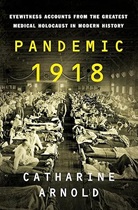
On November 11, 1918, an armistice was signed at Compiègne, France, ending the hostilities of World War I (1914-1918). The war formally ended with the Treaty of Versailles on June 28, 1919. Millions of people had perished in the war but there was another killer in 1918 which spread across the globe undetected until its horrifying effects became hauntingly clear. It is known as the Spanish Flu, a virus of the H1N1 influenza strain. During the final year of the war, this silent killer wreaked havoc across the globe as health officials and politicians struggled to contain the deadliest health epidemic in modern history. Author Catharine Arnold takes us back to 1918 when the Spanish Flu changed world history.
The book begins in September 2007, the body of Sir Tatton Benvenuto Mark Sykes (1879-1919) was exhumed at a cemetery in Sledmere, Yorkshire, England. The lead lined coffin holding his remains had helped preserve body tissue scientists believed to hold critical clues about the Spanish Flu. And to understand why they are in the trenches in the fight against influenza, we must step back to the year that changed the world which is the focus of this book which left me speechless. Prior to reading Arnold’s book, I knew that the story would be challenging, primarily due to the subject matter. The cover removes any doubt as to what readers can expect within and once the story begins, it does not let up as she takes us through one of the darkest periods in world history.
Today we have the benefit of advanced medicine and the internet, tools which aid in the rapid recovery from influenza. And although the virus does claim lives each year, the number of deaths is significantly lower than it was in 1918. And as the book progresses, it becomes clear why the virus claimed millions of lives. Further, the virus did not discriminate and touched every sector of society. Author John Steinbeck (1902-1968) and silent film era star Myrtle Gonzalez (1891-1918) are two examples of the notable figures impacted by the virus’s spread. As doctors struggle to understand and contain the virus, it shows no signs of abatement, and the experiences of those who survived are part of what makes this book fascinating. Their stories are vivid, and they pull no punches about their ordeals which leave a chill in the air as the grim reality of influenza settles in. For all of them, it was a trip to hell and back as they stared at death in the mirror. The horror or the plague is compounded by the spread of the virus both unknowingly and unwittingly and I could feel the sense of helplessness which consumed doctors, nurses, city officials, and military personnel as the virus continued to claim victims. The parallels between the Spanish Flu and the Covid-19 epidemic are eerie, but today we are in a far better position than the world’s inhabitants in 1918. However, readers will note the discussion regarding face masks which were controversial and integral as both pandemics ran their courses.
The book is a roller coaster ride through 1918, and I can only imagine how it affected those who survived. We have some of their words here, but there were scores of people who fell victim to the Spanish Flu, survived, and moved forward with permanent scars and dark memories. But just when you think the story of the Spanish Flu is finished, the author takes us to Hong Kong in 1997 where a three-year-old child named Lam Hoi-ka falls victim to influenza, sparking fears that the deadly virus was returning. The concerns of health officials were valid as readers will see in the story. In hindsight we know that a new plague did not happen, but Hoi-ka’s death did play a crucial role in scientists understanding the influenza virus and its spread to humans from animal species. And this is an important tool which will help physicians confront future pandemics. And as we continue to plan for future events, we can use the Spanish Flu as an example of where we should never return. The book is beautifully written, and while grim in content, it does contain valuable historical information. Despite the subject matter, I found it easy to read and I could not put it down once I started. If you are curious about the Spanish Flu and the 1918 Pandemic, this book is must read.
ASIN : B079LB96CJ
Publisher : St. Martin’s Press, August 28, 2018
 FREETHINKING BIBLIOPHILE