
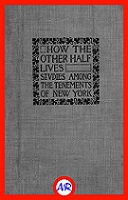
 A few weeks ago, my family had its first gathering in nearly two years. The even took place at Jacob A. Riis Park in Queens, New York. As I walked the boardwalk next to the beach, I wondered how many people there knew the story of Jacob A. Riis (1849-1914) for whom the park is named. In 1890 this book by Riis was published and more than one hundred years later is stands as a crucial piece of writing about the island of Manhattan. At the time Riis wrote the book, the City of New York had yet to be incorporated. That occurred eight years later on January 1, 1898. His focus here is on the tenements in lower Manhattan and the different ethnic groups that inhabited the area. And though New York has changed significantly in the years since Riis wrote this book, the gap between the wealthy and poor still remains wide.
Riis personally visited the tenements and made his observations regarding the people who called the them home. And what he reveals is not entirely shocking but should serve as a reminder that before the skyscrapers rose across Manhattan, many parts of the island were home to families on all income levels and poverty was more common that some may think. And in the area that was once known as the Five Points, life was tougher and deadlier. The pictures that emerge from Riis’ work show two different worlds that exist in the same city. The wealthy lived comfortably further uptown but, in the tenements, it was hell on earth. In the tenements we find immigrants from Ireland, Italy, Poland, China, and various other places from which they departed. All were in search of a better life in America but found themselves at the bottom of the social ladder where they were joined there by black Americans who had struggled to fit into American society in the wake of the Civil War and the failed Reconstruction Acts. Riis gets up close and personal with each group and leaves us his thoughts which are sure to raise eyebrows.
I do warn readers that the author uses coarse language at times and his references to some groups and areas would never make it past a publisher’s desk today. More than once I winced at his use of such terms as “Chinaman” and “Jewtown”. But I also realize that in 1890 this style of writing was perfectly acceptable. And despite the terms he chooses for certain discussions, Riis’ goal of shedding light on how the other half lived is thoroughly accomplished. And the illustrations that are included help to reinforce the message he is delivering. Today it might seem unreal that such conditions existed in New York, but they did, and the tenements were beyond deplorable. Disease, hunger, crime, and despair could be found all over, and many met early deaths trying to survive in the depths of hell. Their stories are consolidated here through Riis’ storytelling that is engaging and will keep readers tuned in and rooting for the underdog. Riis is also rooting for them as well and fully understand the challenges they face. To make that point clear he explains to the reader that:
“The poorest immigrant comes here with the purpose and ambition to better himself and, given half a chance, might be reasonably expected to make the most of it. To the false plea that he prefers the squalid homes in which his kind are housed there could be no better answer. The truth is, his half chance has too long been wanting, and for the bad result he has been unjustly blamed.”
Those words are still true today. Readers who are also history buffs may recall that only eight years prior to the publication of this book, Congress had passed the Chinese Exclusion Act which was signed into law by President Chester A. Arthur. The legislation prohibited Chinese laborers from emigrating to the United States and remains one of America’s darkest legacies with regards to immigration and the Chinese-American experience. I am sure Riis was cognizant of that fact and fully understood how and why the Chinese neighborhoods developed into what they became. I found him to be fair for the most part in his descriptions of the tenements but there were times where his words are slightly menacing. But interestingly, Riis is aware of it and mentions it on occasion as he explains the various areas of the tenements. However, there is one group for which he seems to be far harsher upon than others: the Arab/Bohemian. I cannot say why his words about the Bohemians were as sharp as they were, but his criticism of the group is significant in the book. Sadly, even today America’s Muslims are not always fully understood and anti-Arab discrimination is still an issue within our borders. In all fairness, Riis never goes as far to mercilessly bash them or try to incite violence upon them. But I do feel that perhaps he was a little too critical of an immigrant group that has strived for acceptance.
There are many redeeming moments in the book and Riis does make sure to point the great things about the various ethnic groups. And that is what is so striking about the book. His casual use of terms and descriptions could be taken as slightly bigoted, but he never fails to give praise where praise is due. And when it comes to the Negro population, he is brutally honest in the treatment blacks had received in America and how their lives have suffered because of it. I could feel while reading the book that his time in the tenements allowed him to understand the challenges immigrants faced as arrived in America. Faced with a new culture, new language, and exposure to ethnic groups they may have only heard about, immigrants in New York during the 1800s did what was needed to survive and for many, life in the tenements was their daily reality. Lower Manhattan looks different today but at one time the Five Points was a battle zone and life was not guaranteed. It was here that the other half lived. Riis, however, was optimistic and makes this statement that I feel exemplifies at least one thing New York City will always be known for:
“New York is, I firmly believe, the most charitable city in the world. Nowhere is there so eager a readiness to help, when it is known that help is worthily wanted; nowhere are such armies of devoted workers, nowhere such abundance of means ready to the hand of those who know the need and how rightly to supply it. Its poverty, its slums, and its suffering are the result of unprecedented growth with the consequent disorder and crowding, and the common penalty of metropolitan greatness.”
Some readers may find the book to be difficult at times due to Riis’ descriptions of the tenements. He spares very few details, but I believe that was the effect he wanted when he wrote the book. The tenements were not a place of happiness but of hopelessness and uncertainty. New York City is known as the melting pot and the label is accurate, but it is imperative to remember that the melting pot we have come to know has its own dark past and for hundreds of immigrants arriving in Manhattan during the 1800s, life was not a glorious as many had hoped. These are their lives brought to life by Jacob Riis in this book that is and forever shall be part of American history.
“Long ago it was said that “one half of the world does not know how the other half lives.” That was true then. It did not know because it did not care. The half that was on top cared little for the struggles, and less for the fate of those who were underneath, so long as it was able to hold them there and keep its own seat.” – Jacob A. Riis
ASIN : B0796FFTQ4
 Americans in my age range and older will easily recall Nancy Reagan’s (1921-2016) advice to “just say no” to drugs. At the time, America had become fully engulfed in a deadly war against the rising trafficking and use of narcotics. The federal government continued to increase spending each year in the effort to combat drugs in America but regardless of the approach, the drugs kept coming and brought with them lengthy jail sentences, murder, and scores of addicts. However, the drugs did not arrive without help. Drug traffickers quickly realized that the growing market for cocaine and other hard drugs also produced large amounts of money. Drug routes began to sprout up all over the planet as traffickers continued to find ways to elude authorities. Stories of their exploits are plenty. And I believe everyone knows the names of the major drug kingpins such as Pablo Escobar (1949-1993) and Joaquin Guzman known as “El Chapo”. The bosses made the deals, but the groundwork was left to those willing to risk death and capture in a market worth billions of dollars. Among these fearless individuals was Adler Berriman “Barry” Seal (1939-1986). Fans of the Netflix show
 On May 6, 1937, the German aircraft LZ 129, officially known as the Hindenburg, crashed upon landing in Lakehurst, New Jersey. The crash claimed the lives of thirty-two people. Sixty-two people survived the disaster and later gave statements regarding what they saw and heard in the air ship’s final moments. In Berlin, the Third Reich went into crisis mode and grounded all Zeppelin air ships until authorities could figure out what went wrong. The accepted explanation for the disaster is that an electrostatic discharge ignited hydrogen leaking through an outer cover which resulted in a fast-moving fire that caused the air ship’s demise. The case seemed open and shut but is there more to the story? Author Michael McCarthy addresses that question and others about the Hindenburg’s history, Nazi Germany’s rise to power and the aftermath of the Hindenburg’s final voyage to America.
 Of America’s forty-six presidents that have served in office, few are as popular as Ronald Reagan (1911-2004). The 40th President of the United States is remembered for his time in Hollywood, his term as Governor of California and a presidential administration that had its share of controversy. The Iran-Contra scandal remains inextricably linked to Reagan and is a stark reminder of U.S. foreign policy gone wrong. The fallout in Central America from Washington’s influence and interference can still be felt to this day. Reagan is long gone from office and deceased since 2004. However, his name can still be found in conversations about politics in America, when discussing conservatism and the decline of Soviet influence across the globe. Although known to be a fierce conservative, Reagan was able to use his actor’s skills to conceal this from the public. But historians know all too well that there was dark side to the life of Reagan before and during his time in office. Journalist Dan Moldea takes another look at Reagan, paying close attention to his time in Hollywood as president of the Screen Actors Guild (SAG), its dealings with the Music Corporation of America (MCA) and the Italian American mafia.
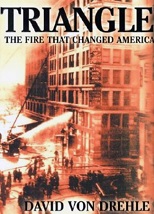 During my first semester at the John Jay College of Criminal Justice many years ago, I attended a class in the field of fire science as part of my graduate degree track. In the class, we, were required to study one of the deadliest fires in New York City history: the Triangle Shirtwaist Factory fire on March 25, 1911. Our professor warned us that the story was deeply disturbing and that the detailed descriptions of the victims would be beyond grisly. However, he also explained that as part of the basis for a career in fire protection, we needed to understand the life safety code and the stories of how and why fire protection has continued to advance. Today, nearly twenty-three years later, I still recall the fire and its impact on workplace safety. But I decided to read this book by David Von Drehle to revisit the fire and perhaps learn something I did not know previously. And what I found within its pages, is a story much longer story than the one I had learned of over two decades ago. And similar to when I first read about the fire in college, I also felt chills go down my spine this time around.
  In the autumn of 1929, between the months of September and October, the world was plunged into financial uncertainty as stock markets in New York City and other places saw a massive devaluation of stocks and bonds. Some investors lost millions in the crash and others less financially secure, saw nearly their entire market portfolio crumble before their eyes. In the wake of the crash, America plunged into the great depression that spread misery and despair across the nation for several more years. The crash remains to this day, one of the greatest financial disasters in history. However, its causes are still up for debate and there is no single reason for the catastrophe but numerous factors did combine to bring the economy to a grinding halt. Authors Gordon Thomas and Max Morgan-Witts have studied the crash and tell the story here about the “day the bubble burst”.
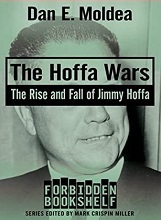 The disappearance of James Riddle Hoffa (1913-1975) still captivates audiences as shown by the success of Martin Scorcese’s
  FREETHINKING BIBLIOPHILE
You must be logged in to post a comment.