
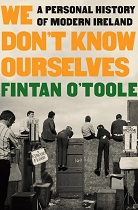
 In February 2016, I visited Dublin, Ireland for the first time so that I could see for myself why this small country was so popular. In my hometown of New York City, Irish culture can easily be found. The police and fire departments have long history of Irish men and women who served as first responders in the “city that never sleeps.” And if you are in search of a drink and meal, a good Irish pub is hard to beat. As for my personal experience abroad, I fell in love with Dublin but I regret not having a better understanding of Irish history at that time. In the years that followed, I began to consume books on Ireland and the conflict known as “The Troubles”, being careful to read material from both sides of the matter. Regardless of how much I have read, I can see that there are stories still untold or in some cases, unknown to those on my side of the Atlantic Ocean. Fintan O’Toole is a native son of Ireland and this biography was included in my list of weekly recommendations. The book caught my attention and I knew I had to read it. It suffices to say that I received more than I could have asked for, and this book is a treasure.
O’Toole’s story begins in 1958 but the author discusses momentous events in world history that shaped his childhood in Ireland. World War II had ended thirteen years prior, and the Korean War had entered a ceasefire only five years earlier. And as we can see in the book, Ireland was still years away from catching up with the rest of the world. In fact, what O’Toole says about basic household needs in the wake of World War II is revealing. Even more telling are the restrictions in place regarding women’s rights, reproduction, and “exposure” to the rest of the world. Frankly, Ireland was in its own protected bubble. But slowly, we see things change as O’Toole takes us through the years in which Ireland evolved. But before we reach the point where conservative Ireland becomes liberal, the author takes us into the dark parts of Ireland’s history as the nation struggled with its own identity.
I would like to point out that this book is not about the Troubles. Of course, O’Toole discusses the conflict, but he did not live in Ulster Province nor was he involved with the Irish Republican Army (“IRA”) or any Ulster volunteer forces. However, his father makes a statement in the book about the Troubles that showed keen foresight. And when the Troubles do start, the violence that ensues is heartbreaking, but only a fraction of the chaos which took place during those years. There are books available which do go into the IRA and Ulster battle more deeply. Two that I recommend are Patrick Radden Keefe’s ‘Say Nothing: A Story of Murder and Memory in Northern Ireland‘, and ‘UVF: The Endgame’ by Jim Cusack and Henry McDonald. And if you are in search of a biography of someone that was there, I recommend ‘Nothing But an Unfinished Song: The Life and Times of Bobby Sands’ by Dennis O’Hearn.
Readers should beware that there are dark parts of the story which do not relate to O’Toole himself but to the nation in general. It is impossible to discuss Ireland without acknowledging the role of the Catholic Church. Its role in the development of Ireland cannot be overlooked. O’Toole is aware of this and discusses its stance against contraception and abortion, and the priests who became sexual predators and used their status to exploit minors. Although there are no graphic descriptions of anything, but the actions of priests and the protection they received will be upsetting. The influence of the Church resulted in a country where birth control was outlawed, abortion was never an option, and basic women’s rights were an uphill struggle. And even more shocking is that this was less than seventy years ago. Today it would be unthinkable to read of these conditions in the United Kingdom, but this was life for Irish women at that time. And there is more to the country’s history as we learn in the book.
It is no secret that America has strong ties to Ireland. The amount of Irish people who left their homes to settle in America is astounding. The author explains the reasons for Irish expats and how society helped create the issue. But was America the answer to everything? Depends on who you ask but it was a step up from the living conditions thousands of families faced in a nation that needed change and to evolve. In June 1963, President John F. Kennedy (1917-1963) made a four-day visit to Ireland, and that historic visit will not be lost on readers. That trip and the excitement it generated is re-told here and is one of the book’s highest moments. But despite the president’s visit, Ireland still had a long way to go. It did eventually change, and in ways no one could have predicted.
Before reaching the climactic moment in which Ireland turns the corner, we also learn more of O’Toole’s life. There is nothing shocking in his own story, but he too grows as Ireland does. However, there is a surreal moment in the book where he is mistaken for a killer. His family life was stable but not without its own challenges parents go through in raising children. As a student, he was familiar with the priests who were later exposed as pedophiles and tells a few stories that sent chills down my spine. Even more disturbing are the parents of the child victims whose reactions I did not expect. Here in America, we had our own experience with it during the priest scandal which erupted in the Northeast, and became the basis for the movie ‘Spotlight‘ starring Michael Keaton and Mark Ruffalo. It is a good film but not easy to watch.
One of the book’s strongest points is the author’s discussions about the corruption within Ireland and how politicians and scandals were exposed. The culture of deceipt created a weird contradiction in which women were expected to be pristine while being exploited by those in power who found themselves embroiled in sex scandals that made my eyes roll in disbelief. The hypocrisy is astounding. However, Ireland was changing and through the author’s eyes we see hope. The Northern Ireland Good Friday Agreement in May 1998 was a significant step in establishing peace but the back story is very interesting, and O’Tool provides commentary on the peace process and the role of United States President William J. “Bill” Clinton. Following the agreement, more is in store for the reader and the book culminates with significant strides made on the issues of abortion and the LGBT community which remained an open yet guarded secret in a county over ninety percent Catholic. The events are historic but what O’Toole explains about the voter demographics regarding abortion proves that people can change. And for Ireland, the only way to move was forward.
O’Toole’s biography is not only his story but a thoughtful and fascinating account of how a country went from being ultra conservative to one of the most liberal places in Europe. Of course, the men and women Ireland have not forgotten its past and that is why they continue focus on its future. If you have visited Ireland and wanted to know more about the country, this is a powerful addition to any library. And if you are Irish, you may learn of things never discussed at the dinner table. Highly recommended.
ASIN : B08X96MBQ8
 The conflict in Northern Ireland known as “The Troubles” claimed over thirty-five hundred lives and brought the
 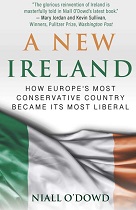 In April 1916, Irish Republicans used the Easter holiday week to launch an insurrection against British rule in Ireland. Through the British regained control of Dublin and later conducted executions of selected participants, the uprising stands to this day as a pivotal moment in the movement for a united Ireland. When I visited Dublin in February 2016, I took a moment to observe murals dedicated to Irish history. I realized that the Ireland I was visiting had changed since the visit of U.S. President John F. Kennedy (1917-1963) in April 1963. Ireland was once known was the most conservative country in Europe but had now become the most liberal. As I walked the streets of Dublin, I heard accents from countries throughout the world and the diversity of languages reminded me of my hometown, New York City. But how did Ireland undergo such a drastic change? The answer can be found in this book that captures an important aspect of Irish history.
 Joseph P. Kennedy, Sr. (1888-1969) frequently reminded those he knew that his ancestor had come to America to escape the “potato famine” in Ireland. While Kennedy was certainly well versed at re-writing his family’s history, the famine did indeed exist and caused death and destruction across southern and western Ireland. I had known of the famine and it resulting in the mass exodus of Irish families who made new lives in North America. However, there was much about the famine that I did not know and felt that this book was the perfect choice to learn about a historical event that changed Irish history. Those of you who follow this blog might recall some of the reviews I have posted regarding the conflict in Northern Ireland known as “the Troubles”. Here, I am shifting gears a bit and taking a step back further in time. And the first question I had for myself before reading this book was just what exactly did happen during the famine? Author Susan Campbell Bartoletti provides the answer to that question and a wealth of information that will allow any reader of this book to fully understand the cause of the famine and the events that transpired.
  FREETHINKING BIBLIOPHILE
You must be logged in to post a comment.