
 On November 25, 1963, my mother prepared to celebrate her birthday, but everyone knew there would be little joy that day. While my mother prepared herself for that day, officials in Washington were making the final adjustments to the funeral of President John F. Kennedy (1917-1963). In Texas, the family of Lee Harvey Oswald (1939-1963) also made their adjustments to his funeral after he was shot and killed while in Dallas Police custody by nightclub owner Jack Rubenstein (1911-1967), known more commonly as Jack Ruby. Over the years, my mother has spoken about that day and has always said that it was the saddest birthday she can recall. The sorrow and tear-streaked faces of those around him are images that have been permanently embedded into my father’s memories that are still intact six decades later. Kennedy’s murder will continue to serve as a topic of debate but what is rarely discussed are his reasons for visiting Dallas and the warnings, he received not to travel to a city known for right-wing activity. Author William Manchester (1922-2004) was asked to author a book covering the Dallas trip from start to finish by former first lady Jacqueline (“Jackie”) Kennedy Onassis (1929-1994). And this account is a thorough explanation the five days in which America experienced the death of a president.
Manchester’s book is not an examination of the crime itself but focuses on the Kennedy party as it left Washington and somberly returned home with a fallen leader. Regarding the assassination, Manchester subscribes to the lone gunman theory but keeps Oswald’s story to a minimum. The book keeps its focus on Kennedy and what was left of his administration after the events in Dealey Plaza. To say that there was mass confusion after Kennedy’s murder would be an understatement. Frankly, all hell broke loose, and no one seemed sure of the procedure during a situation that called for instant responses. Shock consumed everyone but as we see in the book, few should have been surprised. Manchester did a thorough job of capturing the political turmoil as Kennedy sought to diffuse an inter-party battle between Senator Ralph Yarborough (1903-1996) (D-TX) and Texas Governor John Connally (1917-1993). A successful intervention by Kennedy would have paved the way for the presentation of a united Democrat front heading into the 1964 election. But those plans died with Kennedy on November 22, and I am sure that following the assassination, Yarborough must have realized how close he came to being gunned down had the squabble not resulted in him being forced to ride with Vice President Lyndon B. Johnson (1908-1973). The past comes to life through the author’s masterful storytelling in which the main characters assume their positions in a tragedy we know is unfolding.
Because the book is a re-creation of the past, there does exist the possibility that certain dialogue may have been added and/or changed. Manchester did conduct extensive research for the book, and it is my belief that the book is correct. However, it should be noted that Jackie did not approve of the first manuscript and asked Manchester to amend it. The completed manuscript that resulted in this book is admirable, but I did notice things that struck me as odd. The murder of Dallas Police Officer J.D. Tippit (1924-1963) receives little attention in the story and is mentioned in passing. I also found statements from the author regarding Oswald’s alleged guilt to be slightly misleading. Assassination researchers will notice these things instantly. In Manchester’s defense, the book was not intended to be a critique of the crime or the Warren Commission. His assignment was to cover the Kennedy group from start to finish and in that regard he succeeded. But to be fair to the historical record, I belief assertions that Oswald was guilty are open to debate as there are still things about his life that remain a mystery.
After chaos breaks out in Dealey Plaza, the scene shifts to Parkland Hospital. Again, Manchester captures the atmosphere perfectly and supplies a thorough discussion of the panic that ensued following the shooting. Despite first reports, those closest to Kennedy knew the head wound was fatal. However, doctors did what they could before pronouncing him dead. Following the official declaration of death, the book produces a somber feeling as the group must take the body home and prepare for a funeral. The new Commander-In-Chief, Lyndon Johnson, comes across quite differently to what he has been portrayed as elsewhere. Grief consumed the presidential party and as we see in the book, each person managed it differently. This is another area where the book excels. The names of aides and officials will be familiar to readers but here they are parts of the story that do not produce an uplifting conclusion. I can only imagine the thoughts they had as the realization that Kennedy had just been murdered settled in. After making a rough departure from Parkland Hospital and Love Field, Air Force One is soon airborne and on its way back to the nation’s capital. But the story is far from over.
After arriving in Maryland, an autopsy is ordered, and Manchester re-tells the story of the arrival from Dallas. He does not discuss forensic aspects of the autopsy in detail but keeps the focus on the new widowed Jackie and the task of burying Kennedy. At this part of the story, Attorney General Robert F. Kennedy (1925-1968) becomes more of a presence as he aides his sister-in-law with the challenging task of saying goodbye to Jack. Readers interested in the funeral preparations and decisions that produced what was seen on television will appreciate this section. There is no joy to be found but what can be appreciated are the painstaking decisions and tasks executed by those who loved the late president. The impact of Kennedy’s death cannot be understated, and Manchester again captures the public sentiment and worldwide sadness in the wake of the assassination. The book’s inevitable conclusion slowly approaches as the funeral procession marches towards Arlington National Cemetery. The events seen on television screens are explained as a backdrop before Manchester closes the discussion.
Although I did find misstatements in the book, I still enjoyed reading it. Manchester brilliantly chronicled the Texas trip and the devastating fallout. Conspiracy theorists and researchers will know the story inside and out but for others who are not familiar with the Kennedy murder, this book is a reliable source of information about the reasons for the trip, the mood behind-the-scenes and the extraordinary effort needed to bring Kennedy home and restore order to Washington. There are things about the assassination we may never learn but Manchester’s work is a crucial part in keeping the historical record intact.
ISBN-10: 0316370711
ISBN-13: 978-0316370714
 I have had many discussions with my father wherein he recalled his memories of the Cuban Missile Crisis in October, 1962. He explained with vivid detail how he and his classmates had to take part in daily air raid drills due to the increasing threat of a nuclear holocaust. The discovery by U.S. intelligence of Soviet missiles on Cuban soil, accelerated what was already a tense conflict. Today we refer to it as the Cold War but there were many things taking place that were anything but cold. And as former Secretary of Defense Robert S. McNamara remarked in Errol Morris’
  Peace is a state of being that mankind constantly seeks to achieve even as tensions flare between nations making the threat of armed and nuclear conflict a very real possibility. The detonation of the bombs over the Japanese cities of Hiroshima and Nagasaki in August, 1945, changed modern warfare permanently. Man had entered the nuclear weapon era and the fear of complete annihilation reached even the most hardened leaders of the free world. In the wake of World War II, the United States and Soviet Union took center stage in the battle for global supremacy. The Cold War ushered in a new level of caution as Washington and Moscow became increasing distrustful of each other.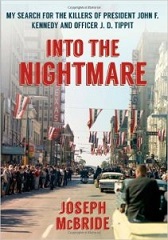
 On July 21, 1964, New Orleans police officers responded to a call about a mysterious fire in an apartment complex. When officers arrived and entered the apartment, they found the body of Dr. Mary Sherman (1913-1964), a noted orthopedic surgeon and cancer researcher. The details surrouning her grisly demise are hair raising, chilling and also mystifying. The murderer was never caught. Edward T. Haslem is a New Orleans native whose father was a close acquaintance of Sherman. In fact, his father was asked to identify her remains and the incident left him visibily shaken as Haslam captures the below passage:
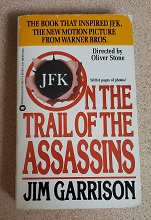 I decided to use the spare time at hand to reorganize my book case and other shelves upon which sit the other literature that I have come to love and appreciate. While perusing the books, I found this book by former New Orleans District Attorney James “Jim” Garrison (1921-1992) who is remembered for bringing the only public trial in the murder of President John F. Kennedy (1917-1963). In 1992, Warner Brothers released Oliver Stone’s
  One of the most important questions surrounding the assassination of President John F. Kennedy (1917-1963) has always been why was he murdered? We do have the official explanation that Lee Harvey Oswald (1939-1963), a former Marine and attempted defector to the Soviet Union, murdered Kennedy due to his own deranged thoughts which no one has been able to accurately explain. And although he was murdered before he could stand trial in a Texas courtroom, Oswald remains labeled as Kennedy’s assassin. But to understand the murder of any politician, it is necessary to examine the political and social climate in existance at the time. There are many clues to why Kennedy was murdered if we are willing to look. Douglas Horne served on the Assassination Records Review Board, the organization that was developed to examine the voluminous recorsds produced in response to the President John F. Kennedy Assassination Records Collection Act of 1992. The act was created as a result of Oliver Stone’s groundbreaking film
  I recently reviewed Jacob Hornberger’s
  The unexpected increase in free time at my disposal has provided me with ample opporunity to increase the amount of reading material at my disposal. I decided to take another look at the murder of President John F. Kennedy (1917-1963), whose death remains one of most puzzling crimes in American history. The official narrative is that on November 22, 1963, lone gunman and former Marine Lee Harvey Oswald (1939-1963) fired three shots at Kennedy’s motorcade from the Texas School Book Depository, fatally wounding Kennedy and severly wounding Texas Governor John Connally (1917-1993). The case seemed open and shut with Oswald forever being labeled as the lone nut or lone gunman. On the surface, the case seems simple but there were many strange things that took place that day after Kennedy died that are not only mind boggling but also deeply disturbing. One of them is the handling of his body and the autopsy that was conducted at Bethesda Naval Hospital.
 In
In  FREETHINKING BIBLIOPHILE
You must be logged in to post a comment.