
 On May 14, 1948, World Zionist Organization executive head David Ben Gurion (1886-1973) proclaimed the Declaration of the Establishment of the State of Israel, formally establishing a Jewish state. To Zionists, the accomplishment was the fruit of their labors, but in Washington, D.C., there was cause for concern. Officials in the State Department witnesses one of their greatest fears come true and accepted the reality that the Middle East would never be the same again. It is easy to make the mistake of believing that the term Jewish is monolithic, but the reality is far different. In fact, as this book shows, within Judaism there are sharp divisions over faith, identity, and ideology. A hotly contested issue is Zionism, the driving force behind the creation of a Jewish state as envisioned by Austrian Jewish journalist Theodore Herzl (1860-1904), who is considered to be the father of Zionism. American foreign policy makers understood that the changes to come in Palestine would not be warmly welcomed and would inflame tensions between the new settlers and Palestinians who called the area home. With hindsight, we know that they were eventually overruled and today, conditions in the region remain tense. If officials knew this would happen, then why did they agree to the partition? Author Alison Weir traveled to Israeli and Palestinian territories as part of her research into one of the most important questions of the twentieth century.
As per the author’s words, the book originally started as an article that evolved into the larger story presented here. By no means is the book a complete discussion of the Zionist movement or the creation of Israel. Both subjects are far too extensive and intricate to cover in one book. But Weir does provide the right amount of information to peel back the layers of a story hidden from the American public. It cannot be overstated how crucial World War II was to the creation of Israel. Jews who had the means available fled Germany before the war. Those left behind faced an uncertain future that included a horrific death for millions of men, women, and children. Jews who survived were determined to never let it happen again. The Zionist cause has existed far longer than World War II. In fact, the location for a Jewish state changed more than once as detailed in the book. However, the movement initially struggled to gain the support of American Jews, highlighting the divisions that existed.
The situation in the Gaza strip is the end result of the story at hand. But there is a darker aspect of the account to be found within that challenges the idea that I am my brother’s keeper. What Weir reveals is both shocking and disturbing. To those in power, the means justified the ends, but the revelations also reveal sobering truths about Israel’s creation. And the interactions with officials of the Third Reich are sure to make the hairs on your neck stand up. Further, the support for the Zionist cause here in America is examined and here we see the origins of groups committed to the cause of a Jewish state. Yet even as the movement gains momentum, Washington is still hesitant to support partition for reasons addressed by the author. However, President Harry S. Truman (1884-1972) eventually reverses course and supports the partition. An explanation is given but I suspect there is more to his decision we may never know. Truman was a seasoned president by that time and would have known the political impact of partitioning and the pushback from the Arab world. If he did not, I am sure the Joint Chiefs of Staff would have addressed it due to their concerns revealed in the book. Truman may have agreed to the plan against his better judgment as well.
Every movement has collateral damage, and the Zionist cause is no different. Non-Zionist Jews found themselves caught in a difficult position and the pressures they faced also form part of the discussion. And others who were receptive to the Zionist cause but also cautious about the reputation of America abroad and stability in the Middle East also found themselves under scrutiny as allegiance to the movement was questioned. The debate about Zionism is larger than this book but continues to this day among Jews. I should point out that at no point in the book does Weir challenge the right of Israel to exist. The book is a lesson in history that is not taught in schools. History is not always pleasant and filled with stories that are at times unsettling. But they are crucial to understanding how our world functions today.
The book is short, but the author does provide an extensive list of further reading which includes discussions on Israel, Zionism, and the Palestinian people. This is the not the final word on Zionism, but it is a good place to start.
ASIN: B00J0LXYLM
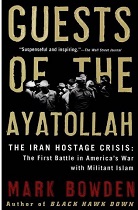 On November 4, 1979, university students seized the U.S. Embassy in Tehran, Iran and detained more than fifty U.S. Government employees. Though some were later released, the majority remained behind for four hundred forty-four days in what is known as the Iran Hostage Crisis. In 1953, Mohammad Mosaddegh (1882-1967) and the National Front Party gained political power in opposition to Mohammad Reza Shah (1919-1980). A twice elected member of Parliament, Mossadegh emerged as a popular figure but within days of the Shah’s exile in August of that year, Mossadegh was removed in a coup sponsored by the British Government and the United States. Mossadegh’s removal and the Shah’s return, inflamed tensions and in November 1979, Iranians decided that America must go. This is the story of the hostage crisis from start to finish in an account that provides a thorough discussion of America’s foreign policy mistakes and Iran’s inner struggle between traditionalism and modernity.
 FREETHINKING BIBLIOPHILE
You must be logged in to post a comment.