
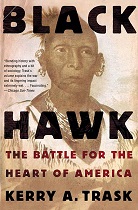
 While reviewing recommendations from Bookbub, I came across this book from author Kerry A. Trask about Black Hawk (1767-1838), a war chief in the Sauk tribe in North America. Today their descendants can be found in the States of Iowa, Kansas, Nebraska, and Oklahoma. The title grabbed my attention, and I began to ask myself how much I knew of Black Hawk and the Sauk people. I soon realized that I knew extraordinarily little and decided to make the purchase and rediscover a piece of American history. And what I found is a haunting yet important book about our nation’s past.
Prior knowledge of the Sauk tribe or the Black Hawk War of 1832 is not necessary to appreciate this book. The author provides a thorough explanation of Sauk history. The only trouble I initially had was keeping a mental picture of locations in the story. A map nearby may be a useful tool and keeping track of their movements, particularly after the treaty signed between Sauk representatives and the U.S. Government in 1804. This agreement would prove to be the pivotal moment in the story and set the Sauk on a collision course with the United States military. However, America was also going through growing pains, and the author discusses the horrid shape of the army in the early 1800s as confrontations with the native tribes increased with deadly consequences.
It should be noted that the book is not an easy or lighthearted read. In fact, there are parts of the story which will be uncomfortable. There are no glorious moments or riding off into the sunset. This story is vivid, raw and touches on a dark time in American history which should be known, understood, and never forgotten. That does not mean that the book is a story of American aggression against native tribes. While there are moments in which foresight would have helped, actions by the native tribes are equally as haunting and focus on the life and death situations which occurred frequently outside of the borders of the United States. I was mindful that in 1804, there were only seventeen states in the union and territory further west was “unorganized”. I say that loosely due to the fact that British and French fur traders continued to operate outside of America’s borders and further north in Canada.
After learning about the Sauk way of life, the story changes gears when Indiana Territory Governor and future President William Henry Harrison (1773-1841) signs the Treaty of St. Louis with Sauk representatives in November 1804. Each side had their view of the treaty, and the author explains the series of events for the reader to decide. Strangely, the Sauk returned years later and agreed once again on the conditions offered. However, Black Hawk and the older leaders decided that they would not surrender their land and the arrival of white settlers in Sauk territory set the stage for dark acts of retribution which Washington could not ignore. Readers familiar with America’s wars with the “Indians” will not be surprised at the descriptions of violence towards settlers. The text is grim, and emphasizes the risk taken by those venturing into unknown territory. While I read, I was reminded of the Fort Parker Massacre in 1836, discussed extensively in S.C. Gwynne’s ‘Empire of the Summer Moon: Quanah Parker and the Rise and Fall of the Comanches, the Most Powerful Indian Tribe in American History‘, a book which left me speechless. It may be tempting to view the natives as “savages”, but it is imperative to remember that they lived in a world far different from Europeans and had their own customs in regard to conflict resolution and protection of their territory.
The Sauk had been forced to move west in 1831 by military intervention but decided to re-claim their land in 1832. And here is where things escalate. Our ringside seat allows us to see the suspense build as Black Hawk and the association of Fox and Kickapoos, form their war council in response to increasing pressure from the United States. And once the military campaigns begin, the heat is turned up and the months between April and August of 1832 would be remembered for the bloodshed and heartache as the Black Hawk War claimed its victims. Early in the campaign, the native tribes maintain an advantage over American troops, but the military might of the United States and a Iowa County militia Colonel Henry Dodge (1782-1867) would prove to be too much. Interesting, two highly important figures in American history make an appearance in the story: future President Abraham Lincoln (1809-1865) and future Confederacy President Jefferson Davis (1808-1889). This caught me completely off guard and added more intrigue to the story. The climatic Battle of Bad Axe would be the final nail in the coffin of the Sauk but Black Hawk’s story was far from over. However, he could not run forever and eventually accepts defeat, but the story takes a few unexpected turns. Following his death in 1838, the story becomes even more bizarre and disturbing as post-mortem events play out.
This book is a gem, and I did not anticipate the impactful story contained within. It is well-researched, well-written and a frank but enlightening discussion of America’s past. A friend once told me that history should never be erased but always understood. The indigenous tribes of North America endured heartache, separation, betrayal, and death as the United States expanded its borders. However, the tribes also battled each other and committed acts of unspeakable violence against settlers looking for greener pastures. History can be uplifting but it can also be sobering and haunting. As I stated before, there is no glory to be found in this raw look at the past. But we can find value in understanding the story of the Sauk and all that they lost.
ASIN : B00GET19F6
Publisher : Henry Holt and Co.; First edition (December 24, 2013)
 FREETHINKING BIBLIOPHILE
You must be logged in to post a comment.