

“The first lesson a revolutionary must learn is that he is a doomed man.” – Huey P. Newton (1942-1989)
On August 22, 1989, former Black Panther Party co-founder Huey P. Newton was shot and killed on a street corner in Oakland, California. His death was sudden and violent, and a reminder that the streets are unforgiving. Newton’s notoriety as a representative of Black voices during the Civil Rights Movement earned him a place on the watchlist of the Federal Bureau of Investigation (“FBI”). To some Newton was a dangerous radical working to destroy America but to others he was an icon who had the courage to stand up to a system in need of an overhaul. Regardless of opinion, Newton was only one of many people who took the streets determined to change America by any means necessary and were not afraid to use violence. Sadly, that meant collateral damage and fear during an era author Bryan Burrough calls days of rage. This is the story of the under radical movement in the United States which produced some of the most dangerous figures this nation has ever seen.
The book is extensive but focuses on several main organizations whose names are well-known. The first is Weatherman a/k/a The Weather Underground which is credited by the FBI to having set off twenty-five bombs in U.S. Government buildings, police stations and the office of the California Attorney General. And its stand out star was Samuel J. Melville (1934-1971) whom we learn of in the story, along with Bernadine Dohrn who ironically is a retired law professor. I did not know about Melville or Dohrn prior to reading the book nor was I familiar with Weatherman. However, by the time I finished the book I was firmly aware of its existence, its actions, and its dark legacy. Burrough delivers on the goods and takes us inside Weatherman and the anarchy it caused. But this is only the beginning in a long book that is nothing short of a roller coaster ride.
As a primer, the author discusses the Civil Rights Movement which sets the stage for the violence to come. However, what is interesting is that neither Dr. Martin Luther King, Jr. (1929-1968) nor Malcolm X (1925-1965) were “extreme” compared to the others figures the author discusses. Dr. King had always preached non-violence and Malcolm strongly believed in self-defense by any means necessary. Neither led any violent raids or set off bombs but the cause they fought for, believed in and died for, was the proof others needed to escalate resistance to levels which caught the attention of the White House. The Black Panther Party found itself on the radar of the FBI and in due time the bureau would make use of its COINTEL program to destroy all organizations it deemed enemies of America. Newton and his colleagues would fall victim as would others whose lives are exmained in the book. The FBI was focused but the underground radical movement was growing exponentially. And as the story progresses, the suspense heightens, and the tension builds as radicals attempt to turn the United States upside down. Violence, sex, drugs, fame and calls for revolution form a potent mix from which both charasmatic and outlandish figures emerged in their quest to change the nation permanently.
I mentioned earlier that there are several organizations discussed in the book. Aside from Weatherman, there is Donald “Cinque” DeFreeze (1943-1974) and the Symbionese Liberation Army (“SLA”) whose story on its own is surreal. Of course, it cannot be told without addressing the abduction and enlistment of Patty Hearst. Her story has been told by others, and it is thoroughly presented here as well but I could not help but shake my head in disbelief DeFreeze’s bizarre rhetoric and his ability to attract followers. The downfall of the SLA and its tragic finale left me with chills, but the book was far from over. In fact, while the SLA is conducting its unorthodox fallacies, members of Weatherman are still moving around America. And the chaos they created would be amplified by more extreme radicals whose names are synonymous with bank heists and gun battles with law enforcement.
The name Raymond Luc Levasseur did not stand out at first but older readers may be familiar with his story. However, that changed as the story progressed and the organization to which he belonged, the United Freedom Front, made itself known in a string of bank robberies and getaways straight out of Hollywood fiction. A tour of duty in Vietnam and racial discrimination had help shape Levasseur into the radical the FBI wanted off the streets as soon as possible. But that did not happen and the story of how Levasseur evaded capture is one of the more fascinating parts of the book. He was not alone and had a family to support and had been joined by other adults. Their ability to pack up and leave on a moment’s notice is surreal and their ability to evade capture was almost flawless except for one crucial mistake. To be fair, bombings were occurring with such frequency that law enforcement officials struggled to keep up and keep track. And just when it seemed that one group might be on the verge of extinction, another rose to the occasion.
My father had previously told me the story of William Morales, a member of the Fuerzas Armadas de Liberación Nacional Puertorriqueña (“FALN”) who had severely injured himself while making a bomb in his Queens apartment. The accident is gruesome but there is more to the story than my father had explained. In fact, Morales’ s disfigurement and escape from justice is unbelievable due to the limited use of his hands and impaired vision. His disappearance from Bellevue Hospital left me speechless. Despite a manunt and nationwide attention, Morales remained on the loose and is still alive today, living in Cuba along with another radical in our story, Joanne Chesimard a/k/a Assata Shakur who remains a wanted fugitive by the FBI. The reasons for her status as a fugitive at large are explained in the book, in particular the shootout on the New Jersey Turnpike on May 2, 1973, in which Trooper Werner Foerster was shot and mortally wounded. The full story of the traffic stop, shootout and her conviction are too extensive for this book but the author weaves into the narrative without breaking the pace or weakening its intensity. Morales and Shakur will likely remain in Cuba for the rest of their lives but there was another Shakur who did not fare as well.
If you are familiar with the late rap star Tupac Shakur (1971-1996) you will be familiar with the story of his step-father Mutulu Shakur (1950-2023), a member of the Black Liberation Army whose actions are some of the darkest parts of the book. Shakur’s descent into radicalism sets him on a dark path destined for destruction. And that point is driven home when Shakur and his co-conspirators rob a Brinks armored car at the Nanuet Mall in Nanuet, New York on October 20, 1981. The full story of the robbery is too intricate for a blog post, but I was glued to the book as the drama unfolded. It is mind blowing and horribly tragic. The robbery left two Nyack police officers and an armed guard dead, and resulted in Shakur serving forty years in prison before being released for health reasons in December 2022. The Brinks robbery remains etched in New York State history and is a chilling chapter to a book that pulls no punches. Burrough gives us an uncut look into America’s haunting past and the years in which armed struggled was a calling card for aspiring young revolutionaries across the country.
Burrough’s book is long but it is beautifully written, well researched, and powerful. The history contained within the book is not pleasant but what the author discusses can serve as reminders of how far America has come and where it should never return to. If you lived through these years and recall the level of danger which existed, this book will bring back profound memories. I intend to discuss it with my father who has always said that the 1960s and 1970s were scary times because of the threat of nuclear war, assassinations, social unrest, revolution, and the rise of serial killers. Many of the figures in this book are now deceased and others well into their senior years are no longer on the streets planning acts of violence. But they have not forgotten theirs nor has America. Their legacies are complex depending on who you ask but the fact remains that hope move side by side with fear as the radical underground grabbed the country’s attention. This book is an invaluable tool in understand how and why the radical underground came to be.
ASIN : B00LFZ84PC
Publisher : Penguin Books (April 7, 2015)
 In his renowned book titled ‘
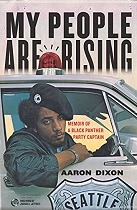 On August 22, 1989, former Chairman of the Black Panther Party for self-defense Huey P. Newtown (1942-1989) was shot and killed in Oakland, California at the early age of forty-seven. The violent ending to his life is a reminder that the streets are unforgiving, and should one choose to embrace them, death is a constant threat. In prior years, Newton rose to fame with party co-founder Bobby Seale as the organization spread across America and became an unavoidable presence, catching the eye of Washington, D.C. The Panthers became so feared that former Federal Bureau of Investigation (“FBI”) Director J. Edgar Hoover (1895-1972) said “the Black Panther party, without question, represents the greatest threat to the internal security of the country.” Hoover refused to see that the Panthers had become an image solidarity and masculinity to thousands of Black youths who had seen and suffered racial discrimination. In the Pacific Northwest, a young man named Aaron Dixon listened to a speech by Bobby Seale and knew from that point on that he was destined to join the Black Panther Party. This book is his memoir of life on the West Coast and the ten years he spent as a Black Panther Party Captain.
 FREETHINKING BIBLIOPHILE
You must be logged in to post a comment.