
 In his renowned book titled ‘Revolutionary Suicide’, Huey P. Newton (1942-1989) began by saying “the first lesson a revolutionary must learn is that he is a doomed man”. The prophetic words are haunting for many members and affiliates of the Black Panther Party met untimely deaths or were forced to flee the United States and live in exile. However, the Black Panther Party for Self Defense became part of history and when Bobby Seale and Newton created the organization in 1966, the created something that changed the way Black Americans viewed themselves. The image that comes to mind when one speaks of the Panthers are young black men with leather jackets and rifles. But behind the imposing public facade, the Panthers were brilliant community organizers and had a vision for Black Americans that could have changed the United States. Photographer Stephen Shames began to cover Panther rallies and eventually followed their progression. This book, co-authored with Seale, gives former members of the party a platform to explain their actions and decisions, in a time when America was amid social upheaval.
Instead of a standard account of the party’s creation, rise and demise, the authors here present a collection of interviews that touch on all aspects of the party’s existence. And to my surprise, I learned a few things I did not previously know. The beauty in the book is that readers can see the passion and hard work behind the scenes that motivated the Panthers to help the community. Party members were surely a mixed bag of characters, but at its core, the group and its affiliated chapters were committed to uplifting Black Americans and helping them to become self-sufficient so that they too could live the American dream. But what stood out to me nearly immediately was the age of the members. In fact, Ericka Huggins explains that: “one thing that people don’t understand about the Black Panther Party is that the median age of a party member in 1969 was nineteen years old“. Today we would say they were just kids but in 1966, those kids became adults and were determined to make their mark.
Readers familiar with the history of the party will know of the free-breakfast program which incredibly was deemed a threat by former Federal Bureau of Investigation (“FBI”) director J. Edgar Hoover (1924-1972). It is no secret that Hoover feared and loathed civil rights organizations whom he felt had “communist” influence. And the introduction of the infamous COINTEL program succeeded in breaking up the Panthers but at an inflated cost to the FBI and Hoover’s image in later years. But as I read the book, I was curious about other programs that Panthers initiated not just in Oakland, California, but across America. What I learned was impressive and surprising. One event that stands out is that shortly before his death, Fred Hampton (1948-1969) had reached an agreement with Jeff Fort, leader of the Black P. Stones gang in Chicago that would have struck fear in Washington, D.C. But due to Hampton’s assassination on December 4, 1969, the agreement died out. These events were recreated in the 2021 film ‘Judas and the Black Messiah‘, starring Daniel Kaluuyah as Hampton and LaKeith Stanfield as William O’Neal (1949-1990), the FBI informant who played a crucial role in Hampton’s demise. As the book progressed, it became even clearer to me why the Panthers were feared. It was not so much due to the presence of firearms but rather the knowledge and pride being instilled in Black Americans which was sorely needed following the murder of Malcolm X (1925-1965). Seale himself has said that had Malcolm not been murdered, the Black Panther Party would have never been created.
Eventually, the party began to disintegrate under the strain of infiltration by FBI informants which instilled paranoia and distrust among party members. The fallout is discussed by the participants, but the book is not an examination of why the party failed. It is chiefly a collection of memories, both good and bad. Among the more tragic parts is the death of George Jackson (1941-1971) on August 21, 1971, while incarcerated at San Quentin State Prison in San Quentin, California. The book ends before Newtown’s own death in 1989 but there is a discussion of the Panthers’ legacy and the situation in America which should be of concern to everyone regardless of their background. The Panthers no longer exist as the group they were once known as, but their presence and importance cannot be overlooked. And contained within this book are voices from the people that were there, risking their lives to give all power to the people.
ASIN: B01IDGS5EK
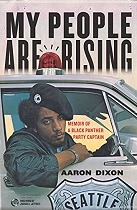 On August 22, 1989, former Chairman of the Black Panther Party for self-defense Huey P. Newtown (1942-1989) was shot and killed in Oakland, California at the early age of forty-seven. The violent ending to his life is a reminder that the streets are unforgiving, and should one choose to embrace them, death is a constant threat. In prior years, Newton rose to fame with party co-founder Bobby Seale as the organization spread across America and became an unavoidable presence, catching the eye of Washington, D.C. The Panthers became so feared that former Federal Bureau of Investigation (“FBI”) Director J. Edgar Hoover (1895-1972) said “the Black Panther party, without question, represents the greatest threat to the internal security of the country.” Hoover refused to see that the Panthers had become an image solidarity and masculinity to thousands of Black youths who had seen and suffered racial discrimination. In the Pacific Northwest, a young man named Aaron Dixon listened to a speech by Bobby Seale and knew from that point on that he was destined to join the Black Panther Party. This book is his memoir of life on the West Coast and the ten years he spent as a Black Panther Party Captain.
 FREETHINKING BIBLIOPHILE
You must be logged in to post a comment.