Fire in the Lake: The Vietnamese and the Americans in Vietnam -Frances Fitzgerald

Last summer at a family cookout, I noticed my uncle who had served in the Vietnam War, wearing a baseball cap which indicated that he was a veteran of the conflict. It was the first time I had seen him wear anything connected to Vietnam or the military. As I watched him, I asked myself why it took so long for Vietnam veterans to find acceptance and peace. He is from a generation which fought in a deeply unpopular war that saw America fall short of its stated goal. The official policy was to help South Vietnam withstand communism and survive as its own democratic republic but the reality on the ground was far more complicated. The truth about South Vietnam is a bitter pill to swallow but necessary in understanding the failures which took place. Author and Pulitzer Prize winner Frances Fitzgerald originally wrote this book in 1971 and it was published in 1972, three years before the conflict’s end. But contained in its pages is an insightful discussion about Vietnamese history, French colonialism, and America’s entry into Indochina. And having finished the book, I can say with certainty that it is one the best books I have ever read about the war in Vietnam. 

Fitzgerald did not serve in the military and the book is not written from a soldier’s point of view. Her focus is on South Vietnam, particularly the instability of its government and the complex social structure in Vietnam which western minds struggled to understand. The book excels is explaining how and why the Vietnamese lived as they did. These lessons seemed to have been lost to officials as the conflict heated up. Readers do not need prior knowledge of the war to find value in this book. In fact, no prior knowledge is needed. Fitzgerald covers the country’s history, the French occupation, and the buildup to American intervention. Her narrative is smooth and flows  beautifully, which makes the book easy to read and engaging from start to finish. 

I have read and reviewed several books on Vietnam, each with its own approach to the war. But the book I found to be the closest in comparison to this discussion by Fitzgerald is Fredrik Logevall’s ‘Embers of War: The Fall of an Empire and the Making of America’s Vietnam‘, which I strongly recommend for anyone interested in the war’s history. However, I believe Fitzgerald’s account in regard to South Vietnam is absolute gold. And the nexus of President Ngo Dinh Diem (1901-1963), brother Ngo Dinh Nhu (1910-1963) and sister-in-law Madame Nhu (Trần Lệ Xuân)(1924-2011) is explored thoroughly in one of the most thorough explanations I have read.  This trifecta of power would affect Vietnam in many ways and haunt the American effort in the years that followed their removal from power in 1963. But this was no secret in Washington as we see in the book. Readers may also want to take a look at the book by former Secretary of Defense Robert S. McNamara (1916-2009) ‘In Retrospect: The Tragedy and Lessons of Vietnam‘, which is a fair analysis of the failures by officials in handling the conflict. McNamara is seen as a villain by some, and the war’s chief architect by others. His role and errors are discussions for another time, but his book is still a valuable source of information. 

Prior to American troops landing in Vietnam, warnings had been issued by both foreign governments and the United States intelligence apparatus. A young and well-traveled senator from Massachusetts named John F. Kennedy (1917-1963) was convinced that a war in Indochina was a disaster, but he would be forced to confront the matter himself when he was elected to the presidency in 1960. But despite numerous warnings, the stage was set in the wake of the Gulf of Tonkin incident in August 1964. President Lyndon B. Johnson (1908-1973) asked for and received congressional authority to use military force in Vietnam.  In four years, the war became an “albatross” around his neck and played a significant role in his decision not to seek or accept the Democratic nomination for the 1968 presidential election. In Vietnam, American military commanders continued to face an enemy encouraged by deception and a mindset that seemed inexplicable to the west. And added to the mix is the National Liberation Front (“NLF”) whose goal was to remove the Diem regime from power and seek reunification with North Vietnam. As I read, I found my view of the conflict changing as I understood more about the NLF and the dislike of the Diem regime. Further, the author highlights the degradation of Vietnamese society due to its American occupiers. This part of the book may be difficult for some to accept, but what the author discusses is crucial in understanding why South Vietnam could never stand on its own. 

As the war rages on, American officials and military commanders are forced to accept uncomfortable truths. Publicly, the belief in American victory remained strong, but behind closed doors, Washington knew that the war was not going as planned and victory not as certain as one would believe. And the Tet Offensive in January 1968, was a sobering wake up call for anyone who assumed the war would be over soon. Fitzgerald discusses the offensive and its impact here as well, and she also pulls no punches regarding American atrocities in Vietnam. The war had turned Indochina into hell, and she drives home the point that instead of liberating South Vietnam, America flipped it upside down in ways which officials had not anticipated. The Vietnamese people had their lives upended for a cause which many of them had no strong feeling in support of.

Following Johnson’s decision not to see re-election in 1968, a new president arrives and inherits the war in Vietnam. The administration of Richard M. Nixon (1913-1994) would have its own difficulties with the raging infernor which he pledged to bring to an end. But he would soon find out that doing so was far more difficult than that implied. The war’s expansion into neighboring Cambodia set off alarm bells and revealed the uncomfortable truth that the nightmare in Vietnam was far from over. The heartbreaking saga plays out in the book but ends in 1971 when Fitzgerald finishes her analysis. Hauntingly, her words proved to be prophetic and the departure of American forces in 1975 was confirmation that without permanent U.S. involvement, reunification was bound to happen. 

After I finished the book, I sat silently for a few minutes thinking about the war and its many casualties. I thought of my uncle who carries scars from the war, both physically and mentally. In a rare moment of admission, he once told me that people asked him why he had answered his draft call. He never wanted to go to Vietnam but did not have the money or connections to avoid being called to serve. So, he took his draft card and arrived at his assigned location. And several months later, he found himself three thousand miles away in a country he had never seen to fight in a war he wanted no part of. And that is the story of many Vietnam veterans who are still with us today. I can only hope that they receive the acknowledgment and acceptance they have not always been given. If you are a student of the Vietnam War, you will appreciate this book. 

ASIN ‏ : ‎ B0028MM2MM
Publisher ‏ : ‎ Little, Brown and Company (May 5, 2009)
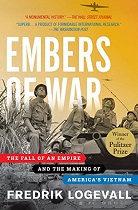
 

Embers of War: The Fall of an Empire and the Making of America’s Vietnam – Fredrik Logevall

LoevallOur resistance will be long and painful, but whatever the sacrifices, however long the struggle, we shall fight to the end, until Vietnam is fully independent and reunified. ” – Ho Chih Minh (1890-1969)
On March 29, 1973, the last American military unit left Vietnam as the war between the United States and North Vietnamese army moved towards its dramatic conclusion. For the first time, America had failed to reach its objective and suffered over fifty-eight thousand casualties. Vietnamese losses were counted at over two million and the nation also faced the challenging task of rebuilding its cities and villages. Millions of veterans on both sides faced a difficult journey as they rebuilt their lives upon return to civilian life. Ho Chih Minh, who died before the war’s conclusion, was vindicated in his belief that Vietnam would one day be reunited. In retrospect, we are faced with the question, why did the Vietnam War take place? Fredrik Logevall, author of JFK: Coming of Age in the American Century (1917-1956), tells the story of the French defeat and how that loss shaped the future conflict between Washington and Hanoi.

Readers should be aware that this book is lengthy, with slightly over nine hundred pages of text. But contained within these pages is the story I should have learned in school. Regarding the Vietnam War, it is accepted that the conflict began with the events in the Gulf of Tonkin between August 2-4, 1965.  However, America’s role in Indochina has a long and complicated history as the author shows here. To set the stage, the author revisits World War II and the Allied effort. This is critical because that conflict changed the world and gave way to future wars in Korea and later Vietnam. The Japanese defeat left a power vacuum which Ho Chih Minh and the Indochinese Communist Party (“ICP”) capitalized on. The ICP was later dissolved in November 1945 after the founding of the Democratic Republic of North Vietnam.  France was alarmed at Hanoi’s actions and embarked on a campaign to reassert its influence over Indochina. Logevall brings the past roaring to life in this account that highlights the early success and the failures that resulted in defeat. But before we reach the conclusive battle at Dien Bien Phu, we must first understand how and why France failed to recapture Vietnam in the First Indochina War (1946-1954).

The story as told by Logevall is filled with critical recreations of the moments that shaped French policy for better and worse. And as the story develops, it becomes clear that the Vietnamese would seek independence at all costs. There were those in France determined to see Ho Chih Minh fail and were willing to look past the ideology that filled the hearts and minds of the Vietnamese.  Curiously, Washington was also watching Indochina closely without taking any direct action. Agents of the Office of Strategic Services (“OSS”) were aware of the doom Vietnam spelled for any country who entered militarily. One of its operatives, A. Peter Dewey (1916-1945), whose story is told here, became an early casualty in a bitter struggle between Western Democracy and Eastern Communist beliefs. Dewey saw the writing on the wall and attempted to sound the alarm. Another OSS officer, Archimedes Patti (1913-1998), also sounded the alarm and takes a significant step in alerting Washington that may have changed history had it been responded to. As I read the story, I could see that experienced officers and politicians knew that Vietnam was a disaster, and the French were going to fail. One of these people was a young politician named John F. Kennedy (1917-1963) who later as president, inherited the Indochina problem from his predecessor Dwight D. Eisenhower (1890-1969). Kennedy appears sporadically throughout the book, and before he is elected to office in 1960.  Eisenhower receives more of the spotlight after taking reigns from Harry S. Truman (1884-1972) whose stance of Indochina remains firmly in place long after his departure early in the story.

As the French and Vietnamese engage in heavy combat, Washington chooses it side and throws it support behind the French. However, the involvement of the United States remains limited and a premonition of how the later battle between American personnel and North Vietnam played out. But the French do have success in the book which had the North Vietnamese on the defensive. The battlefield scenes are on display and the author takes us through them as history plays itself out before the reader’s eyes.  But what the French did not expect is the assistance to Ho Chih Minh by the man who is credited with the French defeat: Võ Nguyên Giáp (1911-2013).  The role of this strategist deeply trusted by Ho Chih Minh should not be overlooked.  His decisions and actions helped to seal France’s fate and the incredible story is told in all the dramatic detail by Logevall who has a knack for adding the right amount of suspense as the story flows. And like the first volume of his biography of Kennedy, the story here flows easily as well, and kept me engaged from start to finish.

It is imperative to keep in mind that the events taking place in the book occur over a period of nine years from 1946 to 1954.  A swift defeat did not happen for reasons explained by the author and the turning tide of French opinion towards Vietnam should have raised alarm bells everywhere including in Washington.  But the truth is that Vietnam was an extension of the Cold War and the obsession with Communist expansion.  The Soviet Union and Chinese Communist Party are also part of the story, and the Korean War is addressed. But despite fears, neither country entered the conflict to fight the French. But they did provide support for North Vietnam in other ways. In the South, the situation is far from ideal, and this is another aspect of the Vietnam War that is critical to the debacle that ensued. Throughout the story, it is apparent to scores of people that South Vietnam lacked a stable government. The decision to install Ngo Dinh Diem (1901-1963) and his brother as the leaders of South Vietnam was doomed from the start and the tense relationship between Diem and Washington never reached a level where he could completely rely on Washington. And nor did Washington have unwavering faith in the brothers who held on to power only through America’s support. Readers may be wondering how those in power missed so many signs that showed Vietnam would be a terrible mistake. There are reasons not discussed in the book, but the short answer is profit and horrible foreign policy. Even as French losses mounted, Washington continued to increase spending. But it was not enough to stop the final French defeat at Dien Bien Phu in 1954. Two years later in 1956, the last French troops withdrew ending France’s involvement with its former possession. But the story was far from over. Ho Chih Minh and his administration had succeeded in removing the French, but they knew that America was lurking in the distance. During his exit speech, Eisenhower warned of the military industrial complex. Vietnam was undoubtedly on his mind. Detractors will point out that he did not stop or reverse involvement of the United States. Between 1954 and 1964 tensions continued to mount and unification remained the goal of the North. Diem became increasingly unpopular in the South, setting the stage for the Second Indochina War (1955-1795).

The actions by Diem are shocking and horrifying and will cause readers to recoil in shock. Opposition continued to grow, and the warning signs were plenty that the Diem regime would collapse at some point in time. But he continued to receive support even as it became clear that the South could not stand on its own. Communist infiltration and disgruntled factions in the South had increased the threat around the Diem regime.  Nevertheless, Washington had committed to supporting Diem based on the “Domino Theory” which never did pan out. The paranoia about communist expansion applied blinders to the eyes of policy makers and it was decided that Vietnam could not fall. However, they failed to see that the fall had already taken place and the North Vietnamese Army would never surrender. By the time Washington understood this, thousands of American troops died on battlefields across Vietnam and unrest at home plagued two presidents to whom Vietnam became a source of embarrassment and consternation.  America eventually did get out of Vietnam but with damage done to its reputation and generations of people both domestic and abroad scarred for life with memories of warfare. The French experience had provided the necessary blueprint, but it is true that those who do not study their history are doomed to repeat it. This is the story of the French defeat in Vietnam and the beginning of America’s involvement in the most unpopular war it has ever fought. Highly recommended.

ASIN:‎ B007EED4P8

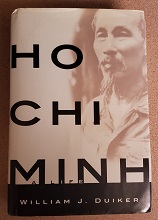
Ho Chih Minh: A Life – William Duiker

UncleHoOn April 30, 1975, the People’s Army of Vietnam and Viet Cong forces succeeded in the occupation of the city of Saigon in the wake of withdrawal by United States Armed Forces.  America’s departure marked the end of the Vietnam War and provided the Democratic Republic of North Vietnam with the opporunity to unify North and South Vietnam.  The final act of unification would have been welcomed by the first Prime Minister of North Vietnam Nyguen Ai Quoc who was known to the world as Ho Chih Minh (1890-1969).  Older Vietanemse sometimes refer to him as “Uncle Ho”, a benevolent figure who’s life as devoted to completely independence in Indochina from French and Chinese rule.   Ho Chih Minh has always come across as a slightly mysterious figure and some parts of his life are still unknown.  However, author William Duiker provides an informative and thought-provoking biography that explains Ho’s life and the true tragedy of the Vietnam War.

In 1976, Saigon was officially renamed Ho Chih Minh City in honor of Uncle Ho.  It was a fitting tribute to the man who truly believed in one Vietnam and made it his purpose to see it come to pass. But just who was the real Ho Chih Minh?  One adjective is surely not enough to describe this mysterious figures whom we learn about deeply in this biography.  The author has exhaustive researched the book and his recreation of the key events in Ho’s life during his evolution into a world leader provide the picture needed for readers to understand the thoughts behind his decisions and actions.

Familiarity with the Vietnamese language and/or Vietnamese history is not required but possession of either or one of them may result in the book becoming a more enjoyable read.  I found the story easy to follow and from the start, Ho’s intrigue is irresistable.  Some readers might be thrown off by the number of Vietnamese names in particular the name Nguyen which appears frequently in the first half of the book.  There are other names as well, including several used by Ho Chih Minh.  And the name by which he was internationally known has its own back story that the author makes sure to cover.

As I read through the book, I began to see that the key to understanding Ho Chih Minh undoubtedly begins in the 1920s and 1930s when France kept Indochina under strict rule.  The young revolutionary then known as Nyugen Ai Quoc, had determined from a young age that Vietnamese Independence was the only thing that matter.  After surrender in World War II, the Japanese military was forced to significant troops from previously occupied territory across Asia. The power vacuum created by Japanese withdrawal provided the opening needed for the August Revolution which changed history for good and set the stage for many battles to come.

Ho’s actions following the war and Washington’s responses or lack thereof are some of the most sobering moments in the book and instantly caused me to think of my uncle who served in the Vietnam War.  Anyone who has long sought to understand why the United States became involved in Vietnam will find this book enjoyable. At times I was speechless as I read and at one point back to understand how a war could have been prevented nearly 20 years before happening.  This part of the book is simply mind-blowing.   The battles within the U.S. State Department are just surreal and tragically, warnings given by those who foresaw a deadly war coming in the future, were largely ignored.  I do wonder what would have changed had North Vietnam and Washington been able to find common ground in the wake of World War II.  From the very start, Washington never seemed to fully grasp what it meant to be Vietnamese for Ho and other party members determined to resist the French and other nations committed to  colonial rule in Southeast Asia.

There are some parts of Ho’s life that show up on rare occasion in the story. In fact readers will notice the lack of several things typically found in a biography.  However,  Duiker does points out that Ho Chih Minh was a man of many secrets and some records have probably been lost for good. Perhaps that is by design or just unfortunate evens. The lack of romance in Ho’s life, particularlly after the August Revolution is certainly one of the more puzzling aspects of the story.  And even for the women that do enter his life, their time is brief for Ho has his mind set on Vietnamese independence at all costs.

The Vietnam War rightfully enters the story towards the end of the book. However, Duiker does not go off course and devote too much time to it.  I believe that was a good approach because by extensively discussing the war, it would have distracted from Ho’s personal story.  Further, Ho died in 1969, several years before the fighting ended. And in his later years, his duties had been adjusted by party members who were responsible for the American threat and the development of a new Vietnam.   Regardless, I believe that it is safe to say that there can be no discussion of modern day Vietnam with taking a long look at the life of Uncle Ho that stretched across several continents, included several spoken languages, arrests, questions of paternity and a battle against colonialism.  The Vietnamese movement for independence remains one of the most important struggles in world history and in the process, Ho Chih Minh went from radical student to a leader on the world stage.

ISBN-10: 0786863870
ISBN-13: 978-0786863877