Bitterly Divided: The South’s Inner Civil War – David Williams

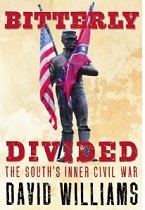
DividedI am consistently amazed at the amount of history related to the American Civil War. The conflict which bitterly divided America, was a moment in which the United States had to reconcile with its dark past and an uncertain future. As a Northerner, the image I had of the Confederacy was generated from films and television. However, the reality of the South was a society divided and plagued with inner turmoil and dysfunction. Author David Williams explores this little-known history of the Confederacy, and the resistance from within to keep the Union together and dismantle the slave-holding elite class in the South.

Within several minutes of reading the opening section of the book, I could not help but feel that the South was doomed from the start. But the war’s conclusion could have been quite different as the author points out, had the South been better prepared and more realistic about secession and independence. However, that did not happen, and as the book progresses, the grim reality facing the Confederate States of America and its President Jefferson Davis (1808-1889) comes into sharper focus. I previously reviewed Bruce Levine’s ‘The Fall of the House of Dixie: The Civil War and the Social Revolution That Transformed the South’which discusses social changes in the South in the aftermath of the conflict. Williams’ account is focused on the failures that began to affect the South’s mission from the very start and the unsettling truths for proponents of the ‘Lost Cause’ myth. There was no  grand or noble effort to crush the North. In fact, what the author reveals here is far from admirable and shows that the South was coming apart at the seams.

I was aware of the high desertion rate Confederate commanders faced as they engaged Union troops. But the number of soldiers who laid down their arms and deserted is staggering. And the crux of the issue is why they deserted to begin with. Williams takes a deep dive into the social climate in which the book is set. A minority of powerful and wealthy figures decided war was good, even if the majority of Southerners were not wealthy, did not own slaves and saw secession as pointless. This detachment from reality placed the South at a disadvantage from the moment the opening shot was fired at Fort Sumter, Charleston, South Carolina on April 12, 1861. It also fostered hatred among citizens of the South towards the slave owners who dragged them into war. But there is far more to the story which Williams tells brilliantly.

Aside from desertion, we also learn that famine was just as crippling. But the actions of women across the South determined to feed their families was eye-opening. The stories told in the book should remove any doubt that the South was “self-sufficient”. In fact, it becomes very obvious that the South could not feed all of its people. Several of the stories are shocking and show that the women had no fear of anyone because food and survival trumped any effort to push back against the Union. But that also raises the question: how could the government not see this ahead of time? There is a good reason which the author discusses, and to say that it was poor planning would be an understatement. The situation across the South was that food was scarce, citizens were bitter, and resentment was building exponentially. And if that were not enough, we also learn more of the anti-secession/pro-Union militias operating within the South to bring down the Confederacy and end the bloody war.

We know from the early part of the book that the majority of Southerners did not approve of secession from the Union. But rebel units loyal to the Union are an aspect of the conflict which I had never heard discussed in any classroom I can recall. This was mind blowing. Civil War buffs may know this part of the story very-well, but if you are not one of those people, this part of the story is surreal. The story is so engaging that I could not stop reading and my mind absorbed the information like a sponge. However, this is the elephant in the room throughout the book and that is slavery.

Williams pulls no punches is discussing the attitude towards slavery whether it is in the South or the North. And what he shows is that while the two sides engaged in war, it was seen as a white man’s war and regardless of the outcome, President Abraham Lincoln had no desire to confront slavery once and for all (1809-1865). Lincoln was willing to let slavery continue if he were able to come to a compromise and hold the Union together. And in the South, slaves themselves became higher in value due to conscription and the South’s need for more able-bodied soldiers. Both sides underestimated the resolve of free and enslaved Blacks who were no longer willing to tolerate being held in bondage. And as we see in the book, although both sides initially abhorred the use of Black troops for varied reasons, the entry of Black Union soldiers into the conflict helped turn the tide of the war. Also, those not in uniform but determined to undermine the South as they spied on the Confederacy are discussed so that their names are not lost to history. By the time I finished the book, I realized that the South was doomed, and nothing was going to save it.

If we are to truly learn American history, we need books such as this which tell us the uncomfortable and sobering truths about what really happened. History is rarely pleasant and often filled with facts that we would rather forget. But the reality is that the Civil War and its aftermath shaped the America we see today. And though the country continues to change, many more years are needed to move away from the not too distant past when the United States became divided and the nation went to war with itself.

ASIN ‏ : ‎ B0042RU4D0

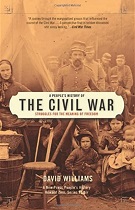
A People’s History of the Civil War: Struggles for the Meaning of Freedom – David Williams

Williams

I may have stated this before, but I absolutely love history. However, I have come to realize that there is much about my own country that I still need to learn. Of all the subjects that remains often misunderstood and debated is the American Civil War.  There is the common belief that the war about ending slavery but to others it was a case of “Northern aggression”. The truth is that there were multiple reasons for the war and not solely because of one above the others. But I do believe that Major Gen. Smedley Butler (1881-1940) was correct when he said, “war is a racket”. The realization that conflict has a monetary value unsettles the mind and spirit. The truth is rarely pleasant but always required to set the record straight. Author David Williams does just that in this remarkable account of the conflict that tore America apart. It can be argued that the Civil War is still affecting American society. I agree to an extent but for us to understand how and why, a full understanding of America and the war is needed. We can start at the beginning with the issue of slavery which is labeled as the major reason for the war. The image of the Confederacy and “Deep South” was one of abundant slave owners and plantations across the region. But as a I learned here, that was not always the case. In fact, what Williams shows is that the South was nowhere near as coherent as one might think. Nor was the number of slave owner and plantations in existence as one might suspect. As I read the book, I was quite surprised to learn of the reality behind the slave owning South and how it affected morale and pride during the war. 

Slavery was a critical issue the country faced as tensions continued to rise. Abolitionist were determined to see it fall and rebellions such as the one led by John Brown (1800-1859) caused pro-slavery parties in the South to take notice. The election of Abraham Lincoln installed fear in the hearts of Southerners, some of whom were certain that he would “take their slaves away”.  Washington was aware of abolitionists efforts but what was the real role of Abraham Lincoln (1809-1965)? Apologists have long sought to absolve Lincoln for many things that do not portray him in the most positive light. What can be seen in the book is that Lincoln’s actions and beliefs did not always fall in line with the iconized version presented in history books. In fact, Frederick Douglass was more explicit in his view of the President following Lincoln’s re-election: 

Though they had succeeded in keeping McClellan out of the White House, Radicals were not enthusiastic about giving Lincoln a second term. “When there was any shadow of a hope,” wrote Frederick Douglass, “that a man of a more decided anti-slavery conviction and policy could be elected, I was not for Mr. Lincoln.”

There is far more to Lincoln’s role revealed in the book and readers may be surprised. His plan for free Blacks will certainly cause readers to pause. However, his role in the conflict can neither be overstated or understated. He was a crucial part of the Union effort that ended in victory. And his actions, regardless of true motives, did help end the system of human slavery in the United States.  

Once the war begins, the course of battle is anything but predictable. However, the author reveals interesting facts about the Confederacy and its ability to achieve victory. When President Barack Obama won his second term, there was calls for “secession” by those unable to accept his re-election. To any rational individual, it was clear that would not happen. But what did happen when Southern States left the Union after Lincoln’s re-election? And what was the final straw that pushed them over the edge? The answers to those questions can be found within and the author also discusses another motive for secession that businesspeople in the North recognized and refused to accept. It soon becomes clear in the book, that slavery is only one of many reasons for the South declaring its independence.

One of the best parts of the book is the discussion about life in the Confederacy. I strongly recommend readers look at Janet Elizabeth Croon’s “The War Outside My Window: The Civil War Diary of LeRoy Wiley Gresham 1860-1865″, which is an excellent read about life in a Southern family that supports the Confederate effort. Far from the united South we may have been led to believe, there was much taking place in the Confederacy that was far from encouraging. And as the author points out: 

By 1864, President Davis publicly lamented that two-thirds of Confederate soldiers were absent, most of them without leave

In the North, things were also not as unified, and the image of the “liberal” North is directly challenged by William’s work. Frankly, though the North was free territory, racial harmony was a myth and social conditions could be just as bad as the South. Blacks were free but still lived like slaves. Interestingly, even before Union victory, members in Congress began to think of how Blacks could be enfranchised. Their efforts and those of the Radical Republicans are highlighted to show the missed opportunities that presented themselves to a country at a crossroads and in need of change. Lincoln’s actions and those of his successor Andrew Johnson (1908-1875), left much to be desired. 

Surprisingly, what is left out of discussions about the Civil War are the true feelings of Southerners who have been painted with the broad brush of being “sympathizers” to the Confederacy’s mission. The truth is far more complicated and fare less glamorous. In fact, life for poor whites in the Confederacy was not much better and the dark reality is brought to life in the story told here. Desertion was a major problem but there were other factors at play that made the desirability of serving under Davis’ army plummet.  Further, battlefield conditions, life as a solider and death for any number of reasons made it clear that war is hell, and no one should take part. To drive home this point, I refer to this section in the book by the author who relays that” 

“In The Impending Crisis of the South, published in 1857, Helper argued vigorously that the “lords of the lash are not only absolute masters of the blacks . . . but they are also the oracles and arbiters of all non-slaveholding whites, whose freedom is merely nominal.”

As the war raged on, casualties began to rise from injuries and other conditions that brought death and destruction. Over six-hundred thousand men died in the American Civil War and the manners in which they perished were often barbaric and tragic. The author thoroughly examines the unsettling aspect of the soldier’s experience which included injuries in combat, inadequate clothing and supplies, famine, infections, viruses, and the lack of advanced medical knowledge. In short, life in the 1800s was rough and even rougher if you were an enlistee fighting in a savage conflict deemed to be a “rich man’s war”. Williams’ book should remove any notion of a valiant effort. On both sides, brutality was common, and desertion remained an issue throughout the war.  And the induction of both slaves and Native Americans into the war was not because those in power had a “change of heart”. The real reasons are far more sobering. The Native American experience has been discussed by other authors and their removal from their lands remains one of the darkest aspects of America’s creation. The experience of the Indian tribes is also discussed here in relation to the war and readers will shake their heads in disgusts and disbelief. 

After I finished the book, I had a moment of silence wherein I allowed myself to digest everything I had read. I had learned of things never presented to me before in any classroom that I can recall. American history is often difficult to accept because the image of America is designed to lift one’s spirits. And while there are aspects of life in the United States that are wonderful, our nation’s history contains dark moments. And it is imperative that we learn the truth so that they never again take place. This book is an invaluable resource for anyone interested in the truth regarding the American Civil War. Highly recommended. 

History is the sum total of things that could have been avoided” -Konrad Adenauer (1876-1967) 

ASIN: ‎B007OWQN7Q

The War Outside My Window: The Civil War Diary of LeRoy Wiley Gresham 1860-1865 – Janet Elizabeth Croon

CroonI was browsing through recommendations on Amazon when this book caught my attention.  As one would expect, the words Civil War stuck on the cover.  However, the name LeRoy Wiley Gresham (1847-1865) did not sound familiar at all.  My interest peaked and I decided to see why the book had earned a five star rating.  And to say that it is a hidden gem would be an understatement. It is indeed special and the author did a remarkable job of putting it all together.

Janet Elizabeth Croon admits early in the book that she had no idea who Gresham was.  I would wager that a majority of Americans are unaware of him as well. He was never mentioned in any of the history books I studied while in school. Nor is he mentioned in literature regarding the Civil War.  But I firmly believe that this journal is one of the most overlooked accounts of the war from the point of view of the Confederacy.  The story is told from the Gresham family home in Macon, Georgia.  LeRoy is what we would call an invalid, having survived a dangerous accident in 1856 in which his left leg was severely broken by a falling chimney. Following the injury, he developed a dangerous and persistent cough in addition to other symptoms that were later diagnosed as tuberculosis, also known as the “white plague”.  LeRoy is never told of the diagnosis and the journal was written by a young man who did not think death was coming for him until his very last moments.

Readers will notice instantly that Gresham is highly articulate for a young man of his age.  It becomes obvious early on that his mobility is limited and he does not get out often.  However, he is a keen observer of the news and those around him.   His awareness and understanding of the raging conflict between the Union and Confederacy speaks volumes about his level of maturity.   And although he was not always correct in some of his observations, that can partly be attributed to faulty reporting in a time before social media and live news broadcasts.  In fact, news moved so slowly at times, that it could be an entire day or two before information reached its final destination.  Regardless, LeRoy follows the war closely, offering detailed insight into the war’s progression.

As I read through the journal, I did notice that most of his days were actually quite eventful with relatives and friends coming and going constantly.  Games are played,  the weather detailed, various foods eaten and plenty of conversation takes place.   Sadly though, LeRoy’s illness does not let up and he comments on his own physical condition nearly every day.  Readers have the benefit of the doubt in knowing what was wrong with him but he was unaware of his terminal diagnosis.  He mentions old medicinal treatments common during the time and some of the names will be foreign to some readers.  The reports of the war’s battles may also be unfamiliar to those that are not Civil War buffs. But the author provides a ton of invaluable footnotes at the end of the chapter to explain almost everything contained in the journal for each year.  Without these footnotes, the journal would have assuredly been a far more challenging read.

As a Black person, I could not ignore the “elephant in the room”.  LeRoy’s family were slave owners and supporters of the Confederacy under Jefferson Davis (1808-1889). As I started the book, I did feel a bit of uneasiness about what I would find.  I did not find anything extreme in the journal but I did notice he was not averse to using racial terminology that was commonplace at the time, in particular for a slave owning family.  However, he does not lace his journals with it and refers to family slaves by their first names in describing the day’s events.   But I was under no illusions that he believed in the abolitionist movement.  LeRoy believed in the Confederacy and was no fan of Abraham Lincoln (1809-1865), but as the journal progressed, I did notice a few changes in his beliefs that will cause the reader to take notice.   And had he lived, perhaps his views might have changed over the course of time.

The journal only covers between 1860 and 1865, so we do not know all of the details regarding the accident that caused him to break his left leg .  The author explains the accident but LeRoy does not talk of his leg much in the journal. In fact, his back is the main focus in addition to his hacking cough and the abscesses that would plague him as the tuberculosis raged through his body eventually reaching his spine.   As a bonus in the book, the author was able to get a doctor to examine what was known of LeRoy’s medical history, the medications he was taking and the care he received to render the most likely diagnosis.  At the end of the book, the doctor takes a very detailed look at the medications which explain even further exactly what LeRoy’s condition was and why he would have been given them.  Reading the journal did make me grateful for modern medicine.

I strongly advise and recommend that anyone interested in the Civil War to read this book.  It is by no means an authoritative source on the war but it is a very intimate look at the conflict through a very different set of eyes.

ASIN: B07D6QQT77