
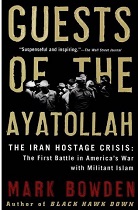
 On November 4, 1979, university students seized the U.S. Embassy in Tehran, Iran and detained more than fifty U.S. Government employees. Though some were later released, the majority remained behind for four hundred forty-four days in what is known as the Iran Hostage Crisis. In 1953, Mohammad Mosaddegh (1882-1967) and the National Front Party gained political power in opposition to Mohammad Reza Shah (1919-1980). A twice elected member of Parliament, Mossadegh emerged as a popular figure but within days of the Shah’s exile in August of that year, Mossadegh was removed in a coup sponsored by the British Government and the United States. Mossadegh’s removal and the Shah’s return, inflamed tensions and in November 1979, Iranians decided that America must go. This is the story of the hostage crisis from start to finish in an account that provides a thorough discussion of America’s foreign policy mistakes and Iran’s inner struggle between traditionalism and modernity.
It is not necessary to have extensive knowledge of Iran’s history or the Shah’s life. However, I strongly recommend Stephen Kinzer’s “All the Shah’s Men: An American Coup and the Roots of Middle East Terror“. The book is an excellent compendium of the coup that removed Mossadegh from power and allowed the despised Shah to return to his former throne. Bowden does provide background information on Iran throughout the book when needed for readers as the story progresses. But first, the author revisits the night of November 4 when all hell broke loose. Like a Hollywood thriller, the movements behind the scenes of embassy employees who realized that something was wrong outside the building take center stage and when the world came through that the embassy had been breached, contingency plans went into effect. The shredding of documents, securing weapons and other protocols highlight the urgency that ensued. We also learn the names of the main figures who are the focus of the story that is developing. Readers may be surprised to learn that the angry Iranians outside are young students and not Islamic radicals. Their goal was to remove American influence from Iran’s affairs. But what they failed to see is that they had become pawns in a chess match. As Bowden states:
“The revolution was shaping up as a struggle between leftist nationalists who wanted a secular, socialist-style democracy and young Islamists like these who wanted something the world had not yet seen, an Islamic Republic.”
The students did not expect to hold the embassy for long but as time progressed, the situation had grown from the seizure of a building to an international crisis between Tehran and Washington. Inside the embassy, employees are shielded from the outside world and current events in America. In Washington, D.C., President James “Jimmy” Carter is struggling with how to resolve the crisis. War was the last thing anyone wanted but Carter knew action must be taken and gave the order to attempt a rescue mission and protect his chances of reelection. He was facing the popular actor turned politician Ronald Reagan (1911-2004) whose appeal to conservatives and war hawks could not be ignored. The planning of the military operation and why it failed are thoroughly explored in the book, and I found myself both inspired and dismayed at what I learned. However, I did not find fault with anyone and realized that officials did what they could with the best intentions they had. Sometimes things do not go as planned. To save face, Washington admitted to the plan and even took steps regarding the Shah’s future to no avail, and the fallout provided the ammunition needed by the man who was determined to reshape Iran into a true Islamic kingdom, Sayyid Ruhollah Musavi Khomeini (Ayatollah Khomeini) (1902-1989). Though he is a minor figure in the book, his influence cannot be underestimated. And this is what the students had not anticipated. Bowden keenly observes that:
“The postrevolutionary struggle was between the victors: the nationalists and the Islamists. They had united to throw out the shah but were now locked in a struggle to shape the new Iran.”
Islamic clerics seized the opportunity provided by the siege to implement their vision or Iran’s future. Their vision was that of a true Islamic Republic incompatible with the customs of the West. To this day, Iran is locked in a struggle between the two. The most bewildering part of the story is that halfway through the crisis, it becomes clear that the students did not have a long-term plan. The movement they initiated had morphed into a new cause over which they had no control. Unsurprisingly, some students had abandoned the movement, but others remained. And even Iranian leaders had little enthusiasm for a situation that was embarrassing the country and inflaming tensions with Washington. Their ineffectiveness at resolving the crisis is a clue into the stronghold by radicals who had infiltrated the government and the siege at the embassy. As to why this happened, I draw focus to this statement by the author that sets the tone for the story:
“Revolution gives ordinary people the false belief that they can remake not just themselves, their country, and the whole wide world but human nature itself. That such grand designs always fail, that human nature is immutable, that everyone’s idea of perfection is different—these truths are all for a time forgotten.”
Readers will observe that opinions and goals for Iran varies among the students. There are hardliners in the group and pacifists who do not want war with America but to see Iran free of any foreign influence. Their interactions with the hostages are invaluable for providing insight into the thought process behind the actions in Tehran. But the beauty of this book is the hostages themselves. Instead of them simply appearing as U.S. personnel, each hostage is given a platform in the book so that readers learn their life story, why they came to Iran and how they manage being held captive by revolutionaries who do not have a complete revolution. I warn readers that there are moments in the book that will produce anger and rage at the treatment Americans received while detained in Tehran. Though none are murdered, they were not immune to harsh interrogations and torture. There are dozens of employees in the story and keeping track of the names is challenging at first but as I read, their names became embedded in my memory making the story easier to follow. Several are now deceased, but Bowden memorializes them in this account that will live on. But as I read the book, I asked myself why the embassy remained open after the Shah fled for the final time. We may never know, and I have no doubt that the hostages asked themselves the same question.
Eventually the remaining hostages were released on January 20, 1981. Carter had been defeated at the polls and America prepared for a new president who had a different vision for the United States. Iran remained locked in the struggle between nationalist and fundamentalist which continues today. The final exodus from Tehran is the most emotional part of the book. And I could feel through Bowden’s words, the sense of relief and joy they must have felt as their aircraft left Iranian airspace. They were free physically but mentally their ordeal was far from over. In the book’s epilogue Bowden provides a follow-up on the former hostages. Their comments on their ordeal and Iran are invaluable and thought-provoking and regardless of where they are currently, none of them will ever forget their time as a hostage in Tehran. I appreciated their stories and what they learned from their time in Tehran. And to say that foreign service employees make enormous sacrifices would be an understatement.
I cannot overstate how much I appreciated this book. It is a tool to understand the mistakes of the past so that they are not repeated in the future. This is world history and a good look at a crisis that could have initiated another world war. The threat of terror still exists today but we can only hope that men and women working abroad in service of America are advised and protected from those threats. Forty-two years have passed since the siege but the lessons from it can still be applied today. I close out with this quote that perfectly explains the hostages’ experience:
“The Americans taken prisoner on November 4, 1979, did not know if they would ever come home. Every day they lived with the threat of trial and execution, of becoming victims of Iranian political violence or an American rescue attempt. They lived with the arrogance of Islamist certainty, which prompts otherwise decent men to acts of unflinching cruelty. My goal was to reconstruct their experience as they lived it. The men and women held hostage in Iran survived nearly fifteen months of unrelenting fear. They were the first victims of the inaptly named “war on terror.””
ASIN: B008UX8GH8
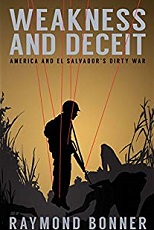 For the first time in a long time, I found myself emotional and angry as I finished this book about the relationship between the United States and the military dictatorship in El Salvador during the small Central American nation’s civil war in the 1980s. I had expected the book to be a tough read and contain many facts that would be both uncomfortable and upsetting. But I admit that I was not prepared for what I learned. This is not the first book I have read or reviewed regarding El Salvador. There are many other books that are very good but take different approaches to the subject matter. It might be fair to say that the other books were a primer for what I was to learn here in this mind-blowing and deeply troubling book by Raymond Bonner, a former Marine who served in Vietnam and current staff writer for the New York Times.
 FREETHINKING BIBLIOPHILE
You must be logged in to post a comment.