
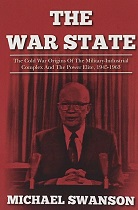
 On January 17, 1961, United States President Dwight D. Eisenhower (1890-1969) gave his farewell address to the nation as it prepared to inaugurate the incoming president, John F. Kennedy (1917-1963). During his address, Eisenhower warned of the “military industrial complex” and its influence over foreign policy. Four years later, America was on the path to war in Vietnam. Following World War II, the world felt relieved as the fighting ended and the planet began the lengthy process of rebuilding what had been lost. But what was not seen at the time publicly, were the growing hostilities between Washington and Moscow which began to form the nexus of the Cold War. But an important question is why did the Cold War take place? While it is true that it was not a traditional war in that troops were on the ground fighting, the world came close to the brink of nuclear war and had those weapons been used, I might not be sitting here today writing this blog post. Today, the United States military is both feared and admired, and the national defense budget for the year 2023 stands at eight hundred eight-six billion dollars. The figure is shocking, but it was not always this way. In fact, the national defense budget was far smaller as presidents sought to reduce military spending and focus on other domestic programs. But at some point, that changed and the money going towards America’s defense took on a life of its own. Author Michael Swanson explains the reasons why in this book that explores the Cold War’s origins, the military industrial complex and the powerful figures behind the scenes that influenced Capitol Hill and the White House as America locked it sights on the Soviet Union and exerting the United States’ influence around the world.
The author provides a primer early in the book to set the stage for the coming discussion, focusing on the financial costs of both World War I and World War II. While reading this section, I made note of a fact he provides about the collection of income tax that will surprise readers. As the second world war raged, American officials were eager to bring the war to a conclusion and prevent more casualties. Their wishes were granted in the form of two bombs that mankind had never seen before. But there were also other effects of the bomb that did not relate directly to its ability to cause destruction. In Moscow, all eyes focused on Japan as Hiroshima and Nagasaki were destroyed, and Soviet Premier Joseph Stalin (1878-1953) knew that things between the two nations had changed forever. As Swanson puts it:
“The detonation of the atomic bomb on Japan marked the beginning of the Cold War, because it posed an existential threat to the Soviet Union.”
In America, the Soviet Union was also seen as an existential threat to the nation’s safety. However, the country lacked an effective method of gathering intelligence. That all changed during the administration of Harry S. Truman (1884-1972), informally known as the “accidental president”. Truman held concerns about a Soviet arms buildup and knew that it would increase its weapons arsenal. He had to act and approved two key events that changed American foreign policy permanently. On September 18, 1947, Truman signed into law the National Security Act which paved the way for the creation of the Central Intelligence Agency (“CIA”). But he was not done there and as relayed by the author:
“Harry Truman ordered a reappraisal of national security policy. Completed on April 14, 1950, this report, titled National Security Council Report 68 (NSC-68), became one of the most important documents of the Cold War. It set the stage for a massive arms race and advocated intervention throughout the entire world.”
Frankly, the arms race was on, and every president after Truman would have to fight elements within their own government as fears of a “Red invasion” and “nuclear holocaust” spread across America. Radicals in the American government were convinced that there was a “missile gap” and that more weapons were needed. As Eisenhower enters the story, the pace of the book picks up due to the Cold War becoming a reality. In fact, the conflict forms the bulk of the book which finishes before the debacle in Vietnam. Eisenhower was a famed Allied commander during World War II and seen behind the scenes as an effective leader who preferred to move in silence when possible. But he was not naive to the growing influence of the military and powerful figures in Washington who wanted America to flex its military muscle. Today it seems surreal, but it is important to remember that during this time, there were people who deeply believed a pre-emptive strike against the Soviet Union was warranted and that war would eventually come no matter what. Eerily, they accepted the fact that millions of people in both countries would perish in less than an hour during a nuclear exchange. The unbelievable story is told here again, and readers will shake their heads in disbelief. But the story reaches an even higher level of insanity when America elected its first Irish-Catholic president.
John F. Kennedy remains highly popular to this day although he only served one thousand days in office before his murder in Dallas, Texas on November 22, 1963. But during his time in office, multiple crisis brought the United States and Soviet Union close to all-out war. He had inherited the Cold War and a Russian adversary named Nikita Khrushchev (1894-1971). And the pawn in the chess match between America and the Soviet Union was the small island of Cuba which came close to being the starting point for the next world war. Swanson revisits the two events that placed everyone on high alert: The Bay of Pigs Invasion and the Cuban Missile Crisis. Readers familiar with both will read this section slightly faster but as someone who had read multiple books on the subject, Swanson version is also good. In fact, I found it to be a very condensed version that is easy to follow without reducing the suspense needed to convey the seriousness surrounding both historical events. As for Kennedy and Khruschev, both men found themselves in a similar position within their governments and shared the same vision for peace. However, both also had to contend with the fact that hardliners in their governments were eager for conflict and might go to any lengths to make it a reality. The author’s discussion of the final weekend in October 1962 will show the concern on both sides about a coup to remove people from positions of power. Thankfully, cooler heads prevailed, and nuclear war did not happen. But in Washington, that was not enough for the military industrial complex, and Southeast Asia was placed on its radar. Kennedy died before finalizing his plans for Indochina but his successor, Lyndon B. Johnson (1908-1973) made it clear that he would not reduce America’s presence and by the time the war ended in 1975, fifty-eight thousand American troops died in Vietnam. But that is a story for another time and another book.
Readers may be tempted to wonder why this story is important today if the Cold War is over. Well, the reason is that defense spending has never been reduced and continues to increase. But we must ask why? Which nation is an existential threat to America today? This section by Swanson towards the end of the book sums up the thinking that almost caused a third world war with nuclear weapons perfectly:
“In the 1950s, air force General Curtis LeMay said he had the ability to order SAC bombers to attack the Soviet Union and destroy all of its war-making capabilities “without losing a man to their defenses.” Americans were completely safe, but they lived in constant fear.”
The past is always prologue, and though the Soviet Union no longer exist, the ideological differences between Russia and America remain. But peace should be the goal and there is enough room on the planet for us all if we place value on our lives which are not guaranteed. This is a good discussion about American history and the dark directions the nation took under misguided fanatical warriors who warmly embraced what could have been Armageddon.
“Cold War? Hell, it was a hot war!” – Robert S. McNamara (1916-2009) (The Fog of War, Sony Pictures 2003)
ASIN: B00EWLGXHW
 On December 26, 1991, the world watched in shock as the Union of Soviet Socialists Republics (USSR) dissolved, splitting the once mighty Soviet Union into fifteen separate nations. I vividly remember watching the news broadcasts and seeing the flag of the Soviet Union lowered for the last time. It was the end of an era highlighted by the Cold War in which Washington and Moscow viewed each other as a threat to world peace. Paranoia, suspicion and espionage propelled the two to the brink of nuclear war on several occasions. In October, 1962, the world watched in gut-wrenching suspense as the Cuban Missile Crisis heated up and threatened to be the spark that ignited the next world war. President John F. Kennedy (1917-1963) and Soviet Premier Nikita Khrushchev (1894-1971) found their selves in a situation that could have resulted in the physical destruction of half the planet within a matter of minutes. Diplomacy eventually prevailed through the use of back door channels encouraged by the realization of figures in both governments that the looming showdown would produce no winners. Tensions between the two super powers cooled but never full subsided and as the dissolution of the USSR played out on television, Washington closely monitored the events while re-examining its global position as Russia emerged from the post-Soviet empire as the country to watch. Twenty-eight years later, the USSR is still recalled as one of the greatest powers in history. Its fall was earth shattering and left so many wondering, how and why did it happen?
 FREETHINKING BIBLIOPHILE
You must be logged in to post a comment.