
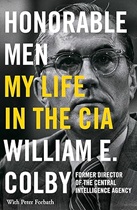
On July 26, 1947, United States President Harry S. Truman (1884-1972) signed the National Security Act, establishing the national security framework currently in place today. This signature piece of legislation paved the way for the creation of the Central Intelligence Agency (“CIA”) which over time, morphed into an agency far different from Truman’s vision in 1947. In September 1973, President Richard M. Nixon (1913-1994) appointed William Colby (1920-1996) as Director of the agency and Colby found himself in charge of an intelligence apparatus he had duly served and knew inside out. He served as director from 1973 to 1976 and during those three years he would submit to congressional hearings and be forced to answer tough questions about past CIA actions that raised public awareness and suspicion. In 1978 he authored this book about his life and time in the CIA which has now been republished in electronic format. It is a fascinating look at the life of a career military and intelligence officer who was a crucial part of America’s national defense.
When I bought the book, I was not sure what to expect. Of course, I knew that Colby had a storied past but the idea of a former CIA director authoring a book still seemed unusual. However, I found his story to be interesting and candid at times. And while he undoubtedly held some things close to the chest, he is frank regarding his time in the intelligence community. But before we reach his induction into the CIA, we learn about his upbringing and prior government service as part of the Office of Strategic Services during which played a critical role in the victory by allied forces in World War II (1939-1945). Like other former OSS operatives, Colby eventually found his way to the CIA. But his path was not direct, and he explains how ended up in Langley, VA following a brief period working for the American Civil Liberties Union. Once he joins the agency, the story takes unexpected turns as he and his family move from one foreign post to the next. The time abroad would shape Colby’s views of the world and domestic issues including women in the workforce and the lack of minorities in the agency. Both issues come back later in the story and Colby identifies the problems which existed and how he set out to correct them. However, as he became more valuable to the agency, he also had a first-hand seat at pivotal events which shocked America and the world.
The story shifts gears when President John F. Kennedy (1917-1963) settles into the White House in January 1961. The Bay of Pigs Invasion, Cuban Missile Crisis and looming threat of war in Vietnam (1965-1975) become hotbed issues which place Kennedy on the defensive and plunged the CIA into the heart of each. Colby explains the agency’s actions and positions, and issues firm clarifications on anything he felt was incorrect about CIA participation, particularly Kennedy’s assassination on November 22, 1963. His comments on the events in Dallas are brief, and he does not discuss the investigation or any conspiracy theories. However, regarding South Vietnam, Colby talks extensively of his visits to the country and the policies enacted to the help the people maintain a separate democratic republic. Following Kennedy’s murder, Lyndon B. Johnson (1908-1973) becomes the next Commander-in-Chief, and within a year, America was at war, with North Vietnam. I do not believe it is necessary to re-hash the conflict, and there are dozens of books on the war which explain it extensively. The war does takes a step back when Nixon assumes office an this section of the book is by far the most interesting and the most volatile.
I was surprised while reading at how direct Colby was in his words. The Nixon presidency soon goes off the rails as he orders CIA intervention in Chile and deals with the fallout of the Watergate scandal created by his own paranoia. Colby does a thorough job of explaining each crisis and how the CIA became ensnared in both. Chile is haunting and is often referred to as the “other 9/11”. The fall of Salvadore Allende (1908-1973) on September 11, 1973, remains one of the darkest chapters in CIA history and is a prime example of the fears Harry Truman had ow what the CIA had become. Watergate is an extensive story on its own, and Colby explains what was known at the time, but this is not intended to be a full examination of the scandal. But what he does say highlights the insanity inside of the Nixon White House. And the section regarding Nixon’s meeting with former CIA Director Richard Helms (1913-2002) is chilling. It soon becomes clear why he resigned from office. Nixon left a mess in his wake, and Colby would be called to appear on Capitol Hill following devastating press releases by journalist Seymour Hersh. He manages each situation gracefully, explaining his position as director while weighing the implications of his words as he walks the fine line between compliance and protecting covert operations critical to the nation’s security. Colby was aware that the agency’s reputation had been severely damaged during the Cold War and that rehabilitation was needed. This did not sit well with everyone such as former Counterintelligence Chief James J. Angleton (1917-1987) whose reputation is controversial on its own. Colby addresses the role of Angleton in the agency and how he viewed the mysterious spy whom no one seemed to understand. We also learn of his friendship with former Secretary of State Henry Kissinger (1923-2023) who is another controversial figure in history. The author does not cast any judgment on Kissinger but does discuss the secrecy surrounding him which made the job of the CIA more difficult. Colby’s account is filled with a who is who cast of figures from the past who have shaped American foreign policy.
In 1976, Colby is relieved of his post, and you can feel the sadness and relief in his words. No longer tasked with running the agency, he had more time for first wife Barbara (1920-2015) and their children. The couple’s story is overshadowed by the larger discussion of the CIA but should not be overlooked. Colby and his family endured immense personal sacrifice and tragedy, as he explains. But he had no regrets about his career and time as director. I did not have any expectations before I started this book, but I can say that I enjoyed reading it. I do not doubt that Colby took secrets with him to his grave and left some things out of the book due to the threat of litigation from the U.S. Government should classified or top-secret information be revealed. However, despite the restrictions on discussing sensitive agency operations, he does not avoid difficult or controversial topics within the agency’s history in the name of transparency. If you are curious about the CIA, how it functioned internally, and some of the most important events in American history, this book may be what you are looking for.
ASIN : B0G1FSJ2RD
Publisher : Open Road Media, January 13, 2026
 FREETHINKING BIBLIOPHILE
You must be logged in to post a comment.