
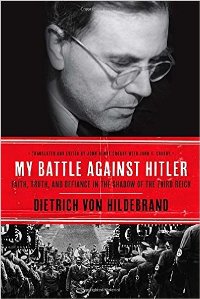
 The tyrannical reign of Adolf Hitler stands as one of the worst the world has ever seen and has been the subject of countless documentaries, films, specials and books. The Third Reich and it’s final solution, produced upon Europe, a dark cloud that it had never seen before. Hitler’s rise to power and rule over Germany is a well-documented story that has been told over and over again. But what isn’t often told are the stories of those who opposed Hitler. Tom Cruise starred in the sensational film ‘Valkyrie” which depicts the failed assassination attempt on Hitler by Claus Von Stauffenberg on July 20, 1944. The attacked injured Hitler but he escaped death and continued to rule until the Allied forces closed in on Berlin on April 30, 1945.
Among the many voices in opposition to Hitler was Dietrich Von Hilderbrand, editor of the journal Der Christliche Ständestaat which became a voice for anti-Nazi beliefs. His outspokenness earned him the wrath of Hitler and his associates forcing Dietrich to flee Germany and Austria. Though pursued by the Nazis, he never abandoned his stance in opposition to the racial ideology of the Third Reich and the antisemitism that was widespread at the time. His voice and beliefs were so well-respected that he was once considered the biggest threat to the survival of National Socialism. In this look into his life, writings and beliefs, we come to know Von Hilderbrand and understand why he was so important to the large number of critics of the Third Reich and its infamous practices.
Catholicism and philosophy are central themes in the book and shed light on the many contradictions and faults that lie in nationalistic ideology. His words resonate with those of us who find ourselves opponents of racial discrimination and the destruction of the moral compass of society. Von Hilderbrand reminds us of the importance of humanity and our individual duty to reconcile our beliefs and actions in accordance to what is not only divine but morally correct. And although his words are more than 70 years old, they are still relevant today. Throughout history there have been many versions of Adolf Hitler surrounded by regimes determined to enforce totalitarian rule through violence and intimidation. In contrast there have always been voices in opposition, some stronger than others. For Nazi Germany, Dietrich Von Hilderbrand serves as one of history’s most important voices against a brutal dictator that disrupted world peace and nearly destroyed the Fatherland.
ISBN-10: 0385347510
ISBN-13: 978-0385347518
 On April 14, 1865, John Wilkes Booth changed the course of United History. The murder of Abraham Lincoln marked the first time a sitting U.S. President had been slain by an assassin. Tragically, Lincoln would not be the last to be assassinated. John F. Kennedy would meet his tragic fate on the streets of Dallas, Texas on November 22, 1963. Lincoln’s murder has become fodder for conspiracy theorist intent on proving that a web of deceit surrounded Lincoln paving the way for the tyrannical Booth to execute his plan. But just how much of a conspiracy was there? And did it involve members of the Confederacy? Was Edward Stanton complicit in pulling back Lincoln’s security detail? And was Mary Surratt rightfully convicted? Edward Steers, through painstaking research answers those questions and more in what is the definitive examination of the assassination of Abraham Lincoln.
 On January 30, 1957 the United States Senate Select Committee on Improper Activities in Labor and Management was created to investigate corruption in American labor unions. Designated with the role of Chief Counsel was a young attorney who later went on to become attorney general and 1968 democratic presidential hopeful, Robert F. Kennedy. In this memoir of his time on the committee, Kennedy recounts the exhaustive investigative efforts of those who served on the committee in an effort to shed light on the nefarious dealings of union and labor officials and effect reform throughout the United States. At the center of the committee’s target lay James R. Hoffa and his International Brotherhood of Teamsters. Starting with Dave Beck, Kennedy carefully reconstructs the deeply seated mismanagement of union funds resulting in the most opulent lifestyles for top officials. Facing a culture in place for many years, Kennedy and his staff are met with opposition and resistance to efforts to probe into the dark side of American labor unions. It’s no secret that Kennedy and Hoffa had a strong distaste for each other and on more than one occasion, Hoffa threatened the future attorney general with physical violence. Kennedy would respond with his “get Hoffa squad” in an attempt to bring down the man who Kennedy believed was a menace to the American way of life.
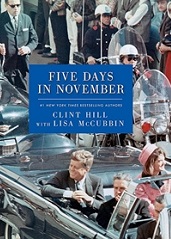 Abraham Zapruder captured a defining and tragic moment in history when his camera recorded the assassination of President John F. Kennedy. The film was originally locked away by Time Life but was finally released to the public years later as a result of the investigation of Jim Garrison into Kennedy’s murder. The film leaves the view speechless and speaks more than a thousand words. Next to the gruesome murder of the President, there’s an iconic sequence that occurs that also remains cemented in the memory of the witnesses in Dealey Plaza that day and the millions others who have repeated watched the film. As the motorcade speeds toward the triple underpass, a Secret Service agent is seen jumping on to the back of the car as it speeds up to transport the mortally wounded Kennedy to Parkland Hospital. The agent is Clint Hill, a veteran of the Secret Service who served several presidents during his multi-decade career. Now 84, he’s become an author over the years, having written a few books, one of which is this account of the fateful trip to Dallas, Texas and the tragedy that ensued.
 In volume I of her three-volume biography of the late Anna Eleanor Roosevelt (1884-1962), Blanche Wiesen Cook explored the early life of the pioneering First Lady of the United States. We learned about her family history, both intriguing and tragic, upbringing by close relatives, her marriage to Franklin and his election of the presidency of the country. The book closes as the family assumes their role as the new occupants of the White House. In this second volume, their story continues with the new President finding himself embattled on several fronts as the depression rages, Adolf Hitler threatens world peace and domestic social tensions threaten to tear the nation apart. The First Lady also finds herself fully immersed in ongoing current events that cause concern for citizens across the country. And it is during this time period, 1933-1938 that she defines herself as she finds her calling as a champion of women’s rights and advocate of equality and well-being for Americans of all ethnic backgrounds.
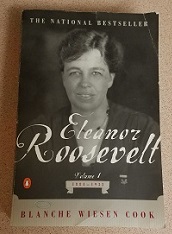 The President of the United States has what many consider to be the toughest job in the nation. Tasked with the impossible feat of making everyone happy at all times while often performing highly unpopular actions, the President often goes through a transformation while in office that results in deep reflection later in life. Standing next to each President in modern times, is the first lady who in her own right, has evolved into a major presence with a voice of her own. This November will mark the end of the Obama administration and as they prepare to leave the White House, I firmly believe the first lady can look back without regret as having served the nation as one of the finest America has seen. She follows a long line of pioneering first women to have occupied the White House, adding a touch of grace and class to what used to be a strictly supplementary role. But many years before Michelle Obama, there was another first lady, who stands out as one of American’s greatest historical figures and whose legacy continues today, Anna Eleanor Roosevelt (1884-1962).
 FREETHINKING BIBLIOPHILE
You must be logged in to post a comment.