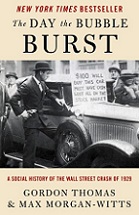
The Day the Bubble Burst: A Social History of the Wall Street Crash of 1929 – Gordon Thomas and Max Morgan-Witts

Morgan-burstIn the autumn of 1929, between the months of September and October, the world was plunged into financial uncertainty as stock markets in New York City and other places saw a massive devaluation of stocks and bonds.  Some investors lost millions in the crash and others less financially secure, saw nearly their entire market portfolio crumble before their eyes.  In the wake of the crash, America plunged into the great depression that spread misery and despair across the nation for several more years.  The crash remains to this day, one of the greatest financial disasters in history.  However, its causes are still up for debate and there is no single reason for the catastrophe but numerous factors did combine to bring the economy to a grinding halt.  Authors Gordon Thomas and Max Morgan-Witts have studied the crash and tell the story here about the “day the bubble burst”.

Prior to reading the book, I was familiar with some of the names that are critical in the story. For example, I knew of William C. Durant (1861-1947), the founder of General Motors and the legendary Joseph P. Kennedy, Sr. (1888-1969), former owner of RKO Studios and Ambassador to Great Britain. Incredibly, Kennedy comes out of the crash with minimal loss and would go to establish his own dynasty that catapulted his son John F. Kennedy (1917-1963) to the White House in the 1960 election.  But there are many others crucial to the story and their lives and actions are intertwined in the fabric of American society both past and present.

I forewarn readers that the story moves from one person to the next and then back again.  And although the book does follow a chronological order, it is actually several stories woven into one. Next to Durant, the life of Charles Stewart Mott (1875-1973) comes into focus as the authors examine his role at General Motors and actions at the Union Industrial Bank which plays a very important role in the story.   The authors also take a look as A.P. Giannini (1870-1949) the founder of Transamerica known today as Bank of America. Continuing on, Jesse Livermore (1877-1940) enters the picture as the poster-boy for the successful stock trader.  Charles E. Mitchell (1877-1955) joins the cast of characters as chairman of National City Bank, known simply today as Citi Bank.  His financial policies are believed by many to be one of the direct causes for the crash of the market. John Pierpont “Jack” Morgan Jr., (Jack Morgan) is a strong presence as well and readers will take note of a key situation involving Morgan and Joseph Kennedy that seemed to grind the latter’s gears and set him on due course to become a financial titan of his own. And finally for the New Yorkers, John J. Raskob (1879-1950) will be of high interest for his enduring contribution to the New York skyline: the Empire State Building.

One of the book’s major strengths is the explanation of the stock market provided by the authors, which is helpful to readers seeking to get an understanding of how the traders were manipulating and playing the market. Of course, the book is not intended to be a stock market guide but simple enough for the everday reader to understand in relation to the story being told.  Today, the market is just a competitive but back then, less regulation existed and traders were far more willing to engage in dubious and illegal activity as can be seen in the story.  The thirst for wealth was so contagious that traders in other countries would also play a role in the crash such as British investor Clarence Hatry (1888-1965), who some blame for ingiting the spark that caused the panic resulting in the plummeting of stock values across world markets.  The authors do not convict him in the book but leave it up to readers to decide. However, they do say this to make their point clear:

“To say that Hatry caused the Wall Street Crash would be to put it far too strongly. But to say that his downfall played no part in it whatsoever would possibly be equally misleading.” 

Undoubtedly, the crash had many causes and the number of people who deserve blame is quite significant. Greed and disregard for financial risk, allowed unrestrained investing into a market, held together by carefully adjusted interest rates and the exchange of foreign currency and other commercial goods. And a ripple in that temperamental network of world markets resulted in a crash no one thought possible yet everyone feared. From housewives to savvy Wall Street players, the impact was brutal and drove some to the brink of suicide. And today that risk is present as the market fluctuates constantly. However, in the wake of the crash, the Federal Government stepped in and imposed tougher regulations to prevent a replay of 1929.  And if there is any doubt as to the severity of the crash, this quote sets the record straight in the most sobering of ways:

“In the five hours the market had gone mad on October 29, it was later estimated that almost as much money in capital value vanished into thin air as the United States had spent on World War I. The loss was around ten times the budget of the Union in the entire Civil War.” 

Towards the end of the book the discussion shifts slightly away from New York and on to Berlin where a young Austrian named Adolf Hitler (1889-1945) is making a name for himself and using Germany’s dire situation and the crash to consolidate his power and grip of the Fatherland.  The connection between the market’s crash and Hitler’s rise to power will be of high interest to history buffs and aficionados of World War II.   And what the authors reveal about the relationship between Wall Street and Germany might leave some shaking their heads in disbelief.  There is far more to the story than I could possibly discuss here but what is disclosed explains why some elements of American society were hesitant to get involved in World War II.  The saying “follow the money” certainly does apply.

In the afterword to the book, the fates of those involved with the crash are detailed by the authors, and here we see how they ended up after devastating financial fallout.  The end result is often sad and in some cases involved criminal prosecution.  The government left no stone unturned and hardly any of the major places was ever the same again.  A few did rebound and fair quite well in later years but they are forever linked to that fateful autumn of 1929.  Some may wonder if another market crash could happen.I believe so but under extraordinary circumstances.  Regulations are far more stringent today and watchdog organizations keep a carefully trained eye on the market.  However, it is also true that if we do not know our history, we are condemned to repeat it.  The 1929 crash was nothing short of earth shattering and the repercussions were felt for decades.  This is the story of how and why it happened.  Highly recommended.

ASIN : B00KQZY1JU

The First Jet Pilot: The Story of German Test Pilot Erich Warsitz – Lutz Warsitz and Geoffrey Brooks

WarsitzEvery time I board a flight at New York’s John F. Kennedy International Airport, I am amazed at the concept of flight. And while I do understand how an aircraft works from a technical standpoint, the process of taking off, cruising and landing still fascinates us and captivates our attention. Today, we reap enormous benefits from the trials and errors of those before us who sometimes gave their lives in the pursuit of flight. In June, 1939, a German pilot named Erich Warsitz (1906-1983) flew an aircraft named the Heinkel He – 176, equipped with a rocket booster for extra lift and speed. The flight was successful and the result of many years of dangerous tests.   The pilot and the engineers around him had just changed history forever and ushered the world into the jet engine era.  This book is a look back at that miraculous time and Warsitz’s life as presented by his son Lutz. 
Instead of writing a standard biography of his father from a third-person point of view, Lutz sat down with his father in the years before his death and conducted numerous interviews with him about his life.  The result is Erich presenting his story as the narrator, taking us back in time before Adolf Hitler (1889-1945) started World War II and led Germany to the brink of total destruction.  And although Hitler does appear in the story, those appearances are few.  The majority of the story takes place at the development facility at Neuhardenberg, where he forms a trio of dedicated flight personnel with Walter Künzel and Wernher von Braun (1912-1977).  Warsitz was a bachelor at the time and as a result, the story remains highly focused on the developments taking place as the engineers get closer to achieving their dream.  He does however, make reference to his personal life on occasion but as readers will learn at the book’s conclusion, his personal life picked up and changed following his release from Soviet control.  Here, we become fully immersed in the world of flight engineering in what could be called an inside look into the development of the He 176. 

What I noticed as I read was the level of danger that the pilots courted each day.  Accidents did happen and in some cases, death was the end result.  Warsitz had his own brushes with danger and describes them in detail as he tells his story.  But with each experience, we see his knowledge as a pilot increase tenfold and by the time the He 176 was ready for final production, he was ready to take the skies.  It is also clear that flying was his passion and he makes this perfectly clear in the book.  His companions in the project also shared his enthusiasm and the success of the He 176 was lost on no one. In fact, the feeling among the crew is summed up by Walter Künzel:

“None of those involved will ever forget the great impression which this maiden flight made on us all. As regards myself personally, who had overall responsibility for the preparation, and gave permission for the take-off, I may say that though outwardly calm, after the successful landing I was absolutely bathed in sweat, and several of us, myself included, had tears in our eyes once the aircraft came to a stop on the ground.”

Because the Third Reich was in power at the time, the work on the He 176 was subjected to scrutiny and approval by the Reichsluftfahrtministerium (RLM).  Officials pay visit on several occasions to take note of the plane’s development.  Politics come into play and Warsitz duly notes the maneuvers required to keep the project afloat as eagle-eyed officials look for any reason to stop all work on the project.  Today, we have the benefit of hindsight to look back on the project’s success, but at that time, Warsitz and the other pilots and engineers walked a very fine line as they pursued jet flight and some of those close calls are described by the narrator. They provide the right amount of suspense in a story that is fascinating at its base. 

The collapse of the Third Reich saw the complete acquisition of Germany by Allied forces. Warsitz recalls his actions as the war came to a close, including his capture and incarceration by the Soviet Union.  He also mentions an interesting fact about German research and where it went after the war.  Upon his release from Soviet hands, he reconstructed his life and explains the path his life took as a former German pilot. But curiously, Warsitz was never officially in the German Air Force. In fact, he makes it clear that he had no interest in politics and regretted Hitler’s decision to ignite a war: 

“It is a dreadful period to look back on. The war took on a peculiar form and Hitler’s leadership became the purest madness. The worst was the deportation of the Jews: I had many working for me in Amsterdam and when I received the deportation orders I was able to help many by giving them ‘indispensable for the work’ status. I employed others intentionally in the hope of offering them protection. Money was the decisive factor. I could help many, but not in all cases and not all the time, and I had to be very cautious, for the Gestapo was present everywhere and always!”

Aside from this statement, there is no mention of the Final Solution or other nefarious acts by the Third Reich. This could be due to his isolation at the development facility and the fact that he was not in the “chain of command” so to speak. Whether he knew more and refrained from saying is lost to history.  But the focus here is on the aircraft and the story does stay on track. Further, there are plenty of books on the Third Reich and its horrible actions in World War II.  The story here is solely about the jet engine age which we all take for granted each time we board a flight at the airport.  Warsitz and others around him, realized the effect their success would have on the world and the importance of their mission was never far from their minds. But with determination, skill and brilliant minds, they changed world history in a way no one thought possible.  Good read. 

“At the time of writing in 1982, forty-three years have elapsed since the world’s first jet flight, and in the intervening years I have often been asked if I realized at that time that the German rocket and jet test programme would be the decisive step forward. We knew – from our technical espionage service – that the British and Americans had such a project but were not so far advanced as we were.”  – Erich Warsitz 

ASIN : B00AE7DHFY

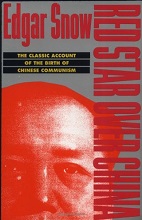
Red Star Over China: The Classic Account of the Birth of Chinese Communism – Edgar Snow

snow On October 1, 1949, the People’s Republic of China was officially established as the ruling party in the nation. Mao Zedong (Mao Tse Tung) 1893-1976) assumed the position of Chairman, a title he held until his death in 1976. The Chinese Communist Party continues to rule the country and imposes its will on Hong Kong. Taiwan remains independent but is often the source of friction between Beijing and western powers. The story of the Chinese communists is a highly intricate tale that is often left out of discussions regarding the aftermath of World War II (1939-1945). Edgar Snow (1905-1972) spent twelve years in China and was able to observe the emergence of the Communist Red Army determined to liberate China both from Japanese imperialism and the control of the White Army, led by the Kuomintang Government (KMT) headed by the Generalissimo Chiang Kai-Shek (1887-1975).  This book is a collection of those memories that take readers back in time to the era when Mao Zedong was beginning to establish himself as a leader and China found itself in the middle of political, economic and social turmoil.
The book was originally published in 1937 but Snow made several revisions.  The Kindle version is the Grove Press Revised edition as of December 1, 2007.  Putting that aside, the crucial text remains and Snow lets us take a look at what he saw and heard as Chinese communism came into existence.  At the beginning of the book, readers will find a good chronology of Chinese history from the mid-1800s onward.  It is not intended to be the final list of dates in China’s history as that is still being written. But it is a good reference source regarding important dates as the world continued to move forward.  It is important to remember that Snow left China in 1936, three years before Adolf Hitler (1889-1945) decided to unleash the German military on Poland and ignite World War II.  The focus here is on the situation within China’s borders as Tokyo set its sights on establishing firm control over the country.  At the same time, the KMT is mounting a resistance but a smaller group of Marxists, called “rebels” by Chiang, want an entirely new course for China, modeled on the Soviet way of life.  As a result, a three-way dance ensues in which all three take shots at each other with the Chinese people serving as collateral damage.

Within the story are numerous figures and keeping track of their names may prove to be quite tedious.  Some may stand out to readers while others will be unfamiliar. Each plays a role in the story at hand but undoubtedly, the stars in China are Chiang Kai-Shek and Mao.  Their influences and prestige cannot be overlooked and Snow provides transcriptions of the numerous discussions that took place with Mao as the Red Army built its base.  Further, Snow found himself in a unique position in history, as he explains with this statement:

“Mao was of interest as a personality, apart from his political life, because, although his name was as familiar to many Chinese as that of Chiang Kai-shek, very little was known about him, and all sorts of strange legends existed about him. I was the first foreign newspaperman to interview him.”

Mao beings to speak freely, about his childhood, China’s occupation by Japan and the vision of Dr. Sun Yet-Sen (1866-1925) whose vision for an independent China was the basis for the Red Army’s mission.

The beauty in this book is not only Mao’s statements but the way in which author explains the formation of the Red Army and the inevitable battle with Chiang Kai-Shek, which curiously could have possibly been avoided.  In fact, Mao himself informed Snow that the main focus of the communist was to see the removal of Japan, even if that mean cooperation with the KMT.  However, the Generalissimo had no intention of cooperating with the rebels. For Mao and the Red Army, Japan had to be removed at all costs but when pressed with Nanking’s involvement in freeing then nation, Chiang’s response set the stage for the future battle to come:

“Chiang Kai-shek replied, “I will never talk about this until every Red soldier in China is exterminated, and every Communist is in prison. Only then would it be possible to cooperate with Russia.”

Today we know that Mao eventually had the last laugh but not before Chiang struck one final blow in establishing the independent nation of Taiwan where he remained in seclusion after exile.  And to this day, the small nation remains a source of tension as the United States and other allies remained committed to its independence from Beijing.

No discussion about communist China is complete without the role of the Soviet Union, led by the infamous Joseph Stalin (1878-1953). And while he does play a minor role in the story, he appears at crucial points, most notably the Chinese Revolution.  Stalin’s support for Mao and the Red Army is critical in the struggle but the partnership was not always at ease and prior to the revolution, Russia played both sides of the fence as it made pacts with Japan while later resisting Asian and German expansion.  Stalin was shrewd leader but also full of paranoia and suspicion.  Regardless, Mao and the Red Army had their own vision for China and as Snow shows us, they were determined to accomplish their goal.  And not even the KMT would be able to stop their advance.  Mao’s destiny was to lead China and when discussing the future with Snow, he remarks:

“The Chinese revolution is a key factor in the world situation. … When the Chinese revolution comes into full power the masses of many colonial countries will follow the example of China and win a similar victory of their own. But I emphasize again that the seizure of power is not our (immediate) aim. We want to stop civil war, create a people’s democratic government with the Kuomintang and other parties, and fight for our independence against Japan.” 

The story is simply incredible and a must read for anyone interested in the history of the Chinese Communist Party.  Because Snow left China in 1936, the later events of World War II and the final battle with the KMT is not discussed in detail.  And there are other books which do focus on that era.  Snow’s purpose here is to enlighten us about the rise of Chinese communism and why it came into existence.  Admittedly, the author provides extensive information not just on Mao but on others equally important.  And readers may find it challenging keeping up with the names of those who enter the story. But what is paramount to remember is that each played their role in the Red Army’s rise and success, and their memories live on in the annals of China’s history.  And to put the finishing touch on their accomplishment’s Mao provides one final statement to Snow that says it all:

“Another reason for its [the Party’s] invincibility lies in the extraordinary ability and courage and loyalty of the human material, the revolutionary cadres. Comrades Chu Teh, Wang Ming, Lo Fu, Chou En-lai, Po Ku, Wang Chia-hsiang, P’eng Teh-huai, Lo Man, Teng Fa, Hsiang Ying, Hsu Hai-tung, Ch’en Yun, Lin Piao, Chang Kuo-t’ao, Hsu Hsiang-ch’ien, Ch’en Chang-hao, Ho Lung, Hsiao K’eh—and many, many excellent comrades who gave their lives for the revolution—all these, working together for a single purpose, have made the Red Army and the soviet movement. And these and others yet to come will lead us to ultimate victory. ” –

Great read and highly recommended.

ASIN : B005012G0G

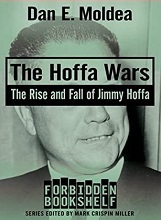
The Hoffa Wars: The Rise and Fall of Jimmy Hoffa – Dan E. Moldea

Hoffawars The disappearance of James Riddle Hoffa (1913-1975) still captivates audiences as shown by the success of Martin Scorcese’s The Irishman starring Robert Dinero as Frank Sheeran (1920-2003) and Al Pacino as Hoffa.  The film shows Scorcese at his best but the story told by Sheeran is known to be full of discrepancies.  Further, the Federal Bureau of Investigation (FBI) has never acknowledge Sheeran as being one of Hoffa’s killers.  Putting that aside, the movie is done very well and one of the rare times when Robert Dinero and Pacino have appeared on screen together.  But there is far more to the Hoffa story that is typically remember because of his fall from grace and disappearance on July 30, 1975.  I personally do not believe his body will ever be found and those who know what happened to him are either deceased or taking that secret with them to their graves.  However, in examining the Hoffa case,  we can focus on why he was killed which is just an important as how he might have been killed.  Dan Moldea has spent years covering the Hoffa case and is considered to be one of the best sources of information on the former leader of the International Brotherhood of Teamsters (“the Teamsters”).  And the result is a spellbinding story that peels the layers back uncovering a story that is nothing short of clash of the titans. 

I find that even today there is still a lot of confusion regarding the Teamsters and what exactly did happen when Hoffa was in power. In the preface to the book, we get a fitting summary that sets the tone for what is to follow:

“The Hoffa Wars tells an important story: how a potentially great force for good—the unionization of America’s truckers and warehouse laborers—was captured by gangsters and converted into a monster that robbed its members of their right to a fair wage and pension, robbed businessmen of their right to a free marketplace and clamped a high tax on American consumers every time they went to the cash register.”

When I first read these words, I admit that I had to reconcile them with the image I have had in my head of Hoffa who is typically portrayed as a benevolent figure that only wanted the best for Teamster members.  And while I have no doubt that he truly believed in the union, I also have to acknowledge that there was many dark secrets about the Teamsters hidden from public light.  As readers will see in the book, behind the scenes there was a power struggle taking place as the deposed king tried to reclaim his thrown.  Moldea leaves no stone unturned and the more unsavory facts about Hoffa’s reign come to light, shattering the myth of the “clean as a whistle”  union president who simply loves ice cream as portrayed by Pacino on screen.  The real Hoffa was a hard-nosed leader who had been through his share of battles in the process of unionization.  And the infiltration of organized crime and politicians proved to be too seductive even for him. The author untangles the complicated web so that we can see just how deep in bed the Teamsters found itself with the Italian-American  Mafia. 

Hoffa was in the process of writing his autobiography at the time of his death. I previously reviewed that book called Hoffa: The Real Story.  Therein, Hoffa does portray himself a fairly positive light. Moldea is not a fan of the book and views it as nothing more than a self-serving account.  I will leave it to readers to decide on their own but I can say that it is a good read to learn more about Hoffa’s early life.  What is clear here, is that Hoffa’s death removed any chance of him completing what surely would have been an explosive best-seller.  And it undoubtedly would have earned him even more enemies who wanted him removed from Teamster affairs permanently. 

The nexus of the book is Hoffa’s battles with Rolland McMaster (1914-2017) and Frank Fitzsimmons (1908-1981).  Moldea takes a close look at Local 299, which dragged Hoffa into an ugly power struggled that developed in the wake of Hoffa’s convictions for fraud by the U.S. Department of Justice.  The verdicts were the culmination of the “Get Hoffa Squad” organized by former United States Attorney General Robert F. Kennedy (1925-1968). The author provides a recap of their battle which was nothing short of savage.  McMaster, who had his own dark past, figures prominently into the story and provides valuable information to Moldea regarding what was happening as Hoffa became the tyrant who would not let go of power. And Hoffa’s successor, Fitzsimmons, has always been a person of high interest not only for taking over the Teamsters in Hoffa’s absence but also for his close alignment with the administration of President Richard M. Nixon (1913-1994), whose connections to the underworld are interesting to say the least. 

Historians are well aware of the bad blood between the Kennedys and Hoffa. And it has been suggested that Hoffa was part of the plot that took John F. Kennedy’s (1917-1963) life in Dallas, Texas on November 22, 1963.  And although there is no smoking gun to be found here, Hoffa was not sad to hear that Kennedy had been shot. Whether he actively participated in the plot to kill Kennedy will always be up for debate.  Much of the information revealed in this sotry comes from Ed Partin (1924-1990) whose testimony was once used to convict Hoffa.  And on an even darker note, Robert Kennedy was also the target of assassins, years before his murder on June 5, 1968 at the Ambassador Hotel in Los Angeles, California.  The story here by Moldea is quite disturbing and apparently, John Kennedy himself had been told of Hoffa’s thirst for revenge.  Exactly how Kennedy found out is not known but he did disclose it to reporter Ben Bradlee (1921-2014) as we learn in the book:  

“The President’s close friend, Benjamin Bradlee, who was then with Newsweek, noted in an entry in his journal for February 11 that the night before, at a private dinner party, the President had confided that Hoffa’s Teamsters had planned to send an assassin to Washington to kill his brother.” 

We know today that Robert Kennedy was not murdered while in Washington but the threat was very real. Robert Kennedy ultimately got his man and Hoffa was forced to stew in prison while the union he felt belonged to him, fell under the control of others.  And it was a position that Hoffa could not accept.  His obssesion with reclaiming the throne would have deadly repercussions later as Hoffa became suspicious of nearly all of his former subordinates. The list of enemies he had made continued to grow and dissent had resulted in splinter groups opposed to his dominance. Their stories are also included here as the story develops, showing that Hoffa was not idolized by all who knew him. 

The Hoffa story is further complicated by the association between the Central Intelligence Agency (CIA) and organized crime figures.  This part of the book may surprise some readers and as Moldea hints, it might have played a role in Hoffa’s death for reasons that have flown under the radar for years.  At this point in the book, we step into different waters as Jack Ruby (1911-1967), David Ferrie (1918-1967) and Sam Giancana (1908-1975) take center stage in plots to remove Cuban President Fidel Castro (1926-2016) from power.  There is a wealth of information but I feel that it is only the tip of the iceberg.  But Moldea did a good job of keeping the story streamlined and focused on Hoffa as the CIA-Mafia plot to kill Castro can easily be a book on its own.  This is Hoffa’ story and these events are only part of the full account. 

Readers should be prepared for many revelations about Hoffa’s life and the Teamsters.  And to be clear, there is no happy ending here.  This is a dark story filled with imposing figures whose lust for power and money knew no bounds. It is a story of paranoia, betrayal and murder.  And as Hoffa, McMaster and Fitzsimmons engage in their three-way dance, the Teamsters’ is forced to hold on while the saga plays out.   Unquestionably, Hoffa’s murder changed everything and Moldea goes through that day to piece together Hoffa’s final moments.  He does not profess to know who killed Hoffa but does explore possible scenarios.  Charles ‘Chucky” O’Brien (1933-2020) had been the focus of attention for decades after it was alleged he drove Hoffa to his final meeting where he was killed. O’Brien always maintained innocence and the jury is still out on whether he set up his former mentor.  Moldea explores his possible role as well but stops short of making accusations against O’Brien.  It is possible that the FBI knows who did kill Hoffa but has never said due to lack of physical evidence and a corpse. The Hoffa disappearance will never fade away as researchers continue to revisit the life of a man who cemented his place in American labor history.  If you are looking for a balanced report of the Teamsters, Jimmy Hoffa and his downfall, this is a good place to start.  Good read. 

ASIN : B00S7EFYRU

Basquiat: A Quick Killing in Art – Phoebe Hoban

BasquiatIf you look at cover of this book, you will see of deeply concentrated eyes staring back at you and it becomes instantly clear that behind those eyes is a long story yearning to be told.  When I saw this book in my list of recommendations on Amazon, I did not recognize the face. I had heard the name but admittedly, did not know anything about his life.  Those of us who find solace and deep interest in the arts are probably familiar with the life of Jean-Michel Basquiat (1960-1988), who in death has earned a place on the list of the best artists from the 1980s. In this stunning biography, author Phoebe Hoban explores Basquiat’s brief and unorthodox life.  And it is a story that is both hard to accept and difficult to ignore.  

One definition for the word tragedy is “a serious drama typically describing a conflict between the protagonist and a superior force (such as destiny) and having a sorrowful or disastrous conclusion that elicits pity or terror“.  It feels as though the definition could accurately describe Basquiat’s life.  At the time of his death he was twenty-seven and joins the “27 Club” of which Janis Joplin (1943-1970), Jim Morrison (1943-1971) and Jimi Hendrix (1942-1970), among others.  His untimely death sent the art world reeling and came the year after the death of his idol and one time mentor, Andy Warhol (1928-1987).  Following his death, interest renewed in his work and today, his paintings can sell for several million dollars or more.  Yet at the time he died, Basquiat had reached rocked bottom as drugs took their toll on his mind and body.   He could not escape fate and his ending is a true tragedy of another young artist gone before his time.  But the question here is just who was Jean-Michel Basquiat?  And how did this young man from Brooklyn become one of the most prominent artists of his time? 

When I learned that Basquiat was a product of my borough, my interest piqued.  New York City has produced some of the greatest personalities across all spectrums and Basquiat is a perfect example. However, he had multiple fronts, one of which was very darka as we learn of in the book.  The foundation for the path his life would take is laid early in the book as Hoban explains Basquiat’s early life with his Haitian father Gerard and Puerto Rican mother Matilde. Life at home is volatile and Basquiat was never able to form the bonds with either parent that are needed through adulthood.  The facts about his life that we learn of in the book are early indications of the recurring theme of his life: masking pain by taking extremes. As the story picks up pace, Basquiat’s journey leads to some unexpected places and art is never far away.  Native New Yorkers will fondly recall the 1980s Village in Manhattan, where artists could be whomever those chose to be and eccentric behavior was treasured ad encouraged. Drugs and art are central theme in Basquiat’s world and remain so throughout the entire book.  Perhaps no one pulled it off as well as Warhol, only rivaled here by Basquiat.  

Of course, love is a part of the story and Basquiat had anything but a normal dating history.  To sum it up, those parts of the book are surreal.  The list of paramours is long and even includes a well-known singer whom some might have guessed would have been Basquiat’s love interest.  Readers should be warned that it is also these parts of the book that are somewhat challenging to read as they reveal a very disturbing side to the late artist who never truly learned what affection and empathy were. But surprisingly, many of the women remained dedicated to him even while on the path to self-destruction.  Some, such as Jennifer Goode, saw the writing on the wall and abandoned ship before the fatal collision.  I wondered as I read, what would have happened had he decided to settle down with one of them? Perhaps he could have saved himself before it was too late.  We will never know for sure, but it is one part of Basquiat’s life that is revealed in the book, showing the artist in a revealing light that leaves more questions than answers.  I am not sure that anyone truly knew him on a deep level.  Trust is a theme in the book and it is reaffirmed in the book several times that he did not trust anyone.  His father’s influence and effect on Basquiat’s life is never far away.  And the two remained at a distance until the day Basquiat died.  

As his fame rises, he draws the attention of those high up in the art world, both on an artistic level and financial level.  Those figures are discussed in the book and even provide statements regarding their time and experiences with Basquiat.  He was far from easy to deal with and what they say shows a young man who never truly grew up.  Mary Boone, a one-time promoter of his work, explained her take: 

“Jean-Michel was a time bomb, and he was going to explode. I knew this when I first took him on,” she admits. “Unlike most of my artists, whether they are still with me or not, like Julian Schnabel, or Eric Fischl, or Ross Bleckner, these are artists I took my time getting to know, and that I felt I would represent for a long time. From the onset with Jean-Michel, it was never like that. I knew this man was like a butterfly. I knew that I would keep my hand open, and he would light on it when he wanted to, and fly away when he wanted to.” 

Great artists walk a very fine line between genius and insanity. For Basquiat, it seemed as if he wanted insanity over anything else.  His hijinks and highly erratic behavior gives rises to questions about his mental state. But we are never really sure if he truly means what he says or if he created a persona that had to be lived up to.  Some people interviewed for the book felt that he was as genuine as one could ask for.  Others saw the dysfunction in him from his childhood and the closest to him knew that he was on a path to destruction and had no desire to change course.  Ironically, in death he achieved the fame that he had not yet quite reached in life, even as a protégé of Andy Warhol.  The story of their first meeting, later and falling out is included in the story, adding another dimension to his life.  To drive home the story, Hoban includes snippets of Warhol’s personal diary, in which Andy is frank about Basquiat and the direction his life is taking. Their relationship came to an end due to an infamous op-ed that gave the impression of Basquiat being Warhol’s sidekick.  However, Warhol’s death did affect him and Hoban relates that: 

“On February 22, 1987, Andy Warhol, who had reluctantly checked into New York Hospital for what should have been a routine emergency gallbladder operation, died. In a sense, so did Basquiat. According to those who knew him best, he never recovered from Warhol’s death.” 

Warhol was not part of the 27 Club but certainly died before his time as well. For Basquiat, it would only push him further down his ill-fated path.  But before then, he would create dozens of paintings that have gone on to achieve world-wide acclaim. 

The world may never see another Jean-Michel Basquiat but in this book, his continues to live on. And had he been able to read this book, I can only imagine what his reaction would be.  It has been said that great artists see life through a different lens. This is certainly true for Basquiat, who marched to the beat of his own drum.  And behind the brilliant artist was  Mr. Hyde ready to come out and embrace the darkest demons any of us could take on.  He loved art but struggled with personal demons and being a black artist in a white artistic world.  His life can serve as an example of the importance of the father and son relationship that guides a boy into manhood.  Gerard Basquiat never had the chance to reach his son but for the fathers that might read this post, this book will show you exactly why your role in the lives of your child or children is extremely important. But I believe you already know that. 

If you are a fan of Jean-Michel Basquiat, this book is a must read. It is not easy to go through at times and he never presents himself as an angel.  He was a man of several faces, each with its own set of issues.  But to accept him is to love him and author Phoebe Hoban shows this brilliantly as she brings him back from the past and to the present.  This book is an excellent account of his hauntingly short and tragic life.   Highly recommended. 

In Basquiat’s paintings, boys never become men, they become skeletons and skulls. Presence is expressed as absence—whether it’s in the spectral bodies and disembodied skulls he paints or the words he crosses out. Basquiat is obsessed with deconstructing the images and language of his fragmented world. His work is the ultimate expression of a profound sense of “no there there,” a deep hole in the soul.” – Phoebe Hoban