Double Play: The Hidden Passions Behind the Double Assassination of George Moscone and Harvey Milk – Mike Weiss

20210218_174427

On Friday, November 18, 1978, San Francisco City Supervisor Harvey Milk (1930-1978) sat down and pressed play on a tape recorder. The reason for the recording was that Milk wanted his words played in the event of his assassination. As a gay politician in the political spotlight in San Francisco, Milk knew that made him a target for rivals and others who disapproved of homosexuals. Less than two weeks later, he was shot and killed on November 27 along with San Francisco Mayor George Moscone (1929-1978) by former District 8 City Supervisor Dan White (1946-1985). After shooting Milk and Moscone, White left City Hall, called his wife Mary Ann who accompanied him to a police station where he turned himself in. To San Franciscans, it must have seemed as if all hell was breaking loose. On November 18, news reports from Guyana had alerted the world to the massacre at Jonestown, Guyana where Jim Jones (1931-1978) and the People’s Temple Church had settled after leaving the United States. More than 900 people died in the mass suicide and murder. Jones escaped the poisoning and instead died from a gunshot wound to the head. The double murders at City Hall sent the city into turmoil and White’s arrest left his former colleagues stunned. White was ultimately convicted of voluntary manslaughter on May 21, 1979 and the verdict set off pandemonium in the city which became known as the White Night Riots. To many, the crime did not make any sense, both White and Milk were beloved by their constituents and highly popular. But beneath the surface, tensions were simmering in the cut-throat world of politics and as author Mike Weiss reveals here, there were hidden passions behind the double assassination.

Some readers may be familiar with the assassinations and may have lived in San Francisco during the time in which the events took place. The book is written in such an engaging style that even readers who know nothing about any of the figures will be able to follow the story without issue. In fact, Weiss provides a recap of the lives of Moscone, Milk and White before jumping into the crazy atmosphere of politics in San Francisco. What I noted as I read is that the book is really three stories in one that merge towards the end as the tragic finale plays out. Personally, I was previously familiar with the story, having read Randy Shilts’ The Mayor of Castro Street and Milk’s An Archive of Hope. And my friends will tell you that Milk is one of my favorite films and Sean Penn absolutely nailed his role as the slain politician. In January 2018, I visited San Francisco and was fortunate to visit the Castro. My girlfriend at the time did not know much about Milk having grown up in another country, but I quickly filled her in and had her watch the film before we departed from New York. Today, what used to be Castro Camera is now the Human Rights Campaign office. But upstairs, is a cut out of Harvey looking down over the street he called home for some of the years he lived in San Francisco. At the time of his death, he had been living in a different location as shown on his swearing in card which is included in the book. Although I knew a significant amount of information about Milk’s story, the book was eye-opening and is filled with seemingly endless bits of information. The author takes us deep behind the scenes so that we can learn what really had been taking place between the politicians at City Hall.

White is undoubtedly the central character in the story for obvious reasons. And while Weiss does shift the focus at times to either Milk or Moscone, we always come back to White as he breaks into politics, a world he was wholly unprepared for. After parting ways with Goldie Judge and connecting with Ray Sloan, White sharpens his appearance but his success in gaining a seat on the Board of Supervisors could not help his personal issues which are explored by the author in ways that I have not seen before. In the film, Josh Brolin delivers a good performance, but the script left much out regarding White’s past. It did capture the essence of his character which is unraveled here. And what we learn, is that the world in which Dan White lived was quite dark.

Moscone is the book’s protagonist but what we learn about the persona life of the mayor is sure to surprise some. There were many things that I did not know about Moscone and in the movie, his character is given limited screen time. Victor Garber was convincing as Moscone but his laid back and composed appearance stands in contrast to the larger-than-life Moscone that we learn of in the book. The mayor in this story is anything but laid back and his antics are sure to repulse more conservative readers. However, Moscone knew how to use the system and his shrewdness as a politician is clear. But I can only wonder how he escaped scandal for as long as he did. Weiss spills a lot of the dirt and it will leave you shaking your head. Despite his personal shortcomings, Moscone knew how to appeal to those whose votes he needed the most and we can only speculate as to where he would have gone next after serving as mayor.

Harvey is the book’s star in the sense that as opposed to White and Moscone, Milk comes across with vastly different energy. But like the other two, his personal life was a mixed bag, and the film showed this the way things were. Diego Luna brilliantly brings Jack Lira back to life on the silver screen and paired perfectly with Penn. But, as we see in the film, Milk had other lovers who had taken their own lives. And in contrast to how it is portrayed in the film, Milk was far more familiar with San Francisco than I had realized. Any book about Milk will undoubtedly discuss the concept of homosexuality. Weiss does not overly focus on the matter and does a great job of keeping the subject relevant without the book having the feel as if it has bias one way or the other. In fact, as I read through the book, the story was so engaging that Milk’s orientation became a complete afterthought. The suspense in the book is kept on high and I assure you that once you start reading you will be hard pressed to put the book down. It really is that good.

As the story moves forward, it becomes clear that the three main figures are on a collision course through destiny. Weiss provides a daily summary of the week leading up to the murders, beginning roughly after the events at Jonestown. By the time the assassinations take place, the metaphorical three-way dance the three were engaged in becomes vividly clear. Milk is the link between Moscone and White but all three have their own agendas and ambitions putting them in inevitable conflict with each other. The day of the murders is discussed from start to finish and includes details left out by filmmakers, in particular the role of Denise Apcar, White’s assistant at the time of his resignation. The supervisor would famously change his mind about resignation and ask for his former job back, sparking a heated discussion with Moscone a week before the murders. And as White commits the violent homicides, chaos erupts at City Hall with police converging on the building from all angles in search of the former supervisor. The President of the Board of Supervisors, Dianne Feinstein, suddenly finds herself thrust into the mayor’s seat and her importance in the story cannot be understated. Today, she is still going strong as a member of the United States Senate. Following White’s surrender, he is interviewed, booked and officially charged with murder. But this is just the beginning and trial that ensued, which is summarized exceptionally well by the author will leave you staring in disbelief.

Today, we know which verdict the jury reached but at the time the trial, most people knew White would be convicted but no one was sure on which charge it would be. In the courtroom, prosecutor Thomas F. Norman (1930-2009) and defense lawyers Doug Schmidt engage in a fierce battle while White’s fate hangs in the air. The author summarizes each showing their personalities and skills as legal professionals. But what is more important, is that Weiss shows how and why the jury reached its verdict. This includes the missteps by the prosecution and and the brilliance in the defense already hindered by White’s own statements to the San Francisco Police. A complex game of chess is on display as each side seeks to outmaneuver the other. In the end, White escaped first degree murder, but by then he was already a broken man. Following his conviction and transfer to Soledad State Prison, we learn more about his post-conviction life through the author and the reality he faced upon release in 1984. And White’s final days are also revisited, providing a haunting closure to an incredible book.

If you are in search of a book that fully explains the murders of Milk and Moscone, you cannot go wrong with this beautifully written account by Weiss. And if you have never watched it, I strongly recommend Rob Epstein’s award-winning documentary The Times of Harvey Milk which I am sure you will find to be a solid film about his life. I enjoyed the documentary myself but loved reading this just a little more. Highly recommneded.

ISBN-10 : 0982565054
ISBN-13 : 978-0982565056
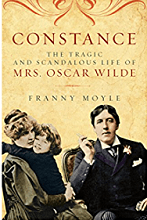
Constance: The Tragic and Scandalous Life of Mrs. Oscar Wilde – Franny Moyle

ConnieIt is no secret that I absolutely love books and this blog is proof of that. The discovery of new reading material literally gives me a dopamine rush that only fellow bookworms can understand. When I saw this book about Constance Wilde (1858-1898), the wife of the late playwright Oscar Wilde (1854-1900), I knew that I had to purchase it. I often quote Wilde in conversation and when writing.  He had a keen sense of human nature and his quotes still hold true today.  At the height of his career, his plays were a hit, and the money was rolling in. But a scandal surrounding his sexual orientation changed all of that and left him a bitter and broken man. His story is complicated but what is often left out of it, is the role of his wife Constance whose own story is equally as moving.  Author Franny Moyle takes a look at her life in this biography that just might make you look at the Wildes in a very different light.

Admittedly, I did not know an extensive amount of information about Constance Wilde.  I knew that Wilde himself had been married and that he was also known to have relations with men.  But what I found in the book far surpassed any of my expectations.  Although Wilde made his fortune in England, their story actually begins in Ireland, where both of them are born.  Moyle provides a brief history of both families before the couple ties the knot.  Within a couple of years, they welcomed two sons, Cyril (1885-1915) and Vyvyan (1886-1967).  To outsiders, the Wildes’ marriage must have seemed like a fairytale come true but behind the scenes there was far more to the story. In fact, the argument could be made that the best part of their marriage was the wedding itself.  Oscar was not known to be simple by any means and the pictures that survive today emphasize that. Constance had signed for a roller coaster ride with a man whose life would be anything but ordinary.  And in the process, she would go through her own trials and tribulations, related mainly to the emotional turmoil created by the man she loved and his “sons”.  At first, the couple has a fairly normal existence with Oscar even attempting to obtain a regular job.  But as fame sets in and the playwright is allowed to indulge in his fancies, trouble slowly brews.  And in conservative Britain, it only spelled doom for the future to come. In nineteenth century, England, sexual freedom was restricted and to be homosexual or bi-sexual was extremely risky and opened on to blackmail quite easily.  Oscar did not seem to mind and his relationships with the same sex were carefully kept secrets by close associates.  His drift away from Constance took hold when Robbie Ross (1869-1918) enters the story and accelerates when he meets Lord Alfred Douglas (1870-1945), known as “Bosie”.  The young Lord would play a crucial role in the lives of both Oscar and Constance in ways they could never have imagined.

There is so much material about the couples’ life that it is easy to forget that Constance is the focus of the book.  And although Moyle covers Oscar’s escapades to highlight the growing distance between husband and wife, she does make sure to tell Constance’s story as well which has its own interesting moments.  One of them is undoubtedly her interest in the occult and association with the Golden Dawn, which we would consider to be a secret society.  Whatever Constance did believe, organized religion was not at the top of her list.  Further, she comes across as quite liberal for her time and fully believed in woman’s rights. Her efforts to help other ladies of stature excel in life are shown to emphasize her standing in society.  But in spite of her successes and fame, her relationship with her own children was complicated as well in particular with younger son Vyvyan.  As Moyle explains, Vyvyan was aware of his mother’s feelings and she relays his thoughts in this passage:

“When he grew up, Vyvyan acknowledged the fact that he was something of a disappointment. He adored Constance, he said, but noted that I was always conscious of the fact that both my father and my mother really preferred my brother to myself; it seems to be an instinct in parents to prefer their first born … I was not as strong as my brother, and I had more than my fair share of childish complaints, which probably offended my father’s aesthetic sense … And most of all, both my parents had hoped for a girl.”

Mother and son started off rough but there are bright moments in the story, particular towards the end.  Constance’s brother Otho Holland Lloyd (1856-1943) adds a crazy sub-story that left me shaking my head. Oscar’s brother Willie Wilde (1852-1899) is perhaps the most tragic figure in the entire story, but he is mentioned only on occasion.  Readers will notice that Constance is plagued by a mysterious illness that becomes crippling as the story progresses.  At the time, doctors had very little knowledge of what was taking place but this article sheds light of what is the most likely explanation for her decline and demise.  It is clear in the story that the bouts of pain are debilitating, and I can only imagine the level of discomfort she must have been in.  Added to that misery was Oscar’s galivanting across Europe with young men, putting himself and the family at risk.  Oscar becomes engulfed in his new world without a care in the world, but every story has its antagonist and that applies here in the form of John Sholto Douglas, 9th Marquess of Queensberry (1844-1900), who was Bosie’s father.  At this point in the book, the story takes a dark and tragic turn resulting in Oscar’s downfall, marriage turmoil and Constance’s flight to save herself and her two boys.

As I read through the story, I could not help to think that Oscar was either crazy, oblivious or so sure of his well-kept secrets that he did not stop to consider that his alternative lifestyle could be his demise.  Queensberry was certainly a rough figure and Oscar had too much ego to make a retreat.  Instead, he meets fire with fire and thus, the stage was set for the battle that changed Wilde’s life and that of his family.   A scandal of that magnitude would hardly register in 2020 but in 1895, tolerance was nothing like it is today and Oscar soon learned that a steep price was to be paid for his extravagance, and his life with Constance was never the same again.  Readers will feel a sense of loss and grief as the playwright’s mental and physical health declines while incarcerated. And although Oscar does get released, his best days are behind him but incredibly, his spirit is not completely broken. I stared in shock while reading about his actions after leaving prison.  It was one more episode in the crazy and unorthodox life of Oscar Wilde.

Constance plays a significant role in Oscar’s well-being while in jail and following his release.  But her duty was to her two sons and she does shy away from doing whatever is needed to protect her two boys.  However, her love for Oscar never wavers but she makes it clear to him where she stands.  And as the couple sees each other for the last time, a sense of dread hangs over the story.  Towards the end, they were separated geographically with Constance in Genoa, Italy and Oscar Paris.  They are two tragic figures bonded by marriage, parenthood, and their love for the stage. Today, Constance Wilde is hardly mentioned in discussions about the famed playwright, but she was far more important than most have realized.  Yet, she did live a tragic and scandalous life that is capture here for all to see.

““The very essence of romance is uncertainty.” – Oscar Wilde

ASIN : B009DA5RCE

Incidents in the Life of a Slave Girl – Harriet Jacobs


JacobsUndeniably, slavery is one of America’s darkest moments.  It was an extremely dehumanizing system of exploitation and violence that destroyed families, claimed lives and helped propel the nation towards the Civil War.  Even today, the issue is hotly contested as we continue to reconcile with its residual effects.  We have come a very long way from the era of legalized slavery in the United States but still have a long way to go before achieving true equality for all.  Black Americans have long suffered grave injustices but there is no need to go into them here.  Instead, the focus will be on this autobiography that was written by a former slave named Harriet Jacobs (1813 or 1815 – 1897).   In the book, the main character has the pseudonym of Linda Brent, who is the slave of the book’s antagonists, Dr. Flint and his family.  And what she reveals about her life reaffirms the many dark truths about a slave’s life. 

It may be hard for some readers to even approach the subject matter due to its nature but in the early 1800s, Jacobs’ experience was the daily reality for thousands of black men and women living in the Deep South. However, in this case there is a rare exception: Linda knows how to read and write.  Generally, it was deeply forbidden for slave to become literate and nearly all faced death if it was discovered they had been reading and writing without the slave-owner’s knowledge.  After introducing us to her immediate family, the story picks up in pace when Dr. Flint enters the picture.  Linda finds herself maturing and catches the roving eye of the doctor, resulting in Mrs. Flint making Linda the target of her rage. Dr. Flint’s infatuation sets the tone for the rest of the book which is a struggle between good and evil until the very end. Linda’s brother Benjamin, provides us with the first act of resistance which shows how many blacks refused to be part of the degrading system of slavery.  He would not be the last and even news of Nat Turner’s (1800-1831) rebellion reaches our main character.  Linda possesses a keen eye to observe the dysfunction of slavery and American society.  She reflects on the plight of the black man and makes a statement that captures the very essence of humiliation and degradation endured by black people: 

“I admit that the black man is inferior. But what is it that makes him so? It is the ignorance in which white men compel him to live; it is the torturing whip that lashes manhood out of him; it is the fierce bloodhounds of the South, and the scarcely less cruel human bloodhounds of the north, who enforce the Fugitive Slave Law. They do the work.” 

Dr. Flint is relentless in his pursuit and develops a fanatical obsession with ruling every aspect of her life.  The two engage in a cat and mouse game with Linda doing her best to avoid the doctor’s advances.  Her grandmother serves as her guardian angel but is limited in her capacity due to her status as a slave.  Linda eventually becomes a mother herself and the rage of the doctor at this perceived “indignation” only reinforces her will to one day become free.  The moment of clarity that comes to her, sets the stage for the second part of the book as she makes her break and finds a way north with the help of another guardian angel who finds a way for her to go north to the Free States. 

Upon arrival in the North, Linda soon embraces a new world.  And while prejudice still exists, she is finally able to live on her terms and away from the doctor. But he proves to be more resilient than expected and his actions to reclaiming her provide the remainder of the book with its heightened suspense that will keep readers in its grip. Linda moves throughout the Northeast, stopping in Philadelphia, New York and Boston.  And incredibly, she experiences a trip abroad that widens her perspective on life in America.  Before returning she informs us that: 

“I remained abroad ten months, which was much longer than I had anticipated. During all that time, I never saw the slightest symptom of prejudice against color. Indeed, I entirely forgot it, till the time came for us to return to America.” 

Although prejudice did and does exist in Europe, the American system of slavery is noted for its brutality.  And America’s dark past with Jim Crow and other systems of discrimination have had profound effects on current day affairs. But her comment, reminds me of how the legendary musician Miles Davis (1926-1991) felt about Paris and returning to America.  Linda does love her country and has found happiness in the North, far removed from the clutches of Dr. Flint.  But a series of events results in her relocating to escape slave hunters. And the Fugitive Slave Act of 1850 sends shockwaves through the communities of free blacks and Abolitionists determined to end slavery once and for all.   She does not fall victim to the act in the story and continues to live as a free woman, due to the interventions of a close friend who could not accept seeing her constantly fleeing for her life.  Dr. Flint also meets his fate in the book and it helps bring the story to the conclusion we all will be hoping for.  And although this is just one account of life in bondage, there were millions of others who had similar experiences.  This story is a critical part of America’s dark and ugly past that continues to haunt us today.  Highly recommended. 

Study the past if you would define the future”  ― Confucius

ASIN : B08LG95G3G

William L. Shirer: Twentieth Century Journey: The Start, 1904–1930; The Nightmare Years, 1930–1940; A Native’s Return, 1945–1988 – William L. Shirer

shirer Quite some time has passed since my last post, mainly due to work matters and my being fully invested in finishing the book that is the subject of this review.  Originally, I had planned on reading this three-part autobiography by William L. Shirer (1904-1993) one book at a time but Amazon also offers them combined and I decided to take the plunge.  Shirer  is by far, one of my favorite authors and there was no way I could pass this one up.  Some of you may be familiar with him and recall that he is best known for his time as a CBS correspondent stationed in Nazi Germany during Adolf Hitler’s (1889-1945) rise to power. Upon returning to the United States, he moved to radio full time and lived the rest of his years as an author of historical non-fiction that has stood the test of time. 

At the onset, I did not fully appreciate the length of the material.  And to say that the e-book is a long would be an understatement.  But contained within is an incredible story by one of America’s greatest witnesses to history.  Up first is volume one called “The Start” and his story begins in the Midwest in Cedar Rapids, Iowa on February 04, 1904, shortly after the turn of the century.  America was a very different place and Shirer is a master storyteller who brings the distant past back to life, allowing us to re-live what it was like in a time before cars, planes and the modern technology we take for granted daily.  As Shirer tells his story, he reveals something about his family’s ancestry that would later be a source of irony in the book. To be more specific, Shirer explains: 

“The family name originally was Scheurer, a fairly common name in the German Black Forest region. Some time during the trek west it was Anglicized to Shirer. My grandfather attached no importance to the change, explaining to me once, when I asked him, that it was done mainly because the town officials and tradesmen mistakenly kept writing it the way they thought it sounded, and it was simpler to go along with them.” 

In a twist of fate, the author of German stock, would make his name famous by reporting on the atrocities of the Third Reich in his family’s fatherland.  But Germany was not his first destination as a foreign news correspondence. In fact, Germany was not even on his list of places to be stationed.  How and why he left the United States to work in Europe is fully explained and it is clear that from a young age, Shirer’s life was destined to be anything but ordinary.  It surely was a complex fate and Shirer sums up the turn of events in this passage: 

“I had come over to Europe for two months. As it turned out, I would remain there to live and work for two decades, experiencing and chronicling the remaining years of an uneasy peace, the decline of the democracies, the rise of the dictatorships, turmoil, upheaval, violence, savage repression, and finally war.” 

Shirer did return to the United States early in his career, but a meeting with Robert Rutherford “Colonel” McCormick (1880-1955) of the Chicago Tribune turned out to be more than he could ever expected and set him down the path that would take him back to Europe and finally Berlin, where he would witness the rise of Nazi Germany.  The first volume is a good and Shirer’s memories of his time in Europe wherein he convalesced with some of the greatest writers and stars are interesting.  Among the many stars who make an appearance are literary greats Sinclair Lewis (1885-1951), Gertrude Stein (1874-1946) and Ernest Hemingway (1899-1961).  Shirer is like a human recorder, observing everything and brining the past back to life through his words.  It becomes clear that Europe is a second home and a place more familiar to him than the United States.  And though he would eventually return home, the reader will begin to see that Europe is the place where the best is yet to come and his to Germany in the second volume called “The Nightmare Years”, is where we see the William Shirer that most of us will be familiar with.  

In the second volume, Berlin takes center stage as Hitler is ramping up the Germany war machine as part of his master plan to dominate Europe. But first, he moves to annex neighboring countries without the use of force and Shirer revisits each episode to explain how Hitler pulled off those feats and why no one moved to stop him.  It will make some readers wonder whether World War II could have been prevented as early as 1938. Hitler seized on the inaction of Britain and France, setting his sights on Poland. But this time, people did step in and the world went to war.  Shirer, who had left the Chicago Tribune in a weird series of events that is discussed in the book, was hired by legendary broadcaster Edward R. Murrow (1908-1965) to become the CBS Correspondent in Berlin. This change of fate placed Shirer at the scene of the crimes so to speak as the Nazi regime plotted and schemed its way to become a looming threat across an entire continent. 

His interactions with the German officials are particularly amusing and reveal the façade presented to ordinary Germanys by the Nazis who had assured them that Germany did not want war with anyone.  Reich Minister of Propaganda Joseph Goebbels (1897-1945) makes repeated appearances throughout the story and the full extent of his delusion is on display.  Shirer gives his analysis of Goebbels and the other characters in Hitler’s inner circle whose names are infamous in world history.  I believe Oscar Wilde had it right when he said “the world is a stage, but the play is badly cast”.  However, in Nazi Germany, the cast was not only but deadly to anyone deemed inferior or Jewish.  Shirer does not go into the issue of the concentration camps extensively and I believe to do so would have required a different book. But he does bring up the matter later on during the Nuremberg trials. This part of the story is focused on the rise, menace and fall of Nazi Germany but in a highly compressed format.  Also, Shirer and his family left Germany in 1940, five years before the Germany military surrendered to Allied forces. His return home and life after war are covered extensive in volume three titled “A Native’s Return”. 

Upon returning home, Shirer starts the process of becoming re-acclimated with his native land. I do not believe he ever imagined how his life would change as he re-settled in America.  He found a place on radio but his relationship with Murrow takes a strange turn and Shirer goes through the entire story of his departure from CBS. I have not heard Murrow’s side if he ever put it in writing or gave statements orally.  But, the influence of former CBS president William S. Paley (1901-1990) is clearly evident and cast a dark cloud over the events as they play out.  But Shirer does not stay down for long and moves through life facing adversity head on.  And one decision in 1954, changed his life and reputation forever. It was then that he decided to write his masterpiece, The Rise and Fall of the Third Reich: A History of Nazi Germany, a book that remains among my favorites.  What I found surprising through Shirer’s words is that originally, no one wanted to publish the book.  It sounds mind-boggling today but I can understand that in 1954, a book over 1,000 pages was not an easy sell and still is not.  But in writing that book, Shirer created the definitive account of the Third SS Reich.  

Following the success of the book, Shirer embark on another project about the French defeat in World War II, a book which I have added to my list.  That book’s creation and reception are explained and shows the extent of knowledge Shirer possessed with regards to the war.  As the third volume progresses, he offers his continuing commentary on historical events in American history from Watergate to the Iran-Contra scandal.  And his frankly discusses his personal problems including the relationship with his wife Tess and his heart problems in later years.  Incredibly, Shirer never stops moving and even fulfils is dream of seeing Russia.  A good recap of that trip is also included in Shirer’s signature writing style.  As the third volume winds down, Shirer provides an overview of his life and those of his closest friends who all meet their own ending in various ways.  It truly is an incredible story of a journey through a century that changed our world.  As an American, he was placed in a unique position observe the world and as a final reflection, Shirer closes the three-part series with this quote that I personally can relate to for a number of reasons: 

“It was a complex fate, maybe, as Henry James said, to be an American and one, I realize, not especially admired by some in other countries and other cultures, who perceived us as “the ugly Americans.” Still, as I wrote in the last line of the general introduction, I am glad it was mine.” – William L. Shirer 

B08L9JTCYQ