
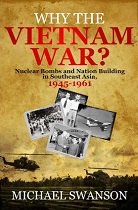
 Fifteen days from now, the fifty-eight anniversary of President John F. Kennedy’s (1917-1963) murder will be upon us. His death continues to remind America of a lost opportunity and leader taken before his time. His presidency inspires debate to this day with some believing that he brought the country dangerously close to nuclear war with the Soviet Union. Others feel that he had yet to reach his full potential as a leader. The truth is far more complicated and both sides often omit the difficulties Kennedy faced behind the scenes from those within his own administration. After the disastrous Bay of Pigs invasion which led to Kennedy firing top officials of the Central Intelligence Agency, he then found himself under pressure to intervene in the nation of Laos. Again, Kennedy resisted, drawing the ire of the Joint Chiefs of Staff and Cold-War hawks in Washington. But the hawks were determined and saw Vietnam as the next battlefield to confront “Soviet influence”. But the question that has always haunted this nation is why did we get involved in Vietnam? What threat did North Vietnam pose to the United States even though it is more than thirteen thousand miles away from American soil? My uncle who served in Vietnam has only spoken of his experiences a handful of times. He keeps the war suppressed in his memory and does his best to stay secluded during July 4th celebrations as the fireworks remind him of being in combat. I often wondered if he has asked himself why he was deployed thousands of miles away from home to a country some Americans did not know existed prior to the conflict. Michael Swanson asked himself about Vietnam and has explored the war paying close attention to its origins and this book is the first of what will be a multi volume set about America’s involvement in Southeast Asia.
Swanson quickly establishes that the Vietnam War started sixteen years earlier than 1961. In fact, the war has its origins in the ascension of North Vietnam to power in the wake of World War II. The evacuation of Japanese military personnel created a power vacuum that allowed the North Vietnamese to take control and establish its headquarters in Hanoi. Washington was paying close attention to the developments and the rise of Ho Chih Minh (1890-1969). He was known as Uncle Ho and proved to be a charismatic figure as well as an icon for millions of Vietnamese who strongly favored an independent Vietnam, free of French colonial rule. And this is what policy makers in Washington failed to realize. However, there were those on the ground who saw Ho Chih Minh’s potential and the futility of French attempts to reclaim Indochina. In the book, we learn the name of former Lieutenant Colonel Archimedes Patti (1913-1998), a former Office of Strategic Services officer who emerges as the voice of reason no one wanted to hear. Patti warned officials back in Washington of what he saw firsthand but sadly, his reports were shelved. And when reflecting back on the war, Patti stated:
“Ho Chi Minh was on a silver platter in 1945,” remembered Archimedes Patti, “we had him. He was willing to, to be a democratic republic, if nothing else. Socialist yes, but a democratic republican.
I recall a Vietnam veteran years ago telling me that he couldn’t understand why America got involved after seeing the French evacuate. He was drafted at 19 and has always maintained that Vietnam was one of the scariest experiences in his life. His question was valid. Why did we take the place of the French and why did we help them in the first place? The author pieces together the story to show Washington’s early involvement in French affairs and I could only shake my head at what he reveals. But there is always more than meets the eye. Swanson knows this and proceeds to explain what was taking place back in Washington that paved the way for such disastrous foreign policy. In fact, he bluntly states that after World War II:
“The United States, however, sought to control societies in order to improve them, in order to incorporate them into the modern capitalist world order through nation building. But becoming an empire changed the United States forever, and led it to fight a disastrous war in Vietnam.”
When John F. Kennedy took office, he had to have known the difficulties he faced from what his predecessor Dwight E. Eisenhower (1890-1969) called the military industrial complex. However, what Kennedy may not have known is that America’s involvement in Vietnam did not start with Eisenhower but with another president, Harry S. Truman (1884-1972). This part of the story came as a surprise because the focus on Truman’s actions in office are often related to World War II and the National Security Act of 1947. But it does make sense that his role is revisited as Vietnam began to draw Washington’s attention not long after the Japanese surrender. I could not help when reading the story that had Truman decided not to get involved in Vietnam, world history might have taken a different course. As the story moves forward, Eisenhower’s administration passes with Vietnam remaining a French issue. It remains dormant until, when the intelligence community and military found itself irate over the president’s refusal to support military intervention across the globe. And it is here that the Vietnam story heats up and Swanson takes us deep inside Kennedy’s administration to explain the true reasons for military engagement in Southeast Asia.
Kennedy had sought to prevent Americans from getting engulfed in a ground war in Vietnam. Swanson captures the essence of the story here and I strongly recommend John Newman’s JFK & Vietnam: Deception, Intrigue and the Struggle for Power which discusses JFK’s battles with his own cabinet and the Joint Chiefs over escalation. Newman leaves no doubt that Kennedy knew Vietnam was a deathtrap for American forces. But war hawks were not ready to admit it and as Swanson shows, a power struggle did in fact take place with a majority of people pushing Kennedy to approve troops and the president pushing back against them. Readers will express surprise at the actions of those working “for” the president. Kennedy was struggling to maintain control over his own administration. Readers with an interest in his assassination will find this aspect of the story highly relevant.
Vietnam veterans known dark truths about the war that many would prefer not to know. Swanson’s job here was not to pacify anyone but to explain why Vietnam happened. And in order to understand the war, it is crucial to understand the importance to Washington of South Vietnam and its former leader Ngo Dinh Diem (1901-1963). Admittedly, there is much about his life I am still learning of, but I now have a better understanding of the truth in regard to South Vietnam and why personnel stationed in the country were sounding the alarm bells to those in power in Washington. And what I read resulted in anger at those who knew the issues in South Vietnam and the low chance of success. Frankly, Washington knew it could not win in Vietnam without a massive commitment of troops and the use of nuclear weapons. But the public backlash at those two concepts would have been political suicide so America had to operate in a limited capacity. But the pressure to invade never let up and as the story moves forward, the stage is set for a showdown between Kennedy and the military industrial complex. However, the book ends before the tragic fates of Diem and Kennedy play out. As Swanson explains, that will be the focus of the next part in the series. But he does summarize the story contained within with this statement that sent chills down my spine:
“The more hawkish members of the Joint Chiefs of Staff viewed Southeast Asia as simply part of a conflict with China over who would control the entire region. When they advocated intervention in Laos in 1961 their plans were for a regional conflict that carried with it a ladder of escalation, the final step of which was an atomic attack on China if they retaliated, one in which they thought they could break the back of Red China.”
Kennedy himself said it best when he observed: “These brass hats have one great advantage, if we … do what they want us to do, none of us will be alive later to tell them that they were wrong.” We can only speculate as to what would have transpired had he lived. I personally believe that the Vietnam War would have never happened. Kennedy was determined to resist the military and dismantle the Central Intelligence Agency but the events in Dallas, Texas on November 22, 1963, changed that permanently. His successor Lyndon B. Johnson (1908-1973) had different plans for Vietnam, and they included the flexing of American military muscle that claimed the lives of fifty-eight thousand Americans and over one million Vietnamese. It remains the war that America did not win. And there thousands of veterans alive today still carrying the scars from that war. If you want to know why the Vietnam War happened, this is a good place to start.
ASIN : B08FHBS17K
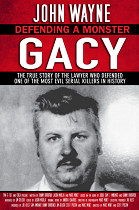 On May 19, 1994, American serial killer John Wayne Gacy (1942-1994) was executed by lethal injection at Stateville Correctional Center in Joliet, Ill, after being convicted of multiple murder charges. It is believed by some people that there were more victims of Gacy that have never been identified. The truth went to the grave with Gacy but what is on the record are the thirty-three homicides attributed to Gacy during his reign of terror. His attorney, Sam Amirante, had just started his own private defense practice when Gacy sought him out for legal representation. Amirante could not have known that his first client would catapult him into the public spotlight in ways none one could have imagined. This is the story of how it happened and how Amirante’s life changed while he defended one of America’s deadliest serial killers.
 FREETHINKING BIBLIOPHILE
You must be logged in to post a comment.