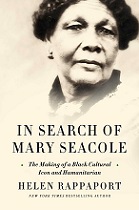
In Search of Mary Seacole: The Making of a Black Cultural Icon and Humanitarian – Helen Rappaport

Seacole

One of the reasons I love to read is because there is always something new to learn. In fact, I would go as far to say there is always a new story waiting to be learned of. I saw this book while browsing for a new read and could not recall seeing the name of Mary Jane Seacole (1805-1881) previously.  The image did look familiar but the story behind the face eluded me. There was only one thing left to do so I bought the book. And what I found is a story that is unique, interesting, and beneficial in discovering history that should be more widely known. Author Helen Rappaport went on a search for the real Mary Seacole, and though there are parts of her life lost to history, this account of her life is a solid foundation. 

I have seen online that debates continue in whether Seacole should be recognized as a nurse, businesswoman or other. The truth is that she was a mix of both and took advantage of the opportunities that came into her life. Her story begins on the island of Jamaica in the early 1800s. The author provides a good discussion of life in that Caribbean nation, then under the control of the British Government. England’s influence can be felt throughout the story, particularly during the Crimea War which Mary sees firsthand. But first, the story of Mary’s life plays out in Kingston, Jamaica. And this includes her marriage to Edwin Seacole (1803-1844). Following his death, Mary’s life took off and we follow her journey to Central America and Great Britain. She rarely sits still in the book and when the war breaks out, she moves again, determined to make her way to the battlefront to assist in any way possible. And it is here that I believe the confusion and controversy over her exact title begins. 

To be clear, Seacole was never designated as “nurse” in the traditional sense. However, she did render aid to wounded soldiers and had prior experience in confronting cholera, still largely misunderstood and without clear remedy. Today, we have an arsenal of tools to fight a cholera outbreak but in Seacole’s time, treatment was non-existent and home remedies were experimental. Further, Seacole was a businesswoman who had success and extensive contacts in the British military. But that success also came with enemies. And readers may be surprised to learn of the animosity between Seacole and the well-known Florence Nightingale (1820-1910). This part of the book did catch me off guard and the dislike and envy from Nightingale is glaringly apparent. Seacole was not a nurse, but she could not be ignored. Rappaport establishes Seacole’s importance with the remark that: 

“There is no doubt that from the late 1850s to her death in 1881, Mary Seacole was the most famous Black woman in the British Empire. Indeed, until she was voted Greatest Black Briton in 2004, only the Trinidadian pianist Winifred Atwell and the Welsh mixed-heritage singer Shirley Bassey had enjoyed an equivalent celebrity; but their popularity had not come until after the Second World War.” 

Seacole’s life was amazing but the biggest mystery in the book is her alleged daughter Sarah, also known as “Sally”. This part of the book leaves room for further research but from all indications, Sally disappeared, and her life remains unknown. However, that did not stop Nightingale from entering the fray and her allegations about Sarah’s parents are startling, but no conclusive evidence was ever produced. We may never know what happened to Sarah, but she did exist and is part of this story. 

Following the war, Mary moves around again, and finds herself in declining health. And on May 14, 1881, died in London at the age of seventy-five. Decades after her death the Jamaican government officially recognized her life and today, she is seen as an iconic figure in both Jamaican and British history but during her time, she endured hardships, heartache, racial prejudice, and sexism but persevered, nonetheless. This is a fascinating read about a figure who made her mark in history at a time when blacks and mixed-race people were still held in bondage. History buffs will also like that the author asks for any contributions to Seacole’s life be made online so if you do know more about her life that is not in the book, you can send the author your suggestions to make the Seacole story as complete as possible. 

ASIN: B09SGP3WJB

Power to the People: The World of the Black Panthers – Stephen Shames and Bobby Seale

ShamesIn his renowned book titled ‘Revolutionary Suicide’, Huey P. Newton (1942-1989) began by saying “the first lesson a revolutionary must learn is that he is a doomed man”. The prophetic words are haunting for many members and affiliates of the Black Panther Party met untimely deaths or were forced to flee the United States and live in exile. However, the Black Panther Party for Self Defense became part of history and when Bobby Seale and Newton created the organization in 1966, the created something that changed the way Black Americans viewed themselves. The image that comes to mind when one speaks of the Panthers are young black men with leather jackets and rifles. But behind the imposing public facade, the Panthers were brilliant community organizers and had a vision for Black Americans that could have changed the United States. Photographer Stephen Shames began to cover Panther rallies and eventually followed their progression. This book, co-authored with Seale, gives former members of the party a platform to explain their actions and decisions, in a time when America was amid social upheaval.

Instead of a standard account of the party’s creation, rise and demise, the authors here present a collection of interviews that touch on all aspects of the party’s existence. And to my surprise, I learned a few things I did not previously know. The beauty in the book is that readers can see the passion and hard work behind the scenes that motivated the Panthers to help the community. Party members were surely a mixed bag of characters, but at its core, the group and its affiliated chapters were committed to uplifting Black Americans and helping them to become self-sufficient so that they too could live the American dream. But what stood out to me nearly immediately was the age of the members. In fact, Ericka Huggins explains that: “one thing that people don’t understand about the Black Panther Party is that the median age of a party member in 1969 was nineteen years old“. Today we would say they were just kids but in 1966, those kids became adults and were determined to make their mark.

Readers familiar with the history of the party will know of the free-breakfast program which incredibly was deemed a threat by former Federal Bureau of Investigation (“FBI”) director J. Edgar Hoover (1924-1972). It is no secret that Hoover feared and loathed civil rights organizations whom he felt had “communist” influence. And the introduction of the infamous COINTEL program succeeded in breaking up the Panthers but at an inflated cost to the FBI and Hoover’s image in later years. But as I read the book, I was curious about other programs that Panthers initiated not just in Oakland, California, but across America. What I learned was impressive and surprising. One event that stands out is that shortly before his death, Fred Hampton (1948-1969) had reached an agreement with Jeff Fort, leader of the Black P. Stones gang in Chicago that would have struck fear in Washington, D.C. But due to Hampton’s assassination on December 4, 1969, the agreement died out. These events were recreated in the 2021 film ‘Judas and the Black Messiah‘, starring Daniel Kaluuyah as Hampton and LaKeith Stanfield as William O’Neal (1949-1990), the FBI informant who played a crucial role in Hampton’s demise. As the book progressed, it became even clearer to me why the Panthers were feared. It was not so much due to the presence of firearms but rather the knowledge and pride being instilled in Black Americans which was sorely needed following the murder of Malcolm X (1925-1965). Seale himself has said that had Malcolm not been murdered, the Black Panther Party would have never been created.

Eventually, the party began to disintegrate under the strain of infiltration by FBI informants which instilled paranoia and distrust among party members. The fallout is discussed by the participants, but the book is not an examination of why the party failed. It is chiefly a collection of memories, both good and bad. Among the more tragic parts is the death of George Jackson (1941-1971) on August 21, 1971, while incarcerated at San Quentin State Prison in San Quentin, California. The book ends before Newtown’s own death in 1989 but there is a discussion of the Panthers’ legacy and the situation in America which should be of concern to everyone regardless of their background. The Panthers no longer exist as the group they were once known as, but their presence and importance cannot be overlooked. And contained within this book are voices from the people that were there, risking their lives to give all power to the people.

ASIN: B01IDGS5EK