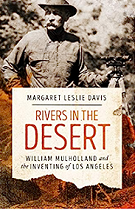
Rivers in the Desert: William Mulholland & the Inventing of Los Angeles – Margaret Leslie Davis

“When the well’s dry, we know the worth of water.” – Benjamin Franklin (1706-1790)

America is a young nation compared to countries around the world, but despite its youth, there is fascinating history contained within its borders. When I saw this book, I realized that I was not familiar with the name of William Mulholland (1855-1935). My curiosity heightened and I found myself eager to see what author Margaret Leslie Davis had to say about him and the City of Los Angeles. It is no secret that California has had issues with its water supply. Droughts induced by the desert climate in the southwestern section of the United States and lack of rainfall have long taken their toll.  And water has always been a treasured commodity essential for human life. But how many of us know how Los Angeles developed its water supply? The story is presented here in a book that affirms the concept of “visionary”.

The story begins at the Owens River as Mulholland and fellow engineer Frederick Eaton (1856-1934) are in search of a water supply sorely needed by Los Angeles. Realizing that the Owens River sits at a higher elevation and has the supply needed for the growing city, they each set out to make the dream a reality. However, their paths soon diverge creating a love hate relationship that remains prevalent throughout the book. Mulholland becomes superintendent of the Municipal Water Department and is soon given the green light to construct the Los Angeles Aqueduct. But the road the completion was far from simple, and the author relives the day-to-day working conditions which proved to be deadly on occasion.  The brutal environment becomes known as well as the vices that plagued workers, mostly Irish immigrants like Mulholland. In fact, one vice is so widespread that the city legislature is forced to step in and pass new laws regarding the aqueduct project. The threat of cave-ins, falling debris and suffocation are eerily present, but the other deadly killer was disease. There are several scenarios that play out in the story highlighting the need for sterile working environments and the importance of efficient medical treatment. And we cannot ignore the importance of food which becomes a crucial issue as the miners ply their trade.

Eventually the Los Angeles Aqueduct is finished, and Mulholland becomes a hero in Los Angeles. But with every great rise, lays the risk of great fall. Further, Mulholland suffered tragedy and grief in his personal life which offsets the jolly public figure tasked with moving Los Angeles forward. The aqueduct project was a booming success and for Mulholland, his name became attached of the American Dream. But on the night of March 12, 1928, everything changed, and the story is turned upside down. Around midnight, the dam collapsed and sent gallons of water flooding the territory below resulting in hundreds of deaths and extensive damage. The fallout and its suspense, captured perfectly by the author, is nothing short of devastating. And Mulholland soon found himself in the crosshairs of an ambitious prosecutor, Asa Keyes (1877-1934). A trial commenced, and Mulholland was on the defense. Davis includes some of his testimony here showing the tense atmosphere surrounding the trial and the grief that consumed Mulholland who is never the same again. Witness statements are also included to give readers an idea of how powerful and fast the flooding water was. And while this drama plays out, the life of Eaton takes its own roller coaster ride, yet the former friends turned into partial enemies, still found a way to connect with each other in times of need. In the end, both engineers suffered their own personal losses and griefs but were instrumental in creating modern day California.

Following the jury’s verdict in which Mulholland is found to be negligent but not criminal, he slowly recedes from the public light. But karma never forgets, and Davis follows up with information on Keyes who has his own fall from grace that left me speechless. As for Mulholland, he was still revered, and his ideas are still relevant today. We follow him all the way to the end in the story as his health declines and destiny approaches. Fate and bad luck changed his life forever, but his contribution to the City of Los Angeles cannot be denied. His legacy is complicated but also a permanent part of California’s history.

ASIN:‎ B00J90EUO4

Operation Underworld: How the Mafia and U.S. Government Teamed Up to Win World War II – Matthew Black

black

I have often heard the saying that “desperate times call for desperate measures”. In times of war, I am sure it holds true on more occasions that can be counted. During World War II, the threat of German infiltration into American society was very real and sabotage a critical issue. Foreign enemies knew that the key to weakening America was covert tactics that allowed access to its shores. In New York City, the waters in and around the Big Apple were especially vulnerable and critical. But there was one problem. The military lacked crucial intelligence to stop foreign subversives from conducting their missions. That all changed with a plan that became known as “Operation Underworld“. To this day it is still taboo but as World War II raged, Allied commanders used every tool at their disposal to defeat the Axis powers. And part of that toolbox was organized crime figures whose legacies are cemented in history. 

The author provides a back story to the events to come by revisiting the actions of President Franklin D. Roosevelt (1882-1945) which focus on ethnic groups suspected of being loyal to Italy, Japan, and Germany. Military officials were aware of sabotage in waters along the Northeast coast but powerless to stop it and espionage. Soon all options are on the table and the story shifts gears when the Office of Naval Intelligence (“ONI”) steps up and introduces its top-secret plan that is executed by Commander Charles R. Haffenden. But first Haffenden needs a point of contact and finds his man in mobster Joseph “Socks” Lanza (1904-1968). The Luciano Crime Family enforcer also ran the Fulton Fish Market and his control over the area provided an ear to the streets which comes into play as the plan is put into action. His control over the rackets also provided an ear to the streets and the ONI was determined to use this asset. However, Lanza is not a mob boss and has limited power in his section of Manhattan. The ONI soon realizes that to aid the war effort and strike a blow against the Axis powers, it needs the help of the big names in the game. One of these people is Mafia titan Charles “Lucky” Luciano (1897-1962), who had been convicted on June 7, 1936, of compulsory prostitution and sentenced to thirty to fifty years in prison. However, even behind bars, Luciano still controlled the family that carried his name. But Haffenden could not walk into the prison and speak to him directly. The covert nature of the plan required shrewd ideas to provide cover and the ONI enlisted the help of Luciano’s lawyer Moses Polakoff (1896-1993) and the man known as the “Mob’s accountant”, Meyer Lansky (1902-1983). 

Black takes us back in time and behind the walls of the Clinton Correctional Facility in Dannemora, New York where we learn of the harsh conditions surrounding Luciano’s incarceration. The prison is dark, cold, and far removed from Luciano’s former residence at the Waldorf Astoria hotel. But a blessing arrives when Polakoff mentions that the government needs the mob’s help, and it might help Luciano get out of prison earlier than expected. But the gangster is still not fully convinced but Lansky’s presence and advice helps sway him to the Allied cause. And to his benefit, Luciano is moved to Great Meadows Prison in Comstock, New York, closer to New York City and in far better condition. After he agrees to help the ONI, the web of cooperation is formed that remains intact through most of the book. 

What is interesting about the book is while the war is raging, Luciano and the other mobsters are doing their part to help the ONI while at the same time conducting their usual mafia related business which includes murder, narcotics, and all sorts of mayhem. It could be argued that the book is not just a story about the secret ONI plan but also a good discussion of the mob’s presence in New York City during that time. Eventually the Axis powers collapse and the war ends. But Luciano remained in prison. The remaining parts of the book discuss his attempts to be released from prison by the same man who convicted him, former New York Governor, Thomas E. Dewey (1902-1971). Although the two had no personal connection, I found it interesting that they could not escape each other as their lives proceeded in different directions. But Black does show that Dewey had moved on from his prosecutor days and Luciano had become a memory for him. As for Luciano, Dewey would always be the man who wrecked his life and was the reason he eventually was deported back to Italy. The saga behind Luciano’s expulsion from America is re-told here in gripping detail with famous mobsters Joe Adonis (1902-1971) and Frank Costello (1891-1973) making an appearance in the story. And admittedly, it is hard not to like Luciano, but I also noted that he was a career criminal who had no issue giving orders for someone’s death and going against the code of the streets when needed such as in the feud with Vito Genovese (1897-1969). But his importance to the Allied effort cannot be overstated. 

As one would expect, the story of Luciano’s help leaks out, but I was not prepared to learn how far the ONI went to destroy any trace of government contact with the mob boss. The final days of Haffenden’s career left me speechless. And had it not been for a decisive action by Dewey to clear his own name and the actions of Manhattan District Attorney Frank Hogan (1902-1974), parts of the story may have been lost forever. Of course, some parts of Operation Underworld were lost forever but the record still stands, and the story told within is sure to be of interest to history buffs with an affinity for World War II.  The war has long been over, and Luciano has been gone since 1962, but it is an incredible story and part of New York City history. Highly recommended. 

ASIN:‎ B09RGLWNKW

Courage Under Fire: The 101st Airborne’s Hidden Battle at Tam Ky – Ed Sherwood, LTC, U.S. Army (Ret.)

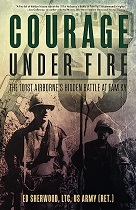
SherwoodIn August 1987, RKO Studio Pictures released ‘Hamburger Hill‘, a Vietnam War era film that recreated “Operation Apache Snow” (May 10, 1969 – June 7, 1969) and focused on the battle on Hill 937 in the A Shau valley known by infantrymen as the “Valley of Death”. The film is gritty, the deaths are gory and by the movie’s conclusion, the concept that war is hell on earth is firmly implanted in the viewer’s mind. However, viewers may not know that there was a second battle being waged at the same time on Hill 367 near Tam Ky. But this mission was called “Operation Lamar Plain” (May 15, 1969 – August 14, 1969) and remained hidden from the public for over fifty years. Lt. Ed Sherwood (Ret.) served in the 101st Airborne Division known as the “Screaming Eagles”, and experienced combat firsthand. And though he was evacuated before the battle’s conclusion due to a significant wound, he made it a goal to set the record straight regarding the battle no one back in America discussed.
As I began the story, I could not help but feel surprised that this battle is absent from books and films on the Vietnam War. In fact, I have watched Ken Burns’ docuseries ‘The Vietnam War‘ and do not recall anything focusing on Operation Lamar Plain or the troops who fought on Hill 367. I found it hard to believe that no one had heard of this battle. I soon learned that was not the case at all, and Sherwood explains towards the end of the book exactly why the public did not learn of the second operation taking place in the Valley of Death. The events on Hamburger Hill are discussed early in the book and Sherwood clears up any confusion that his book is about that battle. But more importantly, he also explains why the A Shau valley was so critical to both sides. It was an essential part of the Ho Chih Minh trail, an extensive network of pathways, routes and tunnels used by the NVA to move supplies. American military commanders know that the trail is critical to NVA operations and any effort to defeat North Vietnam must include destruction or seizure of the supply network. But the Vietnamese were not going away without a fight. And both sides know that a deadly battle lurks in the distance. But before we reach that point, there are other things taking place on the American side, explained by Sherwood as to why the rotation of personnel could be dangerous.

Eventually, Operation Lamar Plain arrives and two men stand out as the soldiers whose actions will help decide the fate of the battle. Captain Leland Roy and Lt. Paul Wharton. Their stories are surreal and a testament to the courage and commitment both men had to their unit and their mission. Sadly, there were significantly casualties suffered the 101st as the battle raged. Sherwood takes us through each day in chronological order with a listing of those killed or missing in action, and those awarded for their actions on the battlefield. I could not help but notice that the average ages of troops were between 19 and 22 years of age. I was disturbed at knowing some of those young men were not old enough to buy a drink in bar but were commander soldiers in life and death situations. And even darker, some of those same men, went to Vietnam and did come back alive. The subject of death and how it is managed is also discussed and there are no words to describe it. Rather, Sherwood sums it up perfectly as a former infantryman. As we learn in the book, the troops did not see themselves as heroes, they simply wanted to do their job and come home alive and in one piece.

Before I continue, I want to pay homage to a woman whose name I did not know before reading this book. She was Lt. Sharon Ann Lane (1943-1969) who was the only female servicewoman killed during combat in the Vietnam War. The circumstances surrounding her death are contained in the book and I also found myself in shock that I had never heard of her death in Vietnam related material.

As the time moves by, Sherwood also includes a list of things taking place back in America or “the world” as troops call it. It is nostalgic and older readers will have vivid memories of that era. But that nostalgia fades quickly as a new day begins and more blood is spilled. But I also noticed the discipline in which troops operated highlighting the necessity for teamwork and precision planning to be an effective combat unit. The men are tired, hungry, and scared but they continue to fight and eventually, the NVA breaks formation on Hill 367. The tide of the battle changes but the physical and mental scars will remain for the troops in the 101st on Hill 367. But if the battle was a success, why was it hidden? Well, Sherwood explains that:

“Once Operation Lamar Plain was successfully kept from the media, war protestors, and political adversaries, there was no benefit to the Military Assistance Command Vietnam, the Joint Chiefs of Staff, or the Nixon administration to disclose that a major battle with high casualties had been hidden from the American people.”

There are countless books, articles, and podcasts on why the American war effort in Vietnam failed in forcing Hanoi’s surrender. That is a discussion is for another time. Here, the focus is on the Hill 367 and the men who gave their lives in service of their country. Sherwood has captured their story for infinity in a book that should be included in all libraries containing material related to the Vietnam War. After finishing this book, I have an even higher level of respect and understanding for what soldiers experienced in Vietnam and why my uncle has rarely discussed that part of his life. Their memories are haunted by death, destruction, Post-Traumatic Stress Disorder (“PTSD”), exposure to Agent Orange and other dark aspects of armed conflict the public pays little attention to.  As Sherwood says, the next time you see a combat veteran, say “remember our fallen”.

“My greatest satisfaction in researching and writing Courage Under Fire was reconnecting over four decades later with veterans from my former 101st unit. Many have become close friends. Also important was finally letting the veterans of Tam Ky (and their families) learn of the battle they valiantly fought so long ago. ” – Lt. Ed Sherwood (Ret.) 

ASIN‏: B0916J8PHV

A Shot in the Moonlight: How a Freed Slave and a Confederate Soldier Fought for Justice in the Jim Crow South – Ben Montgomery

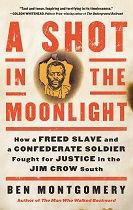
Montgomery_AShotInthe_9780316535540_HC.inddI am consistently amazed at the number of post-Civil War stories I have yet to learn. This book caught my attention, admittedly from the title alone, and it turned out to be an interesting account of an event that could have been lost to history. On the night of January 27, 1897, a mob of men appeared at the home of George Dinning (1857-1930), a former slave in Kentucky, and demanded that he vacate the home and leave the state. Dinning refused and as the two sides stated their positions, a shot was fired from outside the house. While in retreat and fearing for the lives of his wife and children, Dinning returned fire and mortally wounded Jodie Conn (1864-1897). Dinning turned himself in the next day and was later formally charged and charged with a crime. But prison was not the biggest threat. In fact, the local sheriff feared mob retribution at the hands of local whites and makes a quick decision that spares Dinning’s life. And this was the first step on a journey that not only shocked the State of Kentucky but one that changed the American legal system.

Today, the concept of due process is strong, and we have the right to a jury of our peers. But in 1897, for Black Americans, the average jury worked very differently. And if you were a black person accused of murdering a white person, death was almost guaranteed. But for George Dinning, that was not the case. A trial was held, and the author provides selected transcripts of the questioning to show how stories can be influenced and mis-represented. At the end of the proceedings, Dinning is convicted but the Governor of Kentucky, William O’Connell “Bill” Bradley (1847-1914), takes matters into his own hands and sends shockwaves throughout Kentucky.  And incredibly, Dinning’s saga is far from over.

Dinning eventually returns to Simpson County, Kentucky a free man. But his story catches the attention of reporters, politicians, and lawyers. This is where Bennett H. Young (1843-1919) enters the picture. As someone who works in the legal field today, this part of the book was highly relatable. However, I struggled with the fact that Young was a former Confederate soldier who strongly supported and Confederacy and its president Jefferson Davis (1808-1889), but he also believed in the advancement of Black Americans in the wake of the war. It is a contradiction that remains prevalent as the story moves forward to its conclusion.  Young consistently takes bold actions to help blacks that are a permanent part of his complicated legacy. Putting that aside, he does an incredible job of representing Dinning, who is awarded damages in a civil suit against several of the men who surrounded his house on that cold January night in 1897. The judge’s award sends shockwaves across America, changing the concept of legal rights for individuals. For other blacks, Dinning’s victory provided the courage needed to make their own claims for damages against those who had wronged them.  But though George Dinning had won in court, he was far from trouble free.

Following the successful lawsuit, Young eyed the remaining members of the mob and mounts further legal challenges. But before they play out, we reach the book’s darkest moment in which Dinning comes close to losing his life. This part of the story is disheartening yet Dinning again proves that he refused to be intimated or broken. He eventually leaves Kentucky and makes a new home in Indiana where he spent his remaining days. In 2019, Montgomery interviewed Anthony Denning, George’s great-grandson who carries the family named though the spelling is changed slightly. It is likely that Dinning himself made the change after leaving Kentucky. Regardless, the family lineage is intact to this day and George Dinning’s story lives on ninety-seven years after his death. This story has many components but the most important is that it is American history.

“A Winchester rifle should have a place of honor in every black home, and it should be used for that protection which te law refuses to give.” —Ida B. Wells (1862-1931)

ASIN: B0881Y6TGZ