
“When the well’s dry, we know the worth of water.” – Benjamin Franklin (1706-1790)
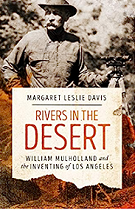
America is a young nation compared to countries around the world, but despite its youth, there is fascinating history contained within its borders. When I saw this book, I realized that I was not familiar with the name of William Mulholland (1855-1935). My curiosity heightened and I found myself eager to see what author Margaret Leslie Davis had to say about him and the City of Los Angeles. It is no secret that California has had issues with its water supply. Droughts induced by the desert climate in the southwestern section of the United States and lack of rainfall have long taken their toll. And water has always been a treasured commodity essential for human life. But how many of us know how Los Angeles developed its water supply? The story is presented here in a book that affirms the concept of “visionary”.
The story begins at the Owens River as Mulholland and fellow engineer Frederick Eaton (1856-1934) are in search of a water supply sorely needed by Los Angeles. Realizing that the Owens River sits at a higher elevation and has the supply needed for the growing city, they each set out to make the dream a reality. However, their paths soon diverge creating a love hate relationship that remains prevalent throughout the book. Mulholland becomes superintendent of the Municipal Water Department and is soon given the green light to construct the Los Angeles Aqueduct. But the road the completion was far from simple, and the author relives the day-to-day working conditions which proved to be deadly on occasion. The brutal environment becomes known as well as the vices that plagued workers, mostly Irish immigrants like Mulholland. In fact, one vice is so widespread that the city legislature is forced to step in and pass new laws regarding the aqueduct project. The threat of cave-ins, falling debris and suffocation are eerily present, but the other deadly killer was disease. There are several scenarios that play out in the story highlighting the need for sterile working environments and the importance of efficient medical treatment. And we cannot ignore the importance of food which becomes a crucial issue as the miners ply their trade.
Eventually the Los Angeles Aqueduct is finished, and Mulholland becomes a hero in Los Angeles. But with every great rise, lays the risk of great fall. Further, Mulholland suffered tragedy and grief in his personal life which offsets the jolly public figure tasked with moving Los Angeles forward. The aqueduct project was a booming success and for Mulholland, his name became attached of the American Dream. But on the night of March 12, 1928, everything changed, and the story is turned upside down. Around midnight, the dam collapsed and sent gallons of water flooding the territory below resulting in hundreds of deaths and extensive damage. The fallout and its suspense, captured perfectly by the author, is nothing short of devastating. And Mulholland soon found himself in the crosshairs of an ambitious prosecutor, Asa Keyes (1877-1934). A trial commenced, and Mulholland was on the defense. Davis includes some of his testimony here showing the tense atmosphere surrounding the trial and the grief that consumed Mulholland who is never the same again. Witness statements are also included to give readers an idea of how powerful and fast the flooding water was. And while this drama plays out, the life of Eaton takes its own roller coaster ride, yet the former friends turned into partial enemies, still found a way to connect with each other in times of need. In the end, both engineers suffered their own personal losses and griefs but were instrumental in creating modern day California.
Following the jury’s verdict in which Mulholland is found to be negligent but not criminal, he slowly recedes from the public light. But karma never forgets, and Davis follows up with information on Keyes who has his own fall from grace that left me speechless. As for Mulholland, he was still revered, and his ideas are still relevant today. We follow him all the way to the end in the story as his health declines and destiny approaches. Fate and bad luck changed his life forever, but his contribution to the City of Los Angeles cannot be denied. His legacy is complicated but also a permanent part of California’s history.
ASIN: B00J90EUO4
 FREETHINKING BIBLIOPHILE