
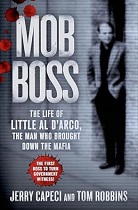
 On September 27, 1963, underworld crime figure Joseph M. Valachi (1904-1971) arrived as the U.S. Capitol to provide testimony to the Senate Select Committee on Improper Activities in the Labor or Management Field, formally known as the “McClellan Committee” due to the presence of its chairman, Senator John L. McClellan (1896-1977). Valachi’s testimony was eye opening and exposed secrets of La Cosa Nostra, loosely translated to “our thing” from the Sicilian dialect. Never before had a rank-and-file member of the Italian American mafia revealed what Valachi disclosed in an open hearing. But over the next forty years, more mobsters would agree to tell what they knew and become cooperating witnesses in federal investigations. Among them was Alphonse “Little Al” D’Arco (1932-2019), a former acting boss of the Lucchese Crime Family in New York City. This is his life story, told to authors Jerry Capeci and Tom Robbins.
As a native New Yorker, I do have a soft spot for books regarding the Italian American mafia due to my childhood when the mob was all over the five boroughs. D’Arco’s name was familiar to me but I was unaware of his story likely due to his low profile. In fact, prior to his deception, few people outside of the mob and select law enforcement officials knew who he was. But looks can be misleading and some of the most powerful mobsters moved very carefully behind the scenes. The Lucchese family has had its share of press and was portrayed in the 1990 blockbuster film ‘Goodfellas‘ by award-winning director Martin Scorsese. The film continues to stand the test of time, but the real story is darker, grittier, and far more complex. D’Arco’s input sheds light on some things not shown on screen, but the crux of the book is his time in the life, and his decision to become a government witness.
The story begins in Brooklyn, New York, and has the feel of a classic immigrant experience when parents left everything at home and emigrated to America in search of a better life. Their children, often born in America, did not always see things the same way and soon learned that the streets could provide more money than their parents would ever see in their lives. But before we reach D’Arco’s entry into La Cosa Nostra, we first revisit his time in the military and his marriage to wife Dolores, with whom he had five children. With each new child came more pressure to earn money and a meeting with Lucchese member Vittorio “Vic” Amuso (b. 1934), sets D’Arco on the path that would lead to his downfall and permanently change his family’s life.
I instantly noticed that D’Arco did not have the vices I had expected in a mob biography. Aside from the money-making schemes he participated in, he does not come across like the gangster we envision when thinking of the mafia. But despite his gentle appearance, he was no pushover and did business with gangsters who found killing to be second nature. What is also interesting is that D’Arco and his sons ran legitimate businesses. And although they did not make him rich, it was steady money and showed that D’Arco was not an illiterate street thug but a highly intelligent and easygoing person who was surrounded by the dark figures in organized crime. As the story progresses, scores of mob figures enter the picture, and I found myself glued to the book as I read of their associations and the issues within the Lucchese family.
Earlier I mentioned the film ‘Goodfellas’ and although D’Arco is not shown in the film, he did associate with the people we see in the movie such as James “Jimmy the Gent” Burke (1931-1996), Thomas DeSimone (1946-1979), Henry Hill (1943-2012) and Paul Vario (1914-1988) who was D’Arco’s captain. All are discussed in the book, but Vario is the most relevant as captain, and unlike the others, D’Arco was a made member. Burke, Hill, and DeSimone were not. On a side note, D’Arco comments on the fate of DeSimone and his disappearance in January 1979. It is not known exactly when he was murdered but what we do know is that the Lufthansa heist at John F. Kennedy International Airport occurred on December 11, 1978 and by January 14, 1979, DeSimone had vanished and was reported missing, never to be seen again. There is no smoking gun, but if D’Arco was truthful which I do not doubt, what he says does match the statements of other former mobsters. And what he says about Jimmy matches Hill’s assessment. There are also Paulie’s sons Lenny (1946-1973) and Peter who was very important in the family. Lenny Vario died in October 1973 after suffering severe burns under mysterious circumstances in July of that year. D’Arco makes a comment about what really happened, but to this day the full story behind Lenny Vario’s death remains unknown. Frankly, the real Goodfellas were nowhere as glamorous as their Hollywood versions.
Combined with the drama surrounding Vario, the Gambinos and Genovese families, D’Arco also has to contend with Vic Amuso and his underboss Anthony “Gaspipe” Casso (1942-2020), who was by far one of the most dangerous mobsters in New York City history. The two bosses eventually become fugitives, and communicate through D’Arco who becomes the acting boss, but their actions and decisions they make are strange, and leave D’Arco puzzled at times. But he follows orders while making mental notes of the paranoia spreading through the family. Murder became a constant tool and the instructions to murder men he once called friends leaves him with an uneasy feeling in his stomach. And it is not long before he begins to see that his own days are numbered. It is at this point that the writing is on the wall, and his choice to turn on the mafia deals a blow to La Cosa Nostra from which it would never recover. Along with him is son Joseph whose time in the life also ended as Uncle Sam became their new extended family.
It was apparent that leaving the life was the most difficult Al and his son Joseph would ever make and there are no winners in the story. Everyone suffers and a key takeaway from this book is that life in the mob was destructive to families and it ruined lives. But D’Arco was able to live out his days in the witness protection program, far away from the people who began to plot his demise. On March 28, 2019, he died at the age of eighty-six, but his story has been captured infinitely in this book which peels back the layers on life in the mafia. If you need a good book about the mob and its impact on those in and outside of the life, this is a good addition to the reading list.
ASIN : B00C74VCC2
Publisher : Thomas Dunne Books, 2013
 FREETHINKING BIBLIOPHILE