
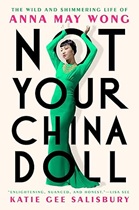
Each day, tourists visiting the City of Los Angeles make their way up to the world-famous Hollywood sign which overshadows the busy metropolis below which became home to the motion picture industry and the destination for people with dreams of becoming stars. However, some stars are home grown as they say and grow into adults with the film industry right in their backyards. In January 1905, a family of Chinese ancestry welcomed a daughter named Wong Liu Tsong who later became known to the world as film star Anna May Wong (1905-1961). In the fifty-six years that she lived, she went from a student helping in her parents’ laundry business to an international star who rubbed elbows with names cemented in Hollywood’s history. But there is more to her story than film roles, press photos, and statements to the media. Behind the scenes her life was far more complicated, and those complexities are unraveled in this biography by Katie Gee Salisbury, which thoroughly explores the late film star’s life.
I first learned of Anna May Wong while reading Jeff Chang’s ‘Water Mirror Echo: Bruce Lee and the Making of Asian America‘. Years before Bruce left his mark on the film world, Wong was blazing her own trail. But I asked myself why had I not heard of her before? After finishing Chang’s book, I sought out material about Anna May Wong and found this book which was everything I had been searching for. The stage is set in Los Angeles where her parents Wong Sam Sing (1860-1949) and Lee Gon Toy (1886-1930) have made home for themselves and their growing family. We travel back in time when discrimination against Asians was socially acceptable and codified in legislation. I must warn readers that some of the subject matter may be difficult to accept. The Chinese Exclusion Act of 1882 hangs over the story like a dark cloud, and even when Anna becomes famous, she still cannot escape the scrutiny by United States Immigration officers as she travels to and from the country of her birth. But early on she was a simple teenage girl in a typical family with strong work ethic and connections to the old country, but Hollywood was the place which both captivated her and held her attention.
As the story progresses, it becomes clear that Anna is not the typical Chinese girl. And through a series of events, she finds her way into the film industry which at that time, had never shown Asian stars in leading roles. To say that Hollywood is a dark place would be an understatement. I am sure that many of us have heard stories about the underside of Tinsel town. Anna May Wong entered this world, and her life was never the same for better and worse. There are dehumanizing and humiliating experiences in the story, and even people who are allegedly “progressive” contribute to the cycle of bigotry which kept her from reaching the stardom she could have obtained. And there is also the practice of “yellowface” which would be seen today as a concept from another planet, but it was standard practice during her era. To reinforce the absurdity of it, Salisbury includes the story of the fictional Charlie Chan, played by Swedish actor Warner Orland (1897-1938). This role which brought him fame and wealth also resulted him becoming both typecast and a victim of substance abuse. It should be noted that Orland was one of several actors to play Chan. Despite the insulting practice, Asian stars did find work, but for Anna, the life changing success she craved came from another continent called Europe.
I was not surprised that she found success across the Atlantic Ocean, due to the obstacles non-white performers faced in America. She had learned the brutal reality of show business and had been changed by her visits to New York City’s Harlem neighborhood and other places which stood in stark contrast to Los Angeles. Along the way she forms friendship will starts from all over, and her friendship with the late Paul Robeson (1898-1976) is a heartwarming part of the story. As she climbs the stardom ladder, she also contents with attention from male suitors. However, there is a major issue with her love interests manifested in the disturbing concept of miscegenation which made it impossible for a life with a husband who was not Chinese. That would change in 1963 when Supreme Court ruled in the case of Loving v. Virginia 388 U.S. 1 (1967) that it was unconstitutional to prevent people of different races to marry. However, by that time Anna May Wong was gone.
Her success in Europe helps elevate her career and I was surprised at the amount of time it took then to travel from one continent to another. But I reminded myself that this was before jet-aircraft for passenger travel. Ships were the main method of travel, combined with rail and surface transit. But that does not stop her from becoming a world-traveler who splits time between multiple continents and even finds time to visit her father in China after he left Los Angeles yearning for life in his ancestral homeland. However, the looming threat from Japan would affect the family later as explained in the book. The trip to China is a mixed bag but it has her in good spirits and there is talk of her starring in a film by Irving Thalberg (1899-1936) called ‘The Good Earth‘ based on the book by author Pearl S. Buck (1892-1973). The film was a hit, but it is also a classic example of how yellowface prevented Asian stars from securing roles they should have landed. The full story as told by the author is hard to believe but this was the reality Wong and Asians faced. What is even more of a gut punch is the tools used by actors dressed in yellow face to prepare for their roles. Frankly, it is a case of adding insult to injury. And this would later be one of the main reasons Bruce Lee was determined to change the perception of Asian stars. Anna Way Wong was far from finished but she soon had another battle to fight with her own body.
Following the success and controversy of ‘The Good Earth’, Wong’s life quiets down a bit. She later finds more success in film and television but is racing against the clock. And this part of the book is heartbreaking. I did not know how severe her personal demons were until I read this biography. A disturbing reality emerges in which we can see how the industry chews up stars and spits them out. Wong was only one of many people both in front of and behind the camera whose lives ended in a downward spiral. By the time I finished the book, I came to understand the struggles and pressures she faced in an industry unwilling to fully embrace her talent. Her life story is an account of what could have been. Thankfully, decades after her death she has begun to receive the attention she rightfully deserves. And although she is long gone, her memory lives in articles, films, and books like this which preserve the life and legacy of a forgotten star in the murky world of motion pictures. The story is beautifully written, and while reading I felt as if I were transplanted back in time to roaring 1920s and 1930s before Germany sparked a second world war. For readers interested in the life of Anna May Wong, this is must read. You will see why she was not your China doll.
ASIN: B0C7TVJKSZ
Publisher: Dutton, March 12, 2024
 FREETHINKING BIBLIOPHILE