
 On May 4, 1955, thirty-month-old Eugene Allen Davis, Jr., died from bulbar poliomyelitis, eight days after receiving a vaccine for polio by his grandfather and famed doctor Alton Oschner, Sr. (1896-1981). The boy’s death left Oschner reeling but his passing was not the only death from the vaccine. And when authorities began to dig deeper, their attention turned to Cutter Laboratories, one of the companies producing the vaccine developed by Dr. Jonas Salk (1914-1995). Health officials sounded the alarm and scrambled to contain the growing crisis. This is the story of the Cutter incident and how it changed the way America produces vaccines.
I had previously read David Ochinsky’s ‘Polio an American Story: The Crusade that Mobilized the Nation Against the 20th Century’s Most Feared Disease’ which provides a broader discussion of the polio virus, the work of Salk and the efforts of Dr. Albert Bruce Sabin (1906-1993). Both men would develop an effective vaccine for the virus but behind the scenes, their relationship was far from harmonious. Sabin does appear in this book but on a smaller scale, and his vaccine is briefly discussed due to the Cutter incident being centered around Salk’s vaccine. But before we get to the involvement of Cutter, the author revisits the emergence of polio and the havoc it wreaked across the United States. And this part of the book sent chills down my spine. It also made me grateful for modern medicine.
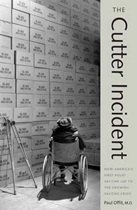
I appreciated the author’s writing style which made it easy to follow along. Prior knowledge of polio is not required for the book making it good for younger readers. However, the older generation who lived through the polio nightmare and recall the rush to vaccinate will find themselves transplanted back in time when America needed every brilliant medical mind it had to defeat a deadly disease. Eventually Salk successfully develops a vaccine to stop polio, but the next challenge was distribution and inoculation. And this is where Cutter Laboratories enters the story. From the cover we know that things did not go according to plan but the reason for the unfortunate incident are thoroughly examined by the author and provide a step-by-step analysis of where the vaccine production went wrong. Although I am not a medical professional, I found the discussion about filters, storage methods, and other principal factors to be remarkably interesting. The fallout from the faulty vaccine is immense but there is no evidence of malicious intent. In fact, none of the manufacturers set out to do anything other than protect Americans from the polio virus which was contained and eradicated due to the demanding work of both Salk and Sabin.
In the wake of the Cutter incident, lawyers get involved and commence legislation against Cutter as one would expect. The lawsuits against Cutter and other companies in later years for other vaccines come with collateral damage and have resulted in precarious situations the public may be unaware of. The details of the legal action taken by vaccine recipients and their families set the stage for the current day stockpile of vaccines which is nothing short of concerning. It should be noted that Cutter was not the only manufacturer to see issues with production and the severity of the faulty vaccine is also due to a significant factor outside of the company’s control. Despite the concern about Cutter’s vaccine, the drive to vaccinate Americans continued and polio rates fell significantly. Today, a polio diagnosis is extremely rare, and vaccines are the reason for it.
The decision to take a vaccine or not is personal and the author does not present a case for either. His take on the situation is unbiased and focuses on how and why Cutter Laboratories found itself at the center of the polio vaccine debate. Further, Jonas Salk who worked diligently on a vaccine would see his professional career suffer and the shocking details are included in the story. And I could not help but notice the tense relationship between him and Albert Sabin. The doctors were close early in their careers but by the time polio arrives, there is not much affection to be found. This part of the discussion is regrettable but nonetheless important. Despite the tension between them, they both played crucial roles in eliminating the polio epidemic and for that we remain in their debt. If you are curious about the polio epidemic and America fought and survived it, this book is for you.
ASIN : B0015GUT5E
Publisher : Yale University Press
Publication date : October 10, 2005

