Coolidge – Amith Shlaes

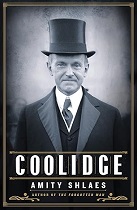
Coolidge

If we compare America to the rest of the world, it is fair to say it is still a “young nation”. But in the years in 1776, the United States has come a long way, and changed world history for better and worse. Every four years, the nation votes on who will be the new Commander-in-Chief. Some candidates  were elected for the first time and then re-elected while others assumed the presidency upon the death of a predecessor. The latter was the case for America’s thirtieth President Calvin Coolidge (1872-1933). The Plymouth, Vermont native is one of history’s most obscure leaders. In fact, I do not recall learning anything about him in school other than his name. So, when I saw this book, my interest piqued, and I became determined to know who Coolidge was and the legacy he left behind.

Prior to starting the book, I had no feelings about Coolidge which left me a neutral position in approaching his story. The author Amity Shlaes tells the story without any bias and provides a straightforward account of Coolidge’s short but incredible life. Coolidge’s story begins in Vermont, where his father John and mother Victoria have a successful farm. On July 4, 1872, John Calvin Coolidge was born, but his parents could not have known that their son would one day be the leader of the country. Sadly, there is heartbreak in his early life, but what transpires was common for life in the 1800s before the discovery of penicillin and  advancements of modern medicine. The monumental loss suffered by Coolidge as a youth did not deter him from moving forward in life which includes becoming an attorney and joining the expanding Republican Party. Love also enters the picture when he meets Grace Goodhue (1879-1957). Shales revisits their courtship, marriage and the birth of their two sons, John (1906-2000) and Calvin, Jr. (1908-1924).

As one would expect, the story picks up in pace when Coolidge begins his journey in politics, not in Vermont but in Massachusetts where he eventually becomes Governor. In 1919, the Boston Police Department went on strike, and Coolidge was faced with an unprecedented situation. The incredible story is laid out in detail, and Coolidge rises to the occasion. I enjoyed learning about this historical event that is a footnote today. I could not imagine a police force strike today, especially in my hometown of New York City. However, it did happen, and the story told within highlights the dangers of a lawless society and the importance of law enforcement. Coolidge becomes a rising star in the Republican Party in the wake of the strike and earns a spot on the ticket of Warren G. Harding (1865-1923) who wins the 1920 election. But in three years, life for everyone changed when Harding died on August 2, 1923. His death ushered in a new administration focused on reducing government spending and eliminating debt. Coolidge would go on to become one of the most frugal presidents in history, but he also supported advancement in technology and other changes in America.

Readers may be surprised to learn that Coolidge was an avid supporter of aviation and during his administration, a sculptor named Gutzon Burglom (1867-1941) envisioned a tribute to selected presidents at place called Mount Rushmore. But Coolidge was known for his frugality and tight constraints on reckless expenditure. His conservative policy and way of life are on full display, and he comes across as a no-nonsense leader who cares little for opinions of him. Shlaes takes us inside the Coolidge White House where the first couple adjusts to life in Washington and confronts old habits from prior administrations. Change does take place, but not rapidly and not without pushback as we see throughout the story. As I read, Coolidge emerged as an incredibly simple leader with a mind keen on controlling the budget and promoting economic growth. Of course, he does allow himself so small pleasures but sticks to his plan for America. During his time in office, the nations saw the passage of the Indian Citizenship Act of 1924 and the Kellogg Briand Pact of 1928 which outlawed war as an instrument of foreign policy.

The story moves along without much fanfare due to Harding’s nature and crafted public image until tragedy strikes in 1924, when Calvin, Jr. makes his departure. I previously did not know of this event but could feel Coolidge’s heartbreak as he confronts the loss of a child. Today Calvin would have certainly survived but in 1924, doctors did what they could with what they had. Life is never the same again, and in 1928, Coolidge decides not to run for re-election and grudgingly supports Republican candidate Herbert Hoover (1874-1964) who becomes the thirty-first President of the United States. After leaving the White House, Coolidge fades away from the spotlight but years of ill health and heavy smoking come to collect their tolls. And at the age of sixty, he is gone. His ending is swift and there is no drama around it as he was home with his wife Grace, but his life can be measured by the series of successful actions and changes he implemented. He was not without his faults and did have detractors but is fair to say that he had the respect of all.

I found this book to be a fascinating account of Coolidge’s life, politics in the 1920s and a thorough discussion of how America was changing after World War I. The backstabbing, strange alliances and power plays we expect from politics is all here in a story that was enjoyable to read. Coolidge remains cool as the events play out and leaves office with a solid track record. The automobile, aviation and reduced government oversight were pushing America forward but in 1929, a stock market crash set the world on a collision course. And in 1933, the same year Coolidge died, an Austrian corporal was designated Chancellor of Germany. Six years later he gave the green light for an attack on neighboring Poland that ignited World War II. If you want to know more about Calvin Coolidge and the America he inherited upon Harding’s death, this is a suitable place to start.

ASIN : B006SJCM0I

Bitterly Divided: The South’s Inner Civil War – David Williams

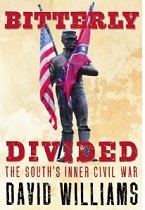
DividedI am consistently amazed at the amount of history related to the American Civil War. The conflict which bitterly divided America, was a moment in which the United States had to reconcile with its dark past and an uncertain future. As a Northerner, the image I had of the Confederacy was generated from films and television. However, the reality of the South was a society divided and plagued with inner turmoil and dysfunction. Author David Williams explores this little-known history of the Confederacy, and the resistance from within to keep the Union together and dismantle the slave-holding elite class in the South.
Within several minutes of reading the opening section of the book, I could not help but feel that the South was doomed from the start. But the war’s conclusion could have been quite different as the author points out, had the South been better prepared and more realistic about secession and independence. However, that did not happen, and as the book progresses, the grim reality facing the Confederate States of America and its President Jefferson Davis (1808-1889) comes into sharper focus. I previously reviewed Bruce Levine’s ‘The Fall of the House of Dixie: The Civil War and the Social Revolution That Transformed the South’which discusses social changes in the South in the aftermath of the conflict. Williams’ account is focused on the failures that began to affect the South’s mission from the very start and the unsettling truths for proponents of the ‘Lost Cause’ myth. There was no  grand or noble effort to crush the North. In fact, what the author reveals here is far from admirable and shows that the South was coming apart at the seams.

I was aware of the high desertion rate Confederate commanders faced as they engaged Union troops. But the number of soldiers who laid down their arms and deserted is staggering. And the crux of the issue is why they deserted to begin with. Williams takes a deep dive into the social climate in which the book is set. A minority of powerful and wealthy figures decided war was good, even if the majority of Southerners were not wealthy, did not own slaves and saw secession as pointless. This detachment from reality placed the South at a disadvantage from the moment the opening shot was fired at Fort Sumter, Charleston, South Carolina on April 12, 1861. It also fostered hatred among citizens of the South towards the slave owners who dragged them into war. But there is far more to the story which Williams tells brilliantly.

Aside from desertion, we also learn that famine was just as crippling. But the actions of women across the South determined to feed their families was eye-opening. The stories told in the book should remove any doubt that the South was “self-sufficient”. In fact, it becomes very obvious that the South could not feed all of its people. Several of the stories are shocking and show that the women had no fear of anyone because food and survival trumped any effort to push back against the Union. But that also raises the question: how could the government not see this ahead of time? There is a good reason which the author discusses, and to say that it was poor planning would be an understatement. The situation across the South was that food was scarce, citizens were bitter, and resentment was building exponentially. And if that were not enough, we also learn more of the anti-secession/pro-Union militias operating within the South to bring down the Confederacy and end the bloody war.

We know from the early part of the book that the majority of Southerners did not approve of secession from the Union. But rebel units loyal to the Union are an aspect of the conflict which I had never heard discussed in any classroom I can recall. This was mind blowing. Civil War buffs may know this part of the story very-well, but if you are not one of those people, this part of the story is surreal. The story is so engaging that I could not stop reading and my mind absorbed the information like a sponge. However, this is the elephant in the room throughout the book and that is slavery.

Williams pulls no punches is discussing the attitude towards slavery whether it is in the South or the North. And what he shows is that while the two sides engaged in war, it was seen as a white man’s war and regardless of the outcome, President Abraham Lincoln had no desire to confront slavery once and for all (1809-1865). Lincoln was willing to let slavery continue if he were able to come to a compromise and hold the Union together. And in the South, slaves themselves became higher in value due to conscription and the South’s need for more able-bodied soldiers. Both sides underestimated the resolve of free and enslaved Blacks who were no longer willing to tolerate being held in bondage. And as we see in the book, although both sides initially abhorred the use of Black troops for varied reasons, the entry of Black Union soldiers into the conflict helped turn the tide of the war. Also, those not in uniform but determined to undermine the South as they spied on the Confederacy are discussed so that their names are not lost to history. By the time I finished the book, I realized that the South was doomed, and nothing was going to save it.

If we are to truly learn American history, we need books such as this which tell us the uncomfortable and sobering truths about what really happened. History is rarely pleasant and often filled with facts that we would rather forget. But the reality is that the Civil War and its aftermath shaped the America we see today. And though the country continues to change, many more years are needed to move away from the not too distant past when the United States became divided and the nation went to war with itself.

ASIN ‏ : ‎ B0042RU4D0

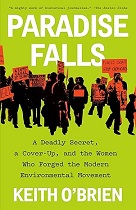
Paradise Falls: A Deadly Secret, a Cover-Up, and the Women Who Forged the Modern Environment Movement – Keith O’Brien

LovecanalIn the 1890s, William T. Love set his sights on the Niagara River near Niagara Falls, New York. He envisioned a lively city full of promise but in 1893, a financial panic disrupted his plans, and by 1897, Love had abandoned his dream. However, the land was deemed valuable by others, and in the 1940s, the Chemical Hooker Company (“Hooker”) purchased the area that had become known as “Love Canal”. In 1953, the company sold the land to the Niagara Falls City School District at the low price of one dollar. To the board it seemed like a dream come true, but lurking underneath the surface were secrets that should have been cause for alarm. For the residents of Love Canal, the neighborhood they had grown to love, became the biggest threat to their lives. When I saw this book for purchase, I stopped for a moment to consider what I knew about Love Canal. I was aware that it was known for being contaminated, but there is far more to the story told by author, Keith O’Brien, who takes a deep dive into the tragic history that will leave you speechless.

The book commences by revisiting the experience of Debbie Gallo, who suffers burns while visiting a local playground. Her mother rushes her to the hospital, and the young girl makes a full recovery. However, their experience was mild in comparison to what was to come. After a brief explanation of the canal’s history and Love himself, the story picks up pace as the main characters enter the story. We soon learn about the families of Lois Gibbs and Luella Kenny, two mothers whose voices became irreplaceable in the struggle to hold Hooker responsible for the contaminants lurking in Love Canal. On the government side, the response from New York States comes through the words and actions of former Governor Hugh Carey (1919-2011) and former Health Commissioner David Axelrod (1935-1994). Carey weaves his in and out of the story, leaving Axlerod to manage the bulk of the tasks as health commissioner. But interestingly, even the health department had its own internal divisions over the Love Canal scandal, with the fiercest advocate for change being Beverly Paigen (1938-2020), whose story highlights the politics at play within the agency. The story is certainly a mix of pivotal figures, including then President James Earl “Jimmy” Carter, who inherits the Love Canal problem which becomes a hotbed political issue as his campaign for re-election is threaten by the popularity of Republican candidate Ronald Reagan (1911-2004). But none of this should take the attention away from the real victims in the story, the people of Love Canal. What they experienced was nothing short of horrific.

As I read the story, I found myself aghast at the staggering number of toxic chemicals investigators found at Love Canal. And regardless of the name revealed, it is understood that none were safe for human exposure. While the State of New York was going through the motions in responding to the crisis, families were falling apart. The story of Luella Kenny and her son Jon Allen is heartbreaking. The signs were there but it seemed as if no one was paying attention except Luella, who knew something was wrong with her son. Then there is the story of Elene Thorton, a resident of public housing who becomes a vocal critic on behalf of the black residents of Love Canal also struggling to have their stories told. Sadly, even in the time of a major crisis, the issue of race comes into play. And the monsters known as envy and greed also enter the story and threaten to undermine the effort to hold Hooker accountable. Frankly, no one comes out of the experience unscathed. Even Gibbs who becomes the spokeswoman for Love Canal saw her personal  life suffer. Her two lives are revisited as the author peels the layers back on the tragedy, revealing the incredible sacrifices by those determined to find resolution.

Probing by investigators underscores the disturbing reality that Hooker had not been fully transparent. But the find that breaks the camel’s back is the discovery of a dreaded and well-known pollutant called Dioxin. You may have heard the name before as it is a known cancer-causing toxin used in the herbicide labeled “Agent Orange” during the Vietnam War. At this point in the story, the floodgates are opened, and Washington can no longer ignore the Love Canal issue. To be fair, President Carter does take action, and the Super Fund legislation is passed by Congress. And the offer by Governor Carey to buy the property of homeowners in Love Canal was a good will gesture. But the efforts were sometimes too little too late. Those who survived Love Canal did so at the cost of personal hardship and in some cases, with lingering health issues.

Today there are new residents living near Love Canal which officials insist are safe. However, I doubt that we will fully know how deep the pollution was in the area. Yes, investigators cleaned up what was possible and demolished unsafe structures. But contamination is never a quick fix and for several decades, Hooker Chemical had free reign to dump its toxins. The story of Love Canal is the proof we need of how lack of oversight can have deadly consequences. This story is unbelievable and includes everything you would expect about a tragedy in a small American town. There are tears, death, fame, jubilation  and even a hostage situation as the people of Love Canal fight for their lives when a paradise fell. Highly recommended.

ASIN : B096DLTZF5

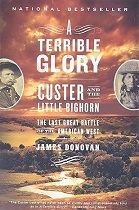
A Terrible Glory: Custer and the Little Bighorn – the Last Great Battle of the American West – James Donovan

CusterOn June 25, 1876, the United States Army’s Seventh Calvary Unit engaged a combined force of Lakota Sioux, Northern Cheyenne, and Arapaho tribe warriors in a battle which resulted in a stunning defeat for the military and became known as “Custer’s Last Stand” due to the death of Lt. Col. George Armstrong Custer (1839-1876). Custer has become a part of American pop culture, and his demise has been studied by scholars and historians. But was his demise a last stand? James Donovan revisits the tragedy of the Seventh Calvary in this book the author calls the last great battle of the American West.

The book is not intended to be a biography of Custer, but Donovan’s discussion of Custer’s early life is important in understanding the soldier he developed into. In comparison to the glorified image of Custer that prevailed in the wake of his death, the truth is far more complex, and the real Custer emerges as a multi-dimensional figure that is part of history for reasons he surely would not have wanted. However, before his demise, he did live an interesting life during the 1800s when America was still expanding its borders, even if it meant war with the natives. Following Custer’s childhood in Ohio, the author moves to his military career which includes service in the American Civil War. And on a personal note, we learn of Custer’s love for his wife, Elizabeth Bacon Custer (1842-1933) who is left to grieve after the battle at Little Bighorn. Custer’s service in the Civil War eventually ended with the defeat of the Confederacy, but for former soldiers, life after the war was far from easy. In fact, Donovan explains the sobering reality army officers faced after the South’s surrender. For Custer, life outside of a uniform was not much of a reality. Fate intervened, and he would join a new mission that would shed as much bloodshed as the Civil War: the battle to contain North America’s Indian tribes. And this is where the book takes a dark turn.

Readers who are sensitive to descriptions of violence, combat and the like should use discretion as the depictions of skirmishes between army troops and native tribes are revisited. The battles were brutal, and the tensions ran high across North America as white settlers and government troops pushed further west. Those who ventured past America’s western border, entered parts unknown. Some were never seen alive again. Treaties between the native tribes and the Bureau of Indian Affairs, did not count for much, and the escalation of tension between both sides raises the level of suspense as Donovan tells the story.  Custer found himself in need of a purpose which came through an invitation to join the Seventh Calvary. This decision would seal his fate although he could not have known this at the time.

As the story moves closer to the battle, Custer prepares his force which includes Indian scouts and even a Black volunteer named Isaiah Dorman (1832-1876) which was strange considering Custer’s views towards black troops during the Civil War. While Custer was preparing for what he believed would be a glorious battle, the natives had plans of their own. And leading the pack were the warriors Sitting Bull (1831-1890) and Crazy Horse (d. 1877). Had Custer known what they were planning, history might be different today. But he did not, and we soon reach the part of the story where the Seventh Calvary moves out on its mission. It was Custer’s last mission and I warn readers that it was far from a last stand but annihilation. In fact, I had to steel myself as I read about the battle’s aftermath. But why did Custer fail?

Donovan discusses the failed strategy that led to defeat but it is hard to say what Custer believed at the time. However, his decision to split the calvary proved to be deadly. As they engage the natives, they soon learn that they are up against thousands of warriors and severely outnumbered. The fractured military units led by Senior Officer Marcus Reno (1834-1889), Captain Frederick Benteen (1834-1898) and Captain Thomas McDougall (1845-1909) were all in trouble and the three military commanders made the decision to withdraw in the face of oncoming waves of tribal warriors. After the battle, the officers would each face scrutiny with Reno becoming persona non grata in military circles. The reasons for his downfall are explained in the book, as well as the position of the Army, forced to confront Custer’s defeat.  But on the side of the late soldier were those determined to preserve his legacy as we seen in the story. His widow Libbie is chief among them even as she continued to mourn the loss of her husband. The book continues after Custer’s death and the fallout is interesting. Of course, politics come into play, and the military itself goes on the defensive. And interesting, it managed to secure Custer’s legacy well into the 1900s.

I cannot ignore the dark undertone of the book, fueled by the fact that Custer’s last moments are still peppered with mystery. That he died in combat is not in dispute, but his movements as the battle rage and the native attack that took his life leave more questions than answers. They also cast a darker cloud over the battle of Little Bighorn. To supplement the book, I watched a couple of videos regarding the battle to learn what historians have discovered in recent years. What I learned is that the battle was even more gruesome than the descriptions in this book. I could not imagine being in that battle against the native tribes thirsty for blood and without the “restraints” of conventional warfare. The author here removes all doubt that the native tribes had one goal and that was to kill as many troops as possible. Sadly, that goal was accomplished, and Custer’s life came to a tragic end. This is not the sole book on the battle nor the definitive account, but it is an excellent place to start if you want to know the story of George Armstrong Custer and the battle that changed American history.

“We will never know, without a reasonable doubt, what happened to Custer and his 210 men. That is because no white observer saw any man of that contingent alive again, and the accounts of those who witnessed its movements—the Sioux and Cheyenne who defeated Custer—are, for many reasons, sketchy and often contradictory.” – James Donovan

ASIN :‎ B000SHPTG0

One Child: The Story of China’s Most Radical Experiment – Mei Fong

fongOn September 25, 1980, the Central Committee of the Chinese Communist Party (“CCP”) took an unprecedented step in drafting an open letter to party members urging support for the “One-Child Policy” initialized by former CCP leader Deng Xiaoping (1904-1997).  The policy became controversial and set into motion a series of events that threaten the long-term stability of the nation known as the “Red Dragon”. Author Mei Fong is a former reporter for the China bureau of the Wall Street Journal and lived in the country for a significant period. This book is an examination of the one child policy and the dark reality of life in China. 
Radical policies are not alien to China. In fact, the nation had already experienced the “Great Leap Forward” instituted by Mao Zedong (1893-1976) in 1958. However, the One-Child Policy was different, and it had devastating effects on multiple levels. The grim reality is revealed in this book that peels back the layers on what took place as the CCP made good on its word. I warn readers that some sections of the book are difficult, in particular discussions about pregnancy terminations. And though there are no brutally graphic descriptions of aggression, the weight of the situations can be felt. Such scenes are unimaginable in the West but in China under the one-child policy, procreation came with staggering risk. The chances of being caught did not deter all couples, and babies were born. But the preference for male babies, coupled with the one-child policy, opened the door for a system dysfunction the author highlights throughout the book. The policy may be obsolete, but the damage it did continues. 

As I read the book, I could only shake my head at the unwelcomed changes in Chinese society. A surplus of bachelors, an aging population, and lack of new births has placed China in a tough position. Currently, the alarm bells have gone off within China that it needs more people. The problem for the CCP is that you cannot undue decades of dangerous policy overnight, and that is a central theme in the book as we learn of the horror stories from the Chinese men and women brave enough to talk to Fong. Their experiences are surreal but sadly normal under the restrictive policy. However, the book contains far more than just a battle over having multiple children. In fact, there are other areas she explores which are mind boggling. 

Readers who have lived in China or are deeply familiar with Chinese society will know and understand what Fong discusses. But for others who are unaware of the dark side to the CCP’s rule, there is a wealth of information to process. Fong takes us inside the international adoption market, supported by the CCP, private lives of men who paid for wives only to see them flee during the night, and the sex doll industry, flourishing as the result of an imbalance between genders. These parts of the book are dark, but necessary in understanding how a misguided policy has damaged those it was designed to protect. The book also focuses on the growing problem of China’s aging population and what it means for the future. 

In the middle of these issue is Fong’s own story as a wife going through the maternity process in China, providing her with a first-hand view of what expectant mothers confront as they carry a child. She eventually leaves China but is sure to open the reader’s eyes to the surrogate market, which thrives in the book. There is also a disturbing section about the possibility of genetic manipulation that will make the hair on your neck stand up.  The author pulls no punches here and lays it all out for the reader to absorb. China will eventually recover at some point, but the past is always prologue. For China, things may become very dark before the light returns. Until then, the policies of CCP leaders will continue to haunt the People’s Republic of China. And this book is crucial in understanding how and why. 

ASIN :‎ B00QPHNV4E

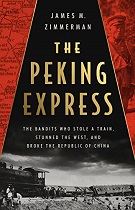
The Peking Express: The Bandits Who Stole a Train, Stunned the West, and Broke the Republic of China – James M. Zimmerman

PekingOn October 1, 1949, Chinese Communist Party leader Mao Zedong (1893-1976) announced the creation of the People’s Republic of China after a brutal struggle against the Kuomintang (“KMT”) forces under the leadership of General Chiang Kai-Shek (1888-1975).  Mao and the CCP had watched China grapple with its own internal conflicts for years which led to instability and uncertainty. On the night of May 5, 1923, Chinese bandits commanded by Sun Meiyao (1898-1923) seized a train traveling between Shanghai and Beijing, known as the “Peking Express”. Local citizens and foreigners were taken hostage by the bandits and forced to march towards Paotzuku mountain. This is the story of what became known as the “Lincheng Incident” re-told by author James M. Zimmerman in stunning detail.

One hundred years have now passed since the events in this book occurred, but the effects of the crisis on modern day China should not be overlooked. After introducing us to the well-connected passengers aboard the train, mostly foreigners, the author changes gears and takes us to the night when all hell breaks loose as a crude act of sabotage changes the lives of the train’s passengers and the course of history. Of course, the most important question is why? Well, there is more than one reason for the bandits’ actions, but financial gain is among them. But I could not ignore the savagery displayed towards native Chinese passengers by the bandits. Mental and physical exhaustion soon creeps in, making the hostage situation difficult to say the least. The female passengers which included Lucy Aldrich (1869-1955), daughter of Rhode Island Republican Senator Nelson W. Aldrich (1841-1915), are released over the course of several days following the incident, but the male passengers were remanded for several more weeks as the incident played out. However, as readers will see, the women did not have an “easy” time, and found that in the wilderness, the elements spare no one.

As I read the book, I began to understand that the rebels did not have a long-term plan. Aside from taking hostages, the end game did not make much sense. Further, the arrival of Chinese military personnel combined with pressure from foreign governments made it clear that the kidnappings would have to be resolved. What ensues is a haphazard pace of events in which more passengers are released while others use any means available to make their escape. And I had no illusions that the bandits were in store for anything but grisly fates upon the events’ conclusion.

The story is surreal, and the lawlessness of rural China in the early 1900s comes into sharp focus. This story is mind boggling, but incredibly important in Chinese history, and it served as the basis for the 1932 film ‘Shanghai Express‘ starring the late Marlene Dietrich (1901-1992).  Following the release of the passengers, the Chinese government wastes no time in dealing with the rebels, and their fates as told by the author, are not for the faint of heart. Frankly, justice was swift and brutal, but to be expected in China. Zimmerman also provides a few words about the lives of the famous passengers whose experiences continued long after their release from the bandits. But none of them could have imagined than fourteen years later, the Japanese Army would launch a military operation during World War II which brought death and destruction to China and made it clear to both the CCP and KMT, that China could only survive once free from foreign occupation. Mao Zedong, years away from becoming “Chaiman Mao”, shrewdly observed the lasting effect of the incident, and as the author points out:

“One of the people closely following the Lincheng Incident was the young Chinese communist leader Mao Tse-tung. In one of his first public speeches, at the Hunan Peasant Congress in December 1926, Mao specifically cited the event as an example of “starving peasants rioting” against the imperialists, warlords, and feudal classes.”

Zimmerman’s research into the events is incredible and my attention never waned while reading. The story is told at the right pace with the right amount of suspense. Without this book, the Lincheng incident may have been forgotten history. However, this book keeps the unbelievable story alive, and is a valuable account of a moment when the world changed.

ASIN ‏ : ‎ B0B9BCP7LP

Last Man Out: Surviving the Burma-Thailand Death Railway: A Memoir – H. Robert Charles

lastmanoutThe soldier above all others prays for peace, for it is the soldier who must suffer and bear the deepest wounds and scars of war. ” – Gen. Douglas McArthur (1880-1964)

Seventy-eight years have passed since Japan surrendered to Allied forces, marking the end of World War II. The war’s brutal conclusion, culminating with the detonation of two atomic weapons, changed history. Although subsequent wars have been fought, World War II remains the deadliest conflict in human history. The European theater of combat during the war has received significant attention due to the existential threat to the world in the form of the Third Reich. However, in the Pacific, the Japanese military waged its own campaign of death and destruction across Asia. H. Robert Charles served as United States Marne about the USS Houston, and on February 28, 1942, he found himself among the survivors of a Japanese attack in the Sunda Strait that decimated their forces and vessel. The surviving soldiers were taken captive as Prisoners of War (“POW”) by the Japanese, who had every intention of making the Americans pay for the battle against Japan. The prisoners were forced to build the Burma-Thailand railway, and this is Charles’s story of the nightmare ordeal the POWs faced until liberation.

Before starting the story of his captivity, a foreword opens the book, followed by a prologue explaining the long road from war survivor to author. It is apparent that he returned home with what we call Post-Traumatic Stress Disorder (“PTSD”) today. But after being coaxed by a fellow veteran to seek counseling, he has a discussion with a therapist who helps break down the walls preventing him from telling his story. And with determination and a sense of purpose, he has left us with this story of a dark time in history which we should never wish to repeat.

As to be expected, the author recalls his early life in post-depression America before joining the United States Marines in 1940. On December 7, 1941, life for Americans changed when the Japanese army bombed the Pearl Harbor, Hawaii Naval Base. The act was in effect a call to arms for the United States. But for Charles and fellow soldiers aboard the USS Houston, the war took them in a different direction. Following their surrender to Japanese forces, the men are moved to Serang, Java and began their ordeal at the labor camp. There is no shortage of brutality by the Japanese, but the men eventually find a solace in a doctor who becomes a savior in the story: Dr. Henri Hekking (1903-1994) of the Royal Dutch Army. To say that he was a godsend would be an understatement. Admittedly, I had never heard of Hekking, but I am sure he is one of many unsung heroes of World War II.

Hekking was a physician well versed in standard practice, but he was also experienced in herbal treatments, often referred to as “unconventional”. As the story progresses, we witness the deterioration in the condition of the prisoners, who begin to suffer from the effects of malnutrition and lack of proper sanitary and hygienic protocols. Injuries are also an issue, and the lack of antiseptic tools made infection a prime concern. However, the doctor proves to be more resourceful than anyone could have imagined. But he was not without his detractors as we see in the story. Despite early misgivings, “Doc” as he is known, earns the trust of everyone as he brings back plants, roots and other items from the nearby jungles that help keep the men alive as the Japanese compel them into manual labor building the long-awaited railway they desired. Morale is low at times as physical exhaustion sets in, but Hekking never gives up and offers these words of advice which still hold true today:

 “It is in the nature of things that without despair there can be no hope, without darkness no daylight,” Doc said. “There has to be meaning. Even if we can’t see it.”

Although Hekking emerges as a pivotal figure, the author is sure to tell his own story which becomes permanently linked to the experience of their Dutch savior who commands respect even from the Japanese, who are never short on cruelty. Unbeknownst to the soldiers, events outside the camp mandated their transfer across several camps, one as far as Saigon in French Indochina. And without warning, they are told that World War II is over, and deserted by evacuating Japanese troops. This is by far the most bizarre part of the book. However, the empire had fallen, and Japan reduced to shell of its former self. For Charles, Hekking and the survivors, their ordeals were far from over as they were faced with having to rebuild their lives in the wake of the war. The author returns to the Midwest and confronts his own demons. Hekking continued to search for his wife and children, with whom he is eventually reunited. And years later, the doctor makes his way to America to see the boys one more time. There is far more to the story contained in the book, which concludes on an uplifting note. If you need an enjoyable book about the Japanese aspect of World War II, this will be a welcomed addition to the library.

“Thanks to Dr. Hekking, only thirteen out of 194 were dead—less than seven percent. It was the best report of any of the doctors in the sixty-five slave labor camps along the railway.” – H. Robert Charles 

ASIN :‎ B005S741XW

Dopesick: Dealers, Doctors and the Drug Company that Addicted America – Beth Macy

dopseickProvisional data from the National Center for Health Statistics at the end of December 2022, showed that overdose deaths in America remained at over one hundred thousand. Although a decrease from the previous year, the statistics are sobering and a reminder that the war against opioid addiction continues as fentanyl claim victims, and a new drug “tranq“, has emerged as the next monster on the streets of America. But how did we get here? And what lies ahead? I previously reviewed San Quinones’ ‘Dreamland: The True Tale of America’s Opioid Epidemic‘ but was curious to read what author Beth Macy discovered in her own research into America’s drug crisis. What I found is another book equally as compelling and important about where the United States went wrong and how deadly the epidemic is.

I do want to issue a disclaimer which is that this book is not for the faint of heart. But if you are intimately acquainted with the epidemic either as a friend, relative or savior of a drug addicted person, then you already know this. Frankly, this is not the book for those in search of a happy conclusion. This is the raw truth about a crisis that continues to expand and claim more lives. However, all does not have to be lost if we pay close attention to what Macy reveals.

The author takes us through the history of opioids, from the discovery of morphine by Friedrich Wilhelm Serturner (1783-1841) to the Harrison Narcotics Act of 1914, and 1924 when heroin was officially outlawed. It is a fascinating compendium of the development of drugs that have morphed into a nightmare. The story changes gears and pace when we reach the years 1995 and the a new drug arises called OxyContin. Hailed at first as a new wonder drug, America soon learned that behind the promises and fake smiles lay a demon that trapped its users in a vicious cycle of dependency. It is not long before doctors began to sound the alarm that all is not well, and addiction in patients begins to increase exponentially. But before any action is taken, lives are unfortunately lost. Macy captures the stories of a select few individuals including convicted drug trafficker Ronnie Jones, who is currently serving a 30 year sentence in federal prison. Each story is riveting yet also heartbreaking, and by the book’s conclusion, I could only sit in silence as weight of the lives lost to opioid addiction settled in.

As I read the book, I could not believe the stories I read. Having witnessed drug use in my own family, I am firmly aware of the lengths to which addicts will go to get their next high. However, what I read here was even crazier at times. And while addicts were dropping dead, pharmaceutical companies continued to reap enormous profits from the marketing and distribution of pain killers that spared no one. However, the author does point out a shocking aspect of the epidemic in regard to addiction rates across demographics. Even the epidemic is touched by race but not in way readers may think. In fact, the irony is haunting, and continues to ripple across suburban America. Further, it also shows that drug use is not just an “inner city” problem. No one is immune.

My youth was spent in East New York, Brooklyn during the 1980s which saw the rise of crack cocaine. I shall never forget those days and the devastation across the City of New York. As I watch the opioid epidemic, it feels like Deja vu. The difference is that the users are not contained in the ghetto or low-income areas, and every sector of America is now confronted with an issue that cannot be ignored. Empty promises by politicians have not helped, and the failures of multiple administrations are highlighted in the book. Macy makes it clear that this is an issue the entire country will need to confront head because it will not go away on its own. But the frightening realization is that by the time the Government takes tougher action, more Americans may be laid to rest as dealers increase the stream of fentanyl and deadlier drugs into the supply.

This is an uncomfortable yet critical book about the horrific impact of opioids and the havoc they have wreaked. However, it also shows that lives can be saved if governments are willing to invest the time, money, and effort into fighting it head on. Until that time comes, it is imperative that books such as this are read by an increasing number of readers who will be fully aware of the signs that come with addiction and the importance of intervention.

ASIN : B078D67JCF

Tied Up in Knotts: My Dad and Me – Karen Knotts & Betty Lynn

KnottsMy brother and I often reminisce about old American television sitcoms we enjoyed while they aired and continue to enjoy them through DVD and streaming services. One of these shows is ‘Three’s Company’ with the late John Ritter (1948-2003). The show was a massive success but a cast change during its run helped cement its place in television history. A supporting character named “Mr. Furley” was the landlord and after the departure of the first actor retained to play the role, a well-known comedic star named Jesse Donald “Don” Knotts (1924-2006) was brought in to replace him. And the rest, as they say, is history. Knotts had earned his stripes in Hollywood before being cast as Furley, but this show undoubtedly helped propel his legacy as a television great. But who was the real Don Knotts? His daughter Karen has carried her father’s legacy and authored this book about the man she called her dad.

As opposed to a standard biography, this book is a collection of memories from friends, family members, former co-stars, and Karen herself. The interviews are eye-opening and provide valuable insight into the personal life of a man who made millions of people laugh. His early life is discussed, and we learn of his origins in the Appalachian town of Morgantown, West Virginia. There were a few things that did surprise me, as I had no prior knowledge of them beforehand. The most surprising thing is that Knotts was a decorated World War II veteran. He was not the first star to serve in the war but joins an honored list of performers who served in a war that turned the world upside down. Following the war, Knotts set his sights on bigger goals, and embraced his role as a husband and father. But his life changes significantly when he meets a fellow star who was blazing his own trail in Hollywood, Andy Griffith (1926-2012). Fans of the ‘Andy Griffith Show‘ will love this part of the book. Karen is there to provide comments about behind the scenes events that reveal the personal side of the stars who created the beloved fictional town of Mayberry, North Carolina. Knotts became “Barney Fife” the deputy who provided comic relief to Griffith’s “Andy Taylor”. The show was a hit and is still fondly remembered today. But behind the camera, Knotts had his own personal struggles which Karen and his son Thomas recall as they talk about their late father.

As I read, I was surprised to learn of Knotts’s multiple marriages, and string of romances. In contrast to the fictional Fife who provides comedic relief, the real life Knotts was well-liked by women. But as Karen explains, his love life was not always stable, however, this also shows that Knotts was human, and no one has the “perfect life”. Additionally, the reality of divorce, addiction, and physical ailments could not be overlooked with the star learning of a condition that would affect him for the rest of his life. Knotts refused to let anything get him down and continued perfecting his craft, and even reels his daughter in on occasion to join him on camera. Karen was a keen observer and discusses stars she met as her father guided her around Hollywood. Her story is fascinating and her friendships with other childhood stars are interesting. The two that stand out are Ron Howard and Desi Arnaz, Jr. Although their father was famous, both Karen and Thomas had their own personal struggles which they frankly discuss in the book. Hollywood may create fiction, but the lives of its stars are very real.

Karen Knotts continues to keep her father’s legacy alive, but for readers looking to understand her famous dad, this book is invaluable. The stars we love give us shows, films and interviews to last a lifetime, but behind the camera, they too fight their own personal battles. But as they say in Hollywood, the show must go on, and for Don Knotts it always did. And as a testament to his character, none of the people interviewed had a negative word to say about him. Knotts himself also speaks in the book, looking at himself objectively and observing the world around him as comedians have always done. This is his story, and that of his children who proudly carry the Knotts name.

ASIN :‎ B08XQZGNPY

Making Jack Falcone: An Undercover FBI Agent Takes Down a Mafia Family – Joaquin “Jack” Garcia with Michael Levin

falcone” Organized crime constitutes nothing less than a guerilla war against society”.
Lyndon Baines Johnson (1908-1973).

On December 16, 1985, Gambino Crime Family boss Paul “Big Paul” Castellano (1915-1985), was shot and killed by assassins as he exited his vehicle in front of Spark’s Steakhouse at 210 West 46th Street in Manhattan. The murder sent shockwaves across the city and law enforcement prepared themselves for mob wars that could have turned the streets of New York City red. The fallout never reached that level but six years later in 1992, John Gotti (1940-2002), the man behind Castellano’s demise, was convicted on thirteen criminal counts, including the hit on his former boss. Gotti was gone but the U.S. Government was far from done with the Gambino Crime Family. In 2003, the Federal Bureau of Investigation (“FBI”) initiated a covert mission to infiltrate the mob outfit. The mission became the second time an FBI agent significantly moved through the ranks of a mafia family. Readers will easily recall the story of agent Joe Pistone who was known on the street as “Donnie Brasco“. This time around, the agent is Joaquin “Jack” Garcia who becomes known as “Jack Falcone”.

As a primer, Garcia takes us through his early days as a child in Cuba, and the family’s move to the United States, where they eventually settle in the Bronx, New York. In 1980, he applies to the FBI and after a minor setback, is on his way to becoming an agent. However, the ice was not easily broken as we see in the book. But Garcia was undeterred and a chance to hit the streets presented itself and changed his career for good. After successfully becoming a skilled undercover asset, he is given the task of infiltrating the feared La Cosa Nostra. And this is where the book changes gears. From the moment he begins to find himself in the same circles as the mobsters, we are introduced to the book’s antagonist, caporegime Gregory DePalma (1932-2009). Garcia thoroughly explains DePalma’s story which has resulted in a stone-cold mobster whose actions throughout the book reflect his life of crime and allegiance to the streets. The seasoned mobster takes a liking to Garcia and soon enough, the two are inseparable.

Garcia’s story is like Pistone’s in many ways, but I did take notice of the staggering amount of food they consumed. In fact, the meals are so voluminous that Garcia jokes about how much weight he gained while working undercover for the FBI. It is no secret that mobsters loved to eat, and I found myself getting cravings for Italian cuisine while reading the book. However, I did not lose track of the main point in the story that DePalma and others were dangerous and deadly people. They killed often and easily, as their lifestyle dictated. And on a couple of occasions, the author comes close to having his cover blown but manages to keep working on his case. From a personal perspective, the amount of sacrifice required by his family cannot be overlooked. Garcia’s wife does enter the story on occasion to give her husband a reality check. But despite all the craziness, Garcia never loses sight of goal to bring down the Gambino family for the last time.

DePalma is easily the least likeable character in the book. The anecdotes from Garcia about the mobster’s arrogance and criminal aptitude should remove any notion of “stand up” gangsters. Further, there is no “honor” or “family” in the traditional sense. The organization was a dysfunctional hierarchy that existed solely for profit. And DePalma was only one of hundreds of mobsters whose sole purposes were money and power. But not even they can escape the realities of life, and the story about DePalma’s son Craig is heartbreaking. I recall an interview with former mobster Phil Leonetti who said mob life is an entirely different world that most people would not understand. I must concur.

The story moves along at a good pace, and Garcia continues to move through the ranks, going as far to earn the complete trust of DePalma who wants to make him an official member of the family. Well, the FBI could not have this, and decides to pull the plug on the operation but not before Garcia builds an airtight case. And one by one, they fall with DePalma staying true to his mafioso code even as the evidence is stacked against him. Following the finale, Garcia provides a nice epilogue about his life after the FBI and the lives of the gangsters he spent time with as he embraced the role of Jack Falcone. Today there are other agents working undercover and putting their lives on the line. Their jobs are often thankless, and their efforts hidden from the public. But this book by Garcia is a blueprint for the hardships and successes that come with a life as a covert law enforcement operative immersed in the criminal underworld.

ASIN: B002QJZ9XG