
 On August 27, 1975, news reports began to emerge that Tafari Makonnen, known to the world as Haile Selassie I (1892-1975), had died at the Jubliee Palace in Addis Ababa, Ethiopia. The man who ruled Ethiopia for forty-four years and who had served as the icon of the Rastafarian movement was eighty-three years old. Selaisse had lived his final years in exile after being deposed in a coup that took place in September, 1974. The world-renown leader was a larger than life figure although he only stood 5’2″. He was recognized on the world stage and helped Ethiopia modernize itself as the wave of independence swept over the African continent in the 1960s. However, his reign was not free of controversy and Selassie was viewed by some as a greedy tyrant who used his position of power to enrich himself and those closest to him. Ryszard Kapuściński (1932-2007) was a Polish journalist who traveled to Ethiopia and interviewed former members of Selassie’s administration. This book is a collection of what they remember from their time in office with regards to the emperor’s daily routine, his achievements and also his downfall.
The book is quite short but it does pack a powerful punch. Observations by those who were closest to him paint an interesting picture of the diminutive giant. But his size provided no indication of his shrewdness and ability to orchestrate an entire government. Selassie controlled the entire country and this quote by a former subordinate drives home the point:
“not only did the Emperor decide on all promotions, but he also communicated each one personally. He alone. He filled the posts at the summit of the hierarchy, and also its lower and middle levels. He appointed the postmasters, headmasters of schools, police constables, all the most ordinary office employees, estate managers, brewery directors, managers of hospitals and hotels—and, let me say it again, he chose them personally.”
Quite frankly, at this time in history, Haile Selassie was Ethiopia. And like the man behind the curtain the Wizard of Oz, there is much to his personal side that reveals how unconventional and unpredictable he truly was. I caution readers that the book is not an autobiography. The author does provide background information when needed but overall, the story focuses on the interviews he conducted with Selassie’s former confederates.
By far, nearly all who are interviewed hold Selassie in high regard and none really have a harsh word to say about him. I found myself wondering if Selassie was a messiah that truly did perform wonders without fail or if it was a case of blind allegiance. They are quick to point the positive changes in Ethiopian society but the narrative changes with the premier of Jonathan Dimbleby’s Ethiopia: The Unknown Famine on British television. I decided to take a look at it myself and was aghast at what I saw. The footage is raw and shocking, and I warn potential viewers that it will also be upsetting. What is seen in the video stands in stark contrast to the image of Selassie that we have come to know over time. But voices within Ethiopia at the time were also sounding the alarm about the famine and they came from an ironic source.
One speakers whose name remains unknown like the others, discusses his son who has studied abroad like many other Ethiopian students who traveled abroad as representatives of their country. These same students who had been sent to foreign countries to become better educated would later play a decisive role in the future of Ethiopia and in Selassie’s reign as ruler. His son has returned to Ethiopia and what he sees, has led him down the path of no return. He tells his father:
“Father,” says Hailu, “this is the beginning of the end for all of you. We cannot live like this any longer. This death up north and the lies of the court have covered us with shame. The country is drowning in corruption, people are dying of hunger, ignorance, and barbarity everywhere. We feel ashamed of this country. And yet we have no other country, we have to dig it out of the mud ourselves. Your Palace has compromised us before the world, and such a Palace can no longer exist. We know that there is unrest in the army and unrest in the city, and now we cannot back down.”
Selassie did not yet know it, but this was the beginning of the end. He had survived one coup previously, but this non-violent coup would seal his fate. Its development and execution are discussed by speaker, one of whom in particular is quite frank about how the contrasting images of two separate Ethiopias was allowed ot exist for so long. No stone is left unturned and in the end, Selassie’s image and legacy would receive staggering blows as the world learn of Ethiopia’s horrible secrets. However, in spite of what was seen and revealed, Selassie has retained his place in world history as the champion of Ethiopia who stood up to Italy and inspired hope within the people. However, his administration also neglected basic facets of a health and progressive society, leading to widespread poverty, famine and senseless deaths. In the end, they would contribute to the downfall of an autocrat.
ASIN: B00B3M3T6Q
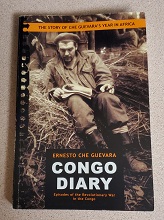 I have been taking advantage of the free time that I now have at my disposal and was reorganizing the book shelves when I came across this book which I had purchased quite some time ago. It is the translated diary of Dr. Ernesto “Che” Guevara (1928-1967), from the failed revoultion in the Democratic Republic of the Congo im 1965. The book was published in 2011 and through the joint efforts of the Che Guevara Studies Center and his widow Aleida March. In the years following the repatriation of Che’s remains to Cuba in 1997, there was a resurgance of interest in his work and this diary is just one of several regarding the revolutions in Cuba, the Congo and Bolivia where he met his untimely death.
 On February 13, 1961, United Nations Ambassador Adlai Stevenson (1900-1965) placed a call to President John F. Kennedy (1917-1963) and informed him that Patrice Lumumba (1925-1961), the first Prime Minister of the Independent Democratic Republic of the Congo, had been murdered a month earlier. The moment that Kennedy took the call was captured by a photographer and the image shows him with his hand covering his face in shock. The picture truly does speak a thousand words and Kennedy’s dismay resonated with millions of people around the world.
 There are many questions about the origin of man, the human race has yet to find conclusive answers for. We know that ancient civilizations existed and flourished before some mysteriously ceased to exist. Relics, structures and writings have survived giving us clues about their lives. Of all of the ancient civilizations, the most inspiring and sought after remains Ancient Egypt. The pyramids and Sphinx are marvels that have puzzled engineers for thousands of years. Without the benefit of blueprints, we can only offer guesses as to how and why the structures were created. But from the temples, mummies and monuments that have survived, it is evidently clear that ingenuity was one of its greatest traits. Africa has been cited as the cradle of civilization, serving as the home to the oldest tribes known to man. The Christian Bible and Hollywood have done their part in bringing the stories to life, and in the process put Ancient Egypt on center stage. The Pharaoh Ramses II in The Ten Commandments, beautifully played by the great Yul Brynner, has become a commonly accepted image of the real life Ramses II. But how accurate was Brynner to his real life counterpart? And what did the Ancient Egyptians look like? It is tempting to think of them based on those we see in Egypt today. But we should know that history often includes many surprising facts, some which we may have never guessed without revisiting the past. Cheikh Anta Diop (1923-1986), of Diourbel, Senegal, was a noted historian and anthropologist, who studied the origin of the human race and in his eye-opening account, he seeks to find the truth about the role of Black Africans in the origin of civilization.
 The name Idi Amin remains among the most infamous our world has ever known. Following the overthrow that removed Milton Obote (1925-2005) from power, the late despot ruled Uganda with relentless brutality as he enriched himself at the peril of hundreds of thousands of Ugandans. In January, 1979, the Ugandan National Liberation Army forced him into exile with the help of the Tanzania People’s Defense Force and former Libyan dictator Libya’s Muammar Gaddafi (1942-2011). Amin spent the last years of his life in Jeddah, Saudi Arabia, where he died on August 16, 2003. Today, nearly fifteen years after his death, he is still reviled by those who remember a dark period in the history of Uganda.
 The death of Idi Amin Dada on August 16, 2003, caused a stir of emotions in Uganda, the country he once ruled with an iron fist. His name is infamous and the crimes of his regime are endless. He ranks high among the worst dictators in world history and is a case study of the rampant abuse of power by a malevolent tyrant. Actor Forest Whitaker brilliantly played the late dictator in the 2006 film The Last King of Scotland. The film was fictionalized in part, but Whitaker capture the essence of Amin’s character and his performance was nothing short of phenomenal. The real Idi Amin was far worse as we know and there is a chance that the true number of the crimes committed by him and his henchmen will never be known. The fates of hundreds of Ugandans remain a mystery with no sense of closure in sight. Nearly four decades have passed since Amin fled into exile but he is a permanent part of Ugandan history. In this book by journalist Andrew Rice, we take a different look at the Amin regime, not through his life but through the lives of those who served him. The lives and stories intersect around the murder of Eliphaz Laki, the former county chief of Ibanda, Mbarara. In 1972, he was apprehended by Amin’s enforcers, led by Yusuf Gowon, assisted and abetted by Nasur Gille and Mohamed Anyure. His murder was covered up until his son Duncan returned to his native country in a quest to find his father’s killers. Duncan emigrated to the United States, settling in New Jersey with his wife. Their union produced four children and Laki supports his family as a lawyer. But the laws of the United States are different from Uganda as we see in the book. This is his story and a step back into time as we revisit the Protectorate of Uganda under the all watchful eye of Amin.
 FREETHINKING BIBLIOPHILE
You must be logged in to post a comment.