
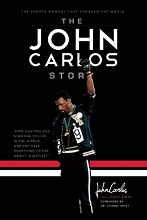
 On October 16, 1968, U.S. track and field runner John Carlos ascended the podium to accept his bronze medal following the 200m race. His teammate and gold medal winner Tommie Smith joined him on the podium and as the United States anthem played in the stadium, the pair raised their fists in solidarity with the growing movement for civil rights in America. Silver medal winner and Australian native Peter Norman (1942-2006) showed his support for the American duo by wearing an Olympic Project for Human Rights badge. The image of them standing with their fists raised remains one of the most powerful pictures of the Civil Rights Movement. However, behind the scenes, the fallout from their gesture was immense and even Norman, who was not American, suffered tremendously. This is the story of John Carlos in his words, which explains the events leading up to the pivotal moment in world history and his life which has been anything but ordinary.
Huey P. Newtown (1942-1989) famously remarked that “the first lesson a revolutionary must learn is that he is a doomed man“. The statement is dark but accurate. For John Carlos, the moment he decided to raise his fist was also the moment that he invited the turmoil that comes with taking a public stand. But prior to that earth shattering moment, he had been an advocate for equality and the stage for Mexico had been set years prior in my hometown of New York City. I did not know Carlos was a New Yorker so one can expect that I was pleasantly surprised. As I read his account of his early life and the struggles his family faced in their housing complex, I found myself gaining more respect for him, as a person not afraid to tackle problems head on. To be fair, there are sections in the book where Carlos himself admits that he was wrong and should have put more thought into his actions. And his father, to whom he was remarkably close, provided a source of guidance that was needed at times. Carlos was also close to his mother, whom he deeply loved and still holds in high regard. I enjoyed reading about his family life and felt that I understood him and why he became a voice for change.
Carlos dabbles in athletics until he finds his calling in running, which incredibly, was not his first choice. That might shock readers, I know it surprised me. But once he starts running, he never stopped, and that path took him from New York City, to Texas, and all the way to Mexico City, where the story picks up in pace for obvious reasons. However, Carlos reveals critical information about the Olympic Project for Human Rights and its original plan for the games. Also, the story takes another turn when famed Olympian Jesse Owens (1913-1980) enters the story. I had no prior knowledge of these events before reading the book and was shocked to learn of the friction backstage. But Owens is not the villain, and his own story is one of triumph and tragedy. And even Carlos realizes that Owens could not escape the ideology that he helped shatter in Berlin as Adolf Hitler (1889-1945) watched in disbelief.
After the Olympic medal ceremony, Carlos knew that he would have to return to the United States but had no idea of how bad the repercussions would be for exposing America on the world stage. Any illusions of returning to America as champion of equality were quickly shattered as he and Tommie Smith became public enemies. Peter Norman also had to face his fate upon returning to Australia. His story is equally heartbreaking but on a positive note, Norman was vindicated in recent years and today he is seen as a hero and in 2012, Australia’s governing body posthumously apologized to him for not being sent to the 1972 Munich Olympics, despite qualifying. The hardships these athletes endured were surreal and it should come as no surprise that Norman’s final years were filled with dark days. Smith and Carlos had their own trials and tribulations. As the book progresses, Carlos reveals his personal struggles with employment, marriage, injury, fatherhood, and the social pressures that came because of being a recognized activist. But there are bright moments and though he was down on occasion he was never out. Thankfully, Carlos is alive today and has overcome challenging times that could have caused another man to lose the plot.
Whether we believe that athletes should make political statements, his story is important and an example of what happens when you take a stand for something you believe in. Carlos himself is aware of the criticism that athletes face when taking on politics but never wavered in his goal to make change. The argument over when and where to make political statements will never end but there are times where they need to be made regardless of who the speaker is. In 1968, John Carlos knew he and Tommie Smith were the ones to make their statement, but they could have never imagined that their actions before a sellout crowd in Mexico City would change the course of history.
ASIN: B005MJDRL8
 The history of America is dark at times, and those moments have been omitted or neglected for many years. However, they are crucial to understanding how and why the United States developed into the nation that it is today. As an American, I am constantly seeking to understand my own country and clarify the myths that have propagated with regards to its past. I am learning uncomfortable truths, but they have not diminished the love that I have for America. In the history of this country, the name of Frederick Douglass (1818-1895) remains a reminder of the institution of slavery that degraded human beings, served as the backbone of an economic system, and led America towards a civil war. Douglass was born into the slave system and became a free man as an adult. This is his story of his time in bondage, freedom from oppression and evolution into a public speaker.
 Recently the world-famous Carnegie Hall in the midtown section of Manhattan announced its schedule for 2021-2022. After the history changing year of 2020, the music venue is set to resume operations as music lovers return to enjoy all that it has to offer. Opened in 1891, Carnegie Hall remains one of the most prestigious concert venues in New York City and keeps the name of its creator alive many years after his death. Andrew Carnegie (1835-1919) long ago cemented his place in American history as a successful philanthropist and one of the driving forces behind the expansion of the American steel industry. In his later years he sat down to write his life story that became this engaging autobiography.
 This may come as a shock to some, but I have always found the topic of death fascinating. I find it so because how we leave here often explains how we lived when we were alive. I am sure we have all asked the same question upon hearing of someone’s death: what was the cause? To determine the cause, care and faith is entrusted to the talents of forensic pathologists who become masters at unraveling the mysteries behind the final moments in the lives of humans. In the City of Los Angeles, pathologists have often faced heavy workloads in a city has seen its share of violent crime. For many years, Dr. Thomas Noguchi was the lead coroner in the County of Los Angeles and was tasked with performing some of the most important autopsies in history. In this short but highly engaging account of the cases that stand out, he explains what he found as he examined the bodies of larger-than-life figures Senator Robert F. Kennedy (1925-1968)(D-NY), actress Marilyn Monroe (1926-1962) and several other Hollywood stars. And though there are no “smoking guns”, Noguchi does a masterful job of explaining the forensic approach and how mysteries are sometimes simpler than they appear.
 The death of George Floyd (1973-2020) initiated a chain of events that have resulted in a criminal trial and more discussions about race in America. It is a subject that will never go away and many still struggle to confront it with the honesty that is sometimes necessary. I have noticed that when it comes to race in America and the nation’s history, it is almost impossible to grasp the entire picture without factoring in the effect of the American Civil War (1861-1865). The conflict tore the nation apart over several issues, the most important of which was the topic of slavery. Many states in the North had already abolished slavery, but in the South, it remained a way of life. And because it was so critical to the South’s existence, the states that formed the Confederacy were willing to fight to the death to preserve what they felt was their right. Today we know with the benefit of hindsight that it was a lost cause from the start but the battle that ensued was a long and bloody conflict that left thousands dead and others critically wounded. Veterans who survived the conflict were forced to live with horrible memories of war that remained with them until their final days. Among the war’s combatants was the Eighteenth President of the United States and former General
  Undeniably, slavery is one of America’s darkest moments. It was an extremely dehumanizing system of exploitation and violence that destroyed families, claimed lives and helped propel the nation towards the Civil War. Even today, the issue is hotly contested as we continue to reconcile with its residual effects. We have come a very long way from the era of legalized slavery in the United States but still have a long way to go before achieving true equality for all. Black Americans have long suffered grave injustices but there is no need to go into them here. Instead, the focus will be on this autobiography that was written by a former slave named Harriet Jacobs (1813 or 1815 – 1897). In the book, the main character has the pseudonym of Linda Brent, who is the slave of the book’s antagonists, Dr. Flint and his family. And what she reveals about her life reaffirms the many dark truths about a slave’s life.
  Quite some time has passed since my last post, mainly due to work matters and my being fully invested in finishing the book that is the subject of this review. Originally, I had planned on reading this three-part autobiography by William L. Shirer (1904-1993) one book at a time but Amazon also offers them combined and I decided to take the plunge. Shirer is by far, one of my favorite authors and there was no way I could pass this one up. Some of you may be familiar with him and recall that he is best known for his time as a CBS correspondent stationed in Nazi Germany during Adolf Hitler’s (1889-1945) rise to power. Upon returning to the United States, he moved to radio full time and lived the rest of his years as an author of historical non-fiction that has stood the test of time.
  I believe that we can all agree that 2020 was a year unlike any other in modern history. The coronavirus, officially known as Covid-19, brought the world to a grinding halt and disrupted our lives in ways we could have never imagined. Here in the United States, we saw the pandemic take hold, social unrest erupt and the election of Joe Biden, Jr., as the next President of the United States of America. His swearing in on January 20, will mark the final stage in the transition between administrations. For some, it signals the return of politics largely void of the more extreme rhetoric that has gripped the country in recent years. Former President Barack Obama, will undoubtedly be called on for support and advice. I have often thought back to the Obama administration and the decisions that were made on a range of issues. But in particular, I have become even more interested in what life is really like as the Commander-In-Chief. This book, by the 44th President of the United States is exactly what I had been looking for. Not only does it provide an insider’s view into life within the White House, it is also a sobering account of life as a politician. There are highs and lows with a lot in between.
  FREETHINKING BIBLIOPHILE
You must be logged in to post a comment.