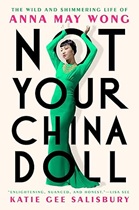
Not Your China Doll: The Wild and Shimmering Life of Anna May Wong – Katie Gee Salisbury

Each day, tourists visiting the City of Los Angeles make their way up to the world-famous Hollywood sign which overshadows the busy metropolis below which became home to the motion picture industry and the destination for people with dreams of becoming stars. However, some stars are home grown as they say and grow into adults with the film industry right in their backyards. In January 1905, a family of Chinese ancestry welcomed a daughter named Wong Liu Tsong who later became known to the world as film star Anna May Wong (1905-1961). In the fifty-six years that she lived, she went from a student helping in her parents’ laundry business to an international star who rubbed elbows with names cemented in Hollywood’s history. But there is more to her story than film roles, press photos, and statements to the media. Behind the scenes her life was far more complicated, and those complexities are unraveled in this biography by Katie Gee Salisbury, which thoroughly explores the late film star’s life.

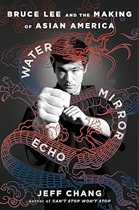
I first learned of Anna May Wong while reading Jeff Chang’s ‘Water Mirror Echo: Bruce Lee and the Making of Asian America‘. Years before Bruce left his mark on the film world, Wong was blazing her own trail. But I asked myself why had I not heard of her before? After finishing Chang’s book, I sought out material about Anna May Wong and found this book which was everything I had been searching for. The stage is set in Los Angeles where her parents Wong Sam Sing (1860-1949) and Lee Gon Toy (1886-1930) have made home for themselves and their growing family. We travel back in time when discrimination against Asians was socially acceptable and codified in legislation. I must warn readers that some of the subject matter may be difficult to accept. The Chinese Exclusion Act of 1882 hangs over the story like a dark cloud, and even when Anna becomes famous, she still cannot escape the scrutiny by United States Immigration officers as she travels to and from the country of her birth. But early on she was a simple teenage girl in a typical family with strong work ethic and connections to the old country, but Hollywood was the place which both captivated her and held her attention.

As the story progresses, it becomes clear that Anna is not the typical Chinese girl. And through a series of events, she finds her way into the film industry which at that time, had never shown Asian stars in leading roles. To say that Hollywood is a dark place would be an understatement. I am sure that many of us have heard stories about the underside of Tinsel town. Anna May Wong entered this world, and her life was never the same for better and worse. There are dehumanizing and humiliating experiences in the story, and even people who are allegedly “progressive” contribute to the cycle of bigotry which kept her from reaching the stardom she could have obtained. And there is also the practice of “yellowface” which would be seen today as a concept from another planet, but it was standard practice during her era. To reinforce the absurdity of it, Salisbury includes the story of the fictional Charlie Chan, played by Swedish actor Warner Orland (1897-1938). This role which brought him fame and wealth also resulted him becoming both typecast and a victim of substance abuse. It should be noted that Orland was one of several actors to play Chan. Despite the insulting practice, Asian stars did find work, but for Anna, the life changing success she craved came from another continent called Europe.

I was not surprised that she found success across the Atlantic Ocean, due to the obstacles non-white performers faced in America. She had learned the brutal reality of show business and had been changed by her visits to New York City’s Harlem neighborhood and other places which stood in stark contrast to Los Angeles. Along the way she forms friendship will starts from all over, and her friendship with the late Paul Robeson (1898-1976) is a heartwarming part of the story. As she climbs the stardom ladder, she also contents with attention from male suitors. However, there is a major issue with her love interests manifested in the disturbing concept of miscegenation which made it impossible for a life with a husband who was not Chinese. That would change in 1963 when Supreme Court ruled in the case of Loving v. Virginia 388 U.S. 1 (1967) that it was unconstitutional to prevent people of different races to marry. However, by that time Anna May Wong was gone.

Her success in Europe helps elevate her career and I was surprised at the amount of time it took then to travel from one continent to another. But I reminded myself that this was before jet-aircraft for passenger travel. Ships were the main method of travel, combined with rail and surface transit. But that does not stop her from becoming a world-traveler who splits time between multiple continents and even finds time to visit her father in China after he left Los Angeles yearning for life in his ancestral homeland. However, the looming threat from Japan would affect the family later as explained in the book. The trip to China is a mixed bag but it has her in good spirits and there is talk of her starring in a film by Irving Thalberg (1899-1936) called ‘The Good Earth‘ based on the book by author Pearl S. Buck (1892-1973). The film was a hit, but it is also a classic example of how yellowface prevented Asian stars from securing roles they should have landed. The full story as told by the author is hard to believe but this was the reality Wong and Asians faced. What is even more of a gut punch is the tools used by actors dressed in yellow face to prepare for their roles. Frankly, it is a case of adding insult to injury. And this would later be one of the main reasons Bruce Lee was determined to change the perception of Asian stars. Anna Way Wong was far from finished but she soon had another battle to fight with her own body.

Following the success and controversy of ‘The Good Earth’, Wong’s life quiets down a bit. She later finds more success in film and television but is racing against the clock. And this part of the book is heartbreaking. I did not know how severe her personal demons were until I read this biography. A disturbing reality emerges in which we can see how the industry chews up stars and spits them out. Wong was only one of many people both in front of and behind the camera whose lives ended in a downward spiral. By the time I finished the book, I came to understand the struggles and pressures she faced in an industry unwilling to fully embrace her talent. Her life story is an account of what could have been. Thankfully, decades after her death she has begun to receive the attention she rightfully deserves. And although she is long gone, her memory lives in articles, films, and books like this which preserve the life and legacy of a forgotten star in the murky world of motion pictures. The story is beautifully written, and while reading I felt as if I were transplanted back in time to roaring 1920s and 1930s before Germany sparked a second world war. For readers interested in the life of Anna May Wong, this is must read. You will see why she was not your China doll.

ASIN‏: ‎B0C7TVJKSZ
Publisher: ‎Dutton, March 12, 2024

Water Mirror Echo: Bruce Lee and the Making of Asian America – Jeff Chang

During the short span of thirty-two years, martial arts expert and film star Bruce Lee (1940-1973) single-handedly changed the view we have of Asian action stars. His movements on camera left audiences speechless and his peers in awe of his speed and reflexes. His sudden death on July 20, 1973, sent shockwaves across the planet, and the void left by his departure has never been filled. I saw this biography by author Jeff Chang and knew instantly that I must read it. And having finished the book, I say with conviction that this is the Bruce I did not know. But I also have a deeper understanding of his trials, tribulations, and the complicated relationship America has had with immigrants from Asia. 

We are introduced to Lee Hoi-Chuen (1901-1965) and Grace Ho (1907-1996), who have emigrated to the United States, making a home in San Francisco where their son Bruce is born on November 27, 1940. Bruce arrives as World War II is raging, and America has its Asian residents under surveillance as fears of Japanese sympathy have become a heightened concern. Chang explores the history of immigration laws aimed at Asian immigrants which range from highly restrictive to the complete exclusion of Chinese. The history is dark and includes facts that I was not aware of personally. However, I was aware the 1882 Chinese Exclusion Act which is by far the most shocking and disturbing piece of legislation. Today it seems unthinkable that such a law was passed but it happened and was official policy, extended through the Geary Act of 1924 before being repealed by Congress in 1943. This section of the book may be upsetting for readers, particularly those of Asian ancestry. Lee Hoi-Chuen and his family move back to Asia, settling in Hong Kong where Bruce’s childhood is on display. As I read, I could see his personality take shape complete with the tint of arrogance we see on scene, mischievous pranks, and the signs of a young man with enormous potential yet to be tapped into. There was one person who did see something in Bruce, and when he meets Yip Man (1893-1972), the Bruce we know begins to take shape.

The book shifts gears when Bruce is sent back to America, to comply with immigration law. And this is a part of his story which has been misunderstood for several decades. I have personally had conversations with friends who did not know Bruce Lee was born in the United States. Today we would call him an “anchor baby”, but American was his home by birth. He returns to the United States without his parents, and his life takes more twists and turns as he enters adolescence and confronts the realities of racial discrimination. We see the intimate side of Bruce as he moves from California to Washington State, makes friends, enrolls in college, falls in love and dives deeper into martial arts which becomes the center of his world. But the world-famous movie star is still years away.

When Bruce decides to begin teaching martial arts, the story becomes more interesting as his students are from all demographics. In fact, his first student and close friend may surprise readers. I smiled as I read the story and frowned when I read about Bruce’s moments when he feels down. Chang’s writing pulled me into Bruce’s life, and I could feel the emotions as the story moved forward. He also includes Bruce’s own words through journal entries, letters and comments to friends which help us form a complete picture of who he was and what drove him to success. There are two key moments in the book which take Bruce’s life in a different direction. The first major event in his life occurs when he meets Linda Emery who becomes one of the most important people in his life. The two married in 1964, but their relationship was complicated by several factors which Chang discusses. The second major event occurs in 1966, when the television show ‘The Green Hornet‘ premiers with Bruce starring as Kato. The show was short-lived, but it did get Bruce’s foot into the door of Hollywood. But the industry still struggled with Asian stars. Change dissects the problem of Hollywood and the section about the Charlie Chan films left me shaking my head. Frankly, it is a bad as “blackface”. Bruce is keen to this and understands that the film industry has a dysfunctional view of Asians.

Bruce’s purpose in life continues to take shape, but the book is haunted by his own premonitions that he would not live a long life. I was not aware that Lee had predicted his own early death. This sent chills down my spine and adds a sense of urgency to everything he does in the story. While teaching, he forms more friendships with Hollywood stars such as James Coburn (1928-2002), Steve McQueen (1930-1980) and Roman Polanski, which are important to his navigation of the entertainment industry. And the bond he had with basketball legend Kareem Abdul Jabbar is heartwarming. However, the stage is set for Bruce’s success when he decides to visit Hong Kong and meet with Raymond Chow (1927-2018), the president of Golden Harvest pictures. The two men envision a series of films to bring kung fu to audiences worldwide but have stiff competition in the Shaw Brothers Studio, a massive film empire created by brothers Run Run Shaw (1907-2014), Runme Shaw (1901-1985), and Runje Shaw (1896-1975). The cat and mouse game between the Shaws and Chow, over Bruce’s star potential plays out in the story and the success of the film ‘The Big Boss‘ (1971) only deepens the rivalry. For Bruce, it was a godsend because another aspect of his life hidden from the public is his financial struggles. In fact, there are several occasions in the book when the family is at rock bottom. But as Golden Harvest turned out films their fortunes improved and Bruce began to shape the film that cemented his legacy in film history.

As I continued reading, I was amazed at the difficulties Bruce faced in making ‘Enter the Dragon‘ which endures to this day as his masterpiece. The movie is all Bruce, yet producers still struggled with allowing stars creative control. Sadly, that issue exists today. But Bruce knew what he wanted to show on screen and explicitly stated so. Snippets of interviews he gave and heated discussions with studio executives confirm his commitment to changing the way audiences viewed Asian stars. In hindsight we know that Bruce prevailed, but we also see that physically he is in rough shape, and a back injury at home which is often overlooked may have marked the first stage towards his premature demise.

Following the success of the Big Boss, Bruce finally finds the stardom he had been searching for. But there is a dark cloud hovering over the story, and the stress and physical exhaustion become eerily apparent. On May 10, 1973, the alarm bells go off as Bruce has a severe medical incident on set requiring hospitalization. I felt a chill as I read of the confusion doctors had about his condition and the story gets much darker. Eventually July 20, 1973, arrives and it is Bruce’s last day alive. Chang approaches the end of his life with the right balance and sticks to what is known. Debates about how Bruce Lee died continue with conspiracy theories rampant. A detailed discussion of his death and the events of that day have been presented by the History Channel in a special which you can view on YouTube. After his death, I could feel the gravity of it while reading. The Bruce I came to know in the book was far more complex and misunderstood that I could have ever anticipated. And I understand the water mirror echo.

In the spring of 2023, the Tribeca Film Festival screened Enter the Dragon as part of a fiftieth anniversary celebration. The theater was jammed packed and we had a blast. After the film ended, the presenters that night surprised us with an in-person discussion with Angela Mao Ying who played Bruce’s sister in the film. It was a surreal moment and hearing her explain how Bruce selected her for the film and the friendship they formed stirred emotions both in the audience and on stage as Ying herself wiped away tears when discussing his legacy. Five decades after his death, he was as popular as ever and will remain an icon in pop culture. There have been imitators and rip-offs but there will never be another Bruce Lee. If you are a fan of Bruce Lee and curious about his life, this is the book you must read. I cannot recommend it enough. 

“I have already made up my mind that in the United States I think something about the Oriental, I mean the true Oriental should be shown”. – Bruce Lee, The Pierre Burton Show – 9/12/1971

ASIN ‏ : ‎ B0DR8B82SZ
Publisher ‏ : ‎ Mariner Books, September 23, 2025

Tupac Shakur: The Authorized Biography – Staci Robinson

In October 1994, the late rap star and actor Tupac Amaru Shakur (1971-1996) appeared for an interview with journalist Ed Gordon of Black Entertainment Television (“BET”). During their conversation, Gordon asked Shakur where he saw himself in ten years. The response was “I just want to be alive”. Two years later he was gone at the age of twenty-five. Twenty-nine years have passed since his death, yet we continue to speak of him, ask about him, and shake our heads at his premature death. A young Black male lost to gun violence is a recurring nightmare which has replayed itself in trouble neighborhoods across America. However, in his short life, Shakur also touched millions of people through his music and his roles in feature films. But there is always more to the story than the flashy jewelry and perfect smiles before the cameras. Author Staci Robinson examines Shakur’s life in a biography which is both thorough and haunting.

Shakur’s story begins long before his birth, and his story cannot be told without discussing his mother Afeni Shakur (1947-2016). As a member of the Black Panther Party, Afeni became well-known by law enforcement and found herself fighting for her freedom during a criminal trial in New York State Supreme Court. Her arrest, incarceration and quest for freedom set the stage for the way she would raise her future son who arrives in June 1971. There are feature films, documentaries, and books about Shakur’s death, but I still found interesting tidbits of information in Robinson’s account. Further, the narrative provides a very intimate look into their lives. And while I read, I could feel the frustration and despair which engulfed him with each relocation and humiliating experience due to their mother’s lack of a steady income. And the absence of a father only added to the anger and grief.

Despite their dire situations, there are bright moments in the book. From an early age, Shakur was talented and had an uncanny ability to connect with people. In 1984, he embarks on his journey to fame with a performance at the Apollo Theater. This part of his life is often overlooked but as Robinson explains how he landed the role of Travis an adaptation of Lorraine Hansberry’s (1930-1965) ‘A Raisin in the Sun‘, I was able to see that the roots for his future success in the entertainment industry were being planted. And though several years would pass before his breakthrough as part of the rap group Digital Underground, a star was born. But I also noticed something else in the book which I had not previously focused on. As we follow Shakur through his pre-teen and teen years, we are also able to see his capacity for absorbing knowledge and deep appreciation for the arts. His mind was a sponge that soaked up anything and everything. His time at the Baltimore School of Performing Arts where he meets lifelong friend Jada Pinkett Smith is one the brightest moments in the story. But the softer side of Shakur stands in stark contrast to the rap star later murdered in Las Vegas, Nevada.

The family’s move to Marin City, California opened new doors for Shakur and paved the way for his life in the music industry. But it was not without its hiccups and the long journey he makes to finding his footing is interesting and highlights the role luck plays in our lives. Of course, Shakur was incredibly talented, but meeting the right people at the right time always pays dividends. And when he meets Leila Steinberg, Atron Gregory and the late Shock G (1963-2021), the story shifts gears as the Tupac we came to know begins to take shape. The story is a roller coaster ride in which Tupac befriends other artists, dates celebrities, breaks into Hollywood and finds himself on the wrong side of the law. And throughout the story, I felt chills each time he told someone he would not live past twenty-five. This dark premonition hangs over the story, and when he is shot and wounded at Quad Studio in Manhattan on November 30, 1994, his premonition is no longer brushed aside.

The Shakur family did not have money, but they did have an endless supply of love for each other, and that is on full display in the book. And despite Afeni’s addiction to crack cocaine which is a dark section in the book, Tupac always loves his mother, and family is there for each other until his last moments. In December 1994, Shakur was convicted in New York State Supreme Court of sexual abuse in a case with many unanswered questions. Shakur always maintained his innocence and was acquitted of far more serious charges, but the experience and his incarceration weighed heavily on him and played crucial roles in the artist who found a new home at Death Row Records. Family is there to lean on throughout it all, but we can also see that he is on a collision course with a dark fate. Eventually he is released on appeal, and the author clarifies exactly how he was bailed out. Marion “Suge” Knight, the CEO of Death Row Records at the time, did play an instrumental role in helping Shakur obtain his freedom, but the full story is a bit more complex and sometimes misunderstood.

Once free and in California, Tupac does not waste time and hits the studio with a vengeance and creates one of the most successful rap albums in history, ‘All Eyez on Me’. Following a trip to New York City in late August 1996, Knight asks Shakur to go to Las Vegas for the Mike Tyson & Bruce Seldon boxing match. The trip should have been routine, but it would be the last time anyone would see Shakur alive. Robinson goes through the series of events culminating with the gunfire from a white Cadillac which pulled alongside Knight and Shakur as they waited at a traffic light on the Las Vegas strip on September 7. The aftermath and scene at the hospital is discussed and the story concludes with his death on September 13. Readers interested in the shooting and pending trial of Duane “Keefe D” Davis, will need to look elsewhere. Robinson does not discuss conspiracy theories or the murder investigations. Nor does she discuss the East and West Coast rivalry in the rap music industry in detail. And she made the right call as that would have resulted in the story veering far off course. I also felt this way after thinking about the other aspects of his life which are not discussed at full length here. There are things I wish had been discussed but I also realized that had she done so, the text would have been extensive and required a multi-volume biography. The author included just enough information to keep the story moving at the right pace. And the most important moments are captured in the narrative. When I reflected on the book after I was finished reading it, I realized that some parts of his life could be a book of their own. Robinson’s book is balanced, with the right mix of Shakur’s gifts, his flaws, the highs, and lows of his life, and all that came with his ascension to stardom. This is a good look at the life of the immortal and infinitely controversial Tupac Shakur. 

 “I‘m not saying I’ll change the world, but I guarantee I’ll spark the brain that will change the world. So keep your head up. Do what you gotta do. And then inside of you, I’ll be reborn.” – Tupac Shakur 

ASIN ‏ : ‎ B0BTLC8NTX
Publisher ‏ : ‎ Crown, October 24, 2023

Blood and Treasure: Daniel Boone and the Fight for America’s First Frontier – Bob Drury and Tom Clavin

In two weeks, the United States will celebrate Thanksgiving Day, with family dinners, the National Football League on television, and memories to last a lifetime. History books used in schools long held the notion that the meetings between Native Americans and European settlers were harmonious and full of warmth. The image its projects is heartwarming and removes the dark truth behind a clash of cultures which saw horrific violence, death, destruction, and the extinction of Indigenous people. Settlers courageous enough to venture in unsettled areas faced life or death decisions daily, and in some cases, they paid the ultimate price for their curiosity. Among these settlers in search of new territory was Daniel Boone (1734-1820), a frontiersman who is credited with westward expansion resulting in the settlement of what is known today as the State of Kentucky. This book is a discussion of his life and the turbulent continent of North America by authors Bob Drury and Tom Clavin. And to call it eye-opening would be an understatement. This book is must-read.

Boone’s name is known in American history. However, the full story is far more complex than the snippets provided in textbooks. The story told here is not a “feel good” account but a raw and unfiltered look at hardships of life during the 1700s and the deadly battles which raged as white settlers pushed further west. I must warn readers that this book is vivid, containing graphic descriptions of battlefield injuries and post-mortem desecration by both Native Americans and the new explorers. Scalping is a well-known custom of Native tribes but the extent to which remains were altered surpasses the depravity of the head wounds one would receive on the losing end of a conflict. Boone would come to have his own experiences battling Native tribes but before we reach the part of the book where blood is spilled, we are provided with a recap of the Boone family and Daniel’s upbringing.

A sizeable portion of the story takes place before the creation of the United States of American on July 4, 1776. Of course, the war is discussed, but it is a back story to Boone’s account. The North America examined by the authors was a land of open territory home to Native Americans. However, the Indigenous people who lived here had a vastly different view of land, and this difference in cultures would set the stage for the bloody battles to follow. I had previously read books which focused on the American frontier and the expansion of the United States, and while those stories were eye-opening, this book is just as gripping, and there were sections of the story which gave me chills. 

As I read, I noticed that the version of Boone we have come to know is different from the real Daniel Boone. We see in the story that the real Danie Boone did not see himself as a folk hero but as a frontiersman with a deep understanding of the complexities of Native American tribes and the dangers of being captured by the Indians. Proof of this comes from Boone’s own ordeal following his capture by a Native Americans. The surreal story is revisited, and it provides us with an inside look at the experiences of people taken as property. Boone lived to tell his tale, but others did not. Grisly fates awaited those chosen for death, and those scenes rival the battlefield atrocities we learn of as the story progresses. And both the tensions and acts of vengeance increase tenfold through the Battle of Point Pleasant in 1774 and Battle of Blue Licks in 1782. Boone was not at the first battle, but the latter would have tragic consequences for Boone and his family. The role of Boone’s brother Squire (1744-1815) was a curveball I did not see coming and left me speechless. The same applies with brother Edward “Neddie” Boone (1740-1780). And at home was Boone’s wife Rebecca (1739-1813) who increases their family size repeatedly throughout the story. This is significant because the amount of time Boone and other explorers were away from home was extensive, and without the aid of telephones and other means of quick communication, information traveled slowly, sometimes taking months to arrive. Frankly, Rebecca was left at home and more than once believed Boone had died. Today it seems unthinkable but in the 1700s, this was the reality of life as an explorer.

Eventually, the American colonists declare war on their British rulers, and the movement for independence kicks into high gear. Although the story here does not focus on the war extensively, it is a factor in the story. Further, the settlement of Boonesborough comes into focus, and the showdown Boone has with Native American tribes lead by the Shawnee in September 1778. It is a pivotal moment in the story, and it help to cement his legacy in American history. Additionally, there are other figures in the story who were also in charge of campaigns against the native tribes, and their roles in the reshaping of North American should not be overlooked such as Richard Henderson, the man behind the ill-fated Transylvania Purchase in March 1775 and Brigadier General George Rogers Clark (1752-1818) of the Virginia Militia. 

Following the Treaty of Paris in 1783, the story winds down and Boone life enters the final stages in the 1820s. Surprisingly, for a man who experienced a staggering amount of physical and emotional pain, he lived longer than most of the people around him but never forgot the pain which came from the tremendous losses his family suffered as North America was engulfed by conflict. The United States Government eventually succeeded in claiming lands once inhabited by Native Americans, and in the process, many became victims of extinction. These dark chapters in American history should not be forgotten and when we give thanks for the lives we have, we should remember those who died in violent conflicts across the continent. Highly recommended. 

ASIN: B08BYC44VP
Publisher ‏ : ‎ St. Martin’s Press, April 20, 2021


American Caesar: Douglas McArthur (1880-1964) – William Manchester

On November 11, 2025, the United States will observe Veteran’s Day and  pay its respect to the nation’s military veterans. Eighty years have now passed since the conclusion of World War II. In Europe, Allied Forces battled the Axis powers, fueled by German Chancellor Adolf Hitler‘s (1889-1945) quest for world domination and in the Pacific, Japan was aging its own war as it sought to spread its influence across Asia. Allied resistance to the Pacific was fierce and important as the European campaign, and at the helm was one of the American military’s greatest leaders, General Douglas McArthur (1880-1964). Today there are buildings, airports and streets named for him, but who was this legendary figure in military circles? Author William Manchester (1922-2004) explores his life in this extensive biography that peels back the layers to reveal the man behind the dark sunglasses and corn cob smoking pipe. 

In American military history, McArthur’s name is firmly cemented. Previously, I reviewed H.W. Brand’s ‘The General v. The President: McArthur and Truman at the Brink of Nuclear War‘, which focuses on the fallout between McArthur and United States President Harry S.  Truman (1884-1972). The complicated story of the two powerful figures is also told here by Manchester, and is a crucial part of McArthur’s fall from grace. But before we reach that point, his icredible life takes center stage, and from the beginning I felt myself pulled into the biography. Manchester was a noted historian and a meticulous writer, who had a talent for bringing history to life with vivid clarity and smooth narratives. Readers should be aware that this book is long and contains well over seven hundred pages of text. But contained within it is a wealth of information about an iconic figure. 

Early in the book, it becomes clear that the military is a crucial part of the McArthur family’s life. The role of McArthur’s father Arthur McArthur, Jr. (1845-1912) is firm, and young Douglas proves to be a brilliant student and blessed with high intellect. But no one could have predicted the name he would make for himself later in life. As we follow the young McArthur from one continent to the next, we witness his gains in battlefield experience, exposure to cultures abroad and ascension in military rank. The young bachelor also finds love in the story, and second wife Jean (1898-2000) would prove to be the rock he needed as he moved through life. The addition of son Arthur, IV introduces fatherhood into the story and throughout the book, McArthur embraces his role as protector of his immediately family and a series of islands in the Pacific known as the Philippines. The story behind his god-like status on the islands is explained thoroughly, and includes his actions during World War II (1939-1945) as Japan ramped up its attacks on the small islands. Although Japan was defeated, the threat from Tokyo was real and the McArthurs faced danger more than once before the Allies began to turn the tide. The discussion regarding the war forms a sizeable section of the book for obvious reasons. When Japan does surrender, McArthur also plays a pivotal role in post-war events but there was another looming threat on the horizon also in Asia. 

On June 25, 1950, North Korean troops poured across the 38th Parallel into South Korea igniting the Korean War. The White House sprang into action, and McArthur once again would be called into service. Korea proves to be far more complicated than World War II, and the reasons why are explored by Manchester without taking the focus away from McArthur. However, we also see the rift developing between Truman and the famed general. And when Truman signs NSC-68, 1950, more confusion is added to the mix. For McArthur the situation was simple and he would do what was needed to defeat North Korea. But the White House and America had no desire for another world war. But what happens to the life long combat soldier who has no more wars to fight?Soon a major issue developes and readers will notice that McArthur is somehat of a “Frankenstein” created by the system he served. And when he acts on his own, the stage is set for a showdown with the White House. I understood Truman’s decision regarding McArthur’sremoval but I did question his methods.  Once home in the United States, the story takes another turn as McArthur becomes a national celebrity with public opinion on his side. But it does not last long and the impact to his image is significant. The story is surreal at times and the differences in which he was revered and loathed are striking. By autumn 1953, the world wars were over and McArthur was already back in America, living out his days quietly as his health began to decline. 

As the 1960s approached, McArthur had begun to decline physically, and in the story, we can see the end is near. But even as he was confronting his own mortality, he sill saw himself as the general of service and there is an interesting meeting with President John F. Kennedy (1917-1963) which sent chills down my spine. McArthur would also have a similar discussion with President Lyndon B. Johnson (1908-1973), and we can only wonder what would have happened had his advice been followed. In the spring of 1964, his health turns sharply for the worse and his last days draw near. The book ends with a somber note at Walter Reed Army Medical Center in Bethesda, Maryland as slips away but his death felt strange after a voluminous account of his life which is intertwined with world history. However, we are all mortal and although he is gone, his memory lives on in our rememberance of his name and accomplishments. He truly was the “American Caesar”. 

“People grow old only by deserting their ideals,” MacArthur had written, paraphrasing another writer. “Years may wrinkle the skin, but to give up interest wrinkles the soul.… You are as young as your faith, as old as your doubt; as young as your self-confidence, as old as your fear; as young as your hope, as old as your despair. In the central place of every heart there is a recording chamber; so long as it receives messages of beauty, hope, cheer and courage, so long are you young. When… your heart is covered with the snows of pessimism and the ice of cynicism, then and then only are you grown old—and then, indeed, as the ballad says, you just fade away.”

Publisher ‏ : ‎ Back Bay Books
Publication date ‏ : ‎ May 12, 2008

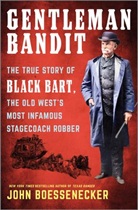
Gentleman Bandit: The True Story of Black Bart, The Old West’s Most Infamous Stagecoach Robber – John Boessenecker

While browsing through my recommendations, I stumbled across this book by author John Boessenecker about Charles  E. Boles (1829-1888)  whom we know as “Black Bart”, a stagecoach robber who executed brazen heists in the United States during the late 1800s. I knew Bart’s name, but his life story was foreign to me, so I decided to purchase this book and learn what I could about a stickup artist who remains infamous in American history. However, the book is not simply a story about a brazen thief, but a story about a complicated man whose life was mysterious and confusing.

Boles’s exploits are certainly a source of fascination, but his personal life is equally captivating. In fact, readers may find the story behind the robber to be even more interesting than his theft of lock boxes from stagecoaches. Boesseenecker carefully traces the Boles’s family history from Shelfanger, England to North America. And though Boles would call the continent home for most of his life, there is a surprise twist regarding his residency in America. His early life is typical of the era, and even when he meets his wife Mary, there is nothing to indicate what would come later. The story moves along nicely, but when the American Civil War erupts, Boles’s life changes permanently.

Prior to reading this book, I was not aware that Boles had served in the Union Army. The author ‘s discussion of Bole’s military service is interesting and highlights the varied experiences of Union troops. Hunger, fatigue and battlefield injuries are part of the story and Boles suffered all three. And like other soldiers, he had left his family at home while he aided the Union effort. In hindsight, it is likely that his time in the military provided the physical and mental training which he employ later as he moved across America executing staged heists. But how did he do this with a family at home? Well, there is an explanation for it, and I was speechless at this point in the book. I can only guess what Boles’s reasons were for his decisions regarding his family, but it suffices to say that he was a strange character. And once he embarks on his career in theft, the story becomes even more surreal.

Black Bart became famous due to the press coverage of the stagecoach heists, but Boles’s identity was a mystery to law enforcement. Further, his nomadic tendencies made tracking him even more difficult. He became ghostlike, moving around from place to place with no final destination in sight. However, the author does a thorough job of compiling a timeline of his movements following his discharge from the Union Army. To be clear, there are parts of Boles’s life which remain a mystery. When his parents pass away in the early 1870s, it seems that it at this point where Black Bart began to take shape and Charles Boles no longe exist. But despite his peculiar nature and social quirks, Boles was highly intelligent, completely literate and in pristine physical condition. And Boessenecker provides a simple yet effective explanation for Boles’s aversion to horses. His heists are daring and comical, but attracted the growing attention of law enforcement who became determined to get the man known as “Black Bart”.

As the story progresses, it becomes clear that the walls are closing in and that Boles’s luck will run out. California proves to be the end of the line for him, and his downfall is swift but not without its flair. He soon finds himself at San Quentin prison for a multi-year stretch. And when he leaves several years later, it seems as if Black Bart will once again wreak havoc across America. However, the story soon ends, not because the author stopped writing but because Bart disappeared. Without any advanced notice or signs, Boles vanished into thin air never to be seen again. To this day, it is unknown what happened to him. Of course there are rumors, but no official account of his death exists. We may never know what happened to Black Bart, but we do know what he accomplished in life, for better or worse and this book is a valuable record of his  life. This account by John Boessenecker is a solid look at the unorthodox life of the “gentleman bandit” who became the most prolific stagecoach robber in American history.

Publisher ‏ : ‎ Hanover Square Press
Publication date ‏ : ‎ March 14, 2023

All Blood Runs Red: The Legendary Life of Eugene Bullard: Boxer, Pilot, Soldier, Spy – Phil Keith with Tom Clavin

People have asked me how I decide on the next book I want to read. Well, the truth is I do not always know and sometimes find hidden gems purely by accident. Such is the case with this book. It was not on my radar at all, but I am deeply grateful that I did discover it. And to be brutally honest, I admit feeling a sense of guilt that I did not know of Eugene Jacques Bullard (1895-1961), whose life story is preserved in this biography by Phil Keith with Tom Clavin which left me grateful and humbled. 

Before continuing, I must point out that there are aspects of Bullard’s life lost to history. However, there is a wealth of information about him in public records, and Bullard both wrote and spoke about his life. You might be wondering how this Black American ended up in France becoming an infantry soldier, pilot, business owner, and celebrity in his own right. The proof is in the pudding as they say, and once I began the book, I found myself glued to it, stealing any spare time to open my Kindle and pick up where I left off. There are sections of the book which are not pleasant to read, and readers sensitive to descriptions of warfare and racial discrimination may want to use discretion. Despite the dark moments in the story, the book is an incredible story of a man who made history in his own way.

Bullard’s story begins in the Deep South, in Georgia where he is born in 1895. It is understood that this time in America was exceedingly difficult for Black people, particularly in rural Georgia. And the difficulties one would expect are in the story, highlighting the sacrifices parents made for their children. As for Eugene, it soon becomes clear that life under Jim Crow is not what he wants, and by the age of sixteen, he is on his way to a life abroad which took him to places he could have never imagined. The unorthodox and surprising chain of events detailed by the authors is a testament to the luck and help from others which shape our lives.

Although he had departed from America, the story is far from over. Arrival in the United Kingdom provides the starting point for his European journey which takes him to France and in the trenches during World War I. The story feels like a depiction out of Hollywood, and as I read about the injuries he sustained and the loss of life, I could not imagine the fear and anxiety which must have gripped him and his fellow soldiers. War is brutal and its savagery is on full display here. However, Bullard had an unusual ability to keep pressing forward, first as a boxer and then as a soldier. And when battlefield wounds and a chance opportunity present a rare opportunity, he takes to the skies in the seat of a cockpit. It is here when the story changes gears as the legend is born.

The book has its twists and turns including his brief love affair with a “lady of the night” and the arrival of American forces in World War I (1914-1918) which brings the nightmare of Jim Crow to France where Bullard and his contemporaries make it clear to the Americans that Europe was not the South. Nonetheless, there were those who tried their best to make his life miserable, and Dr. Edmund Gros (1869-1942) proves to be his arch nemesis. Despite the roadblocks, Bullard continues to earn his fame and builds a life in France. Although the country was not void of racial prejudice, Bullard does well for himself and his club became so popular that he entertained people from all walks of life including authors Ernest Hemingway (1899-1961) and F. Scott Fitzgerald (1896-1940).  He also found love and marriage which produced two daughters and an ill-fated son. The marriage did not last, and it is not clear what happened. We have a general idea based on the book, but Bullard remained silent on some details. Regardless, it is a sad moment in his story and the arrival of World War II (1939-1945) would split the family apart. But there is a happy conclusion to their story which will make you smile. The war brought the reality of the Nazi menace to France’s doorstep, and an underground resistance network develops. Bullard finds a friend and partner in Cleopatre “Kitty” Terrier who becomes a lifelong friend and plays an instrumental role in saving Bullard’s family. Resistance to Nazi Germany’s Third Reich was dangerous and Bullard comes close to meeting his maker in one disturbing incident as explained by the authors. The surreal and uplifting story is a  shining moment in the book.

In July 1940, Bullard returned to the United States and Harlem became his home for the rest of his life. But he was not one to sit still and attempts to revisit the past with a trip to his native Georgia. This part of the book will stir emotions for readers who have spent an extensive amount of time away from home. Today we have email, instant messaging, and social media, but in Bullard’s time, letters and telephone were the methods of communication. Reading his plight reminded me of the conveniences of modern technology and the saying that “there is no place like home”. Bullard returned to New York and found employment at Rockefeller Center operating an elevator while attending official functions in Manhattan related to the French government. And that is the iron of his story. In America his skills and war record were unknown but to the French, he was one of their greatest heroes.But a chance encounter with a studio executive gives Bullard his “fifteen minutes” of fame on national television. Alas, the “Black Swallow of Death” had earned recognition on home soil. 

Time catches up with us all and Bullard was no exception. His physical decline is hard to accept but I also thought of the physical and emotional trauma throughout the story and how each took its toll on him. But throughout the book, Bullard kept pressing forward and beamed with pride at the medals and recognition he earned in Europe. And in time, his own country would honor his life in ways he could not have predicted as a young boy living under Jim Crow. His life story is full of highs, lows, heartbreak, and moments of unimaginable glory. This book has quickly become a favorite of mine and I have already recommended it to a close friend. I now recommended it to anyone interested in an incredible story about world history and Eugene Bullard who proved throughout his life that all blood runs red. 

ASIN ‏ : ‎ B07N7G776W
Publisher ‏ : ‎ Hanover Square Press, January 18, 2023

Greg Scarpa, Legendary Evil: The Many Faces of a Mafia Killer – Jonathan Dyer

The Italian American mafia or “La Cosa Nostra”, became firmly entrenched in American society as immigrants from Italy to their newfound home. On the streets of New York City, a young mobster named Charles “Lucky” Luciano (1897-1962) realized that the constant violence among gangsters was no good for business and envisioned a “commission” to rule mob affairs. Luciano’s vision became a reality and the “Five Families” are now a permanent part of the city’s history. One of these families, the Colombos led by the mob boss Joseph Colombo (1923-1978), is noted for its civil wars, and members who have turned state’s evidence. One of them was not only a ruthless killer, but a bigamist and Federal Bureau of Information (“FBI”) informant. In Brooklyn, Gregory Scarpa, Sr. (1928-1994) became known as the “Grim Reaper” and throughout his career, he would prove more than once that the name had been earned. Author Jonathan Dyer explores the life of the mobster who terrorized adversaries and sent shockwaves through mafia circles.

I previously reviewed Peter Lance’s ‘Deal With The Devil: The FBI’s Secret Thirty-Year Relationship With A Mafia Killer‘ which chronicles Scarpa’s role as an informant. The book is particularly good, and Dyer uses it here as a source for what is a more complete picture of Scarpa’s life. Aside from Lance’s book, I had viewed documentaries on Scarpa and I have also read the book ‘The Mafia Hitman’s Daughter‘ by Linda Scarpa and Linda Rosencranci. His daughter’s book is eye opening and shows the effects life in the mafia has on family members. This book is a mix of both with additional exhaustive research. And the result is a book which will stand the test of time. Dyer provides a raw and unfiltered look at Scarpa’s violent and tragic life. 

Following the early discussion of Scarpa’s early life, the story changes when he meets his first wife Concetta “Connie” Farace (1931-2012). The story is routine, with Scarpa earning his stripes on the street and Connie bearing the couple’s children. However, the story takes a sharp left turn when the FBI institutes the Top Echelon Criminal Informant (TECI) program. This new pilot program by the bureau would find a willing participant in Greg Scarpa who soon joins and begins a thirty-year relationship with the “Hoover” boys. And if that is not shocking enough, the book takes another turn when he meets a teenage girl whom he would remain with for twenty-five years while taking on yet another wife, resulting in a love story completely off the rails. Added to the mix is his protege Larry Mazza, whose role in the couple’s lives is surreal. You must read it to believe it.

In what becomes a strange paradox, Scarpa feeds the FBI crucial information on mafia activity while at the same time engaging in criminal enterprises. In one instance, what should have been an air-tight case against Scarpa and his co-conspirators for a counterfeit money scheme was dismissed under mysterious circumstances. The dismissal raises the unanswered question, was the FBI protecting its asset? As for Scarpa, he continued to enjoy his relationship with the bureau while wreaking havoc in the streets. However, he is credited with assisting the FBI on high profile cases. The only issue is that only one out of the three presented by Dyer seems to be the most plausible. Dyer breaks down each alleged assist by Scarpa and uses the process of elimination to assess which account has the most credibility. But it is not long before the story takes on more bizarre twists and turns.

Scarpa’s relationship with his children is interesting and highlights the contradiction which exists in his story. While he was easily killing fathers and husbands, he went to extreme lengths to protect his own. Each child carries their own scars and trauma in the book. Linda has spoken for herself, but Gregory, Jr., and Joey (1971-1995) are not as fortunate. Gregory Jr. was released from prison in November 2020 and has remained out of the public light. Joey met a horrific death, and the story as told by Dyer is heartbreaking and disturbing. Gregory Jr. was closest to their father and that devotion would earn him a staggering prison sentence and demons to haunt him for the rest of his life.

As the story progresses, Scarpa continues his pattern of manipulation and exploitation but receives a life diagnosis when he goes into the hospital to treat a bleeding ulcer. A tainted blood transfusion leaves Scarpa infected with a disease that changed life as we knew it during the 1980s. And this is where the downfall ofthe mobster begins. His physical decline and power struggle within the Colombo family between supporters of Carmine “The Snake” Persico (1933-2019) and Victor “Vic” Orena, intensifies the suspense as mob hits, criminal indictments and mortality take their toll on all involved. And throughout all, Scarpa remains a gangster to the core. The story is insane and will leave readers shaking their heads at Scarpa’s escapades and violence which ensued. But as the saying goes, every gravy train reaches its destination, and Scarpa finds his meal ticket with the FBI set to expire. And when the government came for justice, Scarpa found himself persona non grata in law enforcement circles. A shocking admission in open court would forever change the way his contemporaries viewed him and cement his legacy in the annals of mafia history. 

Dyer’s account of Scarpa’s life is well-written and well-researched. It is full of information and cross-referenced. It is still a new release, and I am sure readers with a soft spot for mafia history will be interested in what the author has to say. After finishing the book, I did not have any strong emotions towards Scarpa but could see that his life and the lives of those around him became dysfunctional due the mafia’s grip on them. Another former Colombo member Michael Franzese who has gained a new following online once said that the mob destroyed lives. He is absolute correct. If you are a mafia aficionado or in search of an informative book about the streets of New York City and its Five Families, you will enjoy this. 

He was neither God nor devil. He was, like the rest of us, mortal, distinguished from most of his fellow human beings by his unlimited capacity for evil. His existence was terrifying during his life, and the story of his life is a frightening reminder of the human capacity for betrayal and deceit, for duplicity and greed, for violence and death.” – Jonathan Dyer 

ASIN ‏ : ‎ B0FDSNQPCZ
Publisher ‏ : ‎ WildBlue Press (22 July 2025)

The Last Founding Father: James Monroe and a Nation’s Call to Greatness – Harlow Giles Unger

On September 3, 1783, representatives of United States, Great Britain, Spain, and France signed the Treaty of Paris which officially concluded the American Revolutionary War and recognized the newly formed nation of former British colonies. The founding fathers of the United States soon realized that a monumental task lay before them, and they wasted no time in creating the country they had envisioned as the movement for independence gained momentum. Among the men whose vision shaped the America we know today was James Monroe (1758-1831) who served as America’s fifth president. Having outlived his contemporaries, he is accurately referred to as the last founding father by author Harlow Giles Unger who returns with another engaging biography of an American leader. 

I previously reviewed Unger’s biography of President John Quincy Adams (1767-1848), a book which I could not put down as I read the life story of an American figure who helped change the course of history. Adams makes an appearance in this book as well, when President Monroe entrusts him with tasks crucial to America’s development. However, the focus of this story is on Monroe and his incredible life. I approached the book with limited information on Monroe. In school, his name was remembered for the policy which bears his name, the Monroe Doctrine. The story behind Monroe’s 1823 congressional address in which he laid forth the doctrine’s goals is told within, providing readers with an inside look into the thought process behind the actions of the Monroe Administration. 

Monroe’s story begins in Westmoreland County, Virginia in 1758 as American patriots are beginning to question British rule. The growing young man bears witness to British encroachment, and when the war for independence begins, Monroe joins the Continental Army under the leadership of America’s first President George Washington (1732-1799). The two would go on to have a lasting friendship which is discussed by the author. Monroe also found company in mentor and fellow President Thomas Jefferson (1743-1826) who remains a close confidant of Monroe through the rest of the book following their initial acquaintance. Sadly, the same cannot be said of former President James Madison (1751-1836) whose friendship with Monroe took an unexpected turn. The details are contained within, and it is interesting to see the bonds between the men who were responsible for shaping the nation known globally as the United States of America. 

While Monroe was making a name for himself in politics, he also believed in family. He and wife Elizabeth (1768-1830) were deeply in love and she was equally effective at foreign policy as her husband. Her actions regarding the pending fate of Adrienne de La Fayette (1759-1807) in France will surprise readers. She is also remembered as an elegant first lady, and the reasons why are explained in the story. As for James Monroe, building America was paramount, and in 1803, he played a prominent role in the Louisiana Purchase which tripled the size the of the United States overnight. Readers interested in the deal will appreciate this section of the book as the back door dealings spearheaded by Monroe result in a land grab that is still shocking to this day. But while America was growing, England had not forgotten its former colonies, nor its conflict with France, and all hell breaks loose during the War of 1812. The buildup to the conflict is important and Unger explains the events thoroughly and at the right pace. The suspense is gripping, and readers will see the conflict looming in the distance as Europe becomes more unsettled. It would not be the last time that a war in Europe brought America into the conflict. 

Following the war, Monroe returned to the State Department, and in 1816 he makes a decision that changes his life forever when he decides to run for president. With hindsight we know he was successful, and the focus here is on his presidency and his accomplishments as commander-in-chief. However, there is the elephant in the room in every story of America’s early days and that is the issue of slavery. Surprisingly, there is not much about it in the book and early administrations sought to avoid the issue altogether. However, Monroe would be forced to confront the matter during the Missouri Compromise of 1820. Monroe’s position on the matter was unsurprising because he was a slave owner himself just as several founding fathers were. Monroe did see slavery as a threat to the future of the nation and realized that freedom could not exist with enslaved people, but he also reaped the benefits from being a slave owner and believed in the rights of pro-slavery states. He did endorse one plan to rectify wrongs done to African slaves, and it explains the existence of Monrovia, Liberia. The issue of slavery would be decided forty-five years later when the first Republican president did what no leader before him had dared to do.

After departing the White House, Monroe’s life returned to a sense of normalcy, but he faded away from public light and found himself to be a symbol of a bygone era in American history. His legacy had been cemented but the United States was on a new course, chartered by President Andrew Jackson (1767-1845) who remains one of the most controversial leaders in American history. His story is a roller coaster ride on its own and I strongly recommend Jon Meachem’s ‘American Lion: Andrew Jackson in the White House‘ which is a good source of information about Jackson’s command of the United States. As time passes, Monroe’s life changes and on July 4, 1831, he takes his final breath in New York at the age of seventy-three, leaving behind a legacy which shaped American foreign policy for years to come. If you are searching for an enjoyable book regarding America’s founding fathers, this biography of James Monroe will be a fitting addition to your library.

The most beloved president after Washington, Monroe was the only president other than Washington to win reelection unopposed.

ASIN ‏ : ‎ B002RBWF26
Publisher ‏ : ‎ Grand Central Publishing, April 8, 2025 

Just as I Am – Cicely Tyson with Michelle Burford

At the age of ninety-six, actress Cicely Tyson (1924-2021) was able to look back on a journey which no one could have predicted. And when she passed on January 28, 2021, it was another reminder of the mortality which confronts us all. However, there is much to celebrate about her life which she recalls in this autobiography presented to us with the help of author Michelle Burford. The cover caught my attention and once I began, I could not put it down. 

Following a recap of the family’s origins in the small Caribbean nation of Nevis, the story moves to New York City where her parents William (1897-1961) and Fredricka Theodosia Tyson (1897-1974) raise three children in a section of Manhattan Island known as Harlem. Their story is an immigrant tale, and young Cicely soon learns the cruelty of racial discrimination and witnesses the turmoil brewing between her parents. Unbeknownst to her at the time, the actions of her father would come back to play a role in her own life many years later. Cicely, sister Emily (1926-1999), and brother Melrose (1922-1991) each find ways to cope with the strains of family life. The maturing Cicely proves to be the one with the most to learn, and meeting with a pastor’s son named Kenneth throws a curve ball into the story that I did not see coming. And it forces Cicely to evolve from a teenage schoolgirl to an adult very quickly. 

Life becomes complicated for Cicely but eventually stabilizes for her and daughter Joan whom she adores. There are the typical worries about finances, security, and long-term goals. But an unexpected opportunity arises when she decides to answer a call for potential models. One thing leads to the next, and she catches the eye of someone who has connections in the film industry. However, Cicely is skeptical and does not see herself as a Hollywood talent. But she soon comes to terms with it and this quote from her stayed with me long after finishing the book: 

“My mother understood what I didn’t yet at the time, that there’s a path in this life with your name on it. What God means for you to have, no one can take away from you. It’s already yours. Our mission, as God’s children, is to surrender to what he has ordained—and to freely let all else just pass us by.”

As her Hollywood career takes off and the accolades come in, the story changes gears again with the entry of jazz musician Miles Dewey Davis, III (1926-1991). Readers familiar with Davis’s story will know it was beyond wild, but Tyson provides an interesting firsthand account of his battles with substance abuse which Miles himself discussed in his autobiography written with Quincy Troupe. Their story is an unusual account, and their romance did not develop instantly. In fact, Davis was with someone else when they first met. But fate had its own plans, and they would reconnect, find true love with each other, and walk down the aisle to exchange wedding vows. But behind the public image of the sharply dressed power couple, there were dark times due to Davis’s destructive lifestyle. The incidents which occur are surreal but highlight the seriousness of Davis’s condition. Their marriage was a roller coaster ride, and even after separating they remained closed. Tyson comments on an attempt by Miles to reconcile later in life as he continued to deteriorate caught my attention because his proposal instantly puts her on guard and signals that he was dealing with something just as dangerous as drug addiction. 

While Davis comes in and out of the story, Tyson continues to rise as a Hollywood star, and she explains the stories behind her iconic roles and friendships with stars of the past who are no longer with us. It is a fascinating look at the motion picture industry and the challenges faced by black women who find themselves in tinsel town. She waged a constant battle against the stereotypical portrayals of black women and that is part of her enduring legacy. Despite the sexual predators, offensive scripts, and rigors of the entertainment industry, she kept rising as a star and mastering her craft. And in her advanced years, she continued to appear in front of the camera to keep moving forward in life. This is one of the best autobiographies I have read. I only wish it were longer. I thoroughly enjoyed reading about Tyson’s life and the people who were part of it. Recently, I was eager for another biography to read, and this book was just what I needed. 

“To examine, to question, to discover and evolve—that is what it means to be alive. The day we cease to explore is the day we begin to wilt. I share my testimony in these pages not because I have reached any lasting conclusions, but because I have so much to understand. I am as inquisitive about life now as I was as a child. My story will never be finished, nor should it be. For as long as God grants me breath, I will be living—and writing—my next chapter.” – Cicely Tyson 

ASIN ‏ : ‎ B08425MPGS
Publisher ‏ : ‎ HarperCollins Publishers, 2021