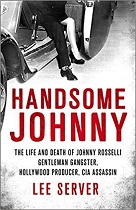
Handsome Johnny: The Life and Death of Johnny Rosselli: Gentleman Gangster, Hollywood Producer, CIA Assassin – Lee Server

On August 7, 1976, a fifty-five-gallon drum was found floating in Dumfoundling Bay near Miami, Florida. Upon closer inspection, authorities were shocked to discover human remains which had been packed inside of the drum with the victim’s legs completely severed. The body was later identified as Johnny “Handsome” Roselli (1905-1976), a well-known Italian American crime figure who had made a fortune in Hollywood and worked with factions within the United States Government to assassinate Cuban leader Fidel Castro (1926-2016).  Roselli’s death was as mysterious as his life as a powerful figure in the criminal underworld. Author Lee Server explores his life in this interesting biography which gave me chills.

I knew of Johnny Roselli before reading the book due to his name appearing in books regarding the assassination of President John F. Kennedy (1917-1963). The Kennedy family makes their appearance in this book as well, when young Jack finds friends in Las Vegas through his connection to singer Frank Sinatra (1915-1998). But before we reach Roselli’s time on the West Coast, we first learn of his early life in Esperia, Italy, and the family’s migration to Boston, Massachusetts. At first it is a standard immigrant tale of the times but when Roselli’s father passes away, life for young Filippo Sacco as he was known then, is never the same. A stepfather enters the picture, but another curveball is thrown at the reader when we learn of the insanity surrounding his mother’s new love. I was speechless as I read this section, but I was not surprised that young Filippo soon found himself on the wrong side of the law which required an exit stage left.

Chicago is what you would expect, full of gangsters, corrupt politicians, and violence galore. And Johnny steps right into, engaging with some of the most dangerous figures in the annals of organized crime, including Alphonse “Al” Capone (1899-1947) and Frank Nitti (1886-1943). Eventually Chicago loses its luster, and an invitation to come out to California arrives. Seizing the moment, Roselli agrees and the biography changes gears as we revisit the golden age of Hollywood, Las Vegas, and their dark secrets. There is a lot to unpack but the author’s writing style is smooth and engaging, and I found myself soaking up the information as the pages went by. He provides the right amount of attention to each subject without affecting the pace of the book. Roselli was firmly entrenched in the film scene and found himself surrounded by the biggest names in the industry. Yet, no one knew anything about his past. He remained a mystery even to those who knew him well. But that anonymity and steady cash flow were derailed when Castro and his revolutionaries took over Cuba. Roselli may not have known it at the time, but his role in the efforts to silence Castro would seal his own fate in ways he could not have predicted.

When the decision is made to covertly approach the mafia to help oust Castro, the story morphs into a surreal tale of strange alliances, double crosses, and secret agreements. This part of the book is wild, and only the beginning. Roselli’s role and the fallout from the failed attempts to topple Castro are discussed in numerous books regarding Kennedy’s murder but Server provides a good summary of what happened to keep the focus on Roselli’s life story. However, what he does discuss is enough to leave readers with enough information to piece together the picture of the intelligence community’s desire to eliminate Castro. The White House was aware of the plans in store for Castro’s domain, and Roselli found himself in a usual position along with mobster Salvatore “Sam” Giacana (1908-1975), who plays a significant role in Roselli’s story and the Castro plots. There is also a discussion of the 1960 election which remains controversial due to claims that it was “fixed” for Kennedy’s win. When the covert plans between the mafia and government agencies are discovered, both Giacana and Roselli soon realize their lives will never be the same after the Government turned its attention to both.

Roselli finds himself on the radar of the Federal Bureau of Investigation (“FBI”) which begins to investigate his background, and what they find regarding his emigration to America comes back to haunt Roselli’s every move. I was not aware of this part of his story and could not help but think it is something we are currently seeing today as background checks take on a more serious nature. Criminal charges and a conviction for an unrelated issue arise, and following several years of incarceration, Roselli is freed in 1973. The author traces his steps as he relocates from California to Florida where his sister and husband reside. His life calms down as he keeps a low profile, but the past was not done with him. He had become a key witness for committees investigating the intelligence community and its bags of tricks. On July 28, 1976, Roselli took his sister’s car and left the house, never to be seen alive again. The author rightfully explains the gruesome death and the discovery of his remains, but the book does not go into motive or suspects. Instead, it concludes right after his body is given to his relatives. I think a discussion about the crime and who wanted him dead would have been beneficial, but the book is still a great read.

Johnny Roselli’s death remains unsolved, but there are theories as to who killed him. Personally, my first guess would be the mafia itself who saw him as a liability. The manner of his death and sudden disappearance have the markings of a mob hit. Whether that is what happened is unknown, but readers can come to their own conclusions. His death was tragic, but his life was anything but ordinary. He lived fast, spent lavishly, enjoyed access to powerful people, and died violently as powerful people covered their tracks and tied up loose ends. However, Roselli did leave his mark on Hollywood and in American history for better and worse. This is his story and a look at the Italian American mafia whose influence in the United States continues to fascinate readers and moviegoers alike.

ASIN‏ : B00AAYF9MK
Publisher ‏ : ‎ St. Martin’s Press, November 13, 2018

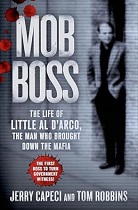
Mob Boss: The Life of Little Al D’Arco, the Man Who Brought Down the Mafia – Jerry Capeci and Tom Robbins

On September 27, 1963, underworld crime figure Joseph M. Valachi (1904-1971) arrived as the U.S. Capitol to provide testimony to the Senate Select Committee on Improper Activities in the Labor or Management Field, formally known as the “McClellan Committee” due to the presence of its chairman, Senator John L. McClellan (1896-1977). Valachi’s testimony was eye opening and exposed secrets of La Cosa Nostra, loosely translated to “our thing” from the Sicilian dialect. Never before had a rank-and-file member of the Italian American mafia revealed what Valachi disclosed in an open hearing. But over the next forty years, more mobsters would agree to tell what they knew and become cooperating witnesses in federal investigations. Among them was Alphonse “Little Al” D’Arco (1932-2019), a former acting boss of the Lucchese Crime Family in New York City. This is his life story, told to authors Jerry Capeci and Tom Robbins. 

As a native New Yorker, I do have a soft spot for books regarding the Italian American mafia due to my childhood when the mob was all over the five boroughs. D’Arco’s name was familiar to me but I was unaware of his story likely due to his low profile. In fact, prior to his deception, few people outside of the mob and select law enforcement officials knew who he was. But looks can be misleading and some of the most powerful mobsters moved very carefully behind the scenes. The Lucchese family has had its share of press and was portrayed in the 1990 blockbuster film ‘Goodfellas‘ by award-winning director Martin Scorsese. The film continues to stand the test of time, but the real story is darker, grittier, and far more complex. D’Arco’s input sheds light on some things not shown on screen, but the crux of the book is his time in the life, and his decision to become a government witness. 

The story begins in Brooklyn, New York, and has the feel of a classic immigrant experience when parents left everything at home and emigrated to America in search of a better life. Their children, often born in America, did not always see things the same way and soon learned that the streets could provide more money than their parents would ever see in their lives. But before we reach D’Arco’s entry into La Cosa Nostra, we first revisit his time in the military and his marriage to wife Dolores, with whom he had five children. With each new child came more pressure to earn money and a meeting with Lucchese member Vittorio “Vic” Amuso (b. 1934), sets D’Arco on the path that would lead to his downfall and permanently change his family’s life.   

I instantly noticed that D’Arco did not have the vices I had expected in a mob biography. Aside from the money-making schemes he participated in, he does not come across like the gangster we envision when thinking of the mafia. But despite his gentle appearance, he was no pushover and did business with gangsters who found killing to be second nature. What is also interesting is that D’Arco and his sons ran legitimate businesses. And although they did not make him rich, it was steady money and showed that D’Arco was not an illiterate street thug but a highly intelligent and easygoing person who was surrounded by the dark figures in organized crime. As the story progresses, scores of mob figures enter the picture, and I found myself glued to the book as I read of their associations and the issues within the Lucchese family. 

Earlier I mentioned the film ‘Goodfellas’ and although D’Arco is not shown in the film, he did associate with the people we see in the movie such as James “Jimmy the Gent” Burke (1931-1996), Thomas DeSimone  (1946-1979), Henry Hill (1943-2012) and Paul Vario (1914-1988) who was D’Arco’s captain. All are discussed in the book, but Vario is the most relevant as captain, and unlike the others, D’Arco was a made member. Burke, Hill, and DeSimone were not. On a side note, D’Arco comments on the fate of DeSimone and his disappearance in January 1979. It is not known exactly when he was murdered but what we do know is that the Lufthansa heist at John F. Kennedy International Airport occurred on December 11, 1978 and by January 14, 1979, DeSimone had vanished and was reported missing, never to be seen again. There is no smoking gun, but if D’Arco was truthful which I do not doubt, what he says does match the statements of other former mobsters. And what he says about Jimmy matches Hill’s assessment. There are also Paulie’s sons Lenny (1946-1973) and Peter who was very important in the family. Lenny Vario died in October 1973 after suffering severe burns under mysterious circumstances in July of that year. D’Arco makes a comment about what really happened, but to this day the full story behind Lenny Vario’s death remains unknown. Frankly, the real Goodfellas were nowhere as glamorous as their Hollywood versions. 

Combined with the drama surrounding Vario, the Gambinos and Genovese families, D’Arco also has to contend with Vic Amuso and his underboss Anthony “Gaspipe” Casso (1942-2020), who was by far one of the most dangerous mobsters in New York City history. The two bosses eventually become fugitives, and communicate through D’Arco who becomes the acting boss, but their actions and decisions they make are strange, and leave D’Arco puzzled at times. But he follows orders while making mental notes of the paranoia spreading through the family. Murder became a constant tool and the instructions to murder men he once called friends leaves him with an uneasy feeling in his stomach. And it is not long before he begins to see that his own days are numbered. It is at this point that the writing is on the wall, and his choice to turn on the mafia deals a blow to La Cosa Nostra from which it would never recover. Along with him is son Joseph whose time in the life also ended as Uncle Sam became their new extended family. 

It was apparent that leaving the life was the most difficult Al and his son Joseph would ever make and there are no winners in the story. Everyone suffers and a key takeaway from this book is that life in the mob was destructive to families and it ruined lives. But D’Arco was able to live out his days in the witness protection program, far away from the people who began to plot his demise. On March 28, 2019, he died at the age of eighty-six, but his story has been captured infinitely in this book which peels back the layers on life in the mafia. If you need a good book about the mob and its impact on those in and outside of the life, this is a good addition to the reading list. 

ASIN ‏ : ‎ B00C74VCC2
Publisher ‏ : ‎ Thomas Dunne Books, 2013


Wilson – A. Scott Berg

Recently, I was in the mood for a good biography and saw this book for sale in my list of recommendations. I thought about current events, and the discussions regarding the system of checks and balances within the United States Government. Like millions of other Americans, I knew the name of the nation’s twenty-eighth President Thomas Woodrow Wilson (1856-1924), but did not know the story of his life. I have seen comments on social media about the pros and cons of his time in office but thought that it was crucial to learn for myself the impact he had on the United States of America. This biography by A. Scott Berg is thorough, well-written and has a beautifully flowing narrative that kept me engaged from start to finish. I came away from the book with a range of feelings but also with a deeper understanding of American history.

This book is long, well over seven hundred pages, but at no point did I feel a sense of boredom. In fact, the opposite occurred, and I found myself eager to keep reading as Wilson’s life moves forward until the end. As the story begins, the author points out that although Wilson was not born in the American South, he was a Southerner and had sympathy towards the region. That is not to say he was a supporter of the Confederacy, but his upbringing in the South impacted his decisions later in life, which are explained in the book. From the beginning, religion is a significant aspect of the story with Wilson clinging to his faith through all trials and tribulations. Today we would call it prudence, but in Wilson’s era the bond between politician and the gospel were deeply intertwined. Wilson was not fanatical, but his daily routine removes any doubt that he believed in the Lord’s book.

Wilson was exceptionally bright, and I was not surprised by his academic advancement in the book. I was not aware that he served as president of Princeton University. That part of the story is fascinating, and his endeavors to move the school forward pay off exponentially. But his time as president is not without its difficulties, and we see in the story that even on campus, politics in administration are a source of consternation. However, Wilson remains steadfast and attracts the eye of political donors who see in him a candidate for public office. And it is at this point in the book where the story changes gears.

Politics is not on his radar, and today we would call Wilson a “book worm”. We would also call him “progressive” in some ways and “regressive” in others. The public soon learned when he was elected Governor of New Jersey. This section of the biography moves quickly, and the reason is that Wilson was in office briefly before he takes another leap to the White House in 1912. That story is surreal, and I am sure for Wilson it was mind boggling to be on the brink of becoming the nation’s commander-in-chief. He went on to win the election but also inherited much larger problems not only affecting New Jersey, but the entire country. At his side is first wife Ellen (1861-1914) who bears him three daughters and proves to be the source of support Wilson needs as the rigors of the oval office take their toll. Wilson proves to be a competent leader, well-liked across the nation and blessed with oratorical skills paralleled by few. But tragedy strikes in 1914, leaving him a shell of himself. This is compounded by health issues, one of which returns later in life to wreak havoc on his body. The health episodes occur quite early in his life and never go completely away. The lack of television and social media made it easier to safeguard the physical issues which were significant. And during the last year of his presidency, the secrecy went to new levels as the public remained in the dark about Wilson’s fading health.

A second wife Edith (1872-1961) becomes the rock in Wilson’s life and from all accounts, they enjoyed a happy union like his first marriage. Edith would outlive Wilson by thirty-seven years and even attend the inauguration of another president blessed with the gift of speechmaking. However, there was another woman in his life named Mary Hulbert Peck (d. 1939). The the jury is still out on whether she was his mistress and while the author suggests that it was not an “affair” in the way we think of it, the truth remains unknown. What we learn in the story is that Wilson wrote her letters, sent books, and remained in contact with her throughout his life. But his wives met Ms. Peck and Wilson never hid his affection for them from her. This part of the story is curious but there is no smoking gun.

Wilson’s presidency is the crux of the book and paramount during this time was World War I, a conflict in America had remained neutral until 1917.  Wilson lays out the case for America’s involvement. It is interesting, and an eerie premonition of what would happen in 1941, as another president and Wilson protege Franklin D. Roosevelt (1882-1945) gave a moving speech in the wake of the Japanese attack on the Pearl Harbor naval base. Following the allied victory, Wilson is convinced another world war is lurking in the future and throws his support behind the Treaty of Versailles and the League of Nations. But first he had to convince America that both were in its best interest, and to do so, he embarks on a cross-country tour speaking directly to American about the future of the planet. I found this part to be absolute gold because it is no frills, just the president speaking to the people in the way only Wilson could do. But for all his successes and crowd moving, Wilson failed in other areas.

I had once heard that Wilson “segregated” Washington. While he did not give any such orders himself, his decisions did result in re-segregation of the federal workforce, and his justification for allowing it to happen is beyond short-sighted. Wilson was undoubtedly a product of his times, and had Southern beliefs when he came to race relations although he did not believe in slavery and wanted blacks to excel in life. However, he fell short of being the progressive president he was seen as by many when failing to confront racial discrimination headfirst. The author pulls no punches about Wilson’s shortcomings when it comes to African Americans, and the missed opportunities to correct the nation’s wrongs. Added to this is the screening at the White House of a film which reinforced the vision of the Confederacy and set blacks back decades. To be fair, the author shows no proof that Wilson was a supporter of the film, nor did he promote it but regrettably kept silent. While I read, I had hoped to see a statement condemning the film, but it never came. For Wilson, racial discrimination was a problem, but it would always take a back seat to world issues. I should point out that he made the mistake of surrounding himself with people who had no desire to see blacks ever have success in America. Frankly, his cabinet had its share of white supremacists. And one of Wilson’s subordinates marries the first couple’s youngest daughter, which adds a layer of complexity to his second term and personal life.

Health remains a constant issue in the book, and Wilson’s decline is evident as the story progresses. After leaving Washington, D.C., he makes several public appearances as discussed by the author, but the Woodrow Wilson of old is long gone. Left behind was a senior ravaged by strokes and the stress of the presidency. Edith does her best to keep him in good spirits but father time spares no one and the former president takes his last breath on February 3, 1924. The last moments of his life are without fanfare, and when he makes his departure, it marks the end of an incredible life that I enjoyed reading about. I neither admired nor despised Wilson but did feel he could have achieved greater ideas and goals. But I also reminded myself that the world was a different place in 1924. But the past is always prologue. This biography is a fair look at the life of Woodrow Wilson and America under his watch. If you are watching the world’s events and want to know more about how we reached this point, this book is a good addition to every library.

ASIN : B00B1FG7QO
Publisher: Berkley, September 10, 2013

Jackal: The Complete Story of the Legendary Terrorist, Carlos the Jackal – John Follain

On the night of June 27, 1975, two French internal security agents named Raymond Dous and Jean Donatini arrived at 9 Rue Tollier in Paris, France along with Michel Moukharbal, a suspect being investigated by French police for attacks against the Israeli airline El Al at Paris-Orly Airport. Before the night was over, all three men were dead and a fourth serious wounded resulting in a manhunt issued by France for Ilich Ramírez Sánchez known to the world as “Carlos the Jackal“. Prior to reading the book I was familiar with his name and parts of his story but did not have the full account. I picked up this book which I saw in my list of recommendations and decided to make the purchase and step into the world of the Jackal.

From the beginning of the book it is apparent that the story will be anything but ordinary. Ramirez’s childhood is unusual and his father’s obsession with the Soviet Union and Vladimir Lenin (1871-1924) is strange considering the fact that the family resides in Venezuela. At home things are not well and his parents’ divorce when Carlos is a teenager proves to be a pivotal moment in his life. Eventually, his mother relocates with the children to Europe and this sets off a chain of events in his life that lead to him becoming one of the most wanted fugitives on the planet. When he gravitates towards Marxism at the Patrice Lumumba University in Moscow, there is no turning back as the Jackal begins to take shape and an usual story develops which sees him move through Europe and the Middle East leaving a trail of death and destruction.

If I had to choose one word to describe Ramirez’s life from this point on, that word would be chaos. Between fatherhood, a marriage, and alliances with Middle Eastern governments as an unofficial agent of terror, the book is a roller coaster ride of insanity. However, what is equally disturbing as the attacks he conducted with subordinates is the support he received from multiple countries. In 1970 he joined the Popular Front for the Liberation of Palestine and remained steadfast in his support which inspired his radicalism. As part of his tool kit, he employed fake passports, fake identification, cash, safe houses, connections in high places and a long list of people willing to follow his every move. The story feels like a tale from Hollywood as the Jackal goes wild. The brazen raid in Vienna, Austria on December 21, 1975 at Organization of the Petroleum Exporting Countries (“OPEC”) headquarters is just one of the insane missions executed by the Jackal.

During his escapades he also finds love when he encounters Magdalena Kopp (1948-2015). Their story is equally surreal but their union did produce Ramirez’s second child. However, being the wife of a world-wide fugitive is not sustainable, and authorities are constantly on their heels. Slowly, the walls begin to close in and the fall out is unpredictable but the comeuppance for a life of crime. Kopp’s fate ironically in Paris, sets off a deadly series of actions by Carlos who is beginning to lose his grip on reality. Sadly, the collateral damage was high and only increased the pressure on French intelligence to capture him at all costs. Following the collapse of their marriage, Kopp makes another decision to relocate which is curious and proves that truth is stranger than fiction. As for Carlos, fate would not be as kind, and he continues to travel through the Middle East eventually finding refuge in Sudan. But it is here where his career concludes as French intelligence make good on their promise to apprehend him for the events in June 1975. His capture and extradition to France is climactic, but was it legal? The author lays out the facts of France’s actions for the reader to decide. But it does prove that when you are a wanted man, governments will not stop until they have you.

The trial in which Carlos is tried and convicted is discussed by the author, and although his life was on the line, Ramirez moves with a detached reality that is both odd and amusing. However, the deaths as a result of his actions are not and when justice is metered out, the story of Carlos the Jackal is over. He remains alive today but no longer able to live out his fantasy of a revolutionary playboy jetsetting across the planet and living the fast life. If you need a book about the life of Carlos the Jackal, this is a good place to start.

ASIN ‏ : ‎ B00IQY3E64
Publisher ‏ : ‎ Arcade; Reprint edition (July 1, 2011)

My Remarkable Journey: A Memoir – Katherine Johnson with Joylette Hylick and Katherine Moore

On February 24, 2020, Katherine Johnson (1918-2020), a mathematician and aerospace technologist at the National Aeronautics and Space Administration (“NASA”) died at the age of 101 years of age. Her remarkable life had ended, but her legacy and importance to the American space program did not. In 2016, the film ‘Hidden Figures‘ was released with actress Taraji P. Henson starring as Johnson. The motion picture received positive feedback but there is more to the story and there is no one better able to tell it than Johnson herself. And that is exactly what she does in this autobiography that is bound to inspire those who read it. And though the book is only two hundred fifty-three pages, her story is unbelievable and a testament to the fact that life is unpredictable.

Johnson’s story begins in White Sulphur Springs, West Virginia, in 1918, and from an early age she learns the ugliness of racial hatred but is supported by a loving family. School becomes her second home, and she develops a fondness for numbers. She did not know it at the time, but her ability to solve complex mathematical equations would take her places in life she could only dream of. And she soon learns that education is the vehicle to success. After leaving high school she was chosen to integrate West Virginia State University. The memories she shares of integration are not pleasant, but they do not stop her momentum. In fact, the adversity only spurs her to reach higher goals. And she makes friends in many places due to her pleasant nature and advanced intellect.

Amid continuing education, Johnson also finds love in first husband James with whom she begins a family. Career wise, she continued to push forward and finds herself at The National Advisory Committee for Aeronautics (“NACA”), the predecessor to NASA. And it is here that the story changes gears as the space mission intensifies. Johnson is joined by other women portrayed in the film, most notably Dorothy Vaughan (1910-2008). The story takes a tragic turn with James’s departure in 1956, but Johnson’s story was far from finished. On July 29, 1958, President Dwight D. Eisenhower (1890-1969) signed legislation which created NASA whose mission was gaining consistent support through Congress. And the arrival of President John F. Kennedy (1917-1963) proved to be the spark that NASA needed to reach heights once thought unreachable. Johnson watches it all unfold as a crucial component of the space mission and can hardly contain her joy when Kennedy pledges support and additional funding for NASA’s objectives. And although the United States did not beat the Soviets to space, NASA did launch successful missions of its own. Johnson provides an interesting anecdote about the role of astronaut John Glenn (1921-2016) and her role in making sure his mission was a success. Her account is fascinating, and a reminder of the importance of merit. There is a statement she makes which has remained with me, and these words may resonate with you as well:

The point is this: if you want to know something or don’t understand, ask questions. The path to your destiny may start with a simple question“.

Love re-enters the story in the form of second husband Jim who she remained married to until his death in 2019. She found another source of happiness and in 1986 she retired from NASA. But little did she know that life had more in store for her. The epilogue follows her post-retirement which includes being awarded the Presidential Medal of Freedom in 2015 by President Barack H. Obama. And then came Hollywood and an appearance at the 89th Academy Awards ceremony. The stories are heartwarming and may leave you shedding a tear. All that takes place in her later years is the comeuppance for a lifetime of government service where she played critical roles in the most momentous events in the history of America’s space program. NASA also made sure to keep her legacy alive, and its actions as explained in the end will ensure that she lives forever. I thoroughly enjoyed reading this book and did not want it to conclude. If you are looking for a delightful read, this is an uplifting story that is sure to leave a smile on your face.

We choose to go to the moon in this decade and do the other things, not because they are easy, but because they are hard, because that goal will serve to organize and measure the best of our energies and skills, because that challenge is one that we are willing to accept, one we are unwilling to postpone, and one which we intend to win.” – President John F. Kennedy, September 12, 1962

ASIN ‏ : ‎ B08G1MTFMS
Publisher ‏ : ‎ Amistad (May 25, 2021)

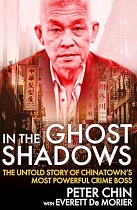
In the Ghost Shadows: The Untold Story of Chinatown’s Most Powerful Crime Boss – Peter Chin with Everett De Morier

The Chinatown section of Manhattan in New York City has always had an aura of attraction and mystery. The Cantonese and Mandarin languages spoken by its inhabitants have provided the neighborhood with a form insulation which kept the eyes of outsiders at bay. But for those who venture into the area, there is an abundance of outstanding cuisine, endless shops, and the realization of a city within a city. I personally have walked the streets of Chinatown as an eager shopper and have driven its streets on my way to the Manhattan Bridge to return to Brooklyn. But what many are unaware of is the dark history of Chinatown and the powerful crime bosses who once ruled with iron fists. This book is the story of the former boss of the Ghost Shadows gang, Peter Chin. Readers may recognize Chin from his appearance on the YouTube channel called Vlad TV. Here, his unbelievable story is presented by author Everett De Morier as told to him by the former crime boss. And it is a deep dive into a world most New Yorkers did not know existed.

You may be wondering why a former crime boss decided to tell his life story. It is a good question, and the long road taken by the author in telling Chin’s story is explained. Chin could take what he knows with him to the grave when he takes his final breath. But a suggestion by a former New York City Police Department (“NYPD”) officer plants a seed in his mind which results in Chin agreeing to tell his story. And once he begins, the book becomes a roller coaster ride as we run the streets of Chinatown and explore the criminal underworld. The story begins in China but when Peter is eight, the family emigrates to New York City where they are reunited with his father Bark Chin, who forms a dark cloud over the home. Also, he makes an appearance late in the story in a role that is interesting and puzzling. Father and son did not have a good relationship, and what Chin recalls left me shaking my head at times. Any questions regarding the importance of a strong father in the home are answered here.

Sadly, Chin’s personal life provided the perfect pretext for his gravitation towards the streets. And through a series of events, he soon finds himself running with the Ghost Shadows. But he quickly learns that Chinatown is a hotbed of turf battles and throughout the story we see the rise and fall of other gangs such as the White Tigers, Flying Dragons under Michael Chen (1950-1983) and the Hip Sing Tong led by the Godfather of Chinatown Benny “Uncle Seven” Ong (1907-1994). Gunfights, fistfights, back door deals and homicides are on the menu as Chinatown turned into a battle zone. While I read, I was taken back because as a New Yorker, I know that geographically, Chinatown is not as big as one might expect. Encounters between gangs often occur due to their proximity to each other. And when they cross paths, the tension escalates at breakneck speed. Chin finds himself a target more than once in the book, and one incident leaves him at Downtown Beekman Hospital for an extended stay. But despite the dangers, Chin continues to rise to the top and along the way as he makes friends with powerful crime figures and others holding access to vast amounts of wealth. It is the type of gangster story Hollywood loves to produce but this is non-fiction and Chin’s life was on the line daily.

There is one area of the story that I wish had more content and that is Chin’s marriage and his son Anthony. His wife and son are mentioned but rarely, and this is likely because Chin was telling the story and chose to keep them out of it. In fact, the author does explain that Chin kept them hidden in Brooklyn for their protection while he conducted business on the streets. As the cash rolls in and he gains fame and respect, his exposure to law enforcement also grows, drawing the attention of the NYPD’s Jade Squad and the Federal Bureau of Investigation (“FBI”). Readers will see that his fall is inevitable but there is still time before that happens, and that means more violence on the streets of Chinatown. The swift pace in which situations escalate gives new meaning to the term “on sight”. Actions are instant and deadly, with shocking displays of rage and destruction which claim innocent lives and places Chinatown’s gangs in the crosshairs of prosecutors who had been given a tool unlike anything courts had seen before: the Racketeer Influenced and Corrupt Organizations Act, simply known as “RICO”.  This new law would devastate criminal organizations across the country and takedown Chinese gangsters, the Italian Mafia and other crime figures who remain behind bars.

Chin’s fall, which we know is coming eventually does but I surprised at the sentenced he received and did not anticipate the judge’s ruling. It hits Chin like a stack of bricks, but jail proves to be the place he needed to be. His time in prison is interesting and shows that old habits die hard. The seasoned gangster moves like you would expect inside prison walls revealing that the world within its walls has its own structure which outsiders would not understand. However, prison also proves to be a turning point when he meets an inmate who gives him two gifts which change his life permanently. And when readers reach this point in the book, the realization that Chin rose to surreal heights without a full formal education will set in. It did for me. And it is here that his redemption begins. Luckily for him, there is life after prison which we learn of towards the end of the book when he is reborn and comes full circle. And in an ironic twist of fate, a prosecutor who once chased him, finds himself facing criminal charges. Further, the prosecutor in Chin’s case would later gain infamy for her role in a case which shook New York City to its core, and later revealed disturbing questions of misconduct, bigotry, and wrongful prosecution. In this story, Chin rides off into the sunset, but his story is not over, and he has many years to live and can look back on his time as the leader of the Ghost Shadows. If you love history and the stories from New York City, you will love this.

Anyone who thinks criminals don’t follow the news coverage about them is dead wrong. They follow it avidly. That’s how Chin’s gang came by their name. A newspaper reporter had written a story about their crimes and concluded with a bit of a poetic flourish: They came in like a shadow and left without a trace . . . like a ghost shadow.”

ASIN ‏ : ‎ B0D2SNJV9Z
Publisher ‏ : ‎ Citadel Press (January 21, 2025)

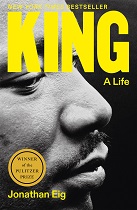
King: A Life – Jonathan Eig

Version 1.0.0

The late Huey P. Newton (1942-1989) once stated that “the first lesson a revolutionary must learn is that he is a doomed man“. These words by Newton have proven to be accurate when examining the lives of those who sought to enact radical change throughout the world. At 6:00 p.m., on the evening of April 4, 1968, Dr. Martin Luther King, Jr. (1929-1968) was standing on the second-floor balcony of the Lorraine Motel in Memphis, Tennessee embracing the fresh air when the sound of a gunshot was heard. The members of his entourage looked up to the balcony to see him lying on his back and mortally wounded. He was rushed to St. Joseph’s Hospital where he was declared dead at 7:05 p.m. An icon of the Civil Rights Movement had been silenced but his impact and words were not. Dr. King did not live to see the fruits of his labor, and he had come to accept that reality before his tragic death. His story has been told numerous times over the years, but when I saw this Pulitzer Prize winning book by Jonathan Eig, I decided to add it to my reading list. And what I found is a well-written, well-researched and balanced account of Dr. King’s short but extraordinary life.

As I began to read the book, I noticed that the footnotes are placed at the end of the book as opposed to the end of each chapter. This approach made the narrative flow much smoother, and I hardly noticed the page count while reading. The book does move chronologically as one would expect from a biography, but it feels more like a discussion than a timeline of King’s life. Further, the author pulls no punches when it comes to King’s faults but also gives credit to his successes, and this gives the book a well-rounded feeling to it. I do caution readers that it is necessary to approach the biography as unbiased as possible because there are parts of the story that do not show King is the most favorable light. But he was a human being and had his flaws like everyone else and there is more to the story than you will find in history textbooks.

The crucial historical moments in America’s past are discussed as they should be, but the private side of his life is where the book excels. His personal emotional struggles with fame and purpose, and infidelity are intense sections of the book but also revealing. Personally, I was aware of his romances outside of his marriage but the scale of it was larger than I had previously known. In fact, Eig’s book shows that the real number of women may be higher than anyone suspected. King was aware of his weakness but his statements regarding his father Martin Luther King, Sr. (1899-1984) are revealing. Women had always been a soft spot for the Kings, and Martin Jr., would find one of his most challenging experiences in his romance with a white woman named Amelia “Betty” Moitz. This is a part of Dr. King’s life I never learned about through any school textbook. In hindsight we know that the relationship did not last but the story is interesting and will have you asking yourself questions about the couple and how their lives would be in the year 2025. Of course, this was during the reign of Jim Crow and interracial dating and marriages were extremely taboo and, in some states, illegal. This section of the book alone should be a reminder of the many freedoms we sometimes take for granted.

Following his courtship of Coretta Scott (1927-2006), the couple elopes and begins to expand their family. However, we soon begin to see that Martin’s calling to the growing movement meant extensive time away from home. Although he did have strong bonds with his children, his rigorous travel schedule, and the amount of territory he covers in the book are surreal. Coretta authored her own book titled ‘My Life, My Love, My Legacy‘ which is a valuable resource regarding the couple’s home life.  Thankfully, help in the movement comes in the form of other activists whose own lives would be deeply affected by their determination for equality. King’s friend and close colleague Rev. Ralph D. Abernathy (1926-1990), and mentors Bayard Rustin (1912-1987) and Stanley Levison (1912-1979) prove to be anchors to keep him grounded as the intensity of the movement increased. The relationship between King and Levison is a focal point in the story due to the latter’s affiliation with communist parties and the interest taken towards both men by the Federal Bureau of Investigation (“FBI”) led by J. Edgar Hoover (1924-1972), whose obsession with King was nothing short of paranoia. The FBI weighs heavily on the story not only due to its surveillance of King, but also due to the bureau’s actions towards other figures in the story such as Malcolm X (1925-1965) who is part of the story on a handful of occasions but represented a far more frightening alternative to Dr. King.

Throughout the book, King fights battles on every front, and his relationship with President Lyndon B. Johnson (1908-1973) produced some of the highest achievements in the lives of both men. However, it also marked the initial descent of their influence and popularity due to circumstances each struggled to control. The buildup and fallout are riveting and tragic but a critical part in the final four years of Martin’s life. Readers who lived through the events discussed in the book may feel a surge of memories coming flooding back to a time in America my father has described as the “scariest years of his life” due to the civil unrest, assassinations, and the war in Vietnam. While Martin was traveling, speaking, and laying his life on the line, Coretta was at home, but that does not mean she was immobile or insignificant. In fact, she was a source of strength and sanity for Martin when he arrived home. And had he retired from the movement as friends had suggested, this book would have a different ending. However, King had found his purpose and the last speech he gave in the days leading up to his assassination continues to give me chills.

Slowly but surely, the moment we know is coming arrives and the darkness surrounding it is no less pronounced today than it surely was then. An epilogue follows the narrative and provides a short follow-up to the post-assassination events. After finishing the book, I found a deeper appreciation for Dr. King’s work and legacy while at the same time accepting his flaws. J. Edgar Hoover was convinced that Dr. King was a “fraud”, but the truth is far more complex. While he may not have measured up to Hoover’s standards, he did place his life on the line for what he believed in, and in doing so he became an icon around the world.  We can disagree on his approach and character, but his impact and achievements stand on their own merits. If you like this book, I also recommend Ralph Abernathy’s ‘And the Walls Came Tumbling Down‘ in which he discusses his friendship with Martin and the mission to break down Jim Crow.

ASIN ‏ : ‎ B0BBD5GXTF
Publisher ‏ : ‎ Farrar, Straus and Giroux (May 16, 2023)

Wyatt Earp: A Vigilante Life – Andrew C. Isenberg

The Wild West, also known as the American Frontier or Old West, remains a special era in United States history. Historical figures such as Jesse James (1847-1882) and Billy the Kid (1859-1881) are a part of American pop-culture with latter the subject of two Hollywood films in which actor Emilio Estevez plays the famed outlaw. But there is another figure equally as popular and controversial, whose life was also adapted for the silver screen. Anyone familiar with the Old West certainly knows the name of Wyatt Berry Stapp Earp (1848-1929), portrayed in films as noble lawman who survived a shootout with Ike Clanton (1847-1887) and his gang of bandits. When I saw this book, I thought of the films ‘Tombstone‘ and ‘Wyatt Earp‘ which are both fun to watch. Earp’s life was portrayed well, but did Hollywood get it right? The answer is both yes and no, and unsurprisingly, there is more to Earp’s story than shown on the silver screen. This biography by Andew C. Isenberg explores Earp’s life to separate fact from fiction. 

Prior to starting the book, I did read reviews from others who were critical of the book as not being extensive enough. However, most agreed that it is well-researched and a fair look at Wyatt’s life. I cannot say whether this is the “definitive” biography, but I can say that for readers in search of a good starting point from which to learn about Earp’s life, this book is sufficient. I did not see Earp as a villain or hero before I purchased the book. And I have always felt that characters from the Old West were products of their time. Of course, that in no way diminishes the importance of morality but in the Old West, the rules of engagement were different, and life could be exceedingly difficult. 

I was fascinated to learn about the Earp family, particularly Wyatt’s brothers Virgil (1843-1905) and Morgan (1851-1882), both of whom were present during the famous shootout with Clanton’s gang. The Earp family story is surreal, and I found myself glued to the book as the Old West came alive. But I also began to see that the Earps were not as “righteous” as we may have been led to believe. They are best known as lawmen but did not always wear badges. And their actions at times during the story are far from law-abiding. Brothels which were a staple of Old West lore, weigh heavily in the story. The “ladies of the night” had both customers and partners, making the Earp story even more convoluted. Added to this are Wyatt’s  love life and his nomadic movements across North America. The book evolves into a roller coaster ride as Wyatt leaves one town for the next. But during one stop he met a man who became a life-long friend and legend in the Old West himself, John Henry “Doc” Holliday (1852-1887). And on October 26, 1881, the Earp brothers and Holliday became legends of the Old West in a shootout that history could not get enough of. 

If you decide to read this book, you may be asking yourself what really happened at the O.K. Corral? It  lasted less than a minute, was deadly and the result of a feud. The conflict is discussed by the author and is thorough, but I also had the feeling that there was more to the story. Of course, none of the participants are alive and surely took to the grave, smaller details they knew about why the shooting took place. The real-life gun battle had none of the flair and slow-motion of Hollywood. It was fast, vicious, and left people shaken. And it was far from the end of the Clanton-Earp saga which continued to play out well after the shootout. The drama is also discussed within, and at times I felt that it would never end between Clanton and the Earps. 

Following the deadly shootout, further tragedy occurs in the book, and Wyatt is forced to confront the deaths of those closest to him. However, his relationship with Holliday becomes a little unusual, and left me slightly puzzled at what happened. Of course, no explanation will be forthcoming, and it is known that Wyatt visited Holliday before the latter succumbed to the tuberculosis that plagued him. Wyatt eventually made his departure from Tombstone and caught the attention of Hollywood. And it is here that the legend was born. In his final years, he was living with his common-law wife, but the drama surrounding his union with Josephine “Sadie” Earp (1861-1944) is crazy but also in line with Earp’s history. And there are  also the tragedies of his first wife Urilla Sutherland Earp (1850-1870) and second wife by common law, Cecilia Ann “Mattie” Blaylock (1850-1888). Wyatt lived an unorthodox life. But is life truly “normal” for any of us? 

The shootout at the O.K. Corral is forever linked with Earp, Holliday and Clanton names, and Wyatt continues to be seen as a lawman of the Old West. This book is a thorough account of his time of earth, and it encouraged me to explore other biographies about the famed gunslinger. But I wondered if he was a hero, villain, pimp, degenerate, murderer, or opportunist? The truth is complex and nowhere as glamorous as Hollywood productions but it was the life he led. But this is only my opinion. You can be the judge. 

ASIN ‏ : ‎ B009LRWHV8
Publisher ‏ : ‎ Hill and Wang; 1st edition (August 6, 2024)

Harriet Tubman: The Road to Freedom – Catherine Clinton

The Merriam Webster dictionary defines courage as the mental or moral strength to venture, persevere, and withstand danger, fear, or difficulty. This definition applies unquestionably to Araminta Ross, better known as Harriet Tubman (1822-1913), whose efforts on what is known as the “Underground Railroad” helped change the fates of enslaved and free blacks across America as the nation grappled with the issue of human bondage. When I saw this book in a list of recommendations, I instantly made the purchase and felt my curiosity increase. In grade school, I learned about Harriet Tubman, but the passage of time and a limited curriculum, left me with a lack of factual information which I found in this gripping biography by author Catherine Clinton.

The lack of knowledge regarding Tubman’s life increased my anticipation as I began to read the book. And from the beginning, I found myself glued to it as I learned about the life of a woman who took courage to a whole new level. Her story begins in Dorchester County, Maryland in 1822 when she is born into an enslaved family. And like other enslaved people, birth records and other vital information are typically incomplete. Added to the confusion is the lack of literacy, a tool commonly used by slaveowners. This afflicted Tubman as well, but it later proved to have its advantages, as we see in the story when her work on the Underground Railroad intensified.

Readers who are sensitive to the subject of slavery and its horrors may find parts of the story upsetting. However, it is a part of American history which can never be erased. Further, the dark moments in the book eventually pave the way for the triumphs later in the story. In 1849, she finally made her escape north, but at the time she was married to her first husband John Tubman (d. 1867). The circumstances surrounding their union are interesting and highlight the complexities enslaved and freed men and women faced in trying to find love. The story of their union is both tragic and shocking, and the author returns to John later in the story after Harriet finds her calling.

The Fugitive Slave Act of 1850 sent alarm bells ringing across America and forced slaves to realize that crossing into free territory was not enough. Harriet understood the implications and began to master the art of subterfuge. But before she changes gears, the story moves to Canada, where Tubman finds solace. However, the country was not without racial prejudice, and the author pulls no punches about the difficulties former slaves faced as they escaped north. For Harriet, her own freedom was not enough, and she became determined to bring down the system of slavery across America, much like her acquaintance and fellow abolitionist John Brown (1800-1859), who makes an appearance in the book. And it is at this point that the legend is born and the story kicks into high gear. Readers will see why she was nicknamed “Moses”.

In Auburn, New York, she was able to make a home for herself due to the actions of former Secretary of State William Seward (1801-1872) who became a lifelong friend. And once she embraced her role as a “conductor” on the Underground Railroad, things are never the same. The story is unbelievable and the courage she had is nothing short of incredible. Frankly, she was fearless and demonstrated this repeatedly in the story. The author brings her actions to life in a vivid but smooth narrative that maintains the right pace and suspense as former slaves are ushered out of the South in search of life as free men and women. But though Tubman had success in her missions, she did pay a heavy price in the form of personal sacrifice, both physically and emotionally. Her reunion with John later in life does not go as planned and leaves her devastated. But a successful reunion with her parents is a high point in the book which is a roller coaster ride until the very end.

Because the book is set during the 1800s, we know the American Civil War will become a part of the narrative and here is no different. But what is incredibly heartwarming are her actions in service to the Union as the war against the Confederacy raged. The conflict was beyond brutal, and its graphic nature is on display here. Tubman’s view of President Abraham Lincoln (1809-1865) is interesting, although the two never met. I wish they had for that would have been quite the discussion. Nevertheless, Lincoln’s death was a shock to her as it was to millions of Americans. The war had ended in April 1865, but the fight for equality and respect was still on. Tubman continued to serve the people and later in life she reaped the benefits, and even finds a new companion Pvt. Nelson C. Davis (1844-1888) who provides her with a sense of normalcy after her days on the Underground Railroad are over. And when she is called home to rest, the conclusion marks the end of a story that left me inspired and speechless. The Underground Railroad was a complex network of locations, resources, and people both black and white who were united in their belief that slavery must end. Harriet Tubman was part of the apparatus that kept it running and on time. This book is a gift that will keep on giving.

“If you are tired, keep going; if you are scared, keep going; if you are hungry, keep going; if you want to taste freedom, keep going.” – Harriet Tubman (1822-1913)

ASIN ‏ : ‎ B000FC1AN4
Publisher ‏ : ‎ Little, Brown and Company; 1st edition (February 2, 2004)

Perón – Joseph A. Page

peronAn old friend once said to me that in Argentina “it is rare for a non-Peronist president to finish a full term”. The remarked surprised me at first but then I thought of the late Juan Domingo Perón (1895-1974) who served as Argentina’s president three times. His final term was short-lived due to his death on July 1, 1974, in Buenos Aires. Today the country is under the leadership of Javier Milei who famously raised a chainsaw on the campaign trail as he promised to slash government spending. Time will tell if Milei’s approach is the right course, but no leader can move Argentina forward without acknowledging the influence of Perón. This biography was on the list of recommendations I regularly receive and immediately caught my attention. And what I found is a well-researched, well-written and engaging account of Perón’s life and the turbulent political history of Argentina. 

During one of my visits to Argentina, I had the opportunity to witness a discussion regarding Perón’s legacy. The participants were people I met through a mutual friend and had come over for dinner. The conversation quickly grew tense with both sides digging into their respective positions. As the only American in the group, I realized that it was imperative for me to listen and refrain from speaking. I was in their country and needed to hear their history as they knew it. And I saw firsthand how Perón had shaped the lives and minds of Argentines decades after his passing. Of course, the discussion was far from the final analysis on the legacy of Juan Perón. But it did provide me with crucial insight, and I relied on those memories as I began to read this definitive biography. 

Although I strongly recommend some research into Perón’s presidency beforehand, it is not required to enjoy this book. The author provides a discussion of Argentine history which readers will find fascinating. Included in the discussion is the election of Hipólito Yrigoyen (1852-1933), who famously became known as “the father of the poor” and the first democratically elected president. As the story moves forward, we are introduced to the Perón family and patriarch Mario Tomás Perón. The story is typical of South America at that time but when Juan decides on a military career over medicine or law, his life and that of Argentines was destined for change. There is nothing about military career which stands out in the book, but he did find time for love and walks down the aisle with Aurelia Tizón (1908-1938) in 1929. Their union is happy but short-lived, and her death serves as an eerie premonition for what would later come in 1952. 

Perón moves through the ranks steadily but before he reaches the pinnacle, the world is forced to confront the growing Nazi threat from the Third Reich in Berlin. The outbreak of World War II set the world ablaze, but it also placed Argentina in a difficult position. The information contained here is crucial for it explains the long and difficult path Argentina and America have traveled together. Neutrality, escaping Nazi leaders and the looming Cold War stirred tensions between the two nations. Page provides a wealth of information to provide the reader with a thorough picture of what happened and why. Further, the impact of former U.S. Ambassador to Argentina Spruille Braden (1894-1978) cannot be overlooked. His battles with Perón are a significant aspect of the relationship between Washington, D.C. and Buenos Aires. 

In 1945, both Germany and Japan surrendered ending World War II. On the domestic front, Perón’s had ascended to the leadership position of the nation and his changes once again when Maria Eva Duarte de Perón (1919-1952) enters the story and becomes the most popular First Lady in Argentina’s history. On her own, Eva Perón is a fascinating figure, and there are books, a play, and a movie about her life. However, the focus here is on Juan and his rise to power. We do learn about their private life, and the dedication Eva had for him. Although it is not clear when she developed the condition that claimed her life, there are clues in the story. But what is definite is that both Juan and Eva both knew that something was terribly wrong with her health. The author explains the developing tragedy with the right amount of tact, making sure to keep Juan as the focus of the book but giving enough attention to Eva’s struggles with her own mortality. Readers who want to know more about her life will find ‘Evita: The Real Life of Eva Perón ‘ by Nicholas Fraser and Marysa Navarro to be a fair starting point. We can see that the end is coming and the final scene in her life plays out as one would expect, devastating Juan and the nation. But there is more to her death and the movement of her casket post-mortem between multiple countries is a surreal and nightmarish story on its own as readers will learn. 

Though in mourning, Juan’s problems were only beginning, and domestic tensions continue to brew. The buildup of the opposition forces to Perón’s reign is captivating, and the stage is soon set for his exile which lasted an overwhelming seventeen years. His defiance and exodus play out like a major motion picture with suspense, tragedy and emotions running rampant. But what Argentines could not have known was that Perón would come back and take control of the country. His time in exile is equally fascinating, and we follow him through South America, the Caribbean, and Spain where he established long-term residency. In each country, Perón is a guest but also witness to history as coups and political violent take place time after time necessitating a quick exit by the former Argentine president. Students of Latin American history will find this section of the book to be intriguing and Venezuela stands out due to current day events. 

Perón’s time in Spain is uneventful, however he soon finds third wife Isabel Martínez de Perón, who is still alive today. Their marriage provided Juan with a boost in image which had been severely damaged through the scandal involving teenager Nelly Rivas (1939-2012). Perón denied any improper behavior regarding their relationship but as shown in the book, there was more to the story. You can be the judge. Isabel’s entry in the picture sealed any hope of Rivas finding her way to Juan and the “Conductor” as Perón was informally known, set his sights on his native land and the throne he once claimed. And thus, the stage is soon set for his triumphant return to Argentina. But before I go further, it is necessary to mention a figure in the story whose name is still obscure. When I read of José López Rega (1916-1989) I could not recall any information I had previously come across to explain his role. However, Page solves that issue and Rega’s involvement in the life of Juan and Isabel is both mystifying and absurd. He was a character out of central casting, but his influence could not be denied. His rise and fall are covered here and provide an interesting and unbelievable sub-story to the main narrative. 

The return of Perón to Argentina plays out as readers will expect, with flair and drama. But what is more important are the incidents which took place preceding his return and allowed for his next presidency. Anyone who knows Argentine politics will understand the short-lived tenures of numerous presidents and military rule to stabilize the country. Page does not go into the “disappeared” which is a dark and unsettling time in Argentina’s history. But as someone who has visited the country, those who were taken in the 1970s never to be seen again have not been forgotten, and the era continues to haunt the nation. The downfall of presidents, military actions and vitriol used by political candidates provides a roller coaster ride that the author takes us through. The story is surreal at times but also a reminder of the fragility of democracy. Argentines who lived through these times have stories they can tell you, and the emotion with which they speak will say more than their words. 

After making his return to Argentina and the presidency, Perón’s life moves toward its conclusion as his health issues become more frequent and serious in nature. Curiously, the Central Intelligence Agency had been keeping reports on the matter and their findings are included in the story. It will be clear to readers that the end is coming and that Perón is slipping away. And on July 1, 1974, the finale plays out bringing the conductor’s life to an end. However, stepping in to fill the void is wife Isabel who becomes the next president. Her time in office is short-lived and a coup forces her into exile as well marking the end of the Perón presidency. And like a house of cards, those close to him fall out of favor and make their exit from the stage. Perón was gone but Argentina was nowhere close to a strong democracy and would go through political and social unrest more than once which threatened to turn the country on its head. Today Argentina is once again at a crossroads but hopefully this is the right turn to move forward and put the errors of the past to rest. If you want to know about Juan Perón, the charismatic yet unorthodox former leader of Argentina, this is must-read. 

ASIN ‏ : ‎ B0BWRJ1Z69
Publisher ‏ : ‎ Open Road Media (April 4, 2023)