
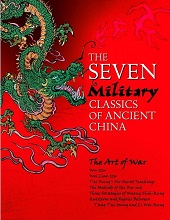
 I decided to change gears and take a look at a book that had been on my to-read list for quite some time. The Seven Military Classics of Ancient China are some of the most widely studied writings in regards to conventional and unconventional warfare. Putting their age aside, the texts provide the reader with an inside look into the strategies behind armed conflict in Ancient China. And what is contained within the pages of this collection of brilliant military strategy, are dozens of lessons that military commanders can still use even today.
As the book opens, the authors provide us with a brief description which explains how the texts can be interpreted:
Canonized in 1080 ce under the reign of Emperor Shenzong of the Song (r. 1067–1085 ce), this collection of texts is as much a representation of scholarly activity in forming a military tradition as it is a matter of practical concern.
I think the statement is correct but also that there is far more to the texts which will be learned by readers. But what exactly are the Seven Military Classics? They are composed of the following works:
- Taigong’s Six Secret Teachings, in which King Wen of Zhou has a discussion with Taigong after meeting the strategist who according to Scribe Bian, was sent from heaven to help Zhou run his country.
- Methods of Sima which begins by focusing on benevolence and righteousness, two critical components of a peaceful kingdom.
- Sun Tzu’s Art of War which is by far the most recognized and referenced manual of all seven classics. This book is by far what many readers will be anxious to get to if they have not already studied Szu’s words.
- Wuzi in which Wu Qi meets with Marquess Wen of Wei to discuss military strategy.
- Wei Liazo in which King Hui of Liang meets with Wei Liaozi to understand discipline, virtue, battle formation and the securing of a city.
- Three Strategies of Huan Shigong which focus on the upper, middle and lower strategies of warfare.
- Questions and Replies between Emperor Taizong of Tang and General Li Jing.
The seven classics do differ slightly in the approach that each take to the issues at hand but the common theme is warfare. Public administration is also given high focus and more than one book discusses the importance of ruling with benevolence and the support of the people. But make no mistakes, these books are military strategy galore, covering fortifications, weapons, troop numbers, battlefield positions and the organization of a disciplined and effective army. Of course, the weapons and chariots referred to in the texts are beyond outdated however what is discussed about the power of a general and the movement of troops is still relevant. And in his eternal widsom, Wu Qi had this to say about war:
“There are five causes of war: the pursuit of fame, wealth, revenge, rebellion, and famine. There are also five types of army: strong, violent, determined, righteous, and treacherous.”
With the exception of the Art of War, the texts explore these topics in clear and accurate detail. Similar to a fly on the wall, we are privy to the discussions between rulers and sages as they discuss the ruling of a nation and the concept of war which is an unavoidable event in the future to come. When it comes to combat itself, without question, the Art of War is the cream of the crop. It is the manual for engaging the enemy and waging a successful military campaign. And out of the seven classics, it holds the biggest place in maintstream culture and is by far the most quoted. And while it is a gem in its own right, the other classics offer just as much valuable and insightful information for leaders of nations and military commanders.
It is hard not to understate the genius behind these seven classics. And although thousnds of years have passed since they were written, the material is still captivating. And if I were the leader of a nation, I would certainly refer to this book on occasion. There are many lessons to be learned if readers are willing to invest their time and attention. Today, conventional warfare is not seen on the scale that it was in centuries prior. But there is no telling as to when the next conflagration will erupt. But if it does, I am sure that the lessons contained in the seven classics will be on the minds of the military figures tasked with achieving victory.
“All warfare is based on deception”. – Sun Tzu (544 – 496 B.C.)
ASIN: B075S9NKPS
 The recent Netflix series
  One of the things that I love about books is that there are so many that I have yet to read. Many of them will be classics that I will never forget. I had always been aware of Ralph Ellison (1914-1994) but remained in the dark about this classic book which was published in 1952. I noticed that I had it on my shelf and decided to see for myself why it remains so highly regarded. Having finished the book, I now understand why Ellison was ahead of his time and why this book is still relevant to this day.

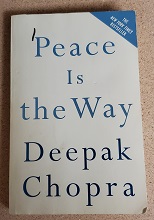 We hear the word peace often, typically while watching news broadcasts regarding ongoing conficts around the world. The search for peace remains the ultimate goal of mediators intent on resolving long standing feuds that have claimed lives and destroyed cities. Cease-fires and treaties are signed by which all parties agree to end hostilities. However, conflict resolution and geunine peace are two very different concepts. Many of us seek peace in our lives, away from those who have wronged us or others who remain a source of irritation. The American pacifist A.J. Muste (1885-1967) believe that there is no way to peace, but instead that peace is the way. That is the central theme of this book by Deepak Chopra, M.D., who along with brothe Sanjiv, wrote the beautiful memoir
  Compton, California has earned a reputation over the last fifty years as a place where people are tough, life is dangerous and unless you are from there, you stay away. Gangs such as the Bloods and the Crips have proliferated across the city in the wake of the Civil Rights Movement and the dawn of the crack cocaine epidemic in the United States. In what could rightly be described as a civil war, thousands of black men, women and children have died on the streets of Comptom and in Los Angeles county as gang wars escalated. In 1888, the City of Comptom had formed its own police department to patrol city limits and at the time of the deadly gang wars erupted, it was pushed to its limit. Some officers would leave the department for much quieter neighborhoods with lower crime rates. Others would stay until it was disbanded in 2000. Among the two most well-known as respected officers were Tim Brennan and Robert Ladd. The duo have been interviewed numerous times in recent years, expressing their thoughts on Compton, the murder of Tupac Shakur (1971-1996) and his alleged killer Orlando Anderson (1974-1998). However, there is far more to their story than what we have come to learn on screen and here the two join with Lolita Files, whom some may recognize from the A & E multi-part series
  The recent Netflix series
  In the spring of 1846, a group of settlers left home in Springfield, Illinois en route to either Oregon or California. A popular destination for many was the City of Yerba Buena, known today as San Francisco. By the first week of may, the party had reached Independence Missouri and soon continued on their route. They soon learned of an apparent shortcut through what is known as the Hastings cut-off near Salt Lake City, Utah. The trail was named after Confederate General Lansford Hastings (1819-1870). It was believed that the shortcut would eliminate as much as three hundred miles off of their trip. The group separated and eighty-seven people continued on the trail. Instead of elminating travel time, their journey was extended by another month. Deeply behind schedule, their provisions began to run low and winter soon set in. By the time their ordeal was over, only forty-eight had survived. Some managed to survive by turning to cannibalism and that act has earned them a permanent place in American pop culture. We have come to know this group pf settlers as the Donner Party.
 When I think back to my youth, I recall various automobiles that were own by my father, uncles and friends. Their cars were American made and typically products of General Motors. Buick, Pontiac and Cadillac were the cars of choice and hardly anyone then owned a foreign car. If you owned a Cadillac, it meant status and success in the America. Detroit became Motor City and its dominance over the U.S. auto industry remained in place for several decades until automakers from Japan and Germany stormed into the American market. The city has an extensive past, beginning with French explorer Antoine de Lamothe Cadillac (1658-1730) for whom the luxury automobile is named after. In 1701, he established what is now Detroit before eventually returning to France where he lived out the rest of his days. The evolution of Detroit is one of America’s greatest success stories and also one of its greatest tragedies. Throughout all, its black citizens have always remained firm in their dedication to seeing Detroit become a city to be envied. Herb Boyd takes another look at his city and the role of black men and women in the development of a famed city.
 I was in search of a quick read and saw this book which I had added previously to my list of books to buy. In my neighborhood, there is a building with a mural dedicated to Frida Kahlo (1907-1954) and as I walk past each time, I think of the fact that so many years after her death, she is still revered by millions of people both in the United States and in her native Mexico. In September, 1925, Frida was a passenger on a bus with her boyfriend Alejandro Gómez Arias. Their bus collided with a street car and left Kahlo with devastating injuries. She suffered broken bones in several parts of her body and the accident displaced three vertebrae in her back. She never fully recovered from the accident and was plagued with constant pain until her death on July 13, 1954. On August 21, 1929, she married Diego Rivera (1886-1957) and accompanied him to the United States, first landing in San Francisco, while he worked as painter. Over course of her time living in the United States and later visiting, she received medical treatment for the lingering effects of the 1925 bus accident. She never failed to write home to her mother whom she loved deeply. Those letters have been translated into English and are composed here to show readers the very intimate relationship between mother and daughter.
 FREETHINKING BIBLIOPHILE
You must be logged in to post a comment.