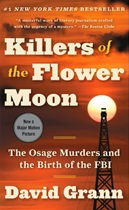
Killers of the Flower Moon: The Osage Murders and the Birth of the FBI – David Grann

I was in the search for a new book and saw this title by David Grann which caught my attention because I knew that I had seen the name before. Then I realized that a Hollywood film of the same name had been released starring Leonardo DiCaprio, Lily Gladstone and Robert De Niro. I have yet to see the film and in hindsight, having read the book first may be a bonus. The movie is on my watchlist and if it is close to the story told within, I can expect a powerful film from director Martin Scorsese. Prior to reading the book, I was not familiar with the Osage murders in Oklahoma during the early 1900s. As a result, I learned the story for the first time, and after finishing the book, I felt anger and sadness. But despite the range of emotions triggered by the story, the book is excellent and the suspense kept me glued to the book as I learned the story of a dark time in Oklahoma’s history.

The book begins with the disappearance of Anna Brown (1885-1921) on May 21, 1921. We soon learn about Anna’s family history and the Osage tribe to which they belong. Her sister Molly Burkhart (1886-1937) and husband Ernest Burkhart (1892-1986) quickly emerge as the central figures in the story, and begin a desperate search for Anna. However, there is more than meets the eye, and to understand Anna’s fate, the author explains the Osage tribe and their relocation from Kansas to Oklahoma by the United States Government. The move proved to be a blessing and a curse but the statistics regarding the Osage’s financial status left me speechless. I was not prepared for the jaw dropping numbers presented by the author. But it was easy to see how they became targets for the violence which arrived at their doorsteps. The situation is made more complex with the mixed marriages between Osage women and white men. Today the couples would not earn a second glance but in the 1920s, Native Americans were still sadly viewed as “savages”. Statements by Ernest’s aunt in the book reflect this mindset. At first, the mixed marriages provided me with a sense of hope but as the layers are pulled back on murders, the plot thickens in ways I did not expect. And this resulted in me wanting to read even more of the book as the saga continued to unfold.

Every story regarding the dark side of human nature has an antagonist, and this book is no different. Here, that person is William K. Hale (1874-1962). It did not take long to realize that Hale was a strange character, and he cast a dark cloud over the story. I could feel the shift in the mood through the author’s words as I learned of Hale’s background and his actions regarding the Osage. The feeling I had about Hale was right on the mark. In Washington, D.C., the Osage murders did not go unnoticed and the Bureau of Investigation, later renamed the Federal Bureau of Investigation (“FBI”), found itself involved with the case after its director J. Edgar Hoover (1895-1792) dispatched special agents under Tom White (1881-1971) to solve the case and bring the murderers to justice. White had his hands full but soon learns that there are dark secrets in the Osage case, and his investigation also highlights the mistakes made by local police. But he gets a break when the home of local resident Bill Smith implodes. The fallout from the collapse of the Smith house soon leads White on another path that goes into the heart of the Osage murders, and what he learns will leave readers reeling. If the story had you on the edge of your seat up until this point,  you had better hold on tight because it soon takes another turn into the dark.

At first, I was not sure how the Smith case would help break the murder investigation, but like a series of dominoes, people begin to fall, and the truth begins to come out, and I could not believe what I read. The tragedy of the Osage tribe is heartbreaking, and the way in which they were targeted is repulsive. Actions of those cursed with greed highlight the power money has over people and the lengths to which people are willing to go to obtain wealth. However, justice prevails and there are prison sentences handed out. And while they may seem light to some readers, I was both surprised and grateful that justice was done in a time when being Native American still provoked disgust and discrimination. But just when you think the story is over, the author takes us another ride in the epilogue where he discusses a disturbing aspect of the Osage murders that the police and FBI have not fully addressed. And the question emerges; how many murders have occurred which were never solved? And how long did the crimes occur? And did the perpetrators have the protection of local officials? The full truth will never be known, but the author presents a chilling case for a far more disturbing trend which had developed in Osage territory.

After I finished the book, I had a moment of silence for Anna Brown and the Osage tribe members whose lives were taken due to greed and vindictiveness. Their story is a tragic tale of Native Americans whose lives were upended, improved and then imperiled. We are unable to go back in time and correct the wrongs done to them, but we can honor their legacy by never forgetting their story. I did not know what to expect when I began this book but it has become a story I will not forget.  This book is well-written and well-researched, and the story is told in a narrative which maintains the right mix of elements to convey the author’s words. And when I do watch the film about the Osage murders, I can reflect back on Grann’s work which I am grateful to have discovered. Highly recommended.

ASIN ‏ : ‎ 0385534248
Publisher ‏ : ‎ Doubleday, April 18, 2017

Greg Scarpa, Legendary Evil: The Many Faces of a Mafia Killer – Jonathan Dyer

The Italian American mafia or “La Cosa Nostra”, became firmly entrenched in American society as immigrants from Italy to their newfound home. On the streets of New York City, a young mobster named Charles “Lucky” Luciano (1897-1962) realized that the constant violence among gangsters was no good for business and envisioned a “commission” to rule mob affairs. Luciano’s vision became a reality and the “Five Families” are now a permanent part of the city’s history. One of these families, the Colombos led by the mob boss Joseph Colombo (1923-1978), is noted for its civil wars, and members who have turned state’s evidence. One of them was not only a ruthless killer, but a bigamist and Federal Bureau of Information (“FBI”) informant. In Brooklyn, Gregory Scarpa, Sr. (1928-1994) became known as the “Grim Reaper” and throughout his career, he would prove more than once that the name had been earned. Author Jonathan Dyer explores the life of the mobster who terrorized adversaries and sent shockwaves through mafia circles.

I previously reviewed Peter Lance’s ‘Deal With The Devil: The FBI’s Secret Thirty-Year Relationship With A Mafia Killer‘ which chronicles Scarpa’s role as an informant. The book is particularly good, and Dyer uses it here as a source for what is a more complete picture of Scarpa’s life. Aside from Lance’s book, I had viewed documentaries on Scarpa and I have also read the book ‘The Mafia Hitman’s Daughter‘ by Linda Scarpa and Linda Rosencranci. His daughter’s book is eye opening and shows the effects life in the mafia has on family members. This book is a mix of both with additional exhaustive research. And the result is a book which will stand the test of time. Dyer provides a raw and unfiltered look at Scarpa’s violent and tragic life. 

Following the early discussion of Scarpa’s early life, the story changes when he meets his first wife Concetta “Connie” Farace (1931-2012). The story is routine, with Scarpa earning his stripes on the street and Connie bearing the couple’s children. However, the story takes a sharp left turn when the FBI institutes the Top Echelon Criminal Informant (TECI) program. This new pilot program by the bureau would find a willing participant in Greg Scarpa who soon joins and begins a thirty-year relationship with the “Hoover” boys. And if that is not shocking enough, the book takes another turn when he meets a teenage girl whom he would remain with for twenty-five years while taking on yet another wife, resulting in a love story completely off the rails. Added to the mix is his protege Larry Mazza, whose role in the couple’s lives is surreal. You must read it to believe it.

In what becomes a strange paradox, Scarpa feeds the FBI crucial information on mafia activity while at the same time engaging in criminal enterprises. In one instance, what should have been an air-tight case against Scarpa and his co-conspirators for a counterfeit money scheme was dismissed under mysterious circumstances. The dismissal raises the unanswered question, was the FBI protecting its asset? As for Scarpa, he continued to enjoy his relationship with the bureau while wreaking havoc in the streets. However, he is credited with assisting the FBI on high profile cases. The only issue is that only one out of the three presented by Dyer seems to be the most plausible. Dyer breaks down each alleged assist by Scarpa and uses the process of elimination to assess which account has the most credibility. But it is not long before the story takes on more bizarre twists and turns.

Scarpa’s relationship with his children is interesting and highlights the contradiction which exists in his story. While he was easily killing fathers and husbands, he went to extreme lengths to protect his own. Each child carries their own scars and trauma in the book. Linda has spoken for herself, but Gregory, Jr., and Joey (1971-1995) are not as fortunate. Gregory Jr. was released from prison in November 2020 and has remained out of the public light. Joey met a horrific death, and the story as told by Dyer is heartbreaking and disturbing. Gregory Jr. was closest to their father and that devotion would earn him a staggering prison sentence and demons to haunt him for the rest of his life.

As the story progresses, Scarpa continues his pattern of manipulation and exploitation but receives a life diagnosis when he goes into the hospital to treat a bleeding ulcer. A tainted blood transfusion leaves Scarpa infected with a disease that changed life as we knew it during the 1980s. And this is where the downfall ofthe mobster begins. His physical decline and power struggle within the Colombo family between supporters of Carmine “The Snake” Persico (1933-2019) and Victor “Vic” Orena, intensifies the suspense as mob hits, criminal indictments and mortality take their toll on all involved. And throughout all, Scarpa remains a gangster to the core. The story is insane and will leave readers shaking their heads at Scarpa’s escapades and violence which ensued. But as the saying goes, every gravy train reaches its destination, and Scarpa finds his meal ticket with the FBI set to expire. And when the government came for justice, Scarpa found himself persona non grata in law enforcement circles. A shocking admission in open court would forever change the way his contemporaries viewed him and cement his legacy in the annals of mafia history. 

Dyer’s account of Scarpa’s life is well-written and well-researched. It is full of information and cross-referenced. It is still a new release, and I am sure readers with a soft spot for mafia history will be interested in what the author has to say. After finishing the book, I did not have any strong emotions towards Scarpa but could see that his life and the lives of those around him became dysfunctional due the mafia’s grip on them. Another former Colombo member Michael Franzese who has gained a new following online once said that the mob destroyed lives. He is absolute correct. If you are a mafia aficionado or in search of an informative book about the streets of New York City and its Five Families, you will enjoy this. 

He was neither God nor devil. He was, like the rest of us, mortal, distinguished from most of his fellow human beings by his unlimited capacity for evil. His existence was terrifying during his life, and the story of his life is a frightening reminder of the human capacity for betrayal and deceit, for duplicity and greed, for violence and death.” – Jonathan Dyer 

ASIN ‏ : ‎ B0FDSNQPCZ
Publisher ‏ : ‎ WildBlue Press (22 July 2025)

Hellhound on his Trail: The Electrifying Account of the Largest Manhunt in American History – Hampton Sides

At 6:05 p.m., on April 4, 1968, Dr. Martin Luther King, Jr. (1929-1968) was standing on a second-floor balcony of the Lorraine Hotel in Memphis, Tennessee when witnesses say they heard a sound like a car backfire. To the members of his entourage, the reality was far more terrifying and instantly grim. The civil rights icon had been shot by a high-powered rifle and was clinging to life as he was rushed to a local hospital. He later succumbed to his wounds, leaving behind his grieving widow Coretta Scott King (1927-2006) and four children. In Washington, D.C., President Lyndon B. Johnson (1908-1973) was briefed on the situation and at the Justice Department, Attorney General Ramsey Clark (1927-2021) made it clear to Federal Bureau of Investigation (“FBI”) director J. Edgar Hoover (1896-1972) that the bureau must take control over the investigation into the murder. Fears of nationwide unrest gripped officials, and law enforcement realized that the killer must be apprehended as soon as possible. The roads leading to that fateful evening in Memphis, and the worldwide manhunt for James Earl Ray (1928-1998) form the crux of this national bestseller that will have you at the edge of your seat.

The first half of the book is composed of two timelines. We are introduced to Eric S. Galt, Ray’s persona as he crosses from Mexico back into the United States. Instantly we can see that Galt is an unlikeable figure who drifts from one place to the next. The author does a masterful job at retracing his steps and presenting them in the smooth narrative format found in the book. As I read, I could see that Galt is strange and nothing good follows him. The second timeline revisits the final months in Dr. King’s life. The tremendous strain his work had on his personal life and health is evident. Further, scrutiny by the FBI was persistent, and J. Edgar Hoover was determined to expose the man he called a “fraud”. The reasons for Hoover’s animosity towards King are examined in the book and left up to the reader to decide. I can say that Dr. King had his flaws like everyone else. But he did not know that a drifter using the stolen identity of Eric Galt was also making his way to Memphis, Tennessee and that they both had a date with destiny.

As Sides moves between the two timelines, you can see that they are bound to intersect. And like dominoes falling, one event after another sets the stage for April 4. I must warn readers that the shooting and aftermath are graphic and will be unsettling. In fact, what Sides explains will send chills down your spine. The murder of Dr. King was nothing short of brutal and cold-blooded. However, that is far from the end of the story. In the wake of the gunfire, Dr. King’s aides scramble to make sense of what happened, and emergency personnel do their best to aid the fallen leader. But his wounds proved to be too severe and after reading the book, death was likely the better option for him. The author’s description of the bullet’s impact will clarify the severity of the wounds. As Dr. King lay dying in the emergency room, the FBI was gearing up for the largest manhunt in American history. And the author takes us on the journey from Memphis to the United Kingdom.

In the middle of all that is happening, there is still the story of America at that time. Sides revisits our nation’s history during a turbulent time when change was both needed and scary. Sides discusses the political climate including Johnson’s decision in March 1968 not to seek or accept his party’s nomination for president of the United States as the Vietnam War becomes an anchor around his neck. The entry of Senator Robert F. Kennedy (1925-1968) into the presidential race became Johnson’s worst nightmare and gave millions of Americans a new found hope for the future. But the push for civil rights and an end to the war in Vietnam had America on edge, and what becomes clear is that the 1960s was a dangerous time in the United States. Eric Galt, whom authorities would learn was James Earl Ray, nearly sent an entire country over the edge with one rifle shot. Within hours, the FBI was on the case.

After the FBI assumes the lead role in the investigation, the book shifts gears as the bureau engages in an all-out effort to find the killer. It is one of the FBI’s shining moments. I was speechless at the savvy skills of special agents and the speed at which they accumulated evidence and added information in an era before modern-day technology. Readers who love crime investigations will find this section of the book irresistible. I was rooting for the agents as they turned over new leads and pieced together the life of James Earl Ray. The information they uncover regarding his family history is crucial and should not be overlooked. I previously was unaware of these details and learning the new facts provided a better sense of how and why James Earl Ray grew into the person that he was. That in no way excuses his actions, and Ray was his own worst enemy. And though he had a head start on the bureau, he engineered his own downfall across the Atlantic Ocean.

In America, mourners focused on paying their respects to Dr. King, whose funeral was a monumental event in the nation’s history. But it was not without its detractors, and no story about Dr. King or the movement would be complete without a word on former Alabama Governor George C. Wallace (1919-1998). He appears in the story, but this is not a biography of him, but rather a discussion of how Wallace’s rhetoric helped create people like James Earl Ray. In later years, Wallace changed his tune and disavowed his former segregationist stance. But others did not, and some of them appear in the story but only briefly. The focus remains on capturing Ray who first fled to Canada before landing in Portugal. But it was the United Kingdom where his train to freedom was derailed.

I could only shake my head as I read of Ray’s time in the United Kingdom under a fake name and passport. Lack of money and a concrete exit plan take their toll, and a series of actions by him on the streets of London are insane. I honestly could not believe anyone could be either that bold or careless, but such is the case here. His sloppiness and eagle-eyed British investigators help bring the international saga to an end but even while in custody, Ray proves to be more moronic. In fact, investigators are surprised at his off-the-cuff statements and cannot believe the cognitive dissonance. The book concludes as he returns to America after losing the fight against extradition. His trial and conviction are not discussed here, the author’s focus was on the events leading up to the crime, the crime itself and the manhunt. But as an added bonus, the epilogue contains a story from 1977 where Ray is serving time in prison and finds a way to escape from the facility. The unbelievable story will have readers shaking their heads. Thankfully, he was found and returned to prison to serve out the life sentence he received. On April 23, 1998, James Earl Ray died at Nashville Memorial Hospital in Madison, Tennessee at the age of seventy from complications due to Hepatitis C.

If you need an enjoyable book about the murder of Martin Luther King and the manhunt for James Earl Ray, you will love this.

ASIN ‏ : ‎ B0036S4BX0
Publisher ‏ : ‎ Vintage, April 20, 2010

Area 51: An Uncensored History of America’s Top Secret Military Base – Annie Jacobsen

Of all the military installations, few are as mysterious as Area 51 which is located at Groom Lake in southern Nevada. The secretive military base has been the subject of rumors that the United States Government is holding the remains of an unidentified flying object (“UFO”) and extraterrestrial lifeforms. The theories are entertaining but remain unproven. This raises the question of what is Area 51? Annie Jacobsen, author of the best-selling book ‘Operation Paperclip: The Secret Intelligence Program that Brought Nazi Scientists to America‘, takes us on a deep dive into the history of Area 51 to reveal as much as possible about America’s most controversial and mysterious military base.

Prior to reading this book, I did not have any pre-conceived ideas about Area 51. Of course, I have heard and read of rumors that the United States Government is concealing alien lifeform and protecting dark secrets. The allegations are unfounded, but what we do know is that the area is heavily guarded and trespassing is forbidden. As a primer to the story to be told, Jacobsen discusses the controversial Robert “Bob” Lazar, a noted conspiracy theorist whose claims regarding secretive government operations have earned him an audience of likeminded individuals. To some he is a tin foil loyalist but was he completely off the mark? Well, the truth is complex but not as sensational as we might hope.

Looking back at the book, the crux of the story is the finale of World War II. We go back in time to 1945 when Allied commanders are on the brink of a Nazi defeat and a battered Japanese military. The development of the Manhattan Project was pivotal to the use of Little Boy and Fat Man against Japan in August 1945, and they were no secret to Soviet Premier Joseph Stalin (1878-1953). His counterpart in America, President Harry S. Truman (1884-1972), had been thrust into the role of commander-in-chief following the death of his predecessor Franklin D. Roosevelt (1882-1945), and quickly learned of America’s secret weapon. Stalin’s infiltration of America’s military secrets set the stage for the next four decades and paved the way for the growth of Area 51, where research and development reached new heights.

The success of the atomic bombs Little Boy and Fat Man had convinced even the most pessimistic generals that air combat was equally as important as ground troops. But before the story kicks into high gear with the Cold War, Jacobsen discusses an incident in Roswell, New Mexico in July 1947 that provided the spark to the rumors of a hidden UFO. The incident reappears later in the story with a plausible explanation for its origins and a surprising revelation about the aviation parts discovered. However, some mystery remains as to what really happened in Roswell. Whatever took place was serious enough to warrant the attention of the United States military and America’s intelligence apparatus. Both would play crucial roles in the development of Area 51.

The book is engaging from start to finish, but Area 51’s story takes on a new dimension when Central Intelligence Agency (“CIA”) operative Richard M. Bissell, Jr. (1909-1994) is assigned control over the base, to the objection of Air Force Gen. Curtis E. Lemay (1906-1990), former commander of the Strategic Air Command and legendary veteran of World War II. Their feud would eventually come to a head in April 1961, when a new President John F. Kennedy (1917-1963) agreed to a CIA mission doomed from the start. But while America was focused on Cuba, the Soviets continued their space program and surveillance on adversaries. The cat and mouse game between America and Russia heats up with U-2 spy flights, espionage, and the belief on both sides of a nuclear confrontation. In hindsight we know that nuclear war did not take place, but that did not stop research and development at Area 51. In fact, the bag of tricks only grew as innovative technology emerged to transform America’s military.

The U-2 spy flights, and the capture of Francis Gary Powers (1929-1977) are also discussed, and both are well-known historical events, but I found the section regarding the development of the aircraft interesting. The engineering behind the new stealth aircraft is surreal, but also not without tragedy through trial and error. Powers’ capture and ordeal made headlines around the world, but they did not stop operations at Area 51. Bissell was removed in 1961 following the Bay of Pigs disaster, but that did not stop Area 51. In fact, defense contractors found a new market as Soviet aggression increased, and a war loomed in Southeast Asia. And in the years to come, a modern technology known as a drone aircraft would take to the skies and change warfare forever. The development of the drone is another interesting section in the book, and we turned the corner with its introduction and use.

While I read, I realized that the book was more important than just Area 51. In fact, it is full of historical information, and Jacobsen’s writing style keeps the narrative going at the right pace. I was aware of some events discussed in the book, but I also learned added information about the height of the Cold War, and classified information which had remained hidden for decades. The more I read, the less I was focused on the existence of aliens or spaceships. It was clear that Area 51 was more than a dumping ground for UFOs. It is a core part of America’s defense and a hub of top-secret activity only those with a certain clearance level are allowed to see. I believe that some secrets of Area 51 will remain hidden for assorted reasons. However, I do not think it is because of sensational claims by conspiracy theorists but instead feel that its importance to the nation’s defense is far too critical to allow compromise. Area 51 will remain off-limits. But Jacobsen has revealed a wealth of information about the mysterious location in southern Nevada.

Readers looking for gossip about hidden aliens, UFOs and other strange items may be disappointed here, but readers interested in facts about the base, and its role in the Cold War and America’s defense network, will appreciate Jacobsen’s work. She admits that she could not learn everything about Area 51, and to be fair there are no public tours of the facility. However, this book is a thorough account of its existence, development, and importance to national security. I would have liked to learn more about engineer and scientist Vannevar Bush (1890-1974), a co-founder of Raytheon and will have to add a biography of him to my reading list. But in regard to Area 51, this book is exactly what I needed. Highly recommended.

ASIN ‏ : ‎ B004THU68Q
Publisher ‏ : ‎ Little, Brown and Company
Accessibility ‏ : ‎ Learn more
Publication date ‏ : ‎ May 17, 2011

The Assassination of Maurice Bishop – Godfrey P. Smith

Maurice

The 1980s was a decade unlike any other, both positive and negative. Hollywood had reached its pinnacle with movies that became eternal classics, the Soviet Union began its decline, NASA experienced a tragedy that haunts us today, and change was rapidly occurring around the world. The Caribbean island of Grenada had a population of less than 100,000 people in the month of October 1983. It is seen as a small island. But on October 19, 1983, that island made news around the world when the leader of the ruling New Jewel Movement (“NJM”), Maurice Rupert Bishop (1944-1984) was assassinated along with several others in a violent coup which plunged the country in chaos and resulted in the deployment of United States Marines by United States President Ronald Reagan (1911-2004). The involvement of American troops has overshadowed the events leading up to the events on October 19. But in order to understand Bishop’s downfall and its aftermath, a discussion regarding the events leading up to the tragedy is necessary. Godfrey Smith, a Belizean journalist, revisits the death of Bishop and the political climate in Grenada, in this book which is both informative and chilling.

Godfrey’s book is less than two hundred pages, but its contents tell a story that gave me a new perspective on the events in Grenada during that time. From the beginning, there is a dark omen over the story due to a meeting of the Central Committee which would have extensive ramifications. However, the subject of the meeting does not appear at first to be something that should have resulted in the death of Bishop and others. But a sad reality is that power is seductive and it corrupts. In the meeting of the Central Committee it is suggested that Bishop shares the duties of leader with Bernard Coard, second in command. The meeting expands into criticism of Bishop’s ruling style, but the matter is put on hold as Bishop wants to think about the party’s future and obtain Coard’s input. Coard was not present, and the talking is done by others. But this meeting would set into motion a chain of events that brought Grenada to the brink of anarchy.

Before we reach the fallout in October 1983, Godfrey provides a short biography of Bishop’s life and his rise in politics. It is a fascinating story, and easy to see why Bishop became the people’s favorite. However, he had his demons like other leaders. We learn of Bishop’s nonchalant manner in handling party issues, and his philandering which became an issue as his personal life became more complicated. His weaknesses provided the pretext needed for subordinates to usurp his authority. But they were not serious enough for death. The question that arises in what happened that caused the Central Committee to remove Bishop by force? The answer partly lies in a trip abroad that should have been routine.

The NJM had established itself as a left-wing government. Further, it had formed closed relations with Caribbean neighbor Cuba through its President Fidel Castro (1926-2016). This should come as no surprise because the NJM was based on Marxist-Leninist ideals and naturally aligned itself with nations founded on similar principles. But Washington was watching closely, and Bishop’s growing ties to Castro did not go unnoticed at home. In fact, as we see in the story, it backfired with deadly consequences. It also raised the issue of how much influence Cuba should have in Grenada’s affairs. Internally, Bishop’s avoidance of the bi-lateral power sharing agreement, planted the seeds of doubt in the minds of people who believed he needed to be removed. The fear of a tyrant was fresh in their minds due to the removal of a former president whose name is rarely mentioned in world history.

As a backstory to the fallout between Bishop and party leaders, we learn of the toppling of Prime Minister Eric Gairy (1922-1997) who was viewed as a dictator. For readers unaware of Gairy’s reign, this is a good primer. Of course, the full story is far more detailed, but for the purposes of this book, the amount of information is sufficient to set the stage for Bishop’s future battle within his own party. His trip abroad which included a visit to Cuba, set the stage for the conspirators to enact their plan. And when the party does meet with Bishop who is reluctant to change the power structure, we see the writing on the wall. A secret meeting without his knowledge proves to be a warning that something was not right. The moment we are waiting for eventually comes when Bishop and others are detained. But the conspirators did not anticipate that the people of Grenada loved Bishop and would not tolerate his incarceration on trumped up charges.

When the people learn that Bishop has been arrested, all hell breaks loose in Grenada. He is eventually freed and retreats to Fort Rupert along with the other officials unjustly detained. At first it seems as if Bishop will prevail, but this location would prove to be a scene of horrific events that are haunting. I must warn readers that the decision to seize the fort and capture its occupants is graphic. Frankly, it was nothing short of murder. As I read, I felt a sense of loss at Bishop’s death and how callous his executioners were in ending the lives of Grenadian officials. It is by far, the darkest moment in the book and I can only imagine the grief felt by Grenadians on that day. In Cuba, Castro was following the events, and his prophetic warning about U.S. involvement was about to come true.

The deployment of U.S. Marines has been labeled an “invasion”. It is true that battles did occur between the U.S. military and Grenadian army, but order was restored, and the October 17 group consisting of those who led the coup against Bishop received their comeuppance for what happened. The author explains the result of the arrival of U.S. troops and trials of conspirators. Today, those who survived their prison sentences are still alive, but they carry with them the memories of October 19, and the insanity which occurred. Bishop’s demise was tragic, and its impact was significant. It is further complicated by the controversy surrounding his grave which has no marker. Readers who find this book enjoyable, should take a look at a Washington Post podcast called ‘The Empty Grave of Comrade Bishop‘ by host Martine Powers. It is a fascination series of episodes which take a deep dive into the life of Maurich Bishop and the island of Grenada.

ASIN ‏ : ‎ B08JF29K7G
Publisher ‏ : ‎ Ian Randle Publishers (September 16, 2020)

The Betrayal of Anne Frank: A Cold Case Investigation – Rosemary Sullivan

anneOn August 4, 1944, Dutch Police Inspector Karl Josef Silberbauer (1911-1972) and a team of officers arrived at 263-267Prinsengracht to conduct an inspection and arrest of any Jews in hiding. That day, eight people were taken from the annex. The youngest, Annelies Marie “Anne” Frank (1929-1945), was forced to leave behind her diary which she kept as the occupants remained hidden during World War II, as the Third Reich’s military executed German Chancellor Adolf Hitler’s (1889-1945) vision for world domination.  Seventy-nine years have passed since the conflict concluded but the question remains, who betrayed Anne Frank and the other occupants of the secret annex? Author Rosemary Sullivan and a team of seasoned investigators formed a unit to investigate the raid at the warehouse and determine who gave officials the information they needed to send Frank and her fellow annex residents to their deaths.
A commonly held belief is that the police received a tip about people hiding in the annex. That raises the issue of who would have wanted to give up the annex’s residents and why? The team tackles the matter from every angle and there are a few things that stand out which place the case in a vastly different light. From Anne Frank’s own words in ‘The Diary of a Young Girl’, we know that the warehouse underneath the annex had been burglarized at least three times. And during the last break in, the men in the annex had gone to inspect the damage and had been seen by people outside the building. However, there is no evidence that any of those people betrayed them. The key to solving the puzzle may be found in post-war events that reveal open secrets.

I do recommend reading Frank’s diary before starting this book, but it is not required. The reason is that Anne’s recap of day-to-day events provides a vivid picture of life inside the annex, complete with the hope, tension and terror that gripped them each day. In this investigative report, the team jumps straight into the raid and its aftermath. Suspicion of who betrayed them began instantly. Of the warehouse workers suspected as being an informant, Willem Van Maaren (1895-1971) stands out the most. Although he was not well-liked and distrusted, the evidence against him is scant and his guilt was never proven. But there are others who may have had a stake in the raid on the annex, and the suspense increases as the investigation unfolds.

Following the war, Anne’s father Otto (1889-1980) returned to Amsterdam and learned that his family had died in the Holocaust. He is responsible for the publishing of Anne’s diary, but as the authors show, there was more that he knew about that last day in the annex. Sullivan and the team provide a thorough discussion of Otto’s life, his marriage to Edith Frank (1925-1945), and the family’s exodus from Nazi Germany in 1933.  Otto was a very shrewd businessman with extensive contacts and knew more about the Dutch Police and Nazis that I first suspected. And an encounter with an employee named Job Jansen, Sr. (1887-1952) provides insight to his awareness of the danger surrounding him, his family and the Jews in Amsterdam. The Jansen story is interesting and adds another level of intrigue. But the mystery only gets deeper as the book progresses.

There was a surprise in the story that caught me off guard. Otto had a dedicated and loyal employee named Miep Gies (1909-2010) who secured Anne’s diary after the raid. In later years, she gave interviews about the annex and raid, and a statement she made in one discussion caught my attention. If she was being truthful when she spoke, then that leads me to believe that Gies knew who the betrayer was. As to why the identity remained secret, it is possible she held the same position as Otto who issues a similar statement. Gies undoubtedly knew more than she was willing to say for reasons she took with her to the grave. But she was candid, a witness to history and the person who had to console Otto when he learned that his wife and daughters had died. But the story is far from over.

To understand how the betrayal occurred, the authors focus on the Jewish community itself in the Netherlands. And to my dismay, the country deported more Jews than any territory outside of Germany. But how did they accomplish this? There are two clues in the Jewish Council, an organization the Germans had compelled them to institute and the compromised Jews who had been flipped by Nazi officials into trapping those in hiding. If you are Jewish and lost relatives in the Holocaust, this part of the book will be difficult. But even if you are not Jewish, it is still difficult to accept. The acknowledgment that Jews betrayed other Jews is a component of the story that required further exploration. Sullivan and her team take a deep dive into this area, uncovering crucial and disturbing information.

Two people enter the story which changes the narrative immensely. The first is Anton Christiaan “Tonny” Ahlers (1917-2000) a Dutch nazi and bounty hunter, and the second is Arnold van den Bergh (1886-1950), a Dutch notary. Both men had compelling reasons to betray Otto and the annex’s occupants, but did they? Ahlers was a nefarious figure and a blackmail artist, and very well could have tipped off the police. The full story is told within, and it is surreal. Van den Bergh’s story is a bit different. As a Dutch notary, he was in an extremely  prominent position and had secured benefits under Nazi rule. However, he and his family had come under scrutiny and were subject to deportation. Did he give up the Franks to save himself and his family? You can be the judge.

The investigative team exhaustively researched the case and with a careful process of elimination, clarifies who did not betray those in the secret annex. Further, they provide convincing evidence to support their conclusion as to who did. After this book was published, it was critizied heavily for the theories it presents. Towards the end of the book, the author addresses those criticisms and how they proceeded with their work. And in regard to the biggest critique of the book’s hypothesis, it is something that had been known when Otto returned to Amsterman and not created by the investigative team. Depsite the negativity from the literary field, what the authors present strongly supports Otto and Mies’s statements regarding the betrayer. But this is just my opinion. Please read it for yourself and find out what we do know about the betrayal of Anne Frank.

“In attempting to determine how Adolf Hitler had taken control, the US Office of Strategic Services commissioned a report in 1943 that explained his strategy: “Never to admit a fault or wrong; never to accept blame; concentrate on one enemy at a time; blame that enemy for everything that goes wrong; take advantage of every opportunity to raise a political whirlwind.” Soon hyperbole, extremism, defamation, and slander become commonplace and acceptable vehicles of power.” 

ASIN ‏ : ‎ B0BLSQLV3L
Publisher ‏ : ‎ Harper Perennial (January 17, 2023)

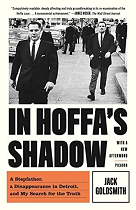
In Hoffa’s Shadow: A Stepfather, a Disappearance in Detroit, and My Search for the Truth – Jack Goldsmith

JckOn the morning of July 30, 1975, Charles “Chuckie” O’Brien (1933-2020) began his day making final preparations for a permanent move to Florida where he planned to reside with his wife Brenda and his stepchildren. But by the end of the day, his life was turned upside down due to the disappearance of his stepfather, former International Brotherhood of Teamsters (“IBT”) President James R. Hoffa (1913-1975), whose disappearance is still an unsolved mystery that has eluded investigators from the Federal Bureau of Investigation (“FBI”) for decades. O’Brien was an easy target because of his proximity to Hoffa. The Netflix film ‘The Irishman‘ (2019) shows O’Brien (played by actor Jesse Plemons) driving Hoffa to his death. But is that what really happened? Jack Goldsmith once called O’Brien dad and later discussed Hoffa’s disappearance with his aging stepfather and this book is what he learned about the case directly from the man everyone knew as “Chuckie”.

Before proceeding, I must address the elephant in the room which is the story of Frank Sheeran (1920-2003) as told in the book “I Heard You Pain Houses: Frank “The Irishman” Sheeran and Closing the Case on Jimmy HoffaThe book is sensational but there are multiple issues with Sheeran’s story. Further, the FBI never charged Sheeran, nor did they consider him a serious suspect. Also, there is absolutely no evidence that Sheeran was one of the hitmen involved the murder of Colombo Family mobster Joseph “Crazy Joe” Gallo (1929-1972) on April 7, 1972. At the time of his death, Gallo was in a bitter inter-family feud with followers of boss Joseph Colombo (1923-1978) and had been blamed for the shooting at Columbus Circle in Manhattan on June 28, 1971, that left the mob boss in a vegetative state until his death. It is true however, that Sheeran did know Hoffa and oversaw his own Teamsters Local in Delaware. Readers will reach their own conclusions, but the facts indicate that Sheeran overstated his role in Hoffa’s life and role as a Mafia hitman.

Goldsmith is a former Assistant Attorney General in the Office of Legal Counsel and was directly involved with the controversy surrounding the Stellar Wind warrantless surveillance program during the administration of President George W. Bush. At the age of twelve, his mother Brenda married O’Brien to the displeasure of the overbearing Hoffa. Despite the adversity faced by the couple, they were determined to live a peaceful life away from the complicated relationships that existed in Detroit due to the influence of O’Brien’s famous stepfather. The author revisits his early life when O’Brien became a part of the family and his path in understanding why the FBI was always interested in what his stepfather was doing and what he knew about Hoffa’s disappearance. Their relationship goes through difficult phases in the book but eventually comes full circle. The crux of the book, however, is the role O’Brien may have played in the crime, if any. And this is where the story picks up in pace and pulls the reader in. Once I reached the section surrounding Hoffa’s role as IBT President and the impending doom, I could not put it down.

Readers searching for a “smoking gun” in the case will not find it here although O’Brien affirms what researchers have long believed about the case. And the key to understanding what did happen lies in the relationship between the Teamsters and the Italian American Mafia. While Hoffa was no gangster, he was not averse to working with controversial figures or groups if it meant the improvement to the status of the IBT and its thousands of members. At the heart of this nexus was O’Brien’s mother, Sylvia Pagano (d. 1970), who is too often omitted from the Hoffa story. Goldsmith explores her connection to Hoffa and O’Brien refutes a persistent rumor about their relationship. Further, the importance of Pagano to Hoffa’s wife Josephine (1918-1980) whose mental and physical conditions were the sources of turmoil and concern in his life. Filmmakers did not include Pagano or reveal the dark side of Josephine’s story in “The Irishman“. Goldsmith had access to FBI files which contained unsettling truths about Hoffa’s marriage and his connections to underworld figures who were not as “loyal” as one might think. This relationship did not go unnoticed, and Hoffa found himself the target of the U.S. Department of Justice under Attorney General Robert F. Kennedy (1929-1968). The bad blood between Hoffa and Kennedy is no secret but what is also shown in the book are the lengths to which Kennedy’s “Get Hoffa Squad” went to bring the labor leader down. The author presents moral and ethical questions about Kennedy’s actions and decisions which had unintended consequences, and inadvertently set the stage for the events which transpired on July 30, 1975. The vengeance with which the Department of Justice came after Hoffa produced important case law that would have crucial role int the author’s actions in the Bush Administration.

Hoffa was convicted in 1967 after Kennedy left the Department of Justice on charges of jury tampering. And this was the first stage in the next eight years in which Hoffa would go from contained threat to an unpredictable liability. And O’Brien was there to witness the events and divulged to Goldsmith as much as he was willing to say on occasion. There are things which ‘The Irishman‘ did get right and one of those things is the tension between Hoffa and Anthony “Tony Pro” Provenzano (1917-1988). The mobster is only part of the story however, and we also learn about Goldsmith’s close relationship to Anthony “Tony Jack” Giacalone (1919-2001) who is like an uncle to the young teen and Vito William “Billy Jack” Giacalone (1923-2012). All three are suspected of having direct knowledge of the circumstances surrounding Hoffa’s disappearance or having played a direct role in the crime. There is no proof offered in the book that any of them did take part but if O’Brien is to be believed, “Uncle Tony” told him in uncertain terms that Hoffa had become a liability to the powers that be in New York.

In December 1971, U.S. President Richard M. Nixon (1913-1994) with conditions. The intriguing story of how the pardon came to be is discussed within and it is a fascinating story which reveals the power and connections held by the labor leader even behind bars. Readers may wonder why Hoffa was pardoned if his successor Frank Fitzsimmons (1908-1981) was well-liked by the mob and the White House. A motive is discussed in and there is credence to it. Of course, secrets surrounding Nixon’s final decision are lost to history but what is clear is that Hoffa had no intention of relinquishing control over the teamsters to anyone, and intended to directly violate the pardon. And this stubbornness sets the stage for his final days. I cannot say what went through Hoffa’s mind when he decided to call out the mob publicly and blast Fitzsimmons in the media but the unbelievable story which Goldsmith revisits is astounding. As depicted in ‘The Irishman‘, people close to Hoffa were warning him to quiet down and back down. In fact, O’Brien reveals that Tony Jack himself was one of the people who tried to get Hoffa to understand the gravity of the situation. Those encounters and Giacalone’s status in Detroit are also omitted from the film. But from what we know about the “Commission”, New York’s Five Families were aware of the Hoffa problem in Detroit and there was too much at stake for the bad press to continue.

The inevitable part of the story we know is coming arrives, and when it happens, O’Brien’s world is shattered. The disappearance and the fallout compose the final part of the book where we see the FBI and others hound O’Brien mercilessly. Throughout the story he maintains his innocence and we learn that there were FBI agents who had ruled him out as a suspect. However, as stated by the author, O’Brien knew more than he was willing to say, but feared repercussions after decades of association with dark figures in the criminal underworld. But nowhere in the book is there solid information that O’Brien drove Hoffa to his death or wanted his stepfather to disappear. In fact, O’Brien shows nothing but love and praise for the man who raised him. Further, if Hoffa did not trust O’Brien with Local 299, I doubt seasoned mobsters would have trusted him with the plot to remove his stepfather from the picture. What I did see is that O’Brien was the victim of endless harassment and a smear campaign because of his relationship with Hoffa but not because the two were on bad terms. And the penalty that was paid by his family is staggering and may have broken a weaker person. But O’Brien never wavered in the goal to clear his name and this part of the story is also omitted from the Hoffa discussion. The author was with him every step of the way as he sought to preserve his reputation, and the actions by the Government are confusing on occasion. In the end, O’Brien is now gone and any secrets he possessed departed with him. But before leaving, he shared a wealth of information with Goldsmith who in turn presents a necessary side to the tragedy of James Riddle Hoffa.

ASIN:‎ B07PNXC7WD

Unchosen: The Hidden Lives of Hasidic Rebels – Hella Winston

winstonSeveral years ago, I accompanied a friend as she undertook the task of burying her late mother who had passed after several years of ill health. The cemetery is for followers of the Jewish faith and as part of the internment process, I was required to wear a yarmulke and spread dirt over the grave. The rabbi explained the meaning behind the acts, and the presence of others in attendance who did not know her mother but came out after hearing of her death. That day I was a witness to a side of Judaism I was not previously aware of. My friend was not Hasidic but strongly identified with her Jewish roots. Today when I drive through parts of Brooklyn, I take notice of the Hasidic Jewish communities in Crown Heights, Borough Park, and Williamsburg. To the public, the people of these sects are elusive and mysterious. Author Hella Winston stepped into these worlds to learn the truth about those who become unchosen.
It is imperative to recognize that Jewish is not a monolithic term. In fact, the divisions between sects, mainly the Satmar and Lubavitch, should not be overlooked. However, what is uniform is their commitment to preserving their faith and the importance of never forgetting the name of Adolf Hitler (1889-1945). The Third Reich’s determination to exterminate Europe’s Jewish population had an unintended result here in New York as Winston points out. Readers will not be surprised at what they learn but what the author does reveal, will put the Hasidic community’s cohesiveness in a clearer perspective. The horrors of World War II cannot be understated and as Winston notes,

“One of the most striking things I came to understand during the course of this research is the power of the Holocaust, and the history of Jewish suffering in general, both in the actual lives of some Hasidic people and in the imaginations of these communities as a whole. There is, of course, the plain historical fact that the Hasidic communities that exist in America today were started almost entirely by refugees from World War II”.

Of course, the Hasidic culture we see does not exist solely because of the war. The scriptures impact every aspect of daily life and readers familiar with orthodox customs are aware of the restrictions in place around the Sabbath and during holidays. The individuals she became acquainted with revealed deeply personal parts of their lives and provided information that I learned of for the first time. One section that stands out is the view held towards Theodore Herzl (1860-1904), considered to be the father of Zionism. Brooklynites may recall that a street in the Brownsville section of Brooklyn bears his name. The reason for the view of Herzl held by the Hasidim is quite simple and in the overall context of the book, makes sense. But there is far more to the story than just Herzl and the people we are introduced to are anything but orthodox.

Winston picked members of both genders and from various families and each story has similar tones but are in fact different. I did observe that although they wanted a different life, they still loved their families and the communities they grew up in. The struggle with faith is not an easy one. Critics online have blasted the book as a condemnation of the Hasidim. I disagree and did not get that feeling while reading and have no ill will towards them. Admittedly, there were customs that I would not want to adhere to but it is not for me to say they are right or wrong for others. And I feel that anyone reading this book has to do so with an open mind. There are however, parts in the stories of the women that will make you scratch your head and have feelings of disapproval and/or disgust. These are the sections that bring to light the reality for Hasidic women. We pass them on the street, on the subways and maybe even the park, but the truth about their daily lives is carefully guarded. Whether the women are happy with their lives or not is for them to reconcile but if we digest what is contained here, it is apparent that not all are content and the number of women who yearn for more out of life could be higher than we think. The same applies for men due to the number of readers who contacted Winston after the book’s publication.

The book’s star is undoubtedly Yossi, whose story is a roller coaster ride in itself. But for all that we do learn about inside the community, there is a realization to be had for those who venture outside of it; none are prepared for the secular world which might as well be another planet. And this is one the tragedies of the book. The speakers have decided to venture in the secular world but have no real foundation to do so as the majority of their lives was spent inside the community which offered not only the resources they needed but security as well. The streets outside the community are unforgiving and more than one speaker falls victim to its darker elements. Thankfully, none perish but their experiences highlight the unchartered waters that await anyone who decides they no longer believe or wish to be Hasidim.

A common aspect I found in the stories is that they were living double lives. While they believed in the scriptures, they could not reconcile that with the practices they witnessed daily. It is a difficult position to be in and the mind will find itself at war with itself. The stories of Chaim, Yitzchak, Dini, Malkie and Leah are all intense on their own and in each one we see that regardless of location or religion, human nature is strong and cannot always be contained. The quest for freedom led some to take extreme measures as they struggled with choices I have been forced to make. And this is one of the best parts of the book that is possibly overlooked. All isolated communities have their secrets and the Hasidim are no different. But what readers should come away with is that if you are not a part of the community, you have freedoms and liberties that are desired by people within the community. And the reality is that they may never know the world as you do. For them, the scriptures control their lives and those in high positions of power pick up where faith does not. The narratives are controlled but not impervious. Over time, I believe that the Hasidim will also adjust to modern times as the younger generation seeks a new path in a rapidly changing world.

Despite the information revealed in the book, there are positive aspects to the Hasidim way of life and there are followers who are happy in the community. And as Winston points out, they too are human beings. The Hasidim also have fears, concerns, passions and insecurities. Winston’s book is not about which way is right or wrong but provides a window in a world we see only from the outside. In no way is the book a definitive account of the Hasidim nor was it intended to be. But if you can see the value in the stories contained within, then you will appreciate what she has brought to light. And if there are Hasidim who have left their communities and not sure about what to do, the organization Footsteps which was started by Malkie Schwartz, a speaker in the book, provides assistance to those in need.

If you are curious about the Hasidic way of life and what happens to those who leave, this is must-read.

ASIN:‎ B0053CUNJ8

Nicaragua, 1961-1990 Volume 1: The Downfall of the Somosa Dictatorship – David Francois

FrancoisIn June 1987, Lt. Col. Oliver North (Ret.) gave testimony in front of the Senate Select Committee on Secret Military Assistance to Iran and the Nicaraguan Opposition and the House Select Committee to Investigate Covert Arms Sales with Iran.  The hearings had cast a dark cloud over Washington and the administration of President Ronald W. Reagan (1911-2004) doubled down on anything that could be conceived as illegal pursuant to United States law.  I can still recall the shock on my father’s face when the news of the scandal broke across media outlets.  The two of us watched the nightly news to learn more about a situation that had danger written all over it.  Those who remember the Iran-Contra affair most likely have images in their minds of North testifying in his military dress before Congress.  Details of the Reagan administration’s covert plans became unraveled but the full truth about the affair remained elusive for many years.  The sale of weapons to foreign nations did not surprise me at all and military hardware has always been big business.  But what did catch my attention was the atmosphere in Central America, a region that suffered extensively due to Washington’s support of dictatorships thirsty for blood and determined to crack down on all opposition. 

Over the years I have made the acquaintance of men and women who fled El Salvador at the height of the nation’s civil war. And the stories they have told me have remain firmly entrenched in my mind as examples of how much suffering occurred to innocent people who were forced to leave the only home they had ever known.  In Nicaragua, revolution and turmoil had taken place as the Sandinista National Liberation Front successfully forced the Somoza regime to flee into exile.  The victory by the Sandinistas caused anger and embarrassment in Washington which was determined not to let the leftist remove the puppet government it preferred.  However, the people of Nicaragua had other plans and wanted a new direction for their country.  This book is the story of how the Somoza dictatorship met its end in Nicaragua.  

The author provides a good explanation on the history of Nicaragua dating back to the era of Christopher Columbus (1451-1506).  As the story moves into the 1800s, affairs in Central American begin to heat up.  Foreign governments begin to take notice of the small Central American nation and intervened in the nation’s affairs.  I was quite amazed at how involved both the United States and Britain became in the country’s policies but soon realized it was a premonition of what would follow.   A revolution in 1912 resulted in the arrival of U.S. Marines in Nicaragua and the occupation lasted until 1933.  But the local population had no desire to live under Washington’s rule at any time and a young revolutionary named Augusto César Sandino (1895-1934) was intent on seeing his country liberated from imperialist domination.  Francois tells the story with the right amount of suspense and keeps the pace flowing at the right speed to move the book forward.   It soon becomes apparent that Sandino’s time is limited, and it is not long before Nicaragua is taken over by Anastasio Somoza García (1896-1956) who placed the country in a vice grip with the assistance of his sons Anastasio Somoza Debayle (1925-1980) and Luis Somoza Debayle (1922-1967).  And for nearly fifty years they ruled Nicaragua with an iron fist and made it their personal kingdom.  But as the author explains, the revolutionaries were far from done. In fact, the Somozas had only increased the determination of the opposition to remove the family from power. 

American readers might be surprised to learn of the enormous amount of assistance Somoza received from Washington.  The United States was aware of Somoza’s tyranny yet continued to supply arms and money to the regime.  The eye-opening details provided here are bound to cause anger and shock and will cause others to wonder if “freedom” was really part of American foreign policy.  Opposition forces were continuing to mount against Somoza, and it may be challenging to keep track of the the groups that were formed.  A table of the acronyms used by the groups is included at the beginning of the book by Francois and will be helpful during the story.  The group that emerges as the main opposition force is the Sandinista National Liberation (FSLN) formed by Carlos Fonseca (1936-1976), Tomás Borge (1930-2012) and Silvio Mayorga (1934-1967).   On the side of Somoza, the Guardia Nacional de Nicaragua (GN) steps up to the plate to do battle with the FSLN and the war that breaks out is nothing short of brutal.  At this point, the story heats up significantly and readers will not want to stop reading as the suspense continues to build.  Francois’ narration of the events resurrects the past with vivid detail. 

Similar to other conflicts, Nicaragua’s war was not as cut and dry as one may have believed. In fact, the country essentially became a battleground between the right and left with Washington deeply concerned about Soviet and Chinese influence.  And as we see in the story, Beijing was fully aware of the events in Nicaragua and attempted to get into the mix.  Even Israel enters the story, and this part of the book is mind bending. Francois proves that there are many dark secrets to every conflict.  As the two sides are locked in a deadly battle, Somoza begins to lose popular support.  The initial descent of the Somoza regime into oblivion takes center stage and Francois takes us through the series of events that not only gave the Sandinistas the upper hand but also saw the disappearance of support from Washington.  At this part of the book, I had to step back for a minute and digest what I was reading.   The abrupt change in policy from Washington is a move we have seen in other places where death and destruction have taken place.  Somoza was once the darling of the U.S. policy in Central America but soon learns that when Washington no longer wants or needs your services, the cold from being hung out to dry can be chilling. 

The end for the regime finally came in July 1979 and for the administration of President James E. Carter, Jr., Somoza’s removal was long overdue. However, the new president had his hands full and the situation in nearby El Salvador was heating up.  In Nicaragua, the long road taken by the opposition had ended and the country faced a new and uncertain future.  Francois explains it best with this statement: 

“The date 19 July 1979 marked a turning point in the history of Nicaragua and the FSLN. Not only had a powerful dictatorship that reigned over the country for nearly 40 years, with the support of the US, ended, but the long and patient fight started by the Sandinistas in the early 1960s finally came to fruition.” 

The Carter administration continued its policy of reigning in dictators in Central America yet failed to completely achieve its goal.  In January 1981, a former actor and one-time Governor of California took office and his policy towards Central America and the “threat” of Soviet influence helped plunge Central America further into chaos.  Congress initially had no idea just how deadly things had become but it soon learned and what was revealed remains one the darkest moments in U.S. foreign policy.  And the key to understanding those events is the story here about the Somoza downfall that had ramifications which spread across Latin America. 

Readers who find this book to highly informative will appreciate Raymond Bonner’s Weakness and Deceit: America’s and El Salvador’s Dirty War and Malcolm Byrne’s Iran Contra: Reagan’s Scandal and the Unchecked Abuse of Presidential Power.  Both are exceptional accounts of America’s involvement in Central American affairs.  Francois has a winner here and I am eagerly anticipating volume two.   

ASIN ‏ : ‎ B07RPBY857

How the Other Half Lives (Iluustrated): Studies Among the Tenements of New York – Jacob A. Riis

riisA few weeks ago, my family had its first gathering in nearly two years.  The even took place at Jacob A. Riis Park in Queens, New York.  As I walked the boardwalk next to the beach, I wondered how many people there knew the story of Jacob A. Riis (1849-1914) for whom the park is named. In 1890 this book by Riis was published and more than one hundred years later is stands as a  crucial piece of writing about the island of Manhattan.  At the time Riis wrote the book, the City of New York had yet to be incorporated.  That occurred eight years later on January 1, 1898.  His focus here is on the tenements in lower Manhattan and the different ethnic groups that inhabited the area.  And though New York has changed significantly in the years since Riis wrote this book, the gap between the wealthy and poor still remains wide.

Riis personally visited the tenements and made his observations regarding the people who called the them home.  And what he reveals is not entirely shocking but should serve as a reminder that before the skyscrapers rose across Manhattan, many parts of the island were home to families on all income levels and poverty was more common that some may think.  And in the area that was once known as the Five Points, life was tougher and deadlier.  The pictures that emerge from Riis’ work show two different worlds that exist in the same city.  The wealthy lived comfortably further uptown but, in the tenements, it was hell on earth.  In the tenements we find immigrants from Ireland, Italy, Poland, China, and various other places from which they departed.  All were in search of a better life in America but found themselves at the bottom of the social ladder where they were joined there by black Americans who had struggled to fit into American society in the wake of the Civil War and the failed Reconstruction Acts.  Riis gets up close and personal with each group and leaves us his thoughts which are sure to raise eyebrows.

I do warn readers that the author uses coarse language at times and his references to some groups and areas would never make it past a publisher’s desk today.   More than once I winced at his use of such terms as “Chinaman” and “Jewtown”.   But I also realize that in 1890 this style of writing was perfectly acceptable.  And despite the terms he chooses for certain discussions, Riis’ goal of shedding light on how the other half lived is thoroughly accomplished.  And the illustrations that are included help to reinforce the message he is delivering.  Today it might seem unreal that such conditions existed in New York, but they did, and the tenements were beyond deplorable.  Disease, hunger, crime, and despair could be found all over, and many met early deaths trying to survive in the depths of hell.  Their stories are consolidated here through Riis’ storytelling that is engaging and will keep readers tuned in and rooting for the underdog.  Riis is also rooting for them as well and fully understand the challenges they face.  To make that point clear he explains to the reader that:

“The poorest immigrant comes here with the purpose and ambition to better himself and, given half a chance, might be reasonably expected to make the most of it. To the false plea that he prefers the squalid homes in which his kind are housed there could be no better answer. The truth is, his half chance has too long been wanting, and for the bad result he has been unjustly blamed.”

Those words are still true today.  Readers who are also history buffs may recall that only eight years prior to the publication of this book, Congress had passed the Chinese Exclusion Act which was signed into law by President Chester A. Arthur. The legislation prohibited Chinese laborers from emigrating to the United States and remains one of America’s darkest legacies with regards to immigration and the Chinese-American experience.  I am sure Riis was cognizant of that fact and fully understood how and why the Chinese neighborhoods developed into what they became.  I found him to be fair for the most part in his descriptions of the tenements but there were times where his words are slightly menacing.  But interestingly, Riis is aware of it and mentions it on occasion as he explains the various areas of the tenements.   However, there is one group for which he seems to be far harsher upon than others: the Arab/Bohemian.  I cannot say why his words about the Bohemians were as sharp as they were, but his criticism of the group is significant in the book.  Sadly, even today America’s Muslims are not always fully understood and anti-Arab discrimination is still an issue within our borders.  In all fairness, Riis never goes as far to mercilessly bash them or try to incite violence upon them.  But I do feel that perhaps he was a little too critical of an immigrant group that has strived for acceptance.

There are many redeeming moments in the book and Riis does make sure to point the great things about the various ethnic groups.  And that is what is so striking about the book.  His casual use of terms and descriptions could be taken as slightly bigoted, but he never fails to give praise where praise is due.  And when it comes to the Negro population, he is brutally honest in the treatment blacks had received in America and how their lives have suffered because of it.  I could feel while reading the book that his time in the tenements allowed him to understand the challenges immigrants faced as arrived in America.  Faced with a new culture, new language, and exposure to ethnic groups they may have only heard about, immigrants in New York during the 1800s did what was needed to survive and for many, life in the tenements was their daily reality.  Lower Manhattan looks different today but at one time the Five Points was a battle zone and life was not guaranteed.  It was here that the other half lived.  Riis, however, was optimistic and makes this statement that I feel exemplifies at least one thing New York City will always be known for:

“New York is, I firmly believe, the most charitable city in the world. Nowhere is there so eager a readiness to help, when it is known that help is worthily wanted; nowhere are such armies of devoted workers, nowhere such abundance of means ready to the hand of those who know the need and how rightly to supply it. Its poverty, its slums, and its suffering are the result of unprecedented growth with the consequent disorder and crowding, and the common penalty of metropolitan greatness.” 

Some readers may find the book to be difficult at times due to Riis’ descriptions of the tenements.  He spares very few details, but I believe that was the effect he wanted when he wrote the book.  The tenements were not a place of happiness but of hopelessness and uncertainty.  New York City is known as the melting pot and the label is accurate, but it is imperative to remember that the melting pot we have come to know has its own dark past and for hundreds of immigrants arriving in Manhattan during the 1800s, life was not a glorious as many had hoped.  These are their lives brought to life by Jacob Riis in this book that is and forever shall be part of American history.

“Long ago it was said that “one half of the world does not know how the other half lives.” That was true then. It did not know because it did not care. The half that was on top cared little for the struggles, and less for the fate of those who were underneath, so long as it was able to hold them there and keep its own seat.” – Jacob A. Riis

ASIN ‏ : ‎ B0796FFTQ4