
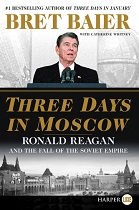
 Readers old enough to remember the Soviet Union will recall the shock and disbelief that came with the Union of Soviet Socialist Republics (U.S.S.R.) flag being lowered for the last time on December 25, 1991. The “Cold War” had come to an end, but a long road lay ahead between the United States and Russia in coming to terms with each other’s way of life. On May 29, 1988, United States President Ronald Reagan (1911-2004) and First Lady Nancy Reagan (1921-2016) arrived in Moscow for a three-day summit with Soviet General Secretary Mikhail Gorbachev and his wife Raisa (1932-1999). It has been held as a triumph in American foreign policy and as an example of strong leadership. In less than three years, the Soviet Union dissolved, and Reagan was vindicated in his predictions of its demise. During the summit, Reagan spoke to the people of the Soviet Union at Moscow University and to this day it stands as a breathtaking moment in world history. But as always, there is more than meets the eye. Fox News host Bret Baier revisits the summit in this book about three days that impacted world history.
Before I continue, I do have to acknowledge that the book may be viewed with skepticism depending on the reader’s political beliefs. Further, it is no secret that Reagan has long been the icon for conservatives. Ironically, he was once a liberal Democrat and as Baier explains, Regan’s parents had no tolerance for ignorance or bigotry. Exactly how Reagan became a conservative is not the point of the book and a full biography of him will better suit readers searching for that information. Baier does provide a short biography of Reagan tracing his roots in Tampico, Illinois, and the path he took to become Governor of California and the Republican candidate who unseated President James “Jimmy” Carter. The story picks up in pace once Reagan is sworn into office and moves into the White House. The chill in the air between the Carters and Reagans is evident in the book but a small part of the bigger picture. To anyone paying close attention, it was evident that all was not well within the Soviet Union. In fact, Baier correctly points out that:
“By the time of the Moscow summit, that fact was evident to everyone, including the Soviets themselves. Yes, they remained a world power. Yes, their arsenal of weapons was still great. But beneath the surface, the economy was in free fall, its citizenry was restless; the architect of perestroika was breaking down the remaining barriers. Reagan’s prediction was coming true, as he, if not others, had always known it would.”
Reagan did believe that the Soviet Union would fall but it should be noted that problems within the U.S.S.R. had been mounting for years, even before Reagan took office. Further, the fall of the Soviet empire is far more extensive and complicated than presented on the surface here. I vividly recall Reagan’s statement telling Gorbachev to “tear down this wall”. The Berlin Wall did fall, and it was a significant turning point in both German and world history. But even that goodwill gesture caused in part by weakening Soviet influence was not enough to stave off the inevitable. Gorbachev knew that trouble was brewing but also faced opposition within his own ranks. However, he had developed a strong relationship with Reagan and that is the crux of the book.
The visit by the Reagans had a profound effect on the Soviet Union and it was an extraordinary act by a U.S. President. Baier takes us deep behind the scenes as the two leaders seek to come to an understanding of key issues. As I read the book, I could see their relationship developing slowly but surely. It is a prime example of how people from diverse backgrounds can find common ground. That is not to say that all went well. In fact, in the book, we see more than one situation where the two leaders remain on opposite ends of a rope with each refusing to give ground. And the first ladies did not have a warm or jovial relationship themselves. Reagan and Gorbachev were leaders of the two most powerful governments on earth and needless to say the stakes were high. Before the book’s conclusion, Reagan leaves office and is succeeded by George H.W. Bush (1924-2018) who developed his own relationship and different relationship with Gorbachev. When Reagan leaves the White House for the last time, the sadness in Washington and in Moscow can be felt through the author’s words. Reagan emerges as a leader that is hard not to like. Of course, the Soviet story was far from over and Gorbachev had to defend himself from party members determined to see his downfall. Baier discusses how close the Soviet General Secretary came to being removed from office and the roles of Boris Yeltsin (1931-2007) and a young intelligence officer named Vladimir Putin who currently has the world watching his every move.
Undoubtedly, Reagan comes across beautifully in the book and I did notice that the darker moments of his president are discussed briefly. The Iran Contra scandal and Sandinista affair in Nicaragua are mentioned but Baier touches only the surface of those matters. The seriousness of each is not felt in the story at hand but I do implore readers to further research those topics to get a full understanding of Reagan’s presidency. To be fair, no administration is perfect, but the people of Central America will surely give you an interesting opinion of the Reagan era. His policies had a profound impact on Latin America that continues to be felt to this day. In the United States, the legacy of the jovial actor turned politician is permanently embedded in the Republican party’s core and he remains an icon of conservative values. If her were alive today, I am not sure if he would recognize what the GOP has become and I believe he would be both shocked and dismayed at world events. The world is a far different place today but the importance of this time in world history captured by Baier cannot be understated. In three days, Ronald Reagan accomplished what decades of U.S. foreign policy failed to do, he captured the attention and minds of the Soviet people. Readers with a thirst for historical information on U.S. and Russian relations will appreciate this book.
ASIN: B072LL4ZN2
 The deaths of nine hikers in the Ural Mountains of Siberia in February, 1959, endures as one the world’s most bizarre mysteries. The official explanation at the time was that their deaths were caused by an extraordinary force. Exactly what that means was never fully explained. As the hikers were found, autopsies were performed which revealed many disturbing facts and do not match the official explanation. The remains of the tragic hikers were buried at the direction of party officials without much or any input from their parents. Almost from the start, Moscow stepped in and gave orders that were to be followed strictly with no deviation. The official explanation still stands today but is that what really happened? Or was there a darker and more sinister reason for their shocking deaths?
 The Chernobyl Nuclear Power Plan was supposed to be the pinnacle of Soviet innovation and a testament to the drive inspired by the spirit of Lenin & Stalin. Its very construction was intended to be a statement that the western powers were no match for their Soviet counterparts. But on April 26, 1986, a meltdown at the Number Four reactor changed all of that and the course of world history. Moscow moved quick to suppress any information coming out of the Soviet Union. Initially the damage control was somewhat successful but before long, nuclear engineers in neighboring countries and across Europe realized that something was terribly wrong and all indicators pointed towards the Soviet Union. Officials were forced to issue a public admission regarding the incident, setting off alarm bells across the globe. I remember watching the news of the disaster with my parents and being in complete shock. My father could only watch and shake his head in disbelief. No one knew what would happen next but it was clear that this accident was unlike any that the world had ever seen before.
 On December 26, 1991, the world watched in shock as the Union of Soviet Socialists Republics (USSR) dissolved, splitting the once mighty Soviet Union into fifteen separate nations. I vividly remember watching the news broadcasts and seeing the flag of the Soviet Union lowered for the last time. It was the end of an era highlighted by the Cold War in which Washington and Moscow viewed each other as a threat to world peace. Paranoia, suspicion and espionage propelled the two to the brink of nuclear war on several occasions. In October, 1962, the world watched in gut-wrenching suspense as the Cuban Missile Crisis heated up and threatened to be the spark that ignited the next world war. President John F. Kennedy (1917-1963) and Soviet Premier Nikita Khrushchev (1894-1971) found their selves in a situation that could have resulted in the physical destruction of half the planet within a matter of minutes. Diplomacy eventually prevailed through the use of back door channels encouraged by the realization of figures in both governments that the looming showdown would produce no winners. Tensions between the two super powers cooled but never full subsided and as the dissolution of the USSR played out on television, Washington closely monitored the events while re-examining its global position as Russia emerged from the post-Soviet empire as the country to watch. Twenty-eight years later, the USSR is still recalled as one of the greatest powers in history. Its fall was earth shattering and left so many wondering, how and why did it happen?
 In the early morning hours of April 26, 1986, engineers at the Chernobyl Nuclear Power Plant in Pripyat, Ukraine, began the process of conducting a test of Reactor No. 4. Unwilling to postpone the test another year, engineers pushed forward under questionable circumstances that proved to have deadly consequences. Within minutes, disaster struck as a thunderous roar and cataclysmic explosion were felt and heard throughout the facility. The eruption of the reactor resulted in a complete implosion and the propulsion of a radioactive dust cloud into the atmosphere. Instantly, Soviet officials set in motion an official coverup of the disaster in an attempt to keep the news of the reactor’s meltdown from reaching western news outlets. On the surface, the Politburo maintained the image of business as usual, but behind the scenes it was pandemonium. In the days and weeks that followed, the people of Pripyat looked death in the face as the reality of the nuclear fallout become terrifyingly clear. Within days, cross-winds moving across Europe carried the dust cloud across several countries, setting off alarm bells as radiation dosimeters showed readings that were literally off the charts. Before long, it became clear that a nuclear disaster had occurred and the most likely source was somewhere in the Soviet Union. Soviet authorities pulled out all the stops in denying anything was amiss but the truth began to leak out and forced Moscow to make troubling admissions. These events an those that followed have become known as the Chernobyl disaster and that story is told here again by author Adam Higginbotham who tells what is perhaps, the full story behind the world’s worst nuclear disaster.
 In December, 1991, the unthinkable happened as the Union of Soviet Socialist Republics (USSR) dissolved into fifteen separate countries. Known informally as the Soviet Union, the USSR seemed at times indestructible to those viewing the union from abroad. But within dissension had been brewing for many years in the wake of the tyrannical reign of Joseph Stalin (1878-1953). His successors embarked on a period of de-Stalinization that thrived under the administration of Nikita Sergeyevich Khrushchev (1894-1971). The Soviet Union remained a superpower and in direct competition with arch-rival the United States. It dissolution shocked the world and left the future of the former Soviet republics in limbo. In the aftermath of the monumental and historic collapse, the individual republics established their own rights to self-governance and in some cases, completely rejected Russian rule. Tensions between many of the nations continues to this day. Currently, Vladimir Vladimirovich Putin serves as the President of Russia, and is as much of a controversial figure as many of his predecessors. His appointment by late President Boris Nikolayevich Yeltsin (1931-2007) gave many Russians hope that a new direction was in store for the beloved country. Today, as we look back at the time that has passed since he was chosen to lead Russia, we can see a tortured nation still suffering from systematic oppression and what is rightly described in this book as totalitarianism.
 On January 23, 1959, Igor Dyatlov (1936-1959) and several of his classmates at the Ural Polytechnic Institute in the City of Sverdlosky, board a train as they commence their hiking expedition to the Otorten Mountain in the Northern Urals in Siberia. On February 12, they are expected to return from their trip but there is no sing of the explorers, some of whom are as young as twenty years of age. Eight days later, a formal search team is put together to find the missing hikers. Over the next several weeks, their remains are found and returned back home. Lev Ivanov is assigned to investigate their deaths and to this day, the official explanation is that they died due to some “unknown force”. The incident that has become known as the Dyatlov Pass, remains one of history’s darkest mysteries. Donnie Eichar, a film producer and author revisits the incident in this chilling look into a mind-boggling event that is nothing short of surreal.
 FREETHINKING BIBLIOPHILE
You must be logged in to post a comment.