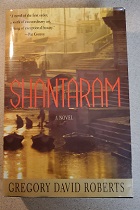
Shantaram: A Novel – Gregory David Roberts

20220123_132734This review will be different from my normal write-up as I have stepped back into the world of fiction. This book came as a gift, and it is one that I will cherish infinitely. But before I continue, I want to point out that this book is long. In fact, it is over nine hundred pages in length and not for the faint at heart. If the length of the book does not deter you, then you will find an incredible story that will remain with you for years to come. And by the time the story ends, readers will be eager to learn more about the lives of the characters that come to life in this spellbinding tale.
The book opens with the main character arriving in Bombay (now Mumbai), India. No one knows his real name and he is fugitive from his native Australia. His fake New Zealand passport allows him to enter the country and it is not long before he becomes aware of how life operates in Bombay. Soon he meets one of the most cheerful characters in the story, Prabaker who we come to know as Prabu. Our character needs a name and becomes Lin or more intimately, Linbaba. Prabu becomes his guide in the new city, and the locals are drawn to the new white face whose background remains a mystery. Lin is soon introduced to the group of characters that form the backbone of the book: Karla, Didier, Modena, and Maurizio. Each has their own backstory which is explained at various points in the book. Of the group, Lin quickly makes friends with Didier who is a rascal and finds himself attracted to Karla, who plays a significant role in events that come later in the book. Modena and Maurizio also play a significant role but for darker and more disturbing reasons.

Money and shelter become the primary concerns for the new arrival, but Lin is able to survive on side hustles before moving to a well-known slum. From this point on in the story, the darkest aspects of Bombay come to life and the people Lin meets while working as a “physician” in the slum, set in motion a chain of events that bring him into to the criminal underworld, However, Lin is a complex figure and performs acts of courage and kindness throughout the book while learning more about the underworld and its lucrative financial incentives. His actions as a deadly plague breaks out in the slum will remind readers of the danger that comes with living in under-developed parts of the world. However, Lin in aware that eyes are watching him as he is performing feats of courage in the slum. As a foreigner, he was destined to stand out and eventually crosses paths with Bombay’s most feared figure, Abel Khader Khan. Khader becomes a second father to Lin who calls him Khaderbai. Through his mentor, he makes the acquaintance of Abdullah and Nazeer, two pillars of strength throughout the story.

Karla is never far from Lin’s mind and one day she approaches him to assist her in solving a problem at a local establishment. It is here that we are introduced to the notorious Madame Zhou. As they leave, Karla and Lin are under the impression that all is well, but they are unaware that Lin now has a target on his back. Ulla, who is intimately involved with Modena, approaches Lin for a favor that requires they meet at a local restaurant late at night. Lin agrees but this trip turns out to be unlike any he has taken before. Things soon go wrong, and Lin finds himself in a world of trouble. To say he goes through hell would be an understatement. The savageness of human nature is put on full display and the author pulls no punches.

As the dark horrors of Bombay become a painful reality, Lin is forced to confront his own demons from his life in Australia. Readers familiar with the author’s life will recognize that the fictional Lin is based on Roberts’s real-life experiences. The other characters in the book are composites of people he knew, and parts of the story are inspired by true events. Karla is the book’s most mysterious character and Lin can never quite figure her out. However, she comes to his aid when needed and serves as a voice of reason at times. But Lin is not mentally where he needs to be and his association with Khader, Abdullah and others in the Bombay underworld, are far from over.

I mentioned before that the story has twists and turns that come of out of nowhere. Lin could not have imagined that he would become friends with Bombay’s biggest gangster or that he would follow him all the way to Afghanistan. At this part in the story, I thought I had mis-read when I learned of the group’s mission there. The story is surreal but makes sense after we learn more about Khader and another figure, Khaled. They are joined by others whose lives have been changed by the Soviet invasion in 1979. However, understanding each of them is not easy but through Lin, their lives come into focus, and we are able to see the complexity of human nature. The men know they must commit dark deed but believe that out of the darkness comes light. The relationship between Lin and Khader is put to the test and before the mission is over, Lin will be re-born. Upon returning to Bombay, Lin is a changed man but wiser to Bombay’s dark side and there remains unfinished business in the underworld. Madame Zhou reappears in what is one of the book’s crazier moments.

The characters in the story are a mix of good and bad and that is what makes it work so well. Some have committed crimes, others have turned to drugs, yet each is struggling to understand their own existence while engaged in one hustle to the next. Roberts does an excellent job of focusing on the concept of morality without directly addressing it. Instead, we learn about the characters and are able to make our own judgments. Upon learning their backgrounds, I found that I did not dislike the majority, and the duality in their nature is given close attention. The story also reminds the reader that the saying there is no honor amongst thieves has a ring of truth to it. But is that accurate in Shantaram? And is it possible that sometimes you must commit an evil act to produce a greater good? As the book shows, there are aspects of human nature that can never be erased but carefully hidden. And as Lin learns in Bombay, the heart means everything in India. The locals, despite their living conditions, are content and teach Lin valuable lessons that one might suspect cannot be found in the slums of Bombay.

As the book moves forward towards its conclusion, Lin becomes embedded in the social fabric of Bombay and well-known to everyone in the underworld. When he arrived at the beginning of the book, he could not have anticipated the road he would take. But at this point in the story, he is a seasoned gangster who has lost as much as he has gained. He comes to terms with the actions and lives of those around him and their effect on his life. Karla remains close, as do Didier and others such as Lisa, Vikram, Lisa and Kavita. Linbaba completes a long journey and along the way we learn why the name Shantaram is so fitting. There is far more the story than I have mentioned here and readers will enjoy reading the book. It is long but written very well and the story is easy to follow. Highly recommended.

ISBN-10 ‏ : ‎ 0312330529
ISBN-13 ‏ : ‎ 978-0312330521

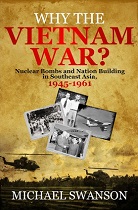
Why The Vietnam War?: Nuclear Bombs and Nation Building in Southeast Asia, 1945-1961 – Michael Swanson

swansonFifteen days from now, the fifty-eight anniversary of President John F. Kennedy’s (1917-1963) murder will be upon us. His death continues to remind America of a lost opportunity and leader taken before his time. His presidency inspires debate to this day with some believing that he brought the country dangerously close to nuclear war with the Soviet Union. Others feel that he had yet to reach his full potential as a leader. The truth is far more complicated and both sides often omit the difficulties Kennedy faced behind the scenes from those within his own administration. After the disastrous Bay of Pigs invasion which led to Kennedy firing top officials of the Central Intelligence Agency,  he then found himself under pressure to intervene in the nation of Laos. Again, Kennedy resisted, drawing the ire of the Joint Chiefs of Staff and Cold-War hawks in Washington. But the hawks were determined and saw Vietnam as the next battlefield to confront “Soviet influence”.  But the question that has always haunted this nation is why did we get involved in Vietnam? What threat did North Vietnam pose to the United States even though it is more than thirteen thousand miles away from American soil? My uncle who served in Vietnam has only spoken of his experiences a handful of times. He keeps the war suppressed in his memory and does his best to stay secluded during July 4th celebrations as the fireworks remind him of being in combat. I often wondered if he has asked himself why he was deployed thousands of miles away from home to a country some Americans did not know existed prior to the conflict. Michael Swanson asked himself about Vietnam and has explored the war  paying close attention to its origins and this book is the first of what will be a multi volume set about America’s involvement in Southeast Asia.
Swanson quickly establishes that the Vietnam War started sixteen years earlier than 1961. In fact, the war has its origins in the ascension of North Vietnam to power in the wake of World War II. The evacuation of Japanese military personnel created a power vacuum that allowed the North Vietnamese to take control and establish its headquarters in Hanoi. Washington was paying close attention to the developments and the rise of Ho Chih Minh (1890-1969).  He was known as Uncle Ho and proved to be a charismatic figure as well as an icon for millions of Vietnamese who strongly favored an independent Vietnam, free of French colonial rule. And this is what policy makers in Washington failed to realize. However, there were those on the ground who saw Ho Chih Minh’s potential and the futility of French attempts to reclaim Indochina. In the book, we learn the name of former Lieutenant Colonel Archimedes Patti (1913-1998), a former Office of Strategic Services officer who emerges as the voice of reason no one wanted to hear. Patti warned officials back in Washington of what he saw firsthand but sadly, his reports were shelved. And when reflecting back on the war, Patti stated:

“Ho Chi Minh was on a silver platter in 1945,” remembered Archimedes Patti, “we had him. He was willing to, to be a democratic republic, if nothing else. Socialist yes, but a democratic republican.

I recall a Vietnam veteran years ago telling me that he couldn’t understand why America got involved after seeing the French evacuate. He was drafted at 19 and has always maintained that Vietnam was one of the scariest experiences in his life. His question was valid. Why did we take the place of the French and why did we help them in the first place? The author pieces together the story to show Washington’s early involvement in French affairs and I could only shake my head at what he reveals. But there is always more than meets the eye. Swanson knows this and proceeds to explain what was taking place back in Washington that paved the way for such disastrous foreign policy. In fact, he bluntly states that after World War II:

“The United States, however, sought to control societies in order to improve them, in order to incorporate them into the modern capitalist world order through nation building. But becoming an empire changed the United States forever, and led it to fight a disastrous war in Vietnam.” 

When John F. Kennedy took office, he had to have known the difficulties he faced from what his predecessor Dwight E. Eisenhower (1890-1969) called the military industrial complex. However, what Kennedy may not have known is that America’s involvement in Vietnam did not start with Eisenhower but with another president, Harry S. Truman (1884-1972). This part of the story came as a surprise because the focus on Truman’s actions in office are often related to World War II and the National Security Act of 1947. But it does make sense that his role is revisited as Vietnam began to draw Washington’s attention not long after the Japanese surrender. I could not help when reading the story that had Truman decided not to get involved in Vietnam, world history might have taken a different course. As the story moves forward, Eisenhower’s administration passes with Vietnam remaining a French issue. It remains dormant until, when the intelligence community and military found itself irate over the president’s refusal to support military intervention across the globe. And it is here that the Vietnam story heats up and Swanson takes us deep inside Kennedy’s administration to explain the true reasons for military engagement in Southeast Asia.

Kennedy had sought to prevent Americans from getting engulfed in a ground war in Vietnam. Swanson captures the essence of the story here and I strongly recommend John Newman’s JFK & Vietnam: Deception, Intrigue and the Struggle for Power which discusses JFK’s battles with his own cabinet and the Joint Chiefs over escalation. Newman leaves no doubt that Kennedy knew Vietnam was a deathtrap for American forces. But war hawks were not ready to admit it and as Swanson shows, a power struggle did in fact take place with a majority of people pushing Kennedy to approve troops and the president pushing back against them. Readers will express surprise at the actions of  those working “for” the president.  Kennedy was struggling to maintain control over his own administration.  Readers with an interest in his assassination will find this aspect of the story highly relevant.

Vietnam veterans known dark truths about the war that many would prefer not to know. Swanson’s job here was not to pacify anyone but to explain why Vietnam happened. And in order to understand the war, it is crucial to understand the importance to Washington of South Vietnam and its former leader Ngo Dinh Diem (1901-1963). Admittedly, there is much about his life I am still learning of, but I now have a better understanding of the truth in regard to South Vietnam and why personnel stationed in the country were sounding the alarm bells to those in power in Washington. And what I read resulted in anger at those who knew the issues in South Vietnam and the low chance of success. Frankly, Washington knew it could not win in Vietnam without a massive commitment of troops and the use of nuclear weapons. But the public backlash at those two concepts would have been political suicide so America had to operate in a limited capacity. But the pressure to invade never let up and as the story moves forward, the stage is set for a showdown between Kennedy and the military industrial complex. However, the book ends before the tragic fates of Diem and Kennedy play out. As Swanson explains, that will be the focus of the next part in the series. But he does summarize the story contained within with this statement that sent chills down my spine:

“The more hawkish members of the Joint Chiefs of Staff viewed Southeast Asia as simply part of a conflict with China over who would control the entire region. When they advocated intervention in Laos in 1961 their plans were for a regional conflict that carried with it a ladder of escalation, the final step of which was an atomic attack on China if they retaliated, one in which they thought they could break the back of Red China.” 

Kennedy himself said it best when he observed: “These brass hats have one great advantage, if we … do what they want us to do, none of us will be alive later to tell them that they were wrong.” We can only speculate as to what would have transpired had he lived.  I personally believe that the Vietnam War would have never happened. Kennedy was determined to resist the military and dismantle the Central Intelligence Agency but the events in Dallas, Texas on November 22, 1963, changed that permanently. His successor Lyndon B. Johnson (1908-1973) had different plans for Vietnam, and they included the flexing of American military muscle that claimed the lives of  fifty-eight thousand Americans and over one million Vietnamese. It remains the war that America did not win.  And there thousands of veterans alive today still carrying the scars from that war. If you want to know why the Vietnam War happened, this is a good place to start.

ASIN ‏ : ‎ B08FHBS17K

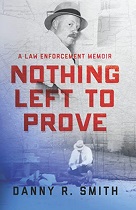
Nothing Left to Prove: A Law Enforcement Memoir – Danny R. Smith

SmithA friend whom I have known since elementary school recently finished twenty years with the New York City Police Department. Though eligible for retirement, he continues to serve the city where he was born. I and other friends have never failed to remind him to be careful on the dangerous streets of New York. Long hours, dangerous criminals and bureaucratic obstacles can sometimes make being a police officer a difficult and thankless job. And when I watch the hit show The First 48, I am  always amazed at the skills of homicide detectives as they solve crimes in cities across America. Danny R. Smith served as a homicide detective in the Los Angeles Sheriff’s Department for seven out of the twenty-years he reported for duty. This is his story as part of law enforcement in the City of Angels. 
The book begins with Smith revisiting the day when he knew that the time had come for him to make his exit from the force. The scene he arrives upon is macabre, but we learn towards the end of the book when he explains the full details surrounding the discovery, that the reason for the find is far simpler and less sinister. However, Smith had reached his breaking point but in order for us to understand why, we have to go back in time to the beginning of the wild ride he took during two decades of service. Expectedly, he explains how he joined the Sheriff’s Department and the path he took to homicide. And it is at that part of the book that the story heats up. As we follow him from one case to the next, the dark side of Southern California comes into vivid focus. But the book is far more than just a former officer’s tales of war on the streets. In the mix of murders, burglaries and other crimes, Smith shows us his personal life and the struggles he endures due to injuries on the job and the mental challenges that come with daily exposure to the deadly side of humanity. It will be hard for any reader not to appreciate the enormous sacrifices made by the people in law enforcement. 

As expected, there are dark moments in the book, but Smith also adds the right amount of humor at times to take the edge off. And what he shows is that the life of a homicide detective is anything but orthodox.  His journeys took him across the United States in pursuit of fugitives who could not escape justice. And the stories he tells of transporting prisoners back across the country are both humorous and interesting. The lengths to which detectives go to capture a suspect are eye opening. But not all suspects are apprehended and crimes do remain unsolved as we see in the book. But it is not for lack of effort.  Smith was a first-class detective who was thoroughly committed to his job and the people of Los Angeles. 

The riots in Los Angeles after the acquittal of police officers charged with beating motorist Rodney King (1965-2012) remain fresh in the minds of all who remember them. I remember watching the aftermath play out on television as Los Angeles went up in flames.  Smith was on the ground and discusses the riots highlighting how dangerous the situation was. But during his career, he experienced the loss of fellow officers.  Each death hits home for Smith and he remembers his fallen officers with grace and how it affected those who continued to do the job. And the harsh reality that the show must go on is apparent as more calls come in for Los Angeles’ finest. The hours are long and the work is dangerous, and I can only imagine the number of stories that did not make it into the book.  Smith’s eyes have seen things that can haunt a person for a long time or make them smile on occasion. 

Smith was as seasoned as detectives come but even he could not avoid fate.  The physical and mental toll of being a police officer comes into focus as the job wears him down over time.  And as the book moves closer to the conclusion, the writing is on the wall. Smith was reaching his end, but I personally did not want the book to finish.  His memories had me glued to the screen and I hated to put the Kindle down.  I can now see why the book has a five-star rating on Amazon. This incredible memoir is perfect for anyone who is interested in the life of a police officer/homicide detective. Smith is now retired but he will forever be a part of Los Angeles history. 

“For those who haven’t been there, know that the great majority of cops are kind and caring souls, driven to the profession with the desire to help others, to protect the weak from bullies and predators, and to stand up for those who are unable to stand up for themselves. We sacrifice holidays and special occasions and sometimes much, much more, to make a difference in our communities. To make a difference in your communities.”

Danny R. Smith 

ASIN ‏ : ‎ B09FGWT2WV

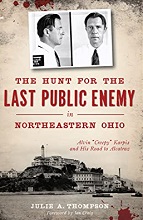
The Hunt for the Last Public Enemy in Northeastern Ohio: Alvin “Creepy” Karpis and his Road to Alcatraz – Julie A. Thompson

ThompsonA few years ago, I visited San Francisco and decided to take the boat ride around the bay under the Golden Gate Bridge.  As the vessel made its way back to the dock, it traveled around the eastern side of the defunct prison once known as Alcatraz.  The facility has long been closed but seeing it in person puts the stories about it into a new perspective.   To some, the prison was  simply known as “the rock”.  Regardless of what it was called, it was home to some of America’s most dangerous criminals. And make no mistake, a decision to send an inmate to Alcatraz was not made lightly.  Further, inmates knew that if you were sent to Alcatraz, you better be prepared to spend a lot of years there.  Alvin F. Karpis (1907-1979) spent three decades at Alcatraz and in the annals of American history, he remains one of the most prominent crime figures from the outlaw era that saw the rise of such as John Dillinger (1903-1934), George “Baby Face” Nelson (1908-1934) and the deadly duo of Bonny Parker (1910-1934) and Clyde Barrow (1909-1934).  Unlike many other outlaws, Karpis not only survived the 1930s but was eventually released from Alcatraz.  This is the story his time on the run, capture by the Federal Bureau of Investigation (“FBI”) and later years as a free man.

The story is undoubtedly focused on Karpis, but the book is not a standard biography.  Instead, the focus is on the mission to apprehend him and his life after being convicted.  Thompson does provide a fair amount of background information on Karpis, but it is not long before the story progresses to the time when Karpis becomes fully engulfed in the criminal underworld.  And once he did, there was no turning back.  However, in comparison to well-known killers from that time, Karpis comes off the complete opposite.  But behind the quiet demeanor was a highly intelligent and crafty individual.  And I believe that aspect of his character is what makes the story is so interesting.  Karpis is not the typical outlaw and in some cases, he was certainly in the wrong place at the wrong time.  That is not to say that he was completely innocent.  In fact, he was far from it. But Thompson does show that he was not the person that came to mind when people thought of America’s most wanted.  But eventually, he caught the attention of FBI Director J. Edgar Hoover (1895-1972) who had committed himself to purging the outlaw from American society and capturing Karpis at all costs.

As readers will see in the story, there is no love lost between Karpis and Hoover.  The outlaw once remarked that when it came to Hoover, he “made that son a bitch”.   I can still feel the venom in Karpis’ words so many years later.  The statement seems outlandish, but is it?  His arrest by the FBI and Hoover’s role in it is explored in the book and I believe that the author addresses it as fairly and accurately as possible.   Was Hoover there? Yes, he was.  Did he personally walk up to Karpis and arrest him?  We may never know for sure.  But what is clear is that Hoover added more prestige to his reputation and was finally able to fend off criticism that he lacked actual field experience.  For Karpis, his ordeal with the law was only beginning. And after a stint at United States Penitentiary Leavenworth, Karpis is moved to Alcatraz where he remained incarcerated for the next twenty-six years.

Karpis’ time at Alcatraz is discussed and we also see the entrance into the story of other famous prisoners there such as Alphonse “Al” Capone (1899-1947).   Also discussed is the reason behind Karpis’ nickname of “creepy”.  I did not expect this part of the book but considering he was in prison, I guess I should not have been too surprised at what is alleged.  And I am sure that other readers will have a similar reaction.  Overall, Karpis’ stint at Alcatraz is quiet compared to his time on the run.  While far from a model prisoner, he was not a problem inmate.  But I have no doubt that Karpis most likely had his hands in some things common in a penitentiary.  In 1962,  Karpis finally left the prison for the last time. and ironically, it was Hoover’s boss, Attorney General Robert F. Kennedy (1925-1968) who finally closed Alcatraz for good.  Karpis spent several more years behind bars before finally being paroled in 1968.  But the conditions of his release may surprise some readers. Personally, I shook my head at what transpired.  But, that chain of events led Karpis to his final residence in Torremolinos, Spain.   On August 26, 1979, he died there at the age of seventy-one, outliving his nemesis Hoover and nearly every major gangster from the depression era.

The story Alvin Karpis is one of violence, politics, love, and disappointment.  Author Julie Thompson did a wonderful job of capturing the essence of Karpis’ chaotic life and the outlaw era.  As he moved through life, Karpis left a trail of destruction that affected two former wives, a son and family members trying to understand where he went wrong.  But to Washington, his life story did not matter because of all intents and purposes, Karpis had become the last public enemy.  The book has all of the elements that are part of the American way.   For those who are interested in American history and a time when the outlaw was also a pop culture icon, this book will satisfy that hunger.

“In the end, can we trust the words of an admitted thief ? Can Karpis’s words stack up against the official records of the FBI and the testimony of J. Edgar Hoover? There is no final jeopardy here. What has been stated with certainty is that Bill Trent, Karpis’s first coauthor, never once in all his fact checking found a Karpis story to be in error.”  – Julie Thompson 

ASIN: B08L9Q2964

Conversations with Lorraine Hansberry (Literary Conversations Series) – Mollie Godfrey

LorraineIt truly is amazing that a person can learn so much about the future by examining the past. In America, there are parts of our nation’s history that people find difficult to control.  Race is at the top of the list and continues to find itself the topic of discussions as the country grapples with instances of systematic discrimination and overt acts by individuals.  However, America is also a very great nation that has the courage to critically examine itself.  The problems we have are not new but instead, more attention is now being paid to them.  And I honestly believe that to remedy those issues, we must continue to look at the past for it provides many valuable lessons from which we can learn.  I picked up this book because 1) I have been a fan of Lorraine Hansberry (1930-1965) for many years and 2) I knew that the book would contain a wealth of highly intellectual discussions about American society that have relevance, even today.   And I can say unquestionably that this short book is a good look at Hansberry’s brilliant mind that was able to dissect America in ways that sets the stage for meaningful dialogue and change.  

The title may give the impression that it is a one-on-one session with Hansberry but in fact, it is a collection of interviews and articles she wrote during the height of her fame.  Some interviews were recorded for television and the audio for the discussion with Studs Turkel (1912-2008) in particular, can be found on YouTube.  Further, she is sometimes a participant in group discussions that include a range of voices such as James Baldwin (1924-1987) and Langston Hughes (1902-1967).  When they are all together, you can feel the energy in the text and each speaker shines in their assessment of being a Negro author and the social climate in America.   Baldwin shines bright as always and his words are hauntingly accurate of the America he loved and sought to change during his lifetime.  Those who are in the process of writing themselves will absolutely love the group discussion.  But the focus here is on Lorraine and she is given her own platform so to speak to share her thoughts which are numerous and enlightening.  What I found to be highly appealing is her ability to reveal herself in a way that instantly makes you feel as if you know her well.  While I read through the book, I picked up a few things that I was not aware of before that added to the Hansberry story which truly is remarkable.  And considering that she is now recognized as a great playwright, this quote might surprise some readers: 

“I was not a particularly bright student. I had some popularity, and a premature desire, probably irritating, to be accepted in my circle on my terms. My dormitory years, which numbered only two at the University of Wisconsin, were spent in heated discussion on everything from politics to the nature of art, and I was typically impatient at people who couldn’t see the truth- as I saw it. It must have been a horror”

There are a couple of discussions where her role is quite minor.  Whether they should have been included or not is not for me to say but I did find myself hoping that Hansberry would have more to say.   But, putting that aside, I was more than satisfied with the statements and written words that came from Hansberry herself.  If I had to find a crux in the book, it would definitely be her play A Raisin in the Sun, which is still one of the longest running plays in Broadway history.  And in 2014, I had the honor of seeing Denzel Washington live as he took on the role of Walter Lee Younger. He was truly remarkable and captured the essence of Walter just as Sidney Poitier did many years ago.  Here, she explains the back story to the play and her intentions when creating what became a masterpiece.  And make no mistake, getting the play to Broadway was a feat.  And surprisingly, it almost did not happen.  In fact, what eventually came to be did so because of encouragement to become a dramatist by her former husband Robert B. Nemiroff (1929-1991), who preserved her works after her death.  As Lorraine speaks, it can be seen just how simple of a person she was at times.  She never comes across as superficial, egotistical or unrelatable.  In fact, as she speaks, you cannot help but to like her even more.  Physically she stood roughly five feet tall but, in this book, she is certainly larger than life.  And when it comes to the Civil Rights Movement, she is spot on in her observations and honestly believed in peace.  The constant struggle for civil rights was exhausting and this quote sums up the frustration and sense of depression that many found within it: 

“The most shocking aspect of the whole thing”, Miss Hansberry concluded, ” is the waist of our youth – when they should be in school, or working, or just having fun, instead of having to ride Freedom buses, be subject to police brutality, go to jail, to get rights that should be unquestioned.”  

The “Movement” as it is sometimes called, forced America to look in the mirror and make amends for a long and brutal history.  Today in 2021, we are still confronting many dark aspects of our past, but the future truly is bright. America is changing again, and I always hope for the better. Hansberry, along with Baldwin, believed that in the future, America could be a place where anyone could live freely.  And although she did not live to see just how far society has come, I believe that if she were alive, she would be both optimistic and dismayed at some of the things we see taking place. As someone who experienced racial violence firsthand, she knew all too well of the dangers that come with extremism.  Throughout her life, she always believed that it was those dangers that caused her father’s demise.  When discussing her past, she is frank about his last days: 

“My father left the South as a young man, and then he went back there and got himself and education. He was a wonderful and very special kind of man. He died in 1945, at the age of fifty-one, of a cerebral hemorrhage, supposedly, but American racism helped kill him. He died in Mexico, where he was making preparations to move all of us out of the United States”

The family remained in the United States after his death and Lorraine soon found a home in New York City. And that move changed her life forever and resulted in the abundance of material she left behind.  Her tragic and untimely death at only age thirty-four, silenced one of the movement’s strongest voices. However, the movement will never end for any of us regardless of what we look like or where we come from.  The oppression of one human being by another is a constant blemish on mankind but it does not deter us from continuing to do right by each other and set examples for future generations. And no matter many years pass by, Lorraine’s voice will be as loud then as it is here and was many years ago.  

ISBN-10 : 1496829646
ISBN-13 : 978-1496829641


Incidents in the Life of a Slave Girl – Harriet Jacobs


JacobsUndeniably, slavery is one of America’s darkest moments.  It was an extremely dehumanizing system of exploitation and violence that destroyed families, claimed lives and helped propel the nation towards the Civil War.  Even today, the issue is hotly contested as we continue to reconcile with its residual effects.  We have come a very long way from the era of legalized slavery in the United States but still have a long way to go before achieving true equality for all.  Black Americans have long suffered grave injustices but there is no need to go into them here.  Instead, the focus will be on this autobiography that was written by a former slave named Harriet Jacobs (1813 or 1815 – 1897).   In the book, the main character has the pseudonym of Linda Brent, who is the slave of the book’s antagonists, Dr. Flint and his family.  And what she reveals about her life reaffirms the many dark truths about a slave’s life. 

It may be hard for some readers to even approach the subject matter due to its nature but in the early 1800s, Jacobs’ experience was the daily reality for thousands of black men and women living in the Deep South. However, in this case there is a rare exception: Linda knows how to read and write.  Generally, it was deeply forbidden for slave to become literate and nearly all faced death if it was discovered they had been reading and writing without the slave-owner’s knowledge.  After introducing us to her immediate family, the story picks up in pace when Dr. Flint enters the picture.  Linda finds herself maturing and catches the roving eye of the doctor, resulting in Mrs. Flint making Linda the target of her rage. Dr. Flint’s infatuation sets the tone for the rest of the book which is a struggle between good and evil until the very end. Linda’s brother Benjamin, provides us with the first act of resistance which shows how many blacks refused to be part of the degrading system of slavery.  He would not be the last and even news of Nat Turner’s (1800-1831) rebellion reaches our main character.  Linda possesses a keen eye to observe the dysfunction of slavery and American society.  She reflects on the plight of the black man and makes a statement that captures the very essence of humiliation and degradation endured by black people: 

“I admit that the black man is inferior. But what is it that makes him so? It is the ignorance in which white men compel him to live; it is the torturing whip that lashes manhood out of him; it is the fierce bloodhounds of the South, and the scarcely less cruel human bloodhounds of the north, who enforce the Fugitive Slave Law. They do the work.” 

Dr. Flint is relentless in his pursuit and develops a fanatical obsession with ruling every aspect of her life.  The two engage in a cat and mouse game with Linda doing her best to avoid the doctor’s advances.  Her grandmother serves as her guardian angel but is limited in her capacity due to her status as a slave.  Linda eventually becomes a mother herself and the rage of the doctor at this perceived “indignation” only reinforces her will to one day become free.  The moment of clarity that comes to her, sets the stage for the second part of the book as she makes her break and finds a way north with the help of another guardian angel who finds a way for her to go north to the Free States. 

Upon arrival in the North, Linda soon embraces a new world.  And while prejudice still exists, she is finally able to live on her terms and away from the doctor. But he proves to be more resilient than expected and his actions to reclaiming her provide the remainder of the book with its heightened suspense that will keep readers in its grip. Linda moves throughout the Northeast, stopping in Philadelphia, New York and Boston.  And incredibly, she experiences a trip abroad that widens her perspective on life in America.  Before returning she informs us that: 

“I remained abroad ten months, which was much longer than I had anticipated. During all that time, I never saw the slightest symptom of prejudice against color. Indeed, I entirely forgot it, till the time came for us to return to America.” 

Although prejudice did and does exist in Europe, the American system of slavery is noted for its brutality.  And America’s dark past with Jim Crow and other systems of discrimination have had profound effects on current day affairs. But her comment, reminds me of how the legendary musician Miles Davis (1926-1991) felt about Paris and returning to America.  Linda does love her country and has found happiness in the North, far removed from the clutches of Dr. Flint.  But a series of events results in her relocating to escape slave hunters. And the Fugitive Slave Act of 1850 sends shockwaves through the communities of free blacks and Abolitionists determined to end slavery once and for all.   She does not fall victim to the act in the story and continues to live as a free woman, due to the interventions of a close friend who could not accept seeing her constantly fleeing for her life.  Dr. Flint also meets his fate in the book and it helps bring the story to the conclusion we all will be hoping for.  And although this is just one account of life in bondage, there were millions of others who had similar experiences.  This story is a critical part of America’s dark and ugly past that continues to haunt us today.  Highly recommended. 

Study the past if you would define the future”  ― Confucius

ASIN : B08LG95G3G

Voices From Iraq: A People’s History 2003-2009 – Mark Kukis

Kukis

When the United States Armed Forces invaded the country of Iraq in March, 2003, I had a very uneasy feeling in my stomach with regards to the future of that Islamic Republic. Occupation by a foreign army is never a process that goes smoothly and even the best military commanders are unable to predict the final outcome.  Yes, Saddam Hussein (1937-2006) was removed from power, subsequently captured and forced to stand trial wherein he was convicted and sentenced to death.  And although he is gone from power in Iraq, his ghost continues to haunt the country and there are many Iraqis who continue to live with mental, emotional and physical scars from the days of his regime and memories of the invasion by American forces.  As a person who lives in the Western Hemisphere, there is much about the Middle East that I have still have yet to learn.  When I saw this book as a recommendation on Amazon, I immediately jumped at the chance to read it.  Mark Kukis covered the conflict from 2006 to 2009 as a correspondent for Time Magazine and saw firsthand the devastation from the invasion.  Appropriately titled Voices From Iraq, it provides readers with the opportunity to read the words spoken by Iraqis who survived one of history’s deadliest regimes and a military invasion by the United States of America.

Readers should be aware that the book is not for the faint at heart. Also, it is not a discussion focused on Hussein himself.  Some of the speakers do mention his name as they remember his reign of terror, but the focus remains on the aftermath of his removal from power.  Be prepared for a graphic descriptions of violence and tragic stories that involve murder, kidnapping and bombings that left paths of devastation in their wakes.  The men and women who sat for the interviews presented in the book are everyday people who had their entire lives turned upside down in a conflict that none of them asked for or desired.  Kukis provides a brief description of their lives and turns the floor over to them so they can tell us exactly what they remember from those dark times in their nation’s history.  And what will happen is that your emotions will embark on a roller coaster ride as you learn the truth about the “liberation” of Iraq.

I believe that it may be of some benefit to readers to learn the back-story of the conflict between Shi’ite and Sunni Muslims, which forms the basis for a lot of the sectarian violence that becomes commonplace without a centralized Iraqi government. In the wake of Hussein’s departure, the Shi’ites soon found themselves the targets of Sunnis who had formerly been party of the Baath party in the Hussein’s Administration.  The vengeance with which they go after the Shi’ites is both alarming and heartbreaking, and through the words of the speakers in the book we can see how many individuals were targeted by Sunni militias determined to eliminate those they determined to be enemies of true Islam under the Sunni ideology.

The rise in sectarian violence and sudden disappearances that occur throughout the book sent chills down my spine.  Nearly all of the victims are men, many of them husbands with large families at home.  Further, there is often no explanation given for their abductions and their families typically learn of their fates through third parties or unfortunately, a trip to the morgue. In some instances we do learn as to what exactly did happen but even then there are parts of the story that even the surviving family members have never figured out.   Some of the speakers became translators for American forces and had joined with them in order to eradicate the menace of al-Qaeda.  In a country where smaller cities are occupied by people of the same sects of Islam, keeping one’s identity secret was not always easy. The level of danger involved in this line of work is captured in their stories highlighting just how close some of them came to having in their lives taken from them because of their efforts to assist the Americans. But make no mistake, those who did help the Americans firmly believed in removing Al-Qaeda from Iraq’s soil. However, the American way and Iraqi way are fundamentally different as explained in this quote by Sheik Hamid al-Hais:

“If the Americans found people from al-Qaeda, they arrested them. We killed them. That’s the difference. That’s why we were able to start defeating al-Qaeda in a matter of months where the Americans had struggled to beat them for years. These people, al-Qaeda, are not human. ” – Sheik Hamid al-Hais

It should be noted that not all of the Iraqis interviewed were thrilled to see the Americans arrived and some picked up arms in defense of the country from those they saw as occupiers.  I think it is important for American readers to understand that there are many things we did not see on television here at home.  As I read through the stories, I began to form a more accurate picture in my mind of the daily reality of life in Iraq after Saddam Hussein.  The fallen dictator’s legacy is largely negative but some supporters did remain and in spite of the terror he inflicted upon Iraqis, he was seen by some as the lesser of two evils.  Azhar Abdul-Karim Abudl-Wahab is a former instructor who firmly believed in the American mission, yet his students offered varying views of the invasion.  He emphasizes that:

“Of course you cannot discuss Iraqi history without mentioning Saddam, whom I viewed as a kind of occupier. I tried to put it in those terms to my students. Saddam stole freedoms from Iraq. He stole money from Iraq. He brought wars on Iraq. All the bad things an occupier might do Saddam actually did. I told them this. For the most part their reply to me was the same. At least he was an Iraqi, they would say. At least he was an Iraqi ” – Azhar Abdul-Karim Abudl-Wahab

Other were more forceful in their views of the Americans whom they viewed with suspicion and in some cases anger.  Regardless of Hussein’s tyrannical reign, the country did have a central power structure. But with the tyrant gone, a free for all commenced during the development of a power vacuum.  And for the people of Iraq, the violence escalated to levels that none of them wanted or could have ever conceived.  Sheik Abdul Sattar Abu Risha is quite blunt in his assessment of the American effort:

“Yes, they are to blame. The first thing the Americans did when they entered Iraq was to disband the Army. They opened up the borders and allowed people to come in. They did not work with us, the people, in the beginning. Al-Qaeda was able to come in and gain influence with the people instead. I don’t think there is any American who can deny that, because that’s the truth.” – Sheik Abdul Sattar Abu Risha

If you have decided to pick up this book then I believe I do not have to tell you that there are no “happy endings”.  Every story is a tragedy on its own and will require sensitive readers to take a break while reading. I personally had to take moment to gather my thoughts while reading some of the stories.  The recollections presented show a lifestyle that is more than any person should bear.  Death lurks around the corner for everyone and even the suspicion of helping the Americans or not practicing what extremist call “true Islam” was an instant death sentence. Quite frankly, this book fully shows why war truly is hell. As an American, I was forced to ask myself: did we truly succeed in Iraq? And if so, at what cost was it to the Iraqi people?

The 2003 Iraq War has largely faded into distant memory for the average American.  Yet, it was less than twenty years ago that an entire country was destabilize in the name of democracy.  A brutal tyrant was removed from power but in the process, the people he left behind were forced to endure hell on earth.  These are the voices from Iraq that tell the truth about a war that continues to haunt two countries.  Highly recommended.

ASIN : B007QXW76Y

Behind the Scenes: Or, Thirty Years a Slave and Four Years in the White House – Elizabeth Keckley

keckleyThe assassination of President Abraham Lincoln remains one of the most important historical events in American history.  Honest Abe, as he was known, had been elected as the first Republican president to serve in the highest office in the land.   The Grand Old Party (GOP) had been founded in 1854 and Lincoln was the icon for what the party stood for.  In the wake of his death, John Wilkes Booth (1838-1865) was shot and killed by law enforcement officers and several of his co-conspirators went the gallows including the first woman to be executed by the United States Government, Mary Surratt (1823-1865). Lincoln’s widow, Mary Todd Lincoln (1818-1882) grieved deeply for her husband but what I was not aware of, was her close friendship with a former slave and dress owner by the name of Elizabeth Keckley (1818-1907).  When I saw the title of the book, I had to do a double-take and quickly realized that I needed to read this book.  And I can after having finished it, that it is an incredible story from a first-hand witness to the personal lives of Abraham Lincoln, his family and important figures in Washington who do not escape Mary’s skeptical eye.

Keckley was born a slave and she recalls her early life which is quite tragic.  Readers who are sensitive to material about slavery in the United States and acts of violence might find the early part of the book slightly difficult to read through but I promise you that it does get better in some ways.  Keckley’s story picks up pace after she earns her freedom due largely in part to the generosity of Mrs. Anne Garland who helps her raise the twelve hundred dollars required by her owner.  After satisfying the price and repaying her debt, she is free to move on in life but I am sure that she could never have imagined that she would not only serve the Lincoln family but also the family of Confederacy President Jefferson Davis (1808-1889).  I was not prepared for this part of the story and I believe it is one of the most curious moments as well.  The section on Jefferson Davis is brief, mainly because she did not spend much time with them as it occurred before the war broke out and the Davis family moved south.  And Mrs. Davis makes some comments that are quite interesting about the impending conflict.  History proved her wrong but her comments are revealing.  Keckley had gained fame as a dress maker whose skills were in high demand and it is because of this that she came into the life of the Lincolns.

Mary Lincoln takes on Keckley as sort of a personal assistant who assumes many roles, even confidant.  Keckley is full of endless memories of many private aspects of the first family’s life.  The death of Willie Lincoln (1850-1862) hits hard and we are allowed to bear witness to their enormous grief.  It is a very intimate portrait of the Lincolns that the public did not see. And when Lincoln himself is assassinated, it is Keckley who comes to Mary’s aid in her time of grief.  But, that is only half the story as the two develop a deeper friendship.  Each moves around the country, often with Keckley meeting Lincoln in yet another city.  But in the end, they were separated by distance and reliant upon written correspondence. Regardless, it is a touching story of friendship in a time where relations between blacks and whites was largely that of upper and persecuted lower class.

I did find Mary’s comments about members of Lincoln’s cabinet to be interesting and in some cases, she was vindicated.  Keckley absorbs all and makes her own comments on occasion about those figures.  The Vice-President Andrew Johnson (1808-1875) is shrouded in infamy through Keckley’s revelations about his non-actions as Lincoln lays dying.  His actions are direct proof in regards to the negative view held by Keckley and others of the man who succeeded Lincoln.  The author does not encounter him herself but does meet members of his family who stand in stark contrast to him.  Johnson’s actions during the Reconstruction Era nearly resulted in his impeachment. The vote of a single senator saved him from eternal embarrassment. Some might say that he did that before impeachment but I leave that to readers to decide.

As Mary and family move on from Washington, Keckley goes out west with them as Robert and Todd continue to grow without their late father. We see some of the lighthearted moments between mother and sons but Abe’s ghost is never far away.   And Mary has a secret about finances that Keckley reveals which may cause readers to stare in disbelief.  That secret also sets the stage for the remainder of the book, in particular the duo’s trip to New York City.   Mary is determined to regain financial stability due to the loss of her husband and status as first lady.  Keckley becomes her crutch and does her best to help Mary in her financial endeavors.  And to show Mary’s increasing concern for money, Keckley includes transcripts of the letters that she received from Mary.  In them, we can see the change in her mental state and concern for her pending transactions as time continues to move forward.  We do not see Keckley’s replies (photocopying as we know it did not exist so it is understandable) but it is clear from Mary’s letters that she does receive replies from Keckley.  The book ends without a final word on Mary, who is dependent on her dear Lizzie, as Keckley is known to those who are fond of her.  In later years, Mary was institutionalized and lived her final years moving around both domestically and internationally.  She died at the age of sixty-three on July 16, 1882 after suffering a stroke the previous day.  Keckley died in May, 1907 and rest at National Harmony Memorial Park in Landover, Maryland.

The book is short but it is a great story by a woman who lived in a horrible system of human explanation and through luck, fortune and destiny, rose above it and found a home in the White House with a president whose actions changed the course of American history.  There are some sad moments in Keckley’s own life although she does not go into deep detail about them. She keeps the focus on those she encounters, undoubtedly to show the incredible journey she found herself on.  If you have the time, I think you will find this to be a great selection and I do feel that it should be part of any library which contains literature on the life and death of Abraham Lincoln.  This is a good account from an incredible woman.

ASIN : B01CD4O772

The First Jet Pilot: The Story of German Test Pilot Erich Warsitz – Lutz Warsitz and Geoffrey Brooks

WarsitzEvery time I board a flight at New York’s John F. Kennedy International Airport, I am amazed at the concept of flight. And while I do understand how an aircraft works from a technical standpoint, the process of taking off, cruising and landing still fascinates us and captivates our attention. Today, we reap enormous benefits from the trials and errors of those before us who sometimes gave their lives in the pursuit of flight. In June, 1939, a German pilot named Erich Warsitz (1906-1983) flew an aircraft named the Heinkel He – 176, equipped with a rocket booster for extra lift and speed. The flight was successful and the result of many years of dangerous tests.   The pilot and the engineers around him had just changed history forever and ushered the world into the jet engine era.  This book is a look back at that miraculous time and Warsitz’s life as presented by his son Lutz. 

Instead of writing a standard biography of his father from a third-person point of view, Lutz sat down with his father in the years before his death and conducted numerous interviews with him about his life.  The result is Erich presenting his story as the narrator, taking us back in time before Adolf Hitler (1889-1945) started World War II and led Germany to the brink of total destruction.  And although Hitler does appear in the story, those appearances are few.  The majority of the story takes place at the development facility at Neuhardenberg, where he forms a trio of dedicated flight personnel with Walter Künzel and Wernher von Braun (1912-1977).  Warsitz was a bachelor at the time and as a result, the story remains highly focused on the developments taking place as the engineers get closer to achieving their dream.  He does however, make reference to his personal life on occasion but as readers will learn at the book’s conclusion, his personal life picked up and changed following his release from Soviet control.  Here, we become fully immersed in the world of flight engineering in what could be called an inside look into the development of the He 176. 

What I noticed as I read was the level of danger that the pilots courted each day.  Accidents did happen and in some cases, death was the end result.  Warsitz had his own brushes with danger and describes them in detail as he tells his story.  But with each experience, we see his knowledge as a pilot increase tenfold and by the time the He 176 was ready for final production, he was ready to take the skies.  It is also clear that flying was his passion and he makes this perfectly clear in the book.  His companions in the project also shared his enthusiasm and the success of the He 176 was lost on no one. In fact, the feeling among the crew is summed up by Walter Künzel:

“None of those involved will ever forget the great impression which this maiden flight made on us all. As regards myself personally, who had overall responsibility for the preparation, and gave permission for the take-off, I may say that though outwardly calm, after the successful landing I was absolutely bathed in sweat, and several of us, myself included, had tears in our eyes once the aircraft came to a stop on the ground.”

Because the Third Reich was in power at the time, the work on the He 176 was subjected to scrutiny and approval by the Reichsluftfahrtministerium (RLM).  Officials pay visit on several occasions to take note of the plane’s development.  Politics come into play and Warsitz duly notes the maneuvers required to keep the project afloat as eagle-eyed officials look for any reason to stop all work on the project.  Today, we have the benefit of hindsight to look back on the project’s success, but at that time, Warsitz and the other pilots and engineers walked a very fine line as they pursued jet flight and some of those close calls are described by the narrator. They provide the right amount of suspense in a story that is fascinating at its base. 

The collapse of the Third Reich saw the complete acquisition of Germany by Allied forces. Warsitz recalls his actions as the war came to a close, including his capture and incarceration by the Soviet Union.  He also mentions an interesting fact about German research and where it went after the war.  Upon his release from Soviet hands, he reconstructed his life and explains the path his life took as a former German pilot. But curiously, Warsitz was never officially in the German Air Force. In fact, he makes it clear that he had no interest in politics and regretted Hitler’s decision to ignite a war: 

“It is a dreadful period to look back on. The war took on a peculiar form and Hitler’s leadership became the purest madness. The worst was the deportation of the Jews: I had many working for me in Amsterdam and when I received the deportation orders I was able to help many by giving them ‘indispensable for the work’ status. I employed others intentionally in the hope of offering them protection. Money was the decisive factor. I could help many, but not in all cases and not all the time, and I had to be very cautious, for the Gestapo was present everywhere and always!”

Aside from this statement, there is no mention of the Final Solution or other nefarious acts by the Third Reich. This could be due to his isolation at the development facility and the fact that he was not in the “chain of command” so to speak. Whether he knew more and refrained from saying is lost to history.  But the focus here is on the aircraft and the story does stay on track. Further, there are plenty of books on the Third Reich and its horrible actions in World War II.  The story here is solely about the jet engine age which we all take for granted each time we board a flight at the airport.  Warsitz and others around him, realized the effect their success would have on the world and the importance of their mission was never far from their minds. But with determination, skill and brilliant minds, they changed world history in a way no one thought possible.  Good read. 

“At the time of writing in 1982, forty-three years have elapsed since the world’s first jet flight, and in the intervening years I have often been asked if I realized at that time that the German rocket and jet test programme would be the decisive step forward. We knew – from our technical espionage service – that the British and Americans had such a project but were not so far advanced as we were.”  – Erich Warsitz 

ASIN : B00AE7DHFY

Fantasy Island: Colonialism, Exploitation, and the Betrayal of Puerto Rico – Ed Morales

MoralesThose of us who have traveled to Puerto Rico and have seen the island outside of San Juan, known why it is called the island of enchantment.  There is no one word explanation for Puerto Rico and I firmly believe that it is a place you have to see to truly understand.  Several years have passed since my last visit to the island but upon resolution of Covid-19, I do plan on returning to the place that holds a special place in my heart.  Hurricane Maria arrived in Puerto Rico on September 20, 2017, and the devastation was nothing short catastrophic.  The storm’s wake revealed the underlying infrastructure in dire need of upgrade that was unable to cope with the hurricane’s power.  The electrical grid began to collapse, roads became blocked and residents had to rely on each other to survive each day.  Currently, the island is still recovering from the storm’s effects and the Trump Administration’s response to the storm is seen by many as subpar.  Some might call that a euphemism but I always refrain from coming as political in any posts.  Further, a political discussion can be found within the pages of this incredible book that explains clearly and thoroughly what went wrong with Puerto Rico from the moment the United States launched its invasion in 1989.  And I believe that the book will leave you with a very different view of the island’s problems and a range of emotions about how it reached its current state.

The book is not a history of the island itself but it does provide valuable information on important events in the island’s history. Readers who are in search of an explanation of Puerto Rico’s history should read Rudolph Adams Van Middeldyk’s The History of Puerto Rico: From the Spanish Discovery to the American Occupation, which provides a concise discussion of its origins and development.  The book is tainted only by the author’s bigoted views towards the end.  And if you feel the need to go back even further in time, Irving Rouse wrote a phenomenal account of the island’s original natives called The Tainos: The Rise and Fall of the People who Greeted Columbus.  The story here begins after Puerto Rico is invaded by the U.S. Military.  Puerto Ricans could not have imagined at the time that the occupation would last to this very day.  In 1917, Congress enacted a piece of legislation that permanently changed the history of Puerto Rico.  Three years prior, the Puerto Rican House of Delegates demanded independence and in 1917, a bipartisan bill in Congress called the Jones Act was passed. As relayed by the author, one of its key components was that:

“The Jones Act also provided for the triple-tax exemption from the sale of government bonds that helped create the current debt crisis. This was the crucial moment that presaged the future debt crisis: the exemption meant that no federal, local, or state taxes could be collected on the bonds, making them more attractive than those issued by the vast majority of US municipalities.” 

Essentially the Jones Act, with its restriction of foreign vessels near Puerto Rican shores, placed the island under the yoke of U.S. business interests which enjoyed exemption from income tax on all levels. The corporations now had no other goal but to reap as many profits as possible while Puerto Ricans suffered in the most difficult of ways.  And although U.S. Citizenship was granted to Puerto Ricans born after 1917, they are still legally restricted from freedoms that mainland Americans are granted at birth.  The exclusion of Puerto Rico from Chapter 9 Bankruptcy protection further sealed its fate as debt continued to climb, immune to restructuring under bankruptcy protection.  These key pieces of legislation are critical to understanding how Puerto Rico was set up to fail.  These things did not go without notice and nationalism began to rise on the island. It eventually gave way to the discussion on complete independence or statehood, a conversation that continues today.

Morales takes us down memory lane to bear witness to the growing independence movement under figures such as Pedro Abizu Campos (1891-1965) whose struggle for Puerto Rican independence is well-known and documented.  I do recommend that readers pick up Armando Pacheo Matos’s Biography of Dr. Ramón Emeterio Betances Alacan: Father of the Puerto Rican Motherland, a good read on the leader of the Lares uprising. Here the discussion focuses on the leaders who represented the Boricuas in search of true freedom.  Others who struck a more conciliatory tone with Washington are also discussed such as Luis Muñoz Marín (1898-1980), whose name was given to the San Juan International Airport. Marin’s father, Luis Muñoz Rivera (1859-1916) is also discussed but took a slightly different approach than his son.  Regardless, both remained committed to a Puerto Rico left to manage its own affairs.

Washington is never far away in the story and as financial interests increased on the island largely through the passage of Section 936 of the Internal Revenue Tax Code which gave corporations a glaring loophole to exploit the island even further while keeping the profits safely on mainland soil.  Hauntingly, Congress never seems to know what to do with Puerto Rico.  As Morales points out, the inability or refusal of Washington to actually fix Puerto Rico’s financial issues, is based in large part on racist beliefs and monetary gain.  The island has been seen as a land mass of inferior people who should be dependent upon the graces of its U.S. overseer. The attitude is immoral, condescending and as we see in the book, tragic for it placed Puerto in an unwinnable position. And unlike Greece and Argentina which had the option of turning to the International Monetary Fund (IMF), Puerto Rico has no such option, leaving creditors salivating at the thought of recouping millions of dollars in foreign debt on the island.

Readers may be surprised to learn of the decisions taken by several presidential administrations.  No single administration deserves all of the blame for the current state of Puerto Rico. However, the mistakes made along the way are clearly evident in the book.  Yes, Donald Trump is central part of the story but so are Bill Clinton and Barack Obama.  Conservatism and Liberalism clash and neither produces the desired effect for the people of Puerto Rico, except for those in positions of power eager to remain in the good graces of Washington.  Morales does not shy away from calling them out and this part of the story is just as shocking as the actions by the U.S. Government in 1917 and later. Their actions, compounded by the formation of the Corporación del Fondo de Interés Apremiante (COFINA) and the Fiscal Oversight and Management Board (FOMB), only served to deepen the issues. And even the passing of the Puerto Rico Oversight, Management, and Economic Stability Act comes under scrutiny for its insufficient tools to actually help the people of Puerto Rico.  In the wake of Hurricane Maria, the Puerto Rican Electric Power Authority (PREPA) came into focus as the horrendous state of the island’s power grid came to the surface.  A discussion on the issue is included, showing the precarious state of the islands infrastructure still in dire need of complete overhaul and how nepotism creeped into the discussion of the restoration of the power grid.

There is far more to be found in the book than what I have discussed here. The story is simply unbelievable at times but the harsh reality of the exploitation employed by the United States against a small island that remains in an uncertain states.  The question America needs to ask itself is what are we going to do with Puerto Rico? Its status as a commonwealth continues to keep it in limbo with a bleak financial outlook and restrictions not enforced on those born on the mainland. Whether Puerto Rico will eventually become a state or become independent remains to be seen but there are growing calls for action to be taken. And if in fact Donald Trump is no longer president in 2021, then it will be up to Joe Biden to take the ball and run with it.  For the people of Puerto Rico, the president may change but the island’s problems do not and they can no longer afford to wait for Washington to truly help their island the way it helps the states in the union.  Action is needed and the Puerto Rican people are mobilizing in the goal of one day living in a truly self-sufficient Puerto Rico.  Highly recommended.

“Puerto Rico is, then, in a privileged position by virtue of our growing skepticism of the American Dream, one that was never really granted to us, that grows ever new tentacles of corruption, where human bodies are just vessels for capital expansion, feeding on themselves and betraying sacred human trusts. By being both on the inside of pseudo-citizenship and outside of sovereignty, Puerto Ricans have a unique incentive to explore new ways to get free.” – Ed Morales

ASIN : B07M77X12S