Tupac Shakur: The Authorized Biography – Staci Robinson

In October 1994, the late rap star and actor Tupac Amaru Shakur (1971-1996) appeared for an interview with journalist Ed Gordon of Black Entertainment Television (“BET”). During their conversation, Gordon asked Shakur where he saw himself in ten years. The response was “I just want to be alive”. Two years later he was gone at the age of twenty-five. Twenty-nine years have passed since his death, yet we continue to speak of him, ask about him, and shake our heads at his premature death. A young Black male lost to gun violence is a recurring nightmare which has replayed itself in trouble neighborhoods across America. However, in his short life, Shakur also touched millions of people through his music and his roles in feature films. But there is always more to the story than the flashy jewelry and perfect smiles before the cameras. Author Staci Robinson examines Shakur’s life in a biography which is both thorough and haunting.

Shakur’s story begins long before his birth, and his story cannot be told without discussing his mother Afeni Shakur (1947-2016). As a member of the Black Panther Party, Afeni became well-known by law enforcement and found herself fighting for her freedom during a criminal trial in New York State Supreme Court. Her arrest, incarceration and quest for freedom set the stage for the way she would raise her future son who arrives in June 1971. There are feature films, documentaries, and books about Shakur’s death, but I still found interesting tidbits of information in Robinson’s account. Further, the narrative provides a very intimate look into their lives. And while I read, I could feel the frustration and despair which engulfed him with each relocation and humiliating experience due to their mother’s lack of a steady income. And the absence of a father only added to the anger and grief.

Despite their dire situations, there are bright moments in the book. From an early age, Shakur was talented and had an uncanny ability to connect with people. In 1984, he embarks on his journey to fame with a performance at the Apollo Theater. This part of his life is often overlooked but as Robinson explains how he landed the role of Travis an adaptation of Lorraine Hansberry’s (1930-1965) ‘A Raisin in the Sun‘, I was able to see that the roots for his future success in the entertainment industry were being planted. And though several years would pass before his breakthrough as part of the rap group Digital Underground, a star was born. But I also noticed something else in the book which I had not previously focused on. As we follow Shakur through his pre-teen and teen years, we are also able to see his capacity for absorbing knowledge and deep appreciation for the arts. His mind was a sponge that soaked up anything and everything. His time at the Baltimore School of Performing Arts where he meets lifelong friend Jada Pinkett Smith is one the brightest moments in the story. But the softer side of Shakur stands in stark contrast to the rap star later murdered in Las Vegas, Nevada.

The family’s move to Marin City, California opened new doors for Shakur and paved the way for his life in the music industry. But it was not without its hiccups and the long journey he makes to finding his footing is interesting and highlights the role luck plays in our lives. Of course, Shakur was incredibly talented, but meeting the right people at the right time always pays dividends. And when he meets Leila Steinberg, Atron Gregory and the late Shock G (1963-2021), the story shifts gears as the Tupac we came to know begins to take shape. The story is a roller coaster ride in which Tupac befriends other artists, dates celebrities, breaks into Hollywood and finds himself on the wrong side of the law. And throughout the story, I felt chills each time he told someone he would not live past twenty-five. This dark premonition hangs over the story, and when he is shot and wounded at Quad Studio in Manhattan on November 30, 1994, his premonition is no longer brushed aside.

The Shakur family did not have money, but they did have an endless supply of love for each other, and that is on full display in the book. And despite Afeni’s addiction to crack cocaine which is a dark section in the book, Tupac always loves his mother, and family is there for each other until his last moments. In December 1994, Shakur was convicted in New York State Supreme Court of sexual abuse in a case with many unanswered questions. Shakur always maintained his innocence and was acquitted of far more serious charges, but the experience and his incarceration weighed heavily on him and played crucial roles in the artist who found a new home at Death Row Records. Family is there to lean on throughout it all, but we can also see that he is on a collision course with a dark fate. Eventually he is released on appeal, and the author clarifies exactly how he was bailed out. Marion “Suge” Knight, the CEO of Death Row Records at the time, did play an instrumental role in helping Shakur obtain his freedom, but the full story is a bit more complex and sometimes misunderstood.

Once free and in California, Tupac does not waste time and hits the studio with a vengeance and creates one of the most successful rap albums in history, ‘All Eyez on Me’. Following a trip to New York City in late August 1996, Knight asks Shakur to go to Las Vegas for the Mike Tyson & Bruce Seldon boxing match. The trip should have been routine, but it would be the last time anyone would see Shakur alive. Robinson goes through the series of events culminating with the gunfire from a white Cadillac which pulled alongside Knight and Shakur as they waited at a traffic light on the Las Vegas strip on September 7. The aftermath and scene at the hospital is discussed and the story concludes with his death on September 13. Readers interested in the shooting and pending trial of Duane “Keefe D” Davis, will need to look elsewhere. Robinson does not discuss conspiracy theories or the murder investigations. Nor does she discuss the East and West Coast rivalry in the rap music industry in detail. And she made the right call as that would have resulted in the story veering far off course. I also felt this way after thinking about the other aspects of his life which are not discussed at full length here. There are things I wish had been discussed but I also realized that had she done so, the text would have been extensive and required a multi-volume biography. The author included just enough information to keep the story moving at the right pace. And the most important moments are captured in the narrative. When I reflected on the book after I was finished reading it, I realized that some parts of his life could be a book of their own. Robinson’s book is balanced, with the right mix of Shakur’s gifts, his flaws, the highs, and lows of his life, and all that came with his ascension to stardom. This is a good look at the life of the immortal and infinitely controversial Tupac Shakur. 

 “I‘m not saying I’ll change the world, but I guarantee I’ll spark the brain that will change the world. So keep your head up. Do what you gotta do. And then inside of you, I’ll be reborn.” – Tupac Shakur 

ASIN ‏ : ‎ B0BTLC8NTX
Publisher ‏ : ‎ Crown, October 24, 2023

The Killing of Tupac Shakur: Who Did It and Why? – Cathy Scott

scottAt 4:03 p.m. on September 13, 1996, rap star Tupac Shakur (1971-1996) died from gunshot wounds he received on September 7 while riding in the passenger seat of a BMW driven by former Death Row Records CEO Marion “Suge” Knight on the Las Vegas strip. Shakur was twenty-five years old and left behind a complicated legacy that remains a top of discussion in rap music culture. I remember with vivid clarity the shock that was felt when his death was announced and have always believed that a part of the rap music genre died with him that day. Officially his murder is listed as unsolved and an open case by the Las Vegas Police Department. Off the record, it has been alleged and believed that Crips gang member Orlando “Baby Lane” Anderson (1974-1998) pulled the trigger of the gun that ended Shakur’s life. The case is filled with rumors, mysteries, and chilling facts. Journalist Cathy Scott stepped into this murky world to set the record straight on Shakur’s murder.

Anderson was never charged by Las Vegas Police for Shakur’s murder but the physical altercation between the two earlier that night at the MGM Grand Hotel did provide a highly probable motive. He had been attacked and beaten by an entourage composed of Shakur, Knight, and affiliates of Death Row Records, who were visiting Las Vegas to attend the Mike Tyson – Bruce Seldon boxing match. The incident was captured on camera and the footage is widely available on the internet for those who have yet to see it. After the shooting on the strip, Anderson was questioned but not detained by police. In interviews following the rapper’s death, he maintained his innocence, and any secrets he did have went with him to his grave when he himself died from gunshot wounds on May 29, 1998. For a more thorough examination of Orlando Anderson’s story, I recommend Lolita Files’s ‘Once Upon a Time in Compton, which provides a more detailed analysis of the raids by the Los Angeles Police Department and Compton Police Department on Anderson’s homes and the evidence that was seized. The information is based on the work of former Compton Gang Unit detectives Tim “Blondie” Brennand and Robert Ladd.

It should be noted that no “smoking gun” exists here in the book. If it had, Scott would have certainly been heralded as the person who finally revealed the truth. Instead, the book is a thorough and chronology of the events that night, the subsequent investigation, and the relevant murder of rapper Christopher “The Notorious B.I.G.” Wallace (1972-1997), whose death on March 9, 1997, seemed to indicate that it was open season on rappers. Interestingly, I found that although I have followed the Shakur case since the shooting, there were things that I learned here that I had not previously known. Further, Scott does not subscribe to any conspiracy theories, thus removing any trace of bias in the book. She is the investigative reporter relaying to the reader what she discovered.

Before discussing the murder, the author sets the stage by exploring the background of Death Row Records and its founder. Readers who have watched the documentary ‘Welcome to Death Row‘ will be familiar with the label’s history and the role of convicted drug dealer Michael “Harry O” Harris. The documentary is far more extensive in the amount of information provided but Scott includes the right amount here to provide an overall picture of how Suge Knight accumulated power in the American music industry. The life of Tupac is also discussed and anyone who has not seen the film ‘Tupac Resurrection‘, should view it either before or after reading this book. In 1995, the lives of Knight and Shakur crossed paths when the CEO offered Tupac a way out of prison. Contrary to widely held belief, Suge Knight did not bail Tupac out of jail but did facilitate the move. The truth about who bailed him out can be found in this New York Times article. Before their meeting was over, Tupac promised that he would put Death Row on the map. He did not exaggerate.

On September 7, 1996, Shakur attended the short-lived boxing match between Tyson and Seldon. While walking through the lobby, his entourage spotted Anderson standing by himself. The story that has persisted over the years is that Trayvon Lane whispered something in Tupac’s ear that caused him to take off running towards Anderson. Investigators later learned that Anderson was part of a group that had assaulted Lane and taken his Death Row chain and medallion and the Lakewood Mall in July 1996. To this day there is speculation regarding what Lane said since he has never given interviews and Shakur is deceased. What is clear is that Tupac was intent on getting to Anderson. Following the assault at the MGM, all hell broke loose as shots were heard on the strip. Police rushed to the scene to find Shakur and Knight wounded. The author goes through the events minute by minute capturing the chaos that ensued. She also reveals that multiple cars did chase the white Cadillac seen by witnesses but there is no further mention of what happened as a result. Finding witnesses willing to talk proved to be a challenge for investigators but one member of the rap group “The Outlaws” named Yafeu Fula (1977-1996), did tell detectives that he was able to see the shooter’s face. The lost opportunity to utilize his knowledge is an additional tragedy in the book and his fate will leave readers speechless.

There was one part of Scott’s discussion of Orlando that did stand out with regard to the lawsuit filed by Anderson against Shakur’s estate and Afeni’s countersuit. Both were pending at the time of Anderson’s death but there had been a surprising turn of events in the case hours before his death. Anderson was no saint, but it is hard to answer the question as to who he really was. The facts presented by Scott stand in contrast to the street reputation of “Baby Lane”. On the A & E show ‘Who Killed Tupac‘, his brother and cousin adamantly stated that Anderson did not shoot Shakur. While reading the book a sense of gloom overcame me due to the story serving as an example of the black-on-black violence that continues to plague inner-city neighborhoods. The author is mindful of this and includes statistics that are sobering. As relayed by Scott,

Statistics show that black-on-black gun violence has been the leading cause of death for black youths 15 to 19 years old since 1969. From 1987 to 1989, the gun homicide rate for black males 15 to 19 increased 71 percent. Of the roughly 20,000 murders committed each year in the U.S. between 1991 and 1995, 50 percent were cases involving black victims.

After Shakur was admitted to the hospital, the level of craziness continued to escalate. Due to Shakur’s notoriety, the hospital found itself a target of the press, prank callers and enemies of the slain rapper. In the years since this book was published, YouTube has become a powerful platform for video presentations and multiple people affiliated with Death Row Records have spoken publicly about the events in Las Vegas. Kenya Ware was a stylist for the record label and Shakur. She spoke with him shortly before the shooting and stated in interviews that as they sat on the Las Vegas strip stunned, passing cars continued to taunt the Death Row entourage. It is not clear if Scott knew this at the time, but she does recall discussions she had outside the hospital with more than one person who told her that they knew who did it and the shooters were not from Las Vegas. That explains the retaliation shootings discussed in the book that erupted across Compton, California in the wake of Shakur’s death.

Inside the hospital, the scene was somber and tense. Scott brings the past alive and discards anything that is hearsay. Her possession of the official autopsy report placed her in a position to stick to the facts of how the rapper died. Stories about Tupac’s final days at the hospital are endless and filtering truth from fiction is a challenge. However, she sticks to the facts and keeps the story streamlined and void of useless gossip. In doing her due diligence as a reporter, Scott spoke to hospital personnel who revealed the absurd phone calls they received. After Shakur died, the number of calls increased, and what the callers were in search of speaks volumes about human nature. Afeni Shakur (1947-2016) had flown to Las Vegas after learning her son was shot and endured days of agony before the end came for him. But she might not have known at the time that her work on behalf of her son was just beginning. Scott discusses Afeni’s actions after her son’s death and her contributions to his legacy. Sadly, Afeni passed on May 2, 2016.

The elephant in the room is the feud between Shakur and Wallace but the author refutes any claims that Bad Boy Records CEO Sean “Puffy” Combs played a role in Shakur’s death. In fact, the entire book is filled with clarifications of long-running rumors with no basis in fact. One rumor is the belief that Suge Knight orchestrated the hit. I never believed the theory nor did the author. Knight, who is serving a twenty-eight-year prison sentence on unrelated charges, has always denied being behind the shooting. She also puts to rest conspiracy theories that claim Shakur is alive after having faked his own death. This book was published in 2002, nine years before the publication of former Los Angeles police officer Greg Kading’s ‘Murder Rap‘ in which Orlando Anderson’s uncle Duane “Keefe D” Davis reveals how Shakur was allegedly killed. Scott was not aware of these claims at the time she wrote this but further complicating matters is that Davis’s claims are unable to be verified as the three other people whom he said were in the car are deceased. Personally, one part of Davis’s story that always bothered me was if he participated in the murder, then why were there no attempts on his life that we know of? And why haven’t Las Vegas police arrested him if he is confessing to being part of the murder? I do not know if Scott will publish a follow-up to his book or a revision addressing Davis’s claims, but if she does, it will be an enjoyable read. Kading has made a name for himself on the matter, but I strongly recommend readers listen to a podcast called ‘The Dossier’ which focuses on the murder of Christopher Wallace and its connection to Shakur’s death.

In recent years, interest in the murders of both rappers has increased and it is remarkable that more than twenty years later, we are still talking about their lives. Both are tragedies in which two young men died far too young. I will never forget the sense of loss felt when their deaths were announced and the realization that rap feuds had moved from the records to the streets. On one of the busiest nights of the year on one of the busiest streets in the country, Shakur was shot and killed in front of hundreds of witnesses, yet his murder remains unsolved as the television show of the same name shows. We may never know the full truth about the shooting that took his life, but this is the story of his murder as it happened in September 1996. Highly recommended.

“I’m not saying I’m gonna change world. But I guarantee that I will spark the brain that will change the world. So keep your head up. Do what you gotta do. And then inside of you, I’ll be reborn“.                    – Tupac Amaru Shakur

ASIN: B00IYS049C

Chaos Merchants: Murders of Tupac Shakur and Notorious BIG-Michael Douglas Carlin and Russell Poole

chaos-merchantsMore than twenty years have passed since the deaths of rap stars Tupac Shakur and The Notorious B.I.G. (Christopher Wallace).  The two rappers were both under thirty years of age and left behind grieving friends and family members who struggled to come to terms with such a sudden and tragic loss.  Officially, both murders are still open investigations.  Fans of the fallen artists have expressed shock that the murders have remained unsolved for so many years.   Theories have been presented surrounding their deaths but no final conclusion had been reached. Following Shakur’s death, his mother Afeni successfully sued Death Row records for control of her son’s master recordings, unpaid earnings and royalties.  The parties reached a settlement in August, 2013 in the amount of 2.2 million dollars.  Wallace’s mother Voletta, commenced a wrongful death suit against the City of Los Angeles for her son’s death in 2002.  On April 5, 2010, the Hon. Jacqueline H. Nguyen dismissed the suit without prejudice.  On May 2, 2016, Afeni Shakur died from heart failure at the age of 69 without knowing the truth about her son’s murder.
Russell Poole (1956-2015) was an Los Angeles Police Officer for eighteen years before retiring in 1999 to form his own private investigation firm.  He had been assigned to Wallace’s murder but found himself confronted with departmental resistance towards solving the murder.  After retiring from the force, Poole became one of the most outspoken voices on behalf of solving the murder of Christopher Wallace and Tupac Shakur.  On August 20, 2015, Poole died while meeting with detectives to discuss the unsolved murder of Wallace.   His death is also shrouded in mystery with the official cause of a “heart attack” falling under suspicion.  Before his death, Poole had decided to collaborate with author Michael Douglas Carlin and filmmaker R.J. Bond to find the truth about Shakur and Wallace’s murders.  Their efforts led to the book Tupac 187 and serve as the basis of the recently released Tupac Assassination III: The Battle For Compton. The documentary can been seen on iTunes and Amazon video and is being considered for Netflix at some point.  I have seen the documentary and it does shed light on information that was previously widely unknown by many.   And while definitely proof of guilt by any party is provided, the evidence trail leads in directions that the general public had never considered before. This composition, Chaos Merchants, is a collection of their notes as they formed what would serve as the basis for their book and the subsequent film.   At 133 pages, it is a quick but engaging read.  And even for those who believe they know all there is to know about the case, you might find something in here that you did not know before.

The biggest strength in this book is that it legitimately challenges the long-held narrative that after a fight at the MGM Hotel & Casino, Shakur was gunned down by Crips gang member Orlando “Baby Lane” Anderson, who repeatedly denied shooting Shakur even making an appearance on CNN to clear his name.  On May 26, 1998, nearly two years after Shakur’s death,  Anderson was shot and killed during a violent confrontation at a car wash in the Compton section of Lost Angeles.  Despite his repeated denials that he was the trigger man involved in Shakur’s shooting, many believed that he was in fact guilty due in part to the story put forth by former officer Greg Kading and Anderson’s uncle, Dwayne “Keefe D” Davis.  But as we learn through Poole, there was more to the story than meets the eye.

The legacy of Russell Poole will live on throughout time as a result of his exhaustive efforts to find the truth and bring closures to these cases.  With this book, he and Carlin have finally removed the lid on many secrets once held firmly in the grip of Death Row records and will have readers shaking their heads in disgust and disbelief.  Alas, we are steps closer to the truth about the nights of September 7, 1996 and March 9, 1997.

ASIN: B01A2VYJTO

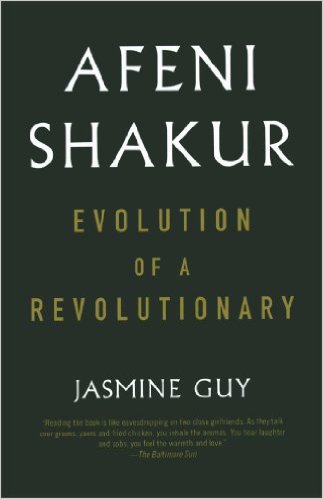
Afeni Shakur: Evolution of a Revolutionary – Jasmine Guy

afeniFollowing the death of Tupac Shakur on September 13, 1996, his mother Afeni was tasked with becoming administrator of his estate and dealing with a staggering amount of litigation resulting from lawsuits filed against the late rap star and lawsuits on his behalf against Death Row records.  Using the proceeds she was awarded through litigation, she established Amaru entertainment in her son’s memory.   Her efforts are characteristic of the former revolutionary Black Panther.  Tupac often talked about his mother to whom he was much closer than his biological father, Billie Garland. Her battles with crack cocaine addiction are well-known and Tupac himself discussed it on several occasions.  In later years after his death, she had been drug-free for a number of years but sadly joined the ranks of African American mothers who have lost their children to the violence of the streets.

Jasmine Guy was a friend of Tupac’s and after his death became friends with his mother.  This book is a collection of their discussions that occurred during their blossoming friendship.  Afeni talks about her own life and as to be expected, her son’s short life and violent death.  Guy visited Shakur’s home in suburban Georgia giving the book the feeling of two old friends sitting on a porch in the summer reminiscing about the days of yesteryear.  Afeni’s story is a deep one, rife with tragedy, drugs, revolution, motherhood and redemption.  She does not avoid the difficult topics and has come to terms with her past actions and inactions.  As this point in her life, she comes across wise beyond her years, freely able to admit when and where she went wrong in life.  She opens up to Guy and the result is a hidden literary gem that fans of the late star will come to appreciate.

Since Tupac’s early death, Afeni has been the voice of his legacy, keeping it alive for future generations.  Sadly, on May 2, 2016, she passed away at the age of 69 from a suspected heart attack.  Her voice has been silenced forever, but for those seeking to understand Afeni and the life she lived, this is her story in her own words.

ISBN-10: 0743470540
ISBN-13: 978-0743470544