
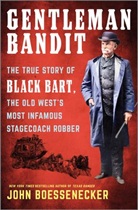
While browsing through my recommendations, I stumbled across this book by author John Boessenecker about Charles E. Boles (1829-1888) whom we know as “Black Bart”, a stagecoach robber who executed brazen heists in the United States during the late 1800s. I knew Bart’s name, but his life story was foreign to me, so I decided to purchase this book and learn what I could about a stickup artist who remains infamous in American history. However, the book is not simply a story about a brazen thief, but a story about a complicated man whose life was mysterious and confusing.
Boles’s exploits are certainly a source of fascination, but his personal life is equally captivating. In fact, readers may find the story behind the robber to be even more interesting than his theft of lock boxes from stagecoaches. Boesseenecker carefully traces the Boles’s family history from Shelfanger, England to North America. And though Boles would call the continent home for most of his life, there is a surprise twist regarding his residency in America. His early life is typical of the era, and even when he meets his wife Mary, there is nothing to indicate what would come later. The story moves along nicely, but when the American Civil War erupts, Boles’s life changes permanently.
Prior to reading this book, I was not aware that Boles had served in the Union Army. The author ‘s discussion of Bole’s military service is interesting and highlights the varied experiences of Union troops. Hunger, fatigue and battlefield injuries are part of the story and Boles suffered all three. And like other soldiers, he had left his family at home while he aided the Union effort. In hindsight, it is likely that his time in the military provided the physical and mental training which he employ later as he moved across America executing staged heists. But how did he do this with a family at home? Well, there is an explanation for it, and I was speechless at this point in the book. I can only guess what Boles’s reasons were for his decisions regarding his family, but it suffices to say that he was a strange character. And once he embarks on his career in theft, the story becomes even more surreal.
Black Bart became famous due to the press coverage of the stagecoach heists, but Boles’s identity was a mystery to law enforcement. Further, his nomadic tendencies made tracking him even more difficult. He became ghostlike, moving around from place to place with no final destination in sight. However, the author does a thorough job of compiling a timeline of his movements following his discharge from the Union Army. To be clear, there are parts of Boles’s life which remain a mystery. When his parents pass away in the early 1870s, it seems that it at this point where Black Bart began to take shape and Charles Boles no longe exist. But despite his peculiar nature and social quirks, Boles was highly intelligent, completely literate and in pristine physical condition. And Boessenecker provides a simple yet effective explanation for Boles’s aversion to horses. His heists are daring and comical, but attracted the growing attention of law enforcement who became determined to get the man known as “Black Bart”.
As the story progresses, it becomes clear that the walls are closing in and that Boles’s luck will run out. California proves to be the end of the line for him, and his downfall is swift but not without its flair. He soon finds himself at San Quentin prison for a multi-year stretch. And when he leaves several years later, it seems as if Black Bart will once again wreak havoc across America. However, the story soon ends, not because the author stopped writing but because Bart disappeared. Without any advanced notice or signs, Boles vanished into thin air never to be seen again. To this day, it is unknown what happened to him. Of course there are rumors, but no official account of his death exists. We may never know what happened to Black Bart, but we do know what he accomplished in life, for better or worse and this book is a valuable record of his life. This account by John Boessenecker is a solid look at the unorthodox life of the “gentleman bandit” who became the most prolific stagecoach robber in American history.
Publisher : Hanover Square Press
Publication date : March 14, 2023

 I am consistently amazed at the amount of history related to the American Civil War. The conflict which bitterly divided America, was a moment in which the United States had to reconcile with its dark past and an uncertain future. As a Northerner, the image I had of the Confederacy was generated from films and television. However, the reality of the South was a society divided and plagued with inner turmoil and dysfunction. Author David Williams explores this little-known history of the Confederacy, and the resistance from within to keep the Union together and dismantle the slave-holding elite class in the South.
 On May 10, 1865, Confederate States of America President
  The more I learn about history, the more I realize how much of it is not taught in schools. I recall learning about the Civil War but in limited discussions. And I fondly remember the 1989 film
 The death of George Floyd (1973-2020) initiated a chain of events that have resulted in a criminal trial and more discussions about race in America. It is a subject that will never go away and many still struggle to confront it with the honesty that is sometimes necessary. I have noticed that when it comes to race in America and the nation’s history, it is almost impossible to grasp the entire picture without factoring in the effect of the American Civil War (1861-1865). The conflict tore the nation apart over several issues, the most important of which was the topic of slavery. Many states in the North had already abolished slavery, but in the South, it remained a way of life. And because it was so critical to the South’s existence, the states that formed the Confederacy were willing to fight to the death to preserve what they felt was their right. Today we know with the benefit of hindsight that it was a lost cause from the start but the battle that ensued was a long and bloody conflict that left thousands dead and others critically wounded. Veterans who survived the conflict were forced to live with horrible memories of war that remained with them until their final days. Among the war’s combatants was the Eighteenth President of the United States and former General
 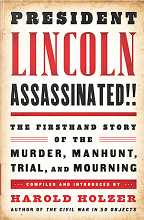 The assassination of President Abraham Lincoln (1809-1865), remains a pivotal moment in American history when the nation was truly at a crossroads. A brutal civil war had just ended and millions of former slaves found themselves unsure of their future post-bondage. The former Confederacy was left in shambles and the Radical Republicans were intent on reconstructing the south in the model of the Union as a whole. Lincoln, was either loved or hated depending on who you asked. In the Confederacy, there was no love lost when he was murdered and as Jefferson Davis (1809-1889) bluntly stated: “Well, General, I don’t know; if it were to be done at all, it were better that it were well done; and if the same had been done to Andy Johnson, the beast, and to Secretary Stanton, the job would then be complete.” Investigators had tried to link Davis to the assassination but the former Confederate leader was never tried or convicted for Lincoln’s murder. The crime cast a dark cloud over the nation and millions of American went into mourning at the loss of the fallen leader. Author Harold Holzer takes us back in time as we re-live the murder and events that followed as they happened in 1865.
 I was browsing through recommendations on Amazon when this book caught my attention. As one would expect, the words Civil War stuck on the cover. However, the name LeRoy Wiley Gresham (1847-1865) did not sound familiar at all. My interest peaked and I decided to see why the book had earned a five star rating. And to say that it is a hidden gem would be an understatement. It is indeed special and the author did a remarkable job of putting it all together.
 FREETHINKING BIBLIOPHILE
You must be logged in to post a comment.