All Blood Runs Red: The Legendary Life of Eugene Bullard: Boxer, Pilot, Soldier, Spy – Phil Keith with Tom Clavin

People have asked me how I decide on the next book I want to read. Well, the truth is I do not always know and sometimes find hidden gems purely by accident. Such is the case with this book. It was not on my radar at all, but I am deeply grateful that I did discover it. And to be brutally honest, I admit feeling a sense of guilt that I did not know of Eugene Jacques Bullard (1895-1961), whose life story is preserved in this biography by Phil Keith with Tom Clavin which left me grateful and humbled. 

Before continuing, I must point out that there are aspects of Bullard’s life lost to history. However, there is a wealth of information about him in public records, and Bullard both wrote and spoke about his life. You might be wondering how this Black American ended up in France becoming an infantry soldier, pilot, business owner, and celebrity in his own right. The proof is in the pudding as they say, and once I began the book, I found myself glued to it, stealing any spare time to open my Kindle and pick up where I left off. There are sections of the book which are not pleasant to read, and readers sensitive to descriptions of warfare and racial discrimination may want to use discretion. Despite the dark moments in the story, the book is an incredible story of a man who made history in his own way.

Bullard’s story begins in the Deep South, in Georgia where he is born in 1895. It is understood that this time in America was exceedingly difficult for Black people, particularly in rural Georgia. And the difficulties one would expect are in the story, highlighting the sacrifices parents made for their children. As for Eugene, it soon becomes clear that life under Jim Crow is not what he wants, and by the age of sixteen, he is on his way to a life abroad which took him to places he could have never imagined. The unorthodox and surprising chain of events detailed by the authors is a testament to the luck and help from others which shape our lives.

Although he had departed from America, the story is far from over. Arrival in the United Kingdom provides the starting point for his European journey which takes him to France and in the trenches during World War I. The story feels like a depiction out of Hollywood, and as I read about the injuries he sustained and the loss of life, I could not imagine the fear and anxiety which must have gripped him and his fellow soldiers. War is brutal and its savagery is on full display here. However, Bullard had an unusual ability to keep pressing forward, first as a boxer and then as a soldier. And when battlefield wounds and a chance opportunity present a rare opportunity, he takes to the skies in the seat of a cockpit. It is here when the story changes gears as the legend is born.

The book has its twists and turns including his brief love affair with a “lady of the night” and the arrival of American forces in World War I (1914-1918) which brings the nightmare of Jim Crow to France where Bullard and his contemporaries make it clear to the Americans that Europe was not the South. Nonetheless, there were those who tried their best to make his life miserable, and Dr. Edmund Gros (1869-1942) proves to be his arch nemesis. Despite the roadblocks, Bullard continues to earn his fame and builds a life in France. Although the country was not void of racial prejudice, Bullard does well for himself and his club became so popular that he entertained people from all walks of life including authors Ernest Hemingway (1899-1961) and F. Scott Fitzgerald (1896-1940).  He also found love and marriage which produced two daughters and an ill-fated son. The marriage did not last, and it is not clear what happened. We have a general idea based on the book, but Bullard remained silent on some details. Regardless, it is a sad moment in his story and the arrival of World War II (1939-1945) would split the family apart. But there is a happy conclusion to their story which will make you smile. The war brought the reality of the Nazi menace to France’s doorstep, and an underground resistance network develops. Bullard finds a friend and partner in Cleopatre “Kitty” Terrier who becomes a lifelong friend and plays an instrumental role in saving Bullard’s family. Resistance to Nazi Germany’s Third Reich was dangerous and Bullard comes close to meeting his maker in one disturbing incident as explained by the authors. The surreal and uplifting story is a  shining moment in the book.

In July 1940, Bullard returned to the United States and Harlem became his home for the rest of his life. But he was not one to sit still and attempts to revisit the past with a trip to his native Georgia. This part of the book will stir emotions for readers who have spent an extensive amount of time away from home. Today we have email, instant messaging, and social media, but in Bullard’s time, letters and telephone were the methods of communication. Reading his plight reminded me of the conveniences of modern technology and the saying that “there is no place like home”. Bullard returned to New York and found employment at Rockefeller Center operating an elevator while attending official functions in Manhattan related to the French government. And that is the iron of his story. In America his skills and war record were unknown but to the French, he was one of their greatest heroes.But a chance encounter with a studio executive gives Bullard his “fifteen minutes” of fame on national television. Alas, the “Black Swallow of Death” had earned recognition on home soil. 

Time catches up with us all and Bullard was no exception. His physical decline is hard to accept but I also thought of the physical and emotional trauma throughout the story and how each took its toll on him. But throughout the book, Bullard kept pressing forward and beamed with pride at the medals and recognition he earned in Europe. And in time, his own country would honor his life in ways he could not have predicted as a young boy living under Jim Crow. His life story is full of highs, lows, heartbreak, and moments of unimaginable glory. This book has quickly become a favorite of mine and I have already recommended it to a close friend. I now recommended it to anyone interested in an incredible story about world history and Eugene Bullard who proved throughout his life that all blood runs red. 

ASIN ‏ : ‎ B07N7G776W
Publisher ‏ : ‎ Hanover Square Press, January 18, 2023

Jackal: The Complete Story of the Legendary Terrorist, Carlos the Jackal – John Follain

On the night of June 27, 1975, two French internal security agents named Raymond Dous and Jean Donatini arrived at 9 Rue Tollier in Paris, France along with Michel Moukharbal, a suspect being investigated by French police for attacks against the Israeli airline El Al at Paris-Orly Airport. Before the night was over, all three men were dead and a fourth serious wounded resulting in a manhunt issued by France for Ilich Ramírez Sánchez known to the world as “Carlos the Jackal“. Prior to reading the book I was familiar with his name and parts of his story but did not have the full account. I picked up this book which I saw in my list of recommendations and decided to make the purchase and step into the world of the Jackal.

From the beginning of the book it is apparent that the story will be anything but ordinary. Ramirez’s childhood is unusual and his father’s obsession with the Soviet Union and Vladimir Lenin (1871-1924) is strange considering the fact that the family resides in Venezuela. At home things are not well and his parents’ divorce when Carlos is a teenager proves to be a pivotal moment in his life. Eventually, his mother relocates with the children to Europe and this sets off a chain of events in his life that lead to him becoming one of the most wanted fugitives on the planet. When he gravitates towards Marxism at the Patrice Lumumba University in Moscow, there is no turning back as the Jackal begins to take shape and an usual story develops which sees him move through Europe and the Middle East leaving a trail of death and destruction.

If I had to choose one word to describe Ramirez’s life from this point on, that word would be chaos. Between fatherhood, a marriage, and alliances with Middle Eastern governments as an unofficial agent of terror, the book is a roller coaster ride of insanity. However, what is equally disturbing as the attacks he conducted with subordinates is the support he received from multiple countries. In 1970 he joined the Popular Front for the Liberation of Palestine and remained steadfast in his support which inspired his radicalism. As part of his tool kit, he employed fake passports, fake identification, cash, safe houses, connections in high places and a long list of people willing to follow his every move. The story feels like a tale from Hollywood as the Jackal goes wild. The brazen raid in Vienna, Austria on December 21, 1975 at Organization of the Petroleum Exporting Countries (“OPEC”) headquarters is just one of the insane missions executed by the Jackal.

During his escapades he also finds love when he encounters Magdalena Kopp (1948-2015). Their story is equally surreal but their union did produce Ramirez’s second child. However, being the wife of a world-wide fugitive is not sustainable, and authorities are constantly on their heels. Slowly, the walls begin to close in and the fall out is unpredictable but the comeuppance for a life of crime. Kopp’s fate ironically in Paris, sets off a deadly series of actions by Carlos who is beginning to lose his grip on reality. Sadly, the collateral damage was high and only increased the pressure on French intelligence to capture him at all costs. Following the collapse of their marriage, Kopp makes another decision to relocate which is curious and proves that truth is stranger than fiction. As for Carlos, fate would not be as kind, and he continues to travel through the Middle East eventually finding refuge in Sudan. But it is here where his career concludes as French intelligence make good on their promise to apprehend him for the events in June 1975. His capture and extradition to France is climactic, but was it legal? The author lays out the facts of France’s actions for the reader to decide. But it does prove that when you are a wanted man, governments will not stop until they have you.

The trial in which Carlos is tried and convicted is discussed by the author, and although his life was on the line, Ramirez moves with a detached reality that is both odd and amusing. However, the deaths as a result of his actions are not and when justice is metered out, the story of Carlos the Jackal is over. He remains alive today but no longer able to live out his fantasy of a revolutionary playboy jetsetting across the planet and living the fast life. If you need a book about the life of Carlos the Jackal, this is a good place to start.

ASIN ‏ : ‎ B00IQY3E64
Publisher ‏ : ‎ Arcade; Reprint edition (July 1, 2011)

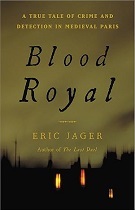
Blood Royal: A True Tale of Crime and Detection in Medieval Paris – Eric Jager

On the night of November 23, 1407, Louis I, duke d’Orléans (1372-1407), younger brother of Charles VI (1368-1422), was violently murdered in Paris, France, by a group of masked assailants who escaped on horseback. Initially, investigators had little information but tasked a local detective named Guillaume de Tignonville (d. 1414) to find Louis’s killers. This book caught my attention due to my fondness for true crime material. The title alone gave me the idea that the material might be macabre, and to a certain extent it is. However, it is also a classic detective story with a plot twist that is shocking and unbelievable. Author Eric Jager takes us back to medieval France in 1407 to unravel a murder that sent chills down my spine.

Prior to reading the book, I was not aware of this historical event and had little knowledge of medieval France. As a result, the book felt like a new lesson in world history. I must warn readers that Louis’s murder is gruesome, and the description of the crime by the author is graphic. The crime is horrific, but what I also noticed was the descriptions of the living conditions for Parisians and the system of rule under Charles and Louis. Frankly, life in the medieval era was not for the faint of heart. Dysentery, pestilence, famine, and warfare routinely threatened people as they did their best to survive each day. After learning about daily life, the story changes when a mysterious man in a robe appears looking for a place to rent. After initial difficulty, he succeeds in renting space from a local family who could not have known that this act would set off a chain of events which lead to the duke’s assassination.

The back story to the duke’s reign is discussed, and it becomes apparent that Louis is anything but ordinary. Further, he has a few vices which earned him his fair share of enemies. And even for the medieval world, some of his actions were both appalling and egregious. The lead investigator de Tignonville finds himself facing a monumental task in finding the duke’s assassins. And here is where the art of solving crimes takes center stage. There are no modern-day forensic tools, this is a classic whodunit with the investigator using the established process of elimination and a laser focus to track down the murderers. But when his investigation takes him to a place he never expected, the story takes a sharp turn which guarantees the fallout will leave no one unscathed.

When the murderer was revealed in the book, I recoiled in shock. But as Jager explains the history between Louis and the person who plotted his death, the pieces of the puzzle fall into place. A deadly cat and mouse game had developed ensured that France would never forget its blood climax. Eventually, the public learns of the plotter’s identity, but what happens next is nothing short of surreal. In fact, it will make you question the concept of justice. Humiliation and absurdity become recurring themes, and even the famed detective is not immune. Complicating matters are personal issues among people in high positions of power, which are centered around fame, money, and infidelity. I guess in that sense, not much has changed today. Louis’s death left the nation in a vulnerable position and when England becomes aware of the turmoil in Paris, all bets are off, and the suspense heightens as conflict arrives at France’s doorstep. The descriptions of violent encounters and their aftermath are raw but also show the reality of those on the losing end of conquest during that time. Invasion was merciless and there was little pity for the losing side. But France did not take British encroachment lying down, and many Frenchmen would answer the call to serve at the Battle of Agincourt (October 25, 1415). Sadly, some people we learn about do not survive the conflict. But their determination to resist Brutal rule in service of France is noted.

Francophiles may possess in depth knowledge of this time in the country’s history. But for the rest of us learning for the first time, Jager’s book is a good place to begin. It is a well-researched and thorough account of a vicious crime that is straight out of a horror film. And that crime brought France to the brink of ruin. It is a case study of the dangers of greed and gratuitous violence. Paris is a different country today, but it too has its dark past which comes alive in the pages of this investigative report which will satisfy the curiosity of true crime lovers.

“Louis’s murder had plunged France into a bloody civil war, leading to a devastating English invasion under Henry V, followed by a brutal foreign occupation that began to lift only with Joan of Arc”.

ASIN ‏ : ‎ B00CO7FI54
Publisher ‏ : ‎ Little, Brown and Company; Illustrated edition (February 25, 2014)

Why England Slept, With a New Foreword by Henry R. Luce-John F. Kennedy

20180603_133752On September 1, 1939, Adolf Hitler’s Third Reich invaded Poland and started the Second World War.  In violation of the terms of the Treaty of Versailles, Germany had rearmed itself and under the determination of Hitler, set its eyes upon conquering all of Europe.  The looming threat of German domination had been lingering for quite some time before the outbreak of the war.  But sadly, many of the nations that would later be opposed to Germany did not think that Hitler would be brazen enough or have the resources to initiate a world conflict.  In hindsight, we know that way of thinking was short-sighted and later highly regrettable.  The actions of the British government in response to Hitler’s annexation of Czechoslovakia, resulted in the condemnation of Prime Minister Neville Chamberlain and established Germany as a legitimate threat to world peace. The episode has been recalled in history books and documentaries and continues to provoke discussion about how Hitler could have been stopped before his army invaded neighboring Poland.

In 1940, a student at Harvard University presented to his professor with his senior thesis entitled Why England Slept.  Twenty years later he became the Thirty-Fifth President of the United States of America, known affectionately as Jack.  To the world, he remains John F. Kennedy (1917-1963).  The thesis was eventually published into this short but well-researched and well-written book that probes the question of why England failed to respond to the growing Germany menace.   Henry R. Luce (1898-1967), the creator of Time-Life magazine provides a foreword to this edition, published in 1962.  Incredibly, the book sold for $.95 as printed on the cover.  I believe it was severely undersold.   The beauty in the book is that Kennedy does not simply lay blame for Hitler at England’s feet. Instead he examines the conditions and beliefs that lead to the slow realization that armament was necessary and that Hitler was a very real threat.  It should be remembered that Kennedy spent a great deal of time in London as the son of then Ambassador to Great Britain and his father, Joseph P. Kennedy.   Fully aware of the nature of British culture and politics, Kennedy wisely incorporates this into the text which helps to explain many of the actions and inaction taken.

In fairness to Britain, it was not easy to foresee the coming of the German nightmare. Hitler invoked secretive maneuvers, arouse national sentiment and provided a source of hope to a nation in despair. And as Kennedy thoroughly points out, he had the advantage of running a dictatorship against a democracy, the latter of which is always slower to respond to the threats of war. Furthermore, distance and size gave Germany advantages against the prying eyes of foreign nations.  Today social media has made it far more difficult to conceal the mass production of good and machinery. But in the 1930s, secrecy was easier to effect and many countries used it to their benefit.  But even so, Britain did know that Hitler was up to something and was aware that Germany had slowly been rearming itself.  But the slowness to act depending on several factors that Kennedy lays out for all to see and understand.  Sympathy of Germany, pacifism in Britain, a restricted budget, naiveté and political ambition combined to severely delay the rearmament of Britain prior to beginning of the deadliest war in world history. And as Kennedy explores each issue, we may find ourselves filled with shock and disbelief towards England’s actions. However it is imperative to remember that we have the benefit of history our on side and look back and see the errors of their ways.  England did not have this advantage and even struggled internally with how to deal with growing danger.

More than seventy years have passed since the end of World War II. Hitler was eventually defeated and Britain was spared from annexation by the Third Reich.  But this account of England’s actions prior to the war will remain a guide for us to use as we face new threats to world peace.   And it is hoped that world leaders will remind us of why England slept.

ASIN: B000JKO9Y4