
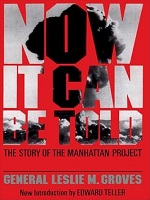
 On May 8, 1945, Allied forces celebrated Victory in Europe Day (V-E Day) marking the surrender of the German armed forces in World War II. In the Pacific, the war against Japan continued to rage forcing Allied commanders to face the grim reality of a ground invasion which became the basis of the proposed Operation Downfall. The invasion would have resulted in a large number of casualties on both sides but ending the war was priority number one. Unbeknownst to troops in the field, Washington had been working diligently on a new weapon that had the potential to end the war. On August 9, 1945, the United States Air Force executed a mission which dropped the atomic bomb named “Little Boy” on Hiroshima, Japan. Three days later on August 9, “Fat Man” was dropped on Nagasaki. The impact was devastating and on August 15, 1945, Japan surrendered, bringing World War II to an end. For those who worked on the Manhattan Project, the success of the bombs was both a blessing and a curse. But no one could deny the hard work and dedication which turned the project from a vision into a reality. And here to explain how it came into existence and succeeded is Gen. Leslie R. Groves (1896-1970), the man in charge.
If you have seen the film ‘Oppenheimer‘ starring Cillian Murphy as the famed scientist, you will recall Groves who is played by Matt Damon. The film was a hit and the type of production we have to expect from director/filmmaker Christopher Nolan and brilliantly captured the suspense and uncertainty surrounding the creation and testing of the bomb. And although the film does not portray the events which conclude World War II, it brought the past to life as the American military and scientists found themselves in a race against time. Groves wrote this book in 1962 ,and the Kindle version was republished in 2009. The story of the project is far more complete today, but Groves’ account is still a fascinating look into the magnitude of the project and secrecy required to ensure its success. But it was not without its challenges.
Groves starts at the beginning when the project receives the green light and is placed under his control. He had been given an assignment but needed to assemble the manpower to get it done. Step by step, he covers the coordination and the factors which went into each decision. There are interesting revelations, and the initial challenge with the enrichment of Uranium at Oak Ridge, Tennessee, highlights the complexity of atomic energy which confronted the scientists. Further, the various hardware components presented their own logistical challenges, but Groves was committed to his assignment, and he thoroughly explains how problems arose and were then resolved. However, the biggest challenges they faced were espionage and maintaining absolute secrecy.
In hindsight, we know that there were spies in Los Alamos. Groves discusses this and in particular, the betrayal by German theoretical physicist Klaus Fuchs (1911-1988) who supplied nuclear secrets to the Soviet Union. There were other threats as well, and Groves explains the need for stringent security and secrecy, even from members of Congress. In fact, on more than one occasion in the book, an issue with a curious politician becomes a threat to the project’s operation. The project was not exposed publicly but the incident heightened the anxiety of those involved. In regard to the people selected to work at Los Alamos, the groups of people who lived there during the project’s duration endured upheaval in their personal lives which has gone unnoticed. Groves pays close focus to the role of women at Los Alamos and how essential it was to assist those who were not in the military and expected to endure unusual living conditions. But while America was protecting secrets at home, it also needed to know if Germany was building a bomb of its own.
World War II historians will be familiar with the name of U.S. Army Counter Intelligence Officer Borish Pash (1900-1995). To say that he was responsible for one of the most important missions of the war would be an understatement. His role and that of the Alsos Mission were critical to America’s success and the Groves provides the goods. The story is incredible and highlights the lengths to which Allied forces went to bring down the Axis powers. Pash’s name is forgotten today but his role in World War II should never be overlooked. Groves pays homage to him and cements his legacy as he explains the importance of the Alsos mission and how it changed the outcome of the war. The intelligence operations in Germany also revealed the scope of the Third Reich’s attempt to harness nuclear power and its intended use. The German scientists captured by the Allied forces reveal interesting facts about Germany’s project in the story, but none proved to be smoking guns.
While the development of the bomb moves forward, Groves also has to contend with the sharing of intelligence with America’s allies Britain and France. The matter was complicated, and the author explains the difficulties they faced in safeguarding the secrecy of the project while maintaining strong ties with the countries supporting the Allied mission to win the war. As readers will learn, even allies can be a thorn in one’s side. And at home, tough decisions were made in regard to the amount of classified intelligence to be shared with foreign governments. But everything changes when the scientists inform military brass that they are ready for a test of the bomb’s efficacy.
The military needed to evaluate the bomb, but where? Groves explains the debate surrounding a testing site and the decision to conduct it at the Alamogordo Bombing Range known as Jornada del Muerto. The suspense builds as the date approaches. Nolan’s film brilliantly captures the events surrounding the test and as I read, images from the movie crept into my mind. After building up to the moment of truth, the results come in and Groves’ first-hand account reveals the joy and horror found among the scientists. But the military had no time to waste, and the matter was brought before President Harry S. Truman (1884-1972) whose order to proceed changed history. The decision to drop the atomic bombs remains controversial and Groves is aware of that. His account is not a discussion on the moral aspect of its use, but rather the rush to end the war in the Pacific. And in order to use the bomb, the United States Air Force enters the story.
Both bombs were ready for use but arming and loading them on to an aircraft proved to be a logistical challenge as explained by the author. We know that the air force was able to load the planes and use the weapons but the movements behind the scenes were equally turbulent. This section in the book was intriguing, and Groves thoroughly explains the selection of targets, the difficulty with selecting the right aircraft and even the flight formation. Familiar names enter the story such as Gen. Paul Tibbets (1915-2007) and Gen. Curtis E. Lemay (1906-1990). All hands were on deck as Fat Man and Little Boy were put to use. The bombs were successful in forcing Japan to surrender, but the war had cost millions of lives around the world. The war was over but what happened to the Manhattan Project? Groves walks us through the war’s end and the shift of atomic energy from a military project to a government issue to be overseen by the newly created Atomic Energy Commission.
The book concludes as the war fades away, and there is no mention of the battle Oppenheimer faced with his opposition to further use of atomic weapons. Nolan’s film captures the saga which engulfed the famed scientist and there are articles online about it. But I would like to point out that while Oppenheimer was instrumental in the success at Los Alamos, we cannot forget the importance Dr. Vannevar Bush (1890-1974) who is a footnote to history. He was far more important than is acknowledged, and Groves gives him his due here. It is often said that World War II changed the planet, and the effects of the war can still be seen today. In the spring of 1945, Allied commanders found themselves faced with the reality that ending the war would not be as simple as people thought. There would be more bloodshed and heartache to bring the Japanese empire to its knees. The developments at Los Alamos proved to be a necessary tool but its creation, usage and existence has continued to haunt us with critical questions which will be asked for an eternity. But if you want to learn about the Manhattan Project from the man who was in charge, this is it.
“In answer to the question, “Was the development of the atomic bomb by the United States necessary?” I reply unequivocally, “Yes.” To the question, “Is atomic energy a force for good or for evil?” I can only say, “As mankind wills it.” – Leslie R. Groves
ASIN : B009SC1LZY
Publisher : Da Capo Press (August 11, 2009)
 On March 4, 1933, a new era in American politics was ushered into Washington as
  In December 1963, one month after the assassination of U.S. President John F. Kennedy (1917-1963), former President Harry S. Truman (1884-1972) authored an op-ed piece in the December 22, 1963, edition of the Washington Post about the Central Intelligence Agency (CIA) and its role in America. While reflecting on what the CIA had become, he stated “there is something about the way the CIA has been functioning that is casting a shadow over our historic position and I feel that we need to correct it.” The agency had been established through the National Security Act of 1947 which was intended to both centralize and simplify national defense and the intelligence apparatus. Five years before the National Security Act was signed into law, President Franklin D. Roosevelt (1882-1945) had also addressed the need for foreign intelligence and through Executive Order 9128 on July 13, 1942, he formally established the Office of Strategic Services (OSS). And to lead the new agency, he turned to former director of the Coordination of Information (COI), the legendary William Joseph “Wild Bill” Donovan (1883-1959). Though he was never director of the CIA, Donovan is credited as being the father of intelligence. Author Richard Dunlop examines Donovan’s life in this intriguing biography and historical account of how the intelligence community came to exist.
 FREETHINKING BIBLIOPHILE
You must be logged in to post a comment.