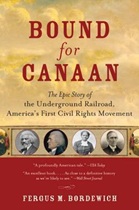
Bound for Canaan: The Epic Story of the Underground Railroad, America’s First Civil Rights Movement – Fergus M. Bordewich

The recent celebration of America’s two-hundred fiftieth anniversary was a milestone celebration, but it also gave rise to deep discussions about the nation’s history and what it means to different demographics. The contradictions between the principles the nation was founded on and what transpired are stark and the system of slavery remains a dark chapter in the story. For Black Americans it is a painful reminder of a time when human beings were characterized as chattel and the idea of all men were created equal was not equally applied. The system was doomed and eventually fell. And before the Emancipation Proclamation by President Abraham Lincoln (1809-1865), Whites, Blacks and Native Americans found ways to liberate slaves from the dehumanizing system of manual labor. In the process, they created a complex network of trails, passageways, safe houses, and clandestine contacts known as the Underground Railroad. This book by author Fergus M. Bordewich dissects the riveting system and how it changed history in the United States.

Early last year, I read Catherine Clinton’s ‘Harriet Tubman: The Road to Freedom‘ which is a fascinating look into Tubman’s extraordinary life. She is well-known as a “conductor” on the Underground Railroad, but Clinton’s book which covers far more than just her role in liberating the enslaved and activities on behalf of the Union during the American Civil War (1861-1865). As expected, she is a part of the story here as well as John Brown (1800-1859), Frederick Douglass (1818-1895) and others with whom I was not familiar. And despite the system’s title, there were times when it was as “underground” as we may think. It was a hybrid system based on covert activity and direct confrontation when necessary. And to make it work, countless men and women put their lives on the line for the sake of humanity.

This book will make some readers uncomfortable due to the subject matter and the frankness with which the history is explained. Today, events which transpire in the book seem surreal, but this was the reality of life in the United States as if expanded and confronted its faults. The issue of slavery has haunted America since its inception, and the glaring contradiction between the nation’s founding principles and the brutal life of slaves was one that politicians struggled to address. In the book, former President Thomas Jefferson (1743-1826) serves as a case study as both a slave owner and one who saw the evils of slavery. His statements and ideas about slavery and its victims are both interesting and disturbing. However, Jefferson was not the only one to struggle with the demon and throughout the book, the issue of morality takes center stage.

As I read the book, I found myself in awe of the people who are major figures in the story being told. There were several names I was not aware of, and I was speechless as their lives played out. The names of David Ruggles (1810-1849), Levi Coffin (1798-1877), Jonathan Walker (1799-1878) and Seth Concklin (1802-1851) are etched into my memory, and their stories are crucial to the history of the Underground Railroad. Of course, they were assisted by a network of people who believed in the eradication of slavery and freedom for the enslaved. And while there are bright moments in the story, there are dark moments too where abolition failed and slave hunters prevailed, and the fate of those captured remains unknown.

While the “railroad” is known to have assisted enslaved people as they escape to the North, the role of Canada is another interesting aspect of the story. In fact, our northern neighbor played a significant role in the lives of former slaves, a role much larger than I knew of previously. And the story of Canada’s participation cannot be told without including Josiah Henson (1789-1883) whose story is told by the author, and it is nothing short of incredible. His role in assisting former slaves and the creation of the Dawn Settlement are examples of the unwavering spirit within abolitionists committed to their cause. And their stories are revisited beautifully by the author in a book which stirred emotion and adjusted the way I view American history.

The Underground Railroad is a critical part of the nation’s history, yet it is often misunderstood and underrated. What I learned in this book has broadened my perspective on the system and how integral it became to slaves facing life and death situations. Further, the narrative commands a deeper respect for those who risked their lives to help the enslaved, and they came from all levels of society. The beauty in this book is that despite the horrors of human bondage, there is a story of common bonds between people from diverse backgrounds who saw an evil they could not accept. It is textbook example of how we are stronger when united. The subject matter is not “easy”, but it is history and the author tells with the right amount of respect for the deceased, adulation for the heroes and contempt for those who deserve it. And the result is a well-written, well-researched and informative book that fills in the gaps regarding the story of the Underground Railroad. Highly recommended.

ASIN ‏ : ‎ B000WCWV08
Publisher ‏ : ‎ HarperCollins e-books, March 17, 2009

The President and the Freedom Fighter : Abraham Lincoln, Frederick Douglass, and Their Battle to Save America’s Soul- Brian Kilmeade

On December 6, 1865, Congress ratified the Thirteenth Amendment to the United States Constitution, which marked the end to slavery and indentured servitude in the United States. President Abraham Lincoln (1809-1865) had approved the version presented before in January of that year but did not live to see it ratified, having been assassinated at Ford’s Theater on April 14, 1865. The ratification of the amendment was a bittersweet vindication of Lincoln and a former slave who became one of America’s strongest voices for abolition. Frederick Douglass (1818-1895) outlived Lincoln by thirty years but remained committed to the goal of equality and an America representative of all its inhabitants. This book is the story of their lives, friendship and the issue of slavery, over which America pulled itself apart.

This book is a not a standard biography of either Lincoln or Douglass, but author Brian Kilmeade does provide enough background information to give readers a solid understanding of their beginnings which stand in stark contrast. Lincoln, who was born free as a White American, was the extreme opposite of Douglass who was born enslaved in Maryland. But as they both matured, America began to go through a metamorphosis and each man would find his calling in pushing the nation forward. However, to appreciate the crossing of their paths in life, Kilmeade moves back and forth between he key events which shaped their views of America and their purposes in life.

Although the book is not a standard biography of either figure, I did find a wealth of information in the book. And for readers who are well read on both, Kilmeade’s narrative can still be of value. While reading the book I could see the importance in the contrast between Douglass and Lincoln setting the stage for future events. And this is a strong aspect of the book. Each man came to detest slavery but through extremely different paths. Lincoln would use the courts and politics, but Douglass’s journey was far more difficult and dangerous and would take him through abolitionist circles which results in the appearance of notable historical figures in the story which heightens the suspense.

Any story regarding Federick Douglass is incomplete without mention of William Lloyd Garrison (1805-1879), a staunch abolitionist and strong influence in Douglass’s life, and the abolitionist John Brown (1800-1859). Each man plays a significant role in the book, and Brown’s story is fascinating on its own. He remains both famous and infamous depending on who you ask. However, we cannot deny the impact of his raid on the Harper’s Ferry federal arsenal in 1859. That event sent shockwaves across the United States and might have been far more deadly if other noted abolitionists had stood behind Brown’s actions. The relationship between Brown and Douglass is a moving part of the story and highlights the difference between conviction and recklessness.

While the abolitionists are fighting the battle against slavery in public, Lincoln comes into his own as a politician with a bright future. His rise to fame in what became the Republican Party is part of the story as well, and what we witness is an odyssey taking place as Lincoln’s views on slavery are challenged and changed. And part of that progression was his relationship with Douglass, which is the crux of the book. As a history lover, I thoroughly enjoyed this part of the story. Of course, we cannot ignore the “elephant in the room” which is the looming American Civil War. The buildup is part of the account, particularly the growing resentment in South Carolina when it becomes clear that Lincoln is the favorite to win the 1860 presidential election. His victory that November was seen as proof by the newly formed Confederate States of America in January 1861 that secession was the only option. And on April 21, 1861, the first shots of the war were fired, sending America into darkness for the next four years. For Douglass and Lincoln, the conflict brought them closer together and saw the end of their friendship.

As the war heats up, both men are watching with uneasiness as Confederate forces prove to be tougher than expected. The Union needed an advantage and here is another crucial part of the story when the subject of black fighting units takes center stage. Ironically, the idea of colored troops caused division as deeply as the war itself. In hindsight we know that the Union eventually formed units of black soldiers who performed equally as courageous as white troops. The saga of the Union’s colored soldiers is captured with grace and respect by the author who has given us a valuable book regarding a dark time in American history. In April 1865, the war comes to a bloody end, but Douglass’s story is not yet finished. And the South was determined to rise again.

Following the war, the story continues with Douglass’s life and the changes he endured as America was altered for better and worse. Reconstruction, Jim Crow, and southern resentment would affect the lives of Black Americans for decades to come. Douglass remained steadfast in the movement for civil rights, but he could not escape father time and makes his departure from the story in 1895. Both men were gone but their legacies were cemented in history. And through books like this we can step back in time to revisit an era when America was at a crossroads with morality, technology, and the very constitution our nation is founded on. There are tragic moments in the book, but it is a story which provides enlightenment, humility and an appreciation for the things we take for granted. Highly recommended.

ASIN ‏ : ‎ B08Z7RC9N6
Publisher ‏ : ‎ Sentinel (November 2, 2021)

My Bondage and My Freedom – Frederick Douglass

Douglass The history of America is dark at times, and those moments have been omitted or neglected for many years. However, they are crucial to understanding how and why the United States developed into the nation that it is today. As an American, I am constantly seeking to understand my own country and clarify the myths that have propagated with regards to its past. I am learning uncomfortable truths, but they have not diminished the love that I have for America. In the history of this country, the name of Frederick Douglass (1818-1895) remains a reminder of the institution of slavery that degraded human beings, served as the backbone of an economic system, and led America towards a civil war. Douglass was born into the slave system and became a free man as an adult. This is his story of his time in bondage, freedom from oppression and evolution into a public speaker.

The story begins with Douglass’s early years at the home of his grandparents. He had not understood that he was born into slavery and had no concept of it. But that soon changed when he was taken to meet his siblings whom he had never met. They reside on a plantation owned by former Maryland Governor Edward Lloyd (1779-1834). And it was here that Douglass came to know the horrors of the slave system for the first time. His observation about the lack of connection to his siblings reveals a devastating effect of slavery. Douglass points out that:

“The practice of separating children from their mother, and hiring the latter out at distances too great to admit of their meeting, except at long intervals, is a marked feature of the cruelty and barbarity of the slave system. But it is in harmony with the grand aim of slavery, which, always and everywhere, is to reduce man to a level with the brute. It is a successful method of obliterating from the mind and heart of the slave, all just ideas of the sacredness of the family, as an institution.” 

The family is the backbone for our journey through life and Douglass understood the tragedy that developed from its destruction. His words are tough to read at times and the cruelty he endures did not always come at the hands of slaveowners or overseers. In fact, the actions of his Aunt Katy are equally deplorable and the two of them never established a close bond. Douglass’ mother does enter the story but briefly and for reasons the reader will find disgust in. However, her life and role are also an example of slavery’s goal in breaking down the will and spirit of those caught in its grip. There is, however, something that Douglass points out which is interesting about slavery itself. During his time in bondage, he observed the lives of blacks and whites, and this statement regarding what he saw is interesting:

“I knew of blacks who were not slaves; I knew of whites who were not slaveholders; and I knew of persons who were nearly white, who were slaves. Color, therefore, was a very unsatisfactory basis for slavery.”

Racism was undeniably a contributing factor for enslavement, but revenue was the driving factor. The system of slavery did not see individuals, but property to be used until it was no longer useful.  The effects upon human chattel were disregarded by those in power. But slaves were not content with remaining in bondage, and it was not long before rebellions erupted across slave-owning territories. The names of John Brown (1800-1859), Denmark Vesey (1767-1822) and Nathaniel “Nat” Turner (1800-1831) stand out among the scores of men and women determined to destroy the system of slavery. Their actions were not lost on Douglass who keenly observed that rebellions would increase as the enslaved sought their natural born right to be free. As Douglass ages, he becomes more aware of the changing sentiment in America and the undercurrent of emotions by those in bondage and their allies in the abolitionist movement. As Douglass states himself:

“The insurrection of Nathaniel Turner had been quelled, but the alarm and terror had not subsided. The cholera was on its way, and the thought was present, that God was angry with the white people because of their slaveholding wickedness, and, therefore, his judgments were abroad in the land.”

I warn readers that his experiences on Lloyd’s plantation are not for the faint at heart. The degradation he endures should spark the fire of anger in anyone who reads this book. I found myself becoming emotional as I read his words and I cannot imagine the humiliation inflicted upon him and others who lived on the plantation. And what is interesting is that the plantation was not located in the deep south but in the State of Maryland. And his life became even more difficult when he was given to Capt. Thomas Auld, a former Army Commander during the War of 1812. Auld quickly becomes the darkest figure in the book and his cruelty towards Douglass is abhorrent. He was determined to break Douglass down and nearly succeeded completely as readers will learn in the book. However, the relationship between Douglass and Auld’s wife Lucretia offsets the darker moments. During his time with Auld, Douglass grows into a strapping young man and becomes determined to escape slavery at all costs. He first refuses to be beaten and after learning to read, began to understand how slavery functions at its core and why illiteracy is a necessary component to keep slaves in line. Once he learns the truth, his path to freedom comes into full focus. However, Douglass never fully reveals how he escaped from Maryland, likely to protect those who had assisted him. He does discuss how he became a free man once in the North but is also careful in that regard.

Following his escape from Maryland, he arrives in New York City but for a short amount of time before moving on to New Bedford, Massachusetts. And although slavery had been abolished in Massachusetts in 1781, Douglass soon learns that prejudice is not solely a product of the South. As he explains, he had his fair share of humiliation in the North as well. However, he was now free and despite the treatment by whites, he continued to evolve and mature. And his spirit becomes unbreakable. He also learns that he has the gift of oration and soon explores that talent to its fullest extent. Today he is regarded as one of the most popular voices of his time but regrettably, none of us will ever have the pleasure of hearing him speak in person. The story takes yet another turn when he is invited to visit several countries in Europe. It is this part of the book in which Douglass learns important truths about America while away from its shores. And what he explains to the reader are supported by the statements from jazz musician Miles Davis (1926-1991), whose experiences in France had opened his eyes to the dysfunction in America. Upon his return to the United States, Douglass was seasoned and armed with a better understanding of the world and the changes needed at home. He devoted the rest of his life the abolitionist movement and in 1877, he was confirmed as United States Marshal for the District of Columbia after being selected by President Rutherford B. Hayes (1822-1893). In later years, he attempted a run for president and held several posts in the U.S. Government. On February 20, 1895, Douglass died at the age of seventy-seven at his home in Washington, D.C. His wife Helen Pitts Douglass (1838-1903) lived several more years until her own death at the age of sixty-five.

I cannot overstate the importance of this work and why it is such a critical read. His story was the exception and not the normal course of action for thousands of enslaved people. He also revealed the contrast between the northern and southern parts of America, paying close attention to the prejudice against people of color across the nation. Frankly, life for Black people was short, humiliating and void of hope at times. However, Douglass and others like him, refused to live out their lives in bondage and were determined to gain their freedom even if it meant death. He is and always will be an icon for those who are oppressed and yearning for freedom.

“The soul that is within me no man can degrade.” – Frederick Douglass

Frederick Douglass