
 On November 11, 2025, the United States will observe Veteran’s Day and pay its respect to the nation’s military veterans. Eighty years have now passed since the conclusion of World War II. In Europe, Allied Forces battled the Axis powers, fueled by German Chancellor Adolf Hitler‘s (1889-1945) quest for world domination and in the Pacific, Japan was aging its own war as it sought to spread its influence across Asia. Allied resistance to the Pacific was fierce and important as the European campaign, and at the helm was one of the American military’s greatest leaders, General Douglas McArthur (1880-1964). Today there are buildings, airports and streets named for him, but who was this legendary figure in military circles? Author William Manchester (1922-2004) explores his life in this extensive biography that peels back the layers to reveal the man behind the dark sunglasses and corn cob smoking pipe.
In American military history, McArthur’s name is firmly cemented. Previously, I reviewed H.W. Brand’s ‘The General v. The President: McArthur and Truman at the Brink of Nuclear War‘, which focuses on the fallout between McArthur and United States President Harry S. Truman (1884-1972). The complicated story of the two powerful figures is also told here by Manchester, and is a crucial part of McArthur’s fall from grace. But before we reach that point, his icredible life takes center stage, and from the beginning I felt myself pulled into the biography. Manchester was a noted historian and a meticulous writer, who had a talent for bringing history to life with vivid clarity and smooth narratives. Readers should be aware that this book is long and contains well over seven hundred pages of text. But contained within it is a wealth of information about an iconic figure.
Early in the book, it becomes clear that the military is a crucial part of the McArthur family’s life. The role of McArthur’s father Arthur McArthur, Jr. (1845-1912) is firm, and young Douglas proves to be a brilliant student and blessed with high intellect. But no one could have predicted the name he would make for himself later in life. As we follow the young McArthur from one continent to the next, we witness his gains in battlefield experience, exposure to cultures abroad and ascension in military rank. The young bachelor also finds love in the story, and second wife Jean (1898-2000) would prove to be the rock he needed as he moved through life. The addition of son Arthur, IV introduces fatherhood into the story and throughout the book, McArthur embraces his role as protector of his immediately family and a series of islands in the Pacific known as the Philippines. The story behind his god-like status on the islands is explained thoroughly, and includes his actions during World War II (1939-1945) as Japan ramped up its attacks on the small islands. Although Japan was defeated, the threat from Tokyo was real and the McArthurs faced danger more than once before the Allies began to turn the tide. The discussion regarding the war forms a sizeable section of the book for obvious reasons. When Japan does surrender, McArthur also plays a pivotal role in post-war events but there was another looming threat on the horizon also in Asia.
On June 25, 1950, North Korean troops poured across the 38th Parallel into South Korea igniting the Korean War. The White House sprang into action, and McArthur once again would be called into service. Korea proves to be far more complicated than World War II, and the reasons why are explored by Manchester without taking the focus away from McArthur. However, we also see the rift developing between Truman and the famed general. And when Truman signs NSC-68, 1950, more confusion is added to the mix. For McArthur the situation was simple and he would do what was needed to defeat North Korea. But the White House and America had no desire for another world war. But what happens to the life long combat soldier who has no more wars to fight?Soon a major issue developes and readers will notice that McArthur is somehat of a “Frankenstein” created by the system he served. And when he acts on his own, the stage is set for a showdown with the White House. I understood Truman’s decision regarding McArthur’sremoval but I did question his methods. Once home in the United States, the story takes another turn as McArthur becomes a national celebrity with public opinion on his side. But it does not last long and the impact to his image is significant. The story is surreal at times and the differences in which he was revered and loathed are striking. By autumn 1953, the world wars were over and McArthur was already back in America, living out his days quietly as his health began to decline.
As the 1960s approached, McArthur had begun to decline physically, and in the story, we can see the end is near. But even as he was confronting his own mortality, he sill saw himself as the general of service and there is an interesting meeting with President John F. Kennedy (1917-1963) which sent chills down my spine. McArthur would also have a similar discussion with President Lyndon B. Johnson (1908-1973), and we can only wonder what would have happened had his advice been followed. In the spring of 1964, his health turns sharply for the worse and his last days draw near. The book ends with a somber note at Walter Reed Army Medical Center in Bethesda, Maryland as slips away but his death felt strange after a voluminous account of his life which is intertwined with world history. However, we are all mortal and although he is gone, his memory lives on in our rememberance of his name and accomplishments. He truly was the “American Caesar”.
“People grow old only by deserting their ideals,” MacArthur had written, paraphrasing another writer. “Years may wrinkle the skin, but to give up interest wrinkles the soul.… You are as young as your faith, as old as your doubt; as young as your self-confidence, as old as your fear; as young as your hope, as old as your despair. In the central place of every heart there is a recording chamber; so long as it receives messages of beauty, hope, cheer and courage, so long are you young. When… your heart is covered with the snows of pessimism and the ice of cynicism, then and then only are you grown old—and then, indeed, as the ballad says, you just fade away.”
Publisher : Back Bay Books
Publication date : May 12, 2008
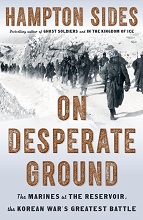 On June 8, 2020, the Democratic People’s Republic of Korea (North Korean Government) cut all lines of communications with the Republic of Korea (South Korean Government). Eight days later, an explosion destroyed the joint liaison building which had been used to host meetings between the two governments. The bombing was instantly seen as an act of aggression by North Korea and prompted a sharp response from its South Korean counterpart. Fears of an armed conflict gripped neighborhood countries as tensions continued to rise. Many eyes in both China and the United States were watching for the events very well could have led to the re-ignition of the Korean War (1950-1953), a conflict that never officially ended. I am constantly amazed at the expressions of surprise people display upon learning this fact. It seems surreal but the fact is that the Korean is still an “open” conflict that is only contained by the 39th Parallel and the watchful eyes of several foreign countries over North and South Korea. The war itself is often reserved for military buffs and overshadowed by both World War II and the Vietnam War. However, the reality is that the conflict in Korea nearly evolved in World War III. Author Hampton Sides is here to tell us about the role of the United States Marines and their experience in the Battle of the Chosin Reservoir.
 FREETHINKING BIBLIOPHILE
You must be logged in to post a comment.