
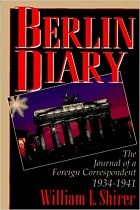
In December 1941, CBS News Foreign Correspondent William L. Shirer (1904-1993) sailed from Europe for the final time as World War II claimed lives and destroyed cities. At the time of his departure, World War II was heading into its second year but several months ahead of the Japanese attack at Pearl Harbor and the entry of the United States into the conflict. The journalist said goodbye to a continent to which he had devoted fifteen years of his life. Upon his return, he assembled his diary, carefully hidden from the Gestapo and Nazi Germany officials and turned them into this account of what he witnessed as Reich Chancellor Adolf Hitler (1889-1945) embarked on a path of world domination and plunged the world into its deadliest conflict. And the result is an eye-opening account of life behind the carefully crafted world image that Nazis put forth to keep the prying eyes of powerful nations averted as the Wehrmacht plundered its way across western Europe.
Shirer may be recognized by readers for his other phenomenal work on the Nazi regime, ‘The Rise and Fall of the Third Reich: A History of Nazi Germany‘, a masterpiece of writing that remains on my shelf and list of favorite books to this day. I strongly recommend it to readers in search of a thorough history of Nazi Germany. Here, the story is focused on life in Germany as the Nazis took hold of the country. At the start of the book, Hitler has already been made Chancellor, so there is little in the journal about the transfer of power from President Paul von Hindenburg (1847-1934) or the Reichstag Fire. The focus is on daily life in Berlin and the sobering Nazi conditions placed on the Reich’s citizens. As an American journalist, Shirer was allowed close access to the notorious figures of the Reich from President and Oberbefehlshaber der Luftwaffe Hermann Göring (1893-1946), Reich Minister of Propaganda Joseph Goebbels (1897-1945) and the notorious Gestapo Chief Heinrich Himmler (1900-1945). Shirer did cross paths with Hitler and witnessed his speeches, but there was no formal interview that Shirer would have referred to had it existed. Regardless of his location and situation within the Reich, he witnesses the truth behind the Reich that contrasted with what Hitler was saying to the German people.
Germany’s rearmament was a direct violation of the Treaty of Versailles, but Hitler had no intentions on adhering to the sanctions and rules placed upon the Fatherland. Western powers were slow to react to the Germany build-up but on the ground, Shirer was able to see how popular Hitler was becoming and the preparations for conflict like no other. He makes notes about German life from the peculiar behavior on the streets and Germans he knows personally. There are bits of humor in the observations yet the dark cloud on the horizon continues to approach. And in the weeks before the Germany invasion of Poland on September 1,1939, the suspense continued to build as Shirer shows in the daily entries. But there are two incidents in the notes that require a comment. The appeasement at Munich, widely seen as the last chance to stop Hitler’s plan is discussed and Shirer’s disbelief at the British actions towards Hitler’s aggression was shared by the author of this post. Former U.S. President John F. Kennedy (1917-1963) once wrote about this in his classic ‘Why England Slept‘, a valuable book about the failure to confront the Austrian menace in Berlin. The other entry in the journal relates to the German advancement on the Rhineland in 1936. What he notes in his journal about the missed opportunity to stop Hitler is one of the war’s most puzzling events. The comments by German officers following the de-escalation on the Rhine highlight the ability of the Germans to bluff their way through as Hitler consolidated power and seized territory.
The journal entries pick up in intensity as the threat of war increases. And like a runaway train, we know that it is coming but nothing can stop it, and the shock felt by Shirer as a correspondent on the ground is captured by his words written after the Germany invasion of Poland. From this point on, the diary takes an entirely different course as the Nazi machine kicks into high gear and then plateaus. England is the “antagonist” in the story according to Hitler, and a sizeable portion of the entries are related to the off and on-again discussions with London about “peace”, though Hitler had no desire to let England survive. The showdown between England and Germany intensifies and soon the Royal Air Force began to hit targets within the Fatherland. Experienced German pilots were aware that England would not be easily defeated, and that Germany had its weaknesses which made winning a world war impossible. As a journalist, Shirer was intent on publishing all news about the German war front both good and bad. However, censorship was in full effect and throughout the story, there are countless battles between the author and German officials who inspected incoming and outgoing communications. The propaganda war waged by the Reich was nothing short of absurd. But it worked within Germany’s borders. Shirer takes note of this and gives insight into German mindset that explains why the people gave Hitler the power he desired. And these observations could have only come from a correspondent in the field watching the events as they happened.
There are occasions in the book where Shirer leaves Germany and travels to other European nations but most of the entries are from Berlin where the promise of a quick war rings hollow as England puts up more of a fight than expected. And the realization that Germany is not invincible begins to dawn on the German people who create crude jokes to describe Third Reich leadership. In the distance is the looming threat of American involvement, about which Shirer makes a premonitory statement that later came to fruition. Hitler also knew it would happen and pre-emptively signed agreements with Japan and Italy, realizing that America would never surrender to German domination. Nonetheless, Shirer accurately sizes up Germany’s sealed fate and the insanity of Adolf Hitler. The final entry in the book provides a fitting conclusion to an unbelievable story. As Shirer watches Europe fade in the distance aboard the vessel that will begin his journey back to America he remarks:
“For a time I stood against the rail watching the lights recede on a Europe in which I had spent all fifteen of my adult years, which had given me all of my experience and what little knowledge I had. It had been a long time, but they had been happy years, personally, and for all people in Europe they had had meaning and borne hope until the war came and the Nazi blight and the hatred and the fraud and the political gangsterism and the murder and the massacre and the incredible intolerance and all the suffering and the starving and cold and the thud of a bomb blowing the people in a house to pieces, the thud of all the bombs blasting man’s hope and decency.”
A year after Shirer returned to the United States, Japan attacked the Pearl Harbor Naval base bringing America into the deadliest war in history. For the next five years the world remained at war in a conflict between democracy and tyranny. In the end, a dictator lay dead and nations in ruins. The threat of dictatorship will never subside and to protect society from the dangers of tyranny, we must remember how it was done. This is the inside story of the Third Reich and Adolf Hitler’s hold over Germany.
ISBN-10: 0883659220
ISBN-13: 978-0883659229
 Seventy-seven years ago, allied forces defeated Adolf Hitler’s (1889-1945) Third Reich and the Axis powers, bringing an end to World War II. In the years following Germany’s defeat, historians have authored books, filmmakers have published documentaries and social media provides endless content about the man who ignited a world conflict. In the wake of the war, outspoken critics of the Third Reich were vindicated in their belief that Hitler would cause Germany’s destruction. He nearly succeeded and following the nation’s surrender on May 7, 1945, the German people faced the cruel reality that their country was in ruins, they were widely despised and faced years of rebuilding, de-Nazification and coming to terms with what had been done in their name. As we have sought to understand the aura of Hitler and his ascension to the position of Chancellor, sharp focus was needed on how and why the Nazis were able to take over Germany. Author William Sherian Allen decided to focus on the town of Northeim to examine the Nazi seizure of power. Northeim lies in the Lower Saxony area of Germany and between the years 1922-1945, the Nazis executed their plan to take over Germany one town at a time. This is the story of how it was done.
 Learning one’s family history can be an enlightening and liberating experience. However, it can also reveal many truths that some wish to remain hidden. So what happens when you discover that your grandfather, the younger brother of a key architect in the “Final Solution” was not as innocent as you have been led to believe? Well, that is what happened to Katrin Himmler, whose grandfather Ernst Himmler (1905-1945), was the younger brother of Schutzstaffel Reichsführer Heinrich Himmler (1900-1945). Himmler’s father had asked her to search the Federal Archives in Berlin for information on his father Ernst and what she discovered was a trove of information not just on her grandfather, but on her uncles Heinrich and Gebhard Himmler (1898-1982). What started out as simple research request, evolved into the family history contained within the pages of this eye-opening account of the Himmler story.
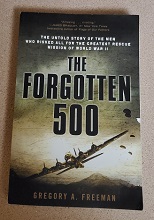 A colleague gave me this book as a gift during the holiday season, mainly due to his knowledge of my fondness for history. I quickly made a mental note to give it a read in the near future. When I saw the title, I was slightly puzzled at the term “The Forgotten 500”. I have read books on World War II but none mentioned any 500 forgotten soldiers. Upon closer inspection, I soon began to realize why I had not heard the story. At the time the mission occurred, it was carefully hidden by the State Department and Office of Strategic Services who did not wish to jeopardize the lives of any remaining U.S. soldiers still trapped behind enemy lines. Further, in the years that followed, the the story faded into the annals of military history regarding the second world war. Even my father, who is an ardent World War II buff, has never mentioned this story. Our next discussion will certainly be interesting.
 Ideology is sometimes as powerful of a tool as violence and in some cases has been the direct cause of violence. In the Middle East, ideology has maintain a stronghold as it finds itself on a crash course with modernity. Those who live outside the Middle East are at times confused and mystified by the traditions and events that occur throughout the Arab nations. In fact, many of us here in the United States do not know how the modern-day Middle East came into existence. To them, I say that the key to understanding the Middle East is to retrace its history to see why and how it developed into what we know it to be today. David Fromkin lends us a helping hand in this incredible historical investigative account of the fall of the legendary Ottoman Empire and the creation of a region that would never truly know peace.
 On September 1, 1939, Adolf Hitler’s Third Reich invaded Poland and started the Second World War. In violation of the terms of the Treaty of Versailles, Germany had rearmed itself and under the determination of Hitler, set its eyes upon conquering all of Europe. The looming threat of German domination had been lingering for quite some time before the outbreak of the war. But sadly, many of the nations that would later be opposed to Germany did not think that Hitler would be brazen enough or have the resources to initiate a world conflict. In hindsight, we know that way of thinking was short-sighted and later highly regrettable. The actions of the British government in response to Hitler’s annexation of Czechoslovakia, resulted in the condemnation of Prime Minister Neville Chamberlain and established Germany as a legitimate threat to world peace. The episode has been recalled in history books and documentaries and continues to provoke discussion about how Hitler could have been stopped before his army invaded neighboring Poland.
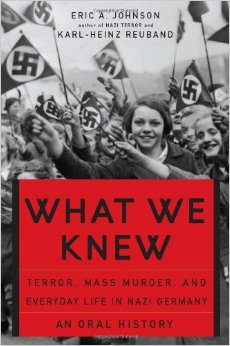
 History always has many witnesses. Audio, video, word of mouth and the written word serve as the recorders for the events that are occurring. When Adolf Hitler began his rise to power, all of Europe and the rest of the world took notice. Many of those nations never imagined that the menace from Austria would become Chancellor of Germany and unleash a wave of terror never before seen across the continent. His climactic rise to power and fall is a case study that has been the subject of debates and discussions since the end of the Second World War in 1945. Even today we continue to learn new facts about Hitler and secrets of the Third Reich. William L. Shirer (1904-1993) lived in Germany as correspondent for CBS news and served as a first-hand witnesses of the rise of national socialism carried under the banner of Hitler’s N.S.D.A.P. As the war in Europe unfolded, he returned to the United States and his memories of his time in Germany served as the basis for the Berlin Diary. During his residence in Germany, he had been censured by Nazi regime from speaking on air. Shirer took advantage of the time to start a book on the Reich, a book that became a masterpiece and the definitive account of the rise and fall of the Third Reich.
 FREETHINKING BIBLIOPHILE
You must be logged in to post a comment.