Greg Scarpa, Legendary Evil: The Many Faces of a Mafia Killer – Jonathan Dyer

The Italian American mafia or “La Cosa Nostra”, became firmly entrenched in American society as immigrants from Italy to their newfound home. On the streets of New York City, a young mobster named Charles “Lucky” Luciano (1897-1962) realized that the constant violence among gangsters was no good for business and envisioned a “commission” to rule mob affairs. Luciano’s vision became a reality and the “Five Families” are now a permanent part of the city’s history. One of these families, the Colombos led by the mob boss Joseph Colombo (1923-1978), is noted for its civil wars, and members who have turned state’s evidence. One of them was not only a ruthless killer, but a bigamist and Federal Bureau of Information (“FBI”) informant. In Brooklyn, Gregory Scarpa, Sr. (1928-1994) became known as the “Grim Reaper” and throughout his career, he would prove more than once that the name had been earned. Author Jonathan Dyer explores the life of the mobster who terrorized adversaries and sent shockwaves through mafia circles.

I previously reviewed Peter Lance’s ‘Deal With The Devil: The FBI’s Secret Thirty-Year Relationship With A Mafia Killer‘ which chronicles Scarpa’s role as an informant. The book is particularly good, and Dyer uses it here as a source for what is a more complete picture of Scarpa’s life. Aside from Lance’s book, I had viewed documentaries on Scarpa and I have also read the book ‘The Mafia Hitman’s Daughter‘ by Linda Scarpa and Linda Rosencranci. His daughter’s book is eye opening and shows the effects life in the mafia has on family members. This book is a mix of both with additional exhaustive research. And the result is a book which will stand the test of time. Dyer provides a raw and unfiltered look at Scarpa’s violent and tragic life. 

Following the early discussion of Scarpa’s early life, the story changes when he meets his first wife Concetta “Connie” Farace (1931-2012). The story is routine, with Scarpa earning his stripes on the street and Connie bearing the couple’s children. However, the story takes a sharp left turn when the FBI institutes the Top Echelon Criminal Informant (TECI) program. This new pilot program by the bureau would find a willing participant in Greg Scarpa who soon joins and begins a thirty-year relationship with the “Hoover” boys. And if that is not shocking enough, the book takes another turn when he meets a teenage girl whom he would remain with for twenty-five years while taking on yet another wife, resulting in a love story completely off the rails. Added to the mix is his protege Larry Mazza, whose role in the couple’s lives is surreal. You must read it to believe it.

In what becomes a strange paradox, Scarpa feeds the FBI crucial information on mafia activity while at the same time engaging in criminal enterprises. In one instance, what should have been an air-tight case against Scarpa and his co-conspirators for a counterfeit money scheme was dismissed under mysterious circumstances. The dismissal raises the unanswered question, was the FBI protecting its asset? As for Scarpa, he continued to enjoy his relationship with the bureau while wreaking havoc in the streets. However, he is credited with assisting the FBI on high profile cases. The only issue is that only one out of the three presented by Dyer seems to be the most plausible. Dyer breaks down each alleged assist by Scarpa and uses the process of elimination to assess which account has the most credibility. But it is not long before the story takes on more bizarre twists and turns.

Scarpa’s relationship with his children is interesting and highlights the contradiction which exists in his story. While he was easily killing fathers and husbands, he went to extreme lengths to protect his own. Each child carries their own scars and trauma in the book. Linda has spoken for herself, but Gregory, Jr., and Joey (1971-1995) are not as fortunate. Gregory Jr. was released from prison in November 2020 and has remained out of the public light. Joey met a horrific death, and the story as told by Dyer is heartbreaking and disturbing. Gregory Jr. was closest to their father and that devotion would earn him a staggering prison sentence and demons to haunt him for the rest of his life.

As the story progresses, Scarpa continues his pattern of manipulation and exploitation but receives a life diagnosis when he goes into the hospital to treat a bleeding ulcer. A tainted blood transfusion leaves Scarpa infected with a disease that changed life as we knew it during the 1980s. And this is where the downfall ofthe mobster begins. His physical decline and power struggle within the Colombo family between supporters of Carmine “The Snake” Persico (1933-2019) and Victor “Vic” Orena, intensifies the suspense as mob hits, criminal indictments and mortality take their toll on all involved. And throughout all, Scarpa remains a gangster to the core. The story is insane and will leave readers shaking their heads at Scarpa’s escapades and violence which ensued. But as the saying goes, every gravy train reaches its destination, and Scarpa finds his meal ticket with the FBI set to expire. And when the government came for justice, Scarpa found himself persona non grata in law enforcement circles. A shocking admission in open court would forever change the way his contemporaries viewed him and cement his legacy in the annals of mafia history. 

Dyer’s account of Scarpa’s life is well-written and well-researched. It is full of information and cross-referenced. It is still a new release, and I am sure readers with a soft spot for mafia history will be interested in what the author has to say. After finishing the book, I did not have any strong emotions towards Scarpa but could see that his life and the lives of those around him became dysfunctional due the mafia’s grip on them. Another former Colombo member Michael Franzese who has gained a new following online once said that the mob destroyed lives. He is absolute correct. If you are a mafia aficionado or in search of an informative book about the streets of New York City and its Five Families, you will enjoy this. 

He was neither God nor devil. He was, like the rest of us, mortal, distinguished from most of his fellow human beings by his unlimited capacity for evil. His existence was terrifying during his life, and the story of his life is a frightening reminder of the human capacity for betrayal and deceit, for duplicity and greed, for violence and death.” – Jonathan Dyer 

ASIN ‏ : ‎ B0FDSNQPCZ
Publisher ‏ : ‎ WildBlue Press (22 July 2025)

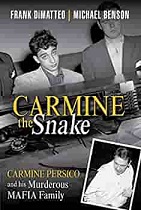
Carmine the Snake: Carmine Persico and His Murderous Mafia Family – Frank DiMatteo and Michael Benson

carmineInfamous gangster Alphonse “Al” Capone (1899-1947) famously quipped that “once you’re in the racket, you’re always in it”. The seasoned gangster knew the pitfalls of a life of crime and conditions that apply. He was convicted on October 18, 1931, of tax evasion and sentenced to eleven years in prison. On November 16, 1939, Capone was released from prison due to effects of Syphilis which had spread to his brain. The disease continued to cause deterioration in the mobster and on January 25, 1947, Capone did in his sleep. It was a sad ending for America’s most famous mobster but less violent than the grisly fates met by other gangsters “in the life”. Carmine “the Snake” Persico (1933-2019), a former Colombo Family boss, also escaped a grisly fate but remained in prison until his death on March 7, 2019. And with his passing was the end of another era in New York City history. In his prime, Persico was one of the City’s most notorious figures and implicated in scores of mafia-related crimes, including the murder of Albert “The Mad Hatter” Anastasia (1902-1957), revisited by here by Frank DiMatteo is a Brooklyn native raised in the Park Slope neighborhood controlled by the Persicos, with whom his father was affiliated. This is the story of Carmine Persico and the terror his mob family unleashed on the City of New York.

Readers familiar with Park Slope might be surprised to learn how saturated the area was with mobsters in the past. Today, the area has changed significantly but remnants of the old days still exist there as they do in other parts of New York. The early part of the book focuses heavily on the Park Slope area where the budding gangsters are getting experience on the gritty streets of Brooklyn. The crimes are petty and routine, until Carmine and older brother Alphonse Persico (d. 1989) have a fateful encounter with a friend turned rival named Steve Bove. At this point in the book, the writing is on the wall that Carmine is destined for a life of crime. From this point on, the schemes become more daring and the violence deadlier. Yet, Persico always manages to slip out of tense situations, earning him the nickname of “the Snake”.

Though Matteo is writing about Persico’s life, a bonus is that the book is filled with information about mob events that shocked the city. Sadly, there are no “smoking guns” that have not been previously revealed but he does offer information that might explain why the events happened. In particular, the murder of Joseph “Joe” Colombo (1923-1978) remains controversial. The assailant Jerome Johnson, was shot and killed immediately by one of Colombo’s bodyguards but the woman he was with, masquerading as a reporter, has never been found along with a second man in their group. The hit has never been fully explained but has been blamed on Colombo’s rival at the time, Joseph “Crazy Joe” Gallo (1929-1972) and his brothers at odds with Colombo and the family’s prior boss, Giuseppe “Joe” Profaci (1897-1962). DiMatteo discusses the Colombo murder, and it is possible that Gallo was telling the truth when he stated he had nothing to do with the shooting. As the author shows, Colombo was respected by not well-liked, and the list of people who might have wanted to see him removed was long. The truth about the crime may be lost to history. But there is no question regarding the bad blood between the Gallo and Colombo factions, a simmering animosity that caused division within the family. The feud between them became so infamous that a part of it was reenacted on screen in The Godfather Part II. I won’t go into detail here, but if you have seen the movie and read this book, you will know which scene it is. Also provided is a satisfying amount of inside information about the production of the Godfather films and the filmmakers’ interactions with real-life gangsters including Persico. DiMatteo does mention other notable crimes in mafia lore such as the Air France Cargo robbery in 1967 and the Lufthansa Heist in 1978, both of which are depicted in Martin Scorsese’s mob classic ‘Goodfellas‘. The crimes are well-documented, so the author does not devote too much of the book to them, but they are discussed in relation to Persico’s story and the state of the mafia at the time.

Hollywood eventually moved on, but as we see in the book, the mob was getting stronger, and more blood was spilled on the streets of New York City before peace was established. But the difference is that the next war was within the family. With Colombo in a comatose state, the grabs for power kicked into high gear. And at Persico’s side was notorious hitman Gregory “The Grim Reaper” Scarpa (1928-1994). Scarpa’s reputation in mob history is cemented as someone not to cross. The section about Scarpa is not a biography but readers unfamiliar with him may want to read Peter Lance’s ‘Deal With The Devil: The FBI’s Secret Thirty-Year Relationship With A Mafia Killer‘ and the account by Scarpa’s daughter titled ‘The Mafia Hitman’s Daughter‘. Scarpa was a dark figure and the battles between the Persico faction and the soldiers loyal to acting boss Vittorio “Little Vic” Orena feel like a story out of the motion picture industry.

The story takes a significant turn at this point and is nothing short of wild. Combined with the inter-family wars brewing, Persico is also on the radar of the U.S. Government and was indicted multiple times as detailed by the author. Franklyn, it seemed that as soon as he was released, he was back inside yet again facing more charges. The unbelievable story as told by DiMatteo highlights the lengths to which federal prosecutors were willing to go in their mission to dismantle the Italian American mafia. The introduction of the Racketeer Influenced and Corrupt Organizations Act, known as the “RICO Act”, signaled that the end was near for the mob. The legislation drafted by attorney G. Robert Blakely became an invincible tool in the Government’s arsenal that is still used to this day. As the convictions piled up, mobsters facing RICO charges knew the only options were to make a plea or face life in prison. Persico ended up with life in prison and had to live with the fact that his sons “Allie Boy” and Michael also followed their dad down the path of no return.

The sad fates of the major players compose the concluding section of the book and there are no happy conclusions. Death, incarceration, and financial ruin decimated the mobsters who found themselves targets of the Government. DiMatteo finished the story before Persico’s death resulting in the epilogue not containing mention of his passing. However, the sentence Persico received made it clear that he would die behind bars and that is exactly what happened. At the time of his death, the power, fame, and money he enjoyed on streets was gone but at his height, his life was one heck of a ride that even Hollywood could not have scripted. This is a fascinating look at the mob and the reality of life in it.

ASIN: B077WW4W1T

The Mafia Hitman’s Daughter-Linda Scarpa with Linda Rosencranci

scarpaThis book is not by any means, an investigative report into Scarpa’s activities.  For the full story on his crimes, relationship with the FBI and its aftermath, the best book that comes to mind is Peter Lance’s ‘Deal With The Devil‘ which chronicles Scarpa’s working relationship with the bureau which spanned several decades.   This is his daughter Linda’s story infused with the recollections a few selected family members and a friend of the family.   The book serves as her journal of what life was like under the roof of the feared mobster whose name sent chills down the spine of many.  Similar to Albert DeMeo, Phil Leonetti and Anthony Colombo,  Linda’s story reveals the ugly and tragic truth of life in a mafia family.   And what we learn through Linda is that no one escapes that life unharmed in some sort of way whether it’s mentally, physically or emotionally.  Prison, murder and other acts of violence become routine occurrences, leaving the surviving family members to grieve for those lost in street wars and deadly encounters of other sorts.

Scarpa, like most other mobsters, did protect his family from the life he led up to a point.  And as we see with Linda, as she ages and learns more about the streets and the life her father has chosen, the stark reality of “the life” hits home awakening her to the bitter truth surrounding the nature of her father’s business.  She is frank with what she knew and what she felt and through her words, we are to see the level of dysfunction plaguing their social circle resulting in a deadly web of violence.  And as the internal struggle for power escalated into an all out war, she is forced to confront even more, the knowledge that her father has murdered men and will murder many more before his own demise from AIDS related complications in June, 1994.

A good portion of the book is narrated by Linda’s mother, “Big” Linda, Scarpa’s widow. And through her recollections, we learn about the true nature of the relationship between Scarpa and the FBI.  A valuable asset during the civil rights era, Scarpa never received pubic credit for his role in breaking those cases, but Linda sets the record straight as she traveled with him on more than one occasion.   And sadly, he was left out of the movie “Mississippi Burning” due to the highly sensitive nature of his working relationship with the bureau.  Former FBI Agent Lin DeVecchio was charged with being complicit in murders carried out by Scarpa, but was acquitted on all charges.  The nature of his relationship with Scarpa came under close scrutiny and in this book, that topic is also discussed freely by both mother and daughter.  It is left up to the reader to decide the level of DeVecchio’s complicity in Scarpa’s activities.

This story by his daughter is moving and filled with all of the elements that could make a modern-day gangster film.  Marriage, divorce, mistresses, money, power and violence all make an appearance throughout the book.  But the one thing that stands out is that nothing is glorified.  There is no glamour or gloating and she is pointedly clear that there are no winners.   What is left are her, her mother and other relatives trying to put their lives back together and even though more than 20 years have passed, their lives continue to be in need of repair.  For some, that healing may never come and others go on trying to live the best life that they can.  Her father is long gone as is her brother Joey, tragically murdered himself on the same Brooklyn streets his father once ran.  For Linda, life will never be the same again and through this, she shares her story to inform others of the risk taken by a life of crime and violence and reminds us that not only do our actions affects us, but they also can affect everyone around us even after we’re long gone from this earth.

ISBN-10: 0786038705
ISBN-13: 978-0786038701